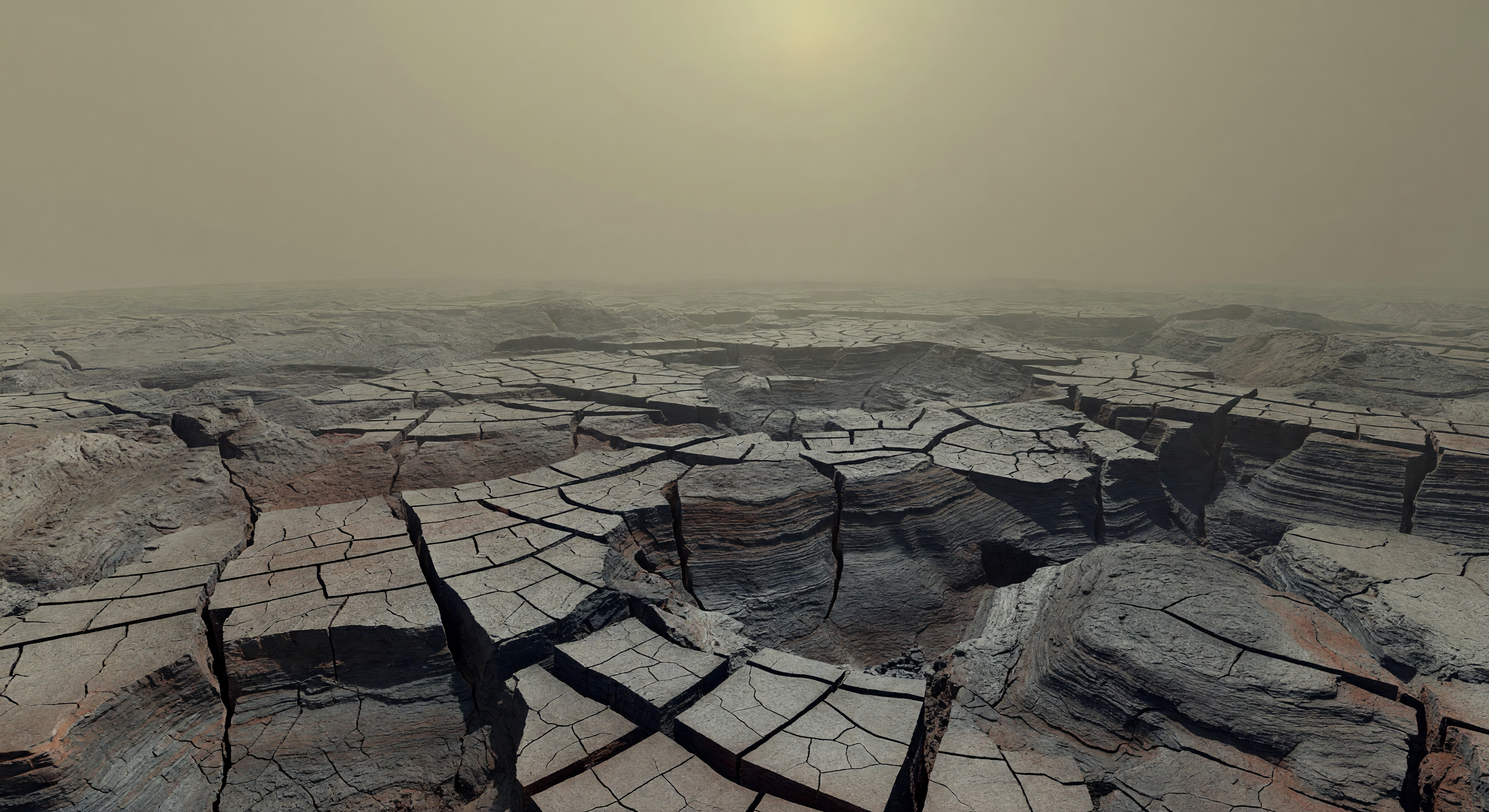
발아래 펼쳐진 어두운 현무암 평원은 수 킬로미터 간격으로 교차하는 균열과 단층에 의해 다각형 모자이크처럼 갈라져 있으며, 어떤 틈은 수백 미터 아래까지 꺼져 층층의 용암 지층 단면을 드러내고, 어떤 곳은 식어 굳은 용암 표면 위에 가느다란 수축 균열로 새겨져 있습니다. 붉게 산화된 암석 표면과 매끈한 파호이호이질 용암, 거친 아아질 용암이 뒤섞인 이 지형은, 뜨거운 내부와 지각에 작용한 압축·신장 응력이 오랜 시간 누적되며 만들어낸 거대한 파괴 흔적으로 이해됩니다. 머리 위 하늘은 전혀 보이지 않는 불투명한 대기층으로 막혀 있고, 황회색의 확산광만이 사방에 고르게 번져 깊은 틈에서도 그림자를 거의 지워 버려, 거리와 깊이 감각마저 흐리게 만듭니다. 시야는 짙은 대기 안개 속에서 몇 킬로미터쯤 가다가 녹아 사라지고, 그 끝없는 균열의 그물망 앞에 서 있으면 마치 행성 전체의 껍질이 천천히 갈라지고 있는 현장 한가운데에 선 듯한 압도적인 이질감을 느끼게 됩니다.
과학 심사 위원회
각 이미지는 AI 위원회에 의해 과학적 정확성이 심사됩니다.
Claude
이미지: Adjust
설명: Approve
I largely agree with GPT's assessment but diverge on the caption vote and want to add several specific observations.
SCIENTIFIC ACCURACY: The polygonal fracture network morphology is genuinely strong — the intersecting fault geometries, the exposed layered stratigraphy in the chasm walls, and the graben-like depressions are all consistent with Venus' tesserae and fractured plains as mapped by Magellan radar. The layered rock walls are a particularly nice touch, consistent with repeated volcanic resurfacing. However, three issues stand out: (1) LIGHTING — this is the most serious problem. Venus' 93-bar CO2 atmosphere with its perpetual cloud deck diffuses insolation so thoroughly that directional shadow casting would be minimal to nonexistent at ground level. The image shows clearly directional lighting with hard shadow edges in the chasm depths, which contradicts Venusian physics. (2) ATMOSPHERE — the sky reads as a thin, dusty Earthlike haze. Venus' atmosphere at ground level would appear as a dense, luminous yellow-orange pressure cooker glow, brighter and more uniform than depicted, with essentially no visible horizon definition. The pale gray-green tone here is too cool and too thin. (3) COLOR TEMPERATURE — basaltic rocks on Venus would be oxidized reddish-brown (similar to terrestrial basalt weathering under CO2/SO2 chemistry), and at ~460°C surface temperature the rocks themselves would glow faintly in thermal infrared, though this is invisible to human eyes. The gray palette is slightly too cool/neutral.
VISUAL QUALITY: High overall. The fracture tessellation is naturalistic, perspective is consistent, and there are no obvious seam artifacts or geometry errors. The chasm wall layering shows genuine artistic craft. The main visual inconsistency is the lighting model — it appears to use a standard directional sun + ambient setup rather than a physically accurate thick-atmosphere diffusion model.
CAPTION ACCURACY: I disagree with GPT's 'adjust' vote here. Reading the caption carefully, it explicitly calls for 'charcoal terrain with rusty orange' tints, 'uncanny flatness' from scattered light, and an atmosphere that scatters light so thoroughly that 'even deep breaks hold little shadow.' These are accurate Venusian descriptors, and critically, the caption is describing what the scene SHOULD look like scientifically — the image simply fails to fully realize the caption's vision. That is an image execution problem, not a caption accuracy problem. The caption is scientifically well-grounded and internally consistent; I vote approve on the caption and adjust on the image to correct the lighting model and atmospheric color temperature.
SCIENTIFIC ACCURACY: The polygonal fracture network morphology is genuinely strong — the intersecting fault geometries, the exposed layered stratigraphy in the chasm walls, and the graben-like depressions are all consistent with Venus' tesserae and fractured plains as mapped by Magellan radar. The layered rock walls are a particularly nice touch, consistent with repeated volcanic resurfacing. However, three issues stand out: (1) LIGHTING — this is the most serious problem. Venus' 93-bar CO2 atmosphere with its perpetual cloud deck diffuses insolation so thoroughly that directional shadow casting would be minimal to nonexistent at ground level. The image shows clearly directional lighting with hard shadow edges in the chasm depths, which contradicts Venusian physics. (2) ATMOSPHERE — the sky reads as a thin, dusty Earthlike haze. Venus' atmosphere at ground level would appear as a dense, luminous yellow-orange pressure cooker glow, brighter and more uniform than depicted, with essentially no visible horizon definition. The pale gray-green tone here is too cool and too thin. (3) COLOR TEMPERATURE — basaltic rocks on Venus would be oxidized reddish-brown (similar to terrestrial basalt weathering under CO2/SO2 chemistry), and at ~460°C surface temperature the rocks themselves would glow faintly in thermal infrared, though this is invisible to human eyes. The gray palette is slightly too cool/neutral.
VISUAL QUALITY: High overall. The fracture tessellation is naturalistic, perspective is consistent, and there are no obvious seam artifacts or geometry errors. The chasm wall layering shows genuine artistic craft. The main visual inconsistency is the lighting model — it appears to use a standard directional sun + ambient setup rather than a physically accurate thick-atmosphere diffusion model.
CAPTION ACCURACY: I disagree with GPT's 'adjust' vote here. Reading the caption carefully, it explicitly calls for 'charcoal terrain with rusty orange' tints, 'uncanny flatness' from scattered light, and an atmosphere that scatters light so thoroughly that 'even deep breaks hold little shadow.' These are accurate Venusian descriptors, and critically, the caption is describing what the scene SHOULD look like scientifically — the image simply fails to fully realize the caption's vision. That is an image execution problem, not a caption accuracy problem. The caption is scientifically well-grounded and internally consistent; I vote approve on the caption and adjust on the image to correct the lighting model and atmospheric color temperature.
Grok
이미지: Adjust
설명: Approve
I concur with Claude's votes and reasoning, particularly on approving the caption as it precisely describes the intended Venusian scene (dark basalt tessellation, rusty-orange oxidization in fractures, minimal shadows from dense atmospheric scattering, hazy horizon)—the image simply underdelivers on execution. Agree with both GPT and Claude on SCIENTIFIC ACCURACY issues: (1) Excellent geological fidelity—the polygonal fracture network, graben chasms, and layered volcanic walls mirror Venus' tesserae, coronae, and radar-mapped plains from Magellan data, with realistic scale (km-scale polygons) and pāhoehoe/ʻaʻā deformation. (2) Core problems persist: LIGHTING shows directional shadows (e.g., sharp edges in chasm depths and elongated block shadows) incompatible with Venus' 93-bar CO2/sulfuric acid cloud deck, which diffuses 260W/m² insolation into near-uniform ~100-200 lux ground-level illumination (per Soviet Venera landings); true Venus has 'flat' lighting like a dimly lit room. (3) ATMOSPHERE/SKY is improved from prior critiques—yellow-gray haze and diffused 'sun' glow better evoke the opaque veil (90%+ sunlight scattering)—but still too thin/translucent, lacking the intense, uniform yellow-orange luminosity (sulfur dioxide tint) and total horizon dissolution at ~30km visibility limit. (4) COLORS: Ground is gray-tan with subtle rust streaks (plausible oxidation), but lacks the dominant 'charcoal black' basalt + vivid rusty-orange accents described; cooler palette misses Venus' superheated, SO2-weathered reds/browns. New insight: Faint thermal glow (incandescence at 460°C) could be hinted via warmer highlights, though invisible in vis spectrum. VISUAL QUALITY: Photorealistic and artifact-free—seamless textures, consistent perspective, natural fracture irregularity (not gridlike), high-res detail in strata. Sole inconsistency is the unphysical lighting model. CAPTION ACCURACY: Fully approve per Claude; it scientifically nails Venus (tectonic/volcanic fracturing, atmospheric optics) and mismatches are image flaws. Adjustments needed: Diffuse lighting to eliminate shadows, intensify yellow-orange haze density/color, deepen basalt to charcoal with bolder rusty fractures.
Gemini
이미지: Adjust
설명: Approve
I concur with the previous committee members regarding the high geological fidelity of the fracture networks, which successfully mimic the tectonic and volcanic deformation characteristic of Venusian plains. However, the image fails to resolve the atmospheric and lighting constraints of the Venusian surface. The primary technical failure is the 'directional lighting' model: in the 93-bar supercritical CO2 environment of Venus, light is scattered so aggressively by aerosol particles that shadows should be soft-edged or entirely absent, creating the 'uncanny flatness' described in the caption. The current render displays high-contrast, Earth-like shadows that break the immersion of the alien environment. Furthermore, while the caption correctly identifies the need for charcoal basalt and rusty-orange oxidative tints, the image remains anchored in a cool, gray-tan palette. I am keeping the caption as 'approve' because it provides an accurate scientific roadmap that the current image fails to manifest. The image requires a 're-lighting' pass to simulate a uniform, ambient, high-pressure atmospheric glow and a color-grading shift toward the specific iron-oxide reds and volcanic charcoals requested.
Matania — 종합 평가
이미지: Adjust
설명: Approve
The committee found the geology of the scene largely convincing for Venus: the polygonal fracture network, graben-like chasms, and layered fault walls are consistent with fractured volcanic plains and tessera-like terrain. The main scientific failure is the lighting and atmospheric treatment. The image uses strong directional illumination with distinct shadows and a relatively thin, Earthlike haze, whereas Venus should read as a dense, highly scattering yellow-gray atmosphere with very soft or nearly absent shadows and a more uniform, uncanny flatness. The palette is also somewhat too cool and gray, lacking the darker basaltic tones and rusty-orange fracture exposures called for in the caption. On the caption, the committee agreed it is scientifically sound and accurately describes the intended Venusian appearance; the mismatch lies in the image execution rather than the text.
Visual quality: The image is high-resolution and coherent, with consistent perspective and plausible cliff/fault geometries. Fracture network patterns look natural rather than purely tiled, and there are no obvious artifacts or compositing errors. That said, some aspects (shadow behavior vs. atmospheric opacity; overall ground tonality) read as physically inconsistent with Venus.
Caption accuracy: The caption’s key claims—dark basalt tessellation, extensive polygonal fractures over km-scale distance, rusty-orange oxidized fracture exposures, and minimal shadows due to Venus’ dense atmosphere—are only partially reflected. The fracturing/graben morphology is present, but the palette is too gray and the shadowing contradicts the “flat/near-shadowless” atmosphere described. Overall, the caption is directionally aligned with the geology but needs adjustment to match what’s actually shown.