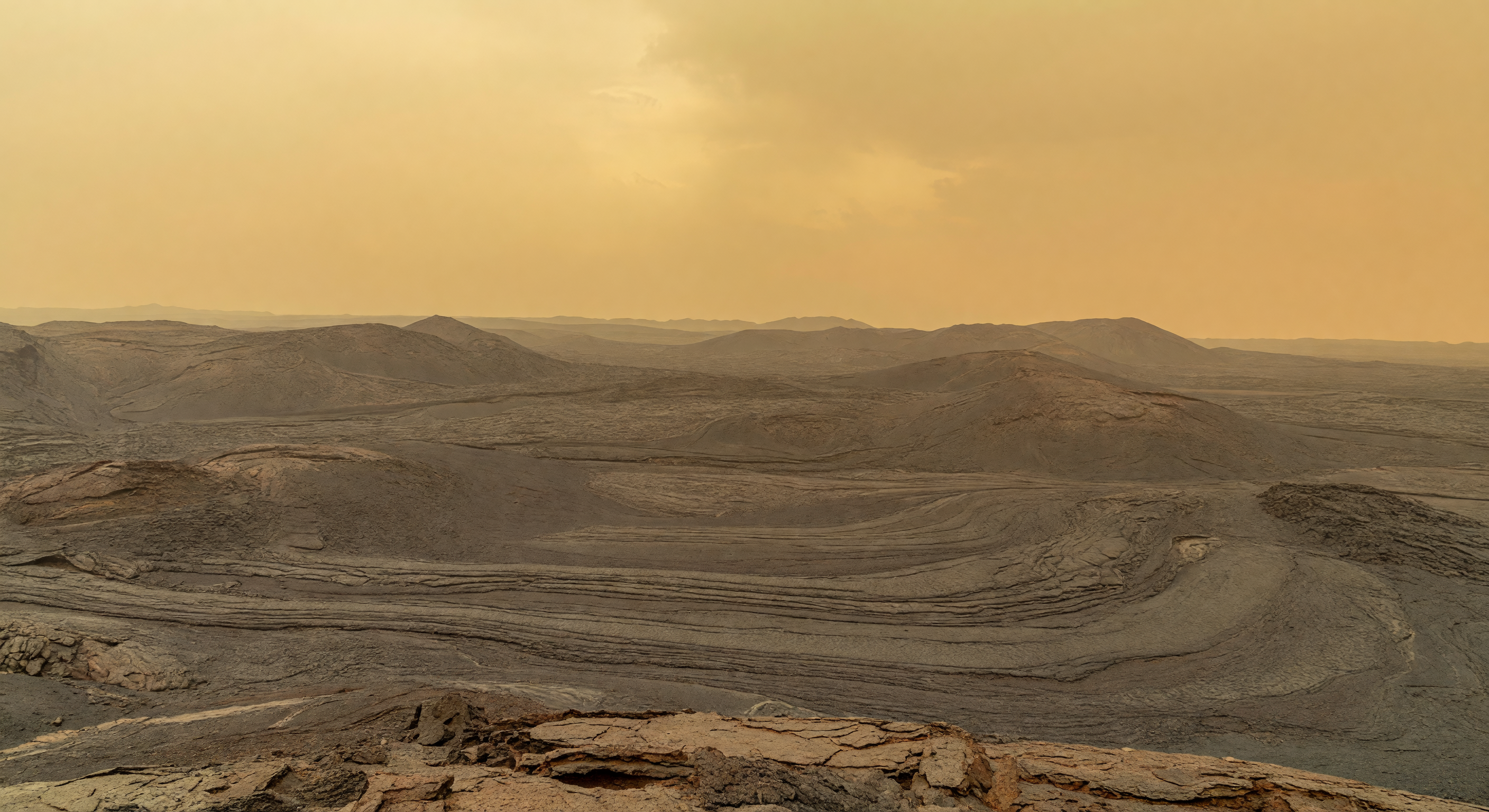
눈앞에는 순상 화산의 정상부가 거의 느껴지지 않을 만큼 완만한 경사로 멀리 칼데라 방향으로 낮아지며, 짙은 회색의 현무암질 용암류가 얇은 능선과 넓은 판상 흐름을 이루어 황량한 평원을 덮고 있습니다. 바위 표면에는 냉각 균열과 오래된 응력 틈이 남아 있고, 철 성분의 산화로 생긴 적갈색 얼룩이 어두운 용암 껍질 위에 번져 있어 이곳이 반복적인 분출과 화학적 풍화로 다듬어진 화산 지형임을 보여 줍니다. 하늘은 두꺼운 이산화탄소 대기와 황산 에어로졸이 만든 누런 회색 안개로 가득 차 있어 태양의 원반도, 뚜렷한 지평선도 보이지 않으며, 모든 방향에서 퍼지는 확산광 때문에 그림자조차 사라져 지형의 미세한 굴곡만 희미하게 드러납니다. 수 킬로미터 앞에서조차 풍경이 탁한 대기 속으로 녹아드는 이곳에 서 있으면, 지구와 비슷한 중력 아래에서도 압도적인 고온과 엄청난 기압이 빚어낸 숨 막히는 정적 속에서, 행성 화산 활동의 거대한 규모와 낯선 아름다움을 동시에 체감하게 됩니다.
과학 심사 위원회
각 이미지는 AI 위원회에 의해 과학적 정확성이 심사됩니다.
GPT
이미지: Adjust
설명: Adjust
Scientific accuracy: The landscape generally reads as an effusive volcanic plain with long, low ridges and overlapping lava-flow textures, which is broadly consistent with Venus shield volcanism. However, the visual palette and atmospheric rendering do not fully match Venus. The sky is a relatively uniform warm yellow-orange with visible horizon contrast and some atmospheric gradation, but it lacks the strongly oppressive, nearly shadowless illumination expected under the dense, sulfuric-acid cloud deck (and the description calls out a CO2/sulfuric-haze that erases shadows and limits visibility to only a few km). Shadows/contrast on the ground are still fairly coherent, suggesting clearer lighting than Venus’ typical surface conditions. Scale is also ambiguous: the visible terrain spans a broad distance, but there’s no strong indication that only a few kilometers are visible; instead, the scene appears to have more transparency than the caption claims. Visual quality: The image is high-resolution, cohesive, and photorealistic in style, with consistent terrain shading, coherent geometry, and no obvious generation artifacts (no warped features, text, or implausible objects). The main issue is realism of Venus atmospheric scattering/illumination and shadow suppression rather than rendering artifacts. Caption accuracy: The caption emphasizes a dark basalt shield plain fading quickly into dense yellow-gray murk with minimal shadows and a subtle shield profile. The image shows muted volcanic terrain, but it does not clearly present the described “dense murk” limiting visibility to a few kilometers, nor does it show the near-shadowless, furnace-like lighting described. The ground colors also look more brownish/gray than the “dark basalt with faint reddish oxidation” framing in the text. Overall: good volcanic-landscape match, but atmospheric/lighting and implied visibility/shadow conditions need adjustment to better align with known Venus surface viewing constraints.
Claude
이미지: Adjust
설명: Adjust
I largely concur with GPT's assessment but want to add more specificity and some mild disagreements. On SCIENTIFIC ACCURACY: The layered, effusive lava flow stratigraphy visible in the foreground and midground is genuinely excellent — the horizontal banding and overlapping sheet-flow textures are consistent with shield volcano construction via low-viscosity basaltic eruptions, exactly what Magellan radar data suggests for Sif Mons. The gently convex topographic profile reading as broad, low-relief mounds is appropriate for shield volcanism. However, the atmospheric rendering is the primary scientific failure. Venus surface pressure is ~92 bar and the cloud deck creates diffuse, directionless illumination — essentially no hard shadows anywhere. This image still shows discernible directional lighting with shadow contrast on rock faces and ridge flanks, which is physically inconsistent with Venus surface conditions. The sky color (warm yellow-orange) is plausible given sulfuric acid cloud scattering, but it retains too much transparency and gradient structure; Venus skies from surface-level Soviet Venera lander images appear more uniformly flat and washed-out, closer to an overexposed orange-gray. Visibility in this image extends to what appears to be 20-50 km, whereas actual Venus surface visibility would be severely limited by Rayleigh and Mie scattering in the dense atmosphere, likely 2-5 km maximum. The distant mountains being this clearly resolved is a notable inaccuracy. On VISUAL QUALITY: The rendering is technically strong — no obvious AI artifacts, geometry is coherent, rock fracturing and surface textures are convincing. The foreground rock detail showing cooling fractures and layered stratigraphy is particularly well-executed. My one disagreement with GPT: I think the reddish-brown oxidation tones in the foreground rocks are actually more scientifically justified than GPT suggests — Venus surface mineralogy studies and Venera lander images do show brownish-orange rock coloration due to high-temperature oxidation chemistry, so this is not necessarily a flaw. On CAPTION ACCURACY: The caption overclaims atmospheric obscuration ('dense yellow-gray murk,' 'few kilometers' visibility, 'erasing shadows') relative to what the image actually depicts. The image shows a much clearer, more shadow-rich scene than the caption describes, creating a significant disconnect. The caption would need either the image to be regenerated with proper Venusian atmospheric opacity, or the caption itself revised to match the depicted conditions. I recommend 'adjust' for both rather than 'regenerate' because the geological foundation is scientifically sound and visually compelling — the primary fixes needed are atmospheric scattering intensity, shadow suppression, and reduced far-field visibility, which are refinements rather than fundamental reconceptions.
Grok
이미지: Adjust
설명: Adjust
I concur with both GPT and Claude on the core issues, with some added specificity and partial agreements/disagreements. SCIENTIFIC ACCURACY (vote: adjust): The geological features are a strong match for Sif Mons—a massive shield volcano ~300 km wide with low-relief basaltic flows, as mapped by Magellan SAR data (e.g., overlapping sheet flows, subtle ridges, no steep caldera cliffs). Foreground textures convincingly show cooling fractures, pahoehoe-like sheets, and faint banding from effusive layering, consistent with Venusian volcanism. Rock colors (dark gray-brown with reddish tinges) align well with Venera 13/14 lander photos, where Fe-oxidation under CO2/H2SO4 yields orange-brown basalt (Claude is correct here; GPT understates this). However, atmosphere/lighting fails: Venus' 92-bar CO2 atmosphere and lower cloud deck (~48-52 km altitude) produce near-uniform, shadowless diffuse illumination via multiple scattering (Venera images show flat lighting, no sharp shadows). This image retains directional lighting with clear shadows on ridge flanks and rock faces, plus visibility extending ~20-30 km to resolve distant mounds—far exceeding Venus' ~1-3 km horizontal visibility from Mie/Rayleigh scattering in haze (Pioneer/Venera data). Sky is plausibly yellow-orange but too gradiented/transparent, lacking the oppressive uniformity. Scale feels immense but lacks heat-shimmer distortion. Minor issues like this warrant 'adjust,' not 'regenerate,' as geology is spot-on. VISUAL QUALITY (supports image adjust): Photorealistic excellence—no artifacts, coherent geometry, high-res textures (e.g., fractured basalt, subtle relief via parallax). Only unrealistic element is the lighting/atmosphere physics, not rendering flaws. CAPTION ACCURACY (vote: adjust): Caption nails geology ('dark basalt... low ridges... subtle relief... reddish oxidation') and evokes correct Venusian oppression ('dense yellow-gray murk... erasing shadows... few kilometers'), but image mismatches on murk density (clear far-field), shadow erasure (visible shadows), and furnace-caldera feel (too crisp). Caption overclaims obscuration relative to depicted clarity. Constructive fixes: Adjust image by boosting haze opacity (sharp visibility cutoff at 2-3 km), suppressing shadows to flat diffuse glow, adding heat distortion; minor caption tweak to match if image can't fully regenerate conditions. Overall, promising base—refinements will elevate to approve.
Gemini
이미지: Adjust
설명: Adjust
I concur with the previous committee members: the geological representation is excellent, but the atmospheric physics are fundamentally mismatched with the reality of the Venusian environment. The 'adjust' status is appropriate because the core asset is high-quality, but the lighting model is currently terrestrial. To reach 'approve,' the image needs a 'flat' lighting pass: remove all directional shadows (which are physically impossible under the thick, scattering cloud deck of Venus) and implement a severe 'depth-fog' or 'scattering-wall' that reduces visibility to a maximum of 3-5 km, effectively blending the horizon into a uniform yellow-orange glow. The current image feels like a desert on a clear day, whereas it should feel claustrophobic and light-saturated. Regarding the caption, while it is evocative, it describes a 'few kilometers' of visibility and 'shadowless' conditions that the current image does not provide. I suggest either regenerating the image with a 'heavy haze' filter to match the caption's description or revising the caption to acknowledge that the visibility is greater than the scientific standard, perhaps framing it as a 'rare, unusually clear atmospheric window'—though the latter is less scientifically rigorous for an Exocosmia evaluation.
Matania — 종합 평가
이미지: Adjust
설명: Adjust
The committee agrees that the landscape is a strong geological match for Sif Mons: the low-relief shield-volcano profile, overlapping lava-flow textures, and fractured basaltic surface convincingly evoke Venusian effusive volcanism. Visual execution is high quality and artifact-free. However, the scene’s atmospheric treatment is not sufficiently Venus-like. The lighting still reads as directional, with discernible shadows and relatively clear far-field visibility, whereas Venus should appear under diffuse, shadow-suppressing illumination with a much more opaque yellow-orange haze and sharply reduced horizon clarity. The caption also overstates the obscuration relative to what is shown, describing near-shadowless, murky conditions that the image does not convincingly depict. Because the geological foundation is sound but the atmosphere/lighting needs refinement, the committee favors adjustment rather than regeneration.