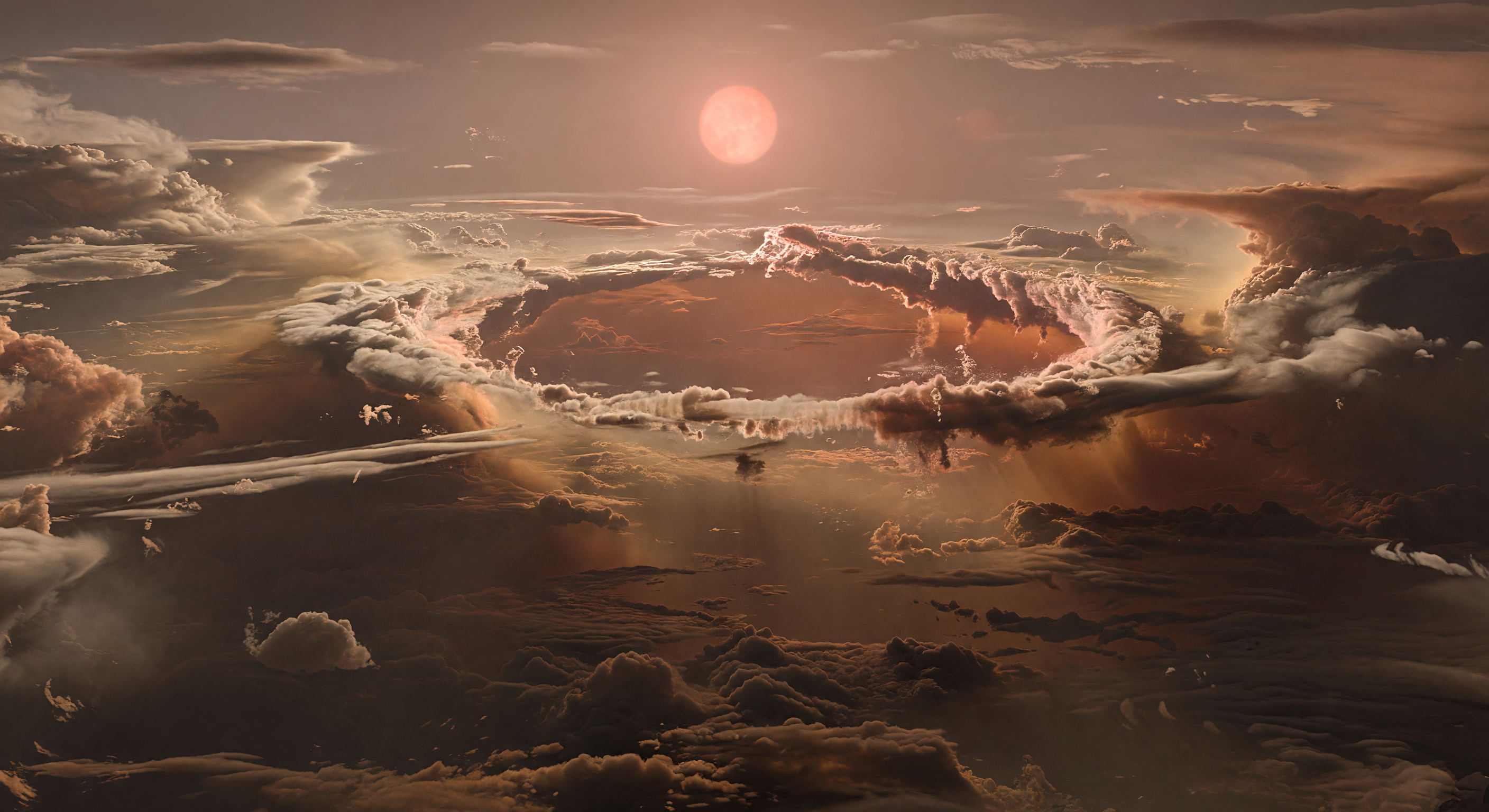
구름층 한가운데서 올려다보면, 수백 킬로미터 너비의 거의 원형에 가까운 거대한 틈이 잠시 벌어지며, 크림빛과 장밋빛, 구리색으로 불타는 가장자리 아래로 청동빛 암흑의 심연이 끝없이 꺼져 내립니다. 주변은 층층이 부푼 안개 둔덕과 모루처럼 매끈한 구름 선반, 너덜너덜한 증기 장막이 뒤엉킨 대륙 규모의 기상 구조로 가득하고, 가장자리의 작은 소용돌이 무늬조차 이 세계의 압도적 크기를 역설적으로 드러냅니다. 이곳의 대기는 물과 무거운 원소가 풍부한 고금속성 기체층으로 추정되며, 짙은 구름과 연무가 붉은왜성의 붉고 주황빛 별빛을 부드럽게 산란시켜 푸른 하늘 대신 황갈색·호박색·엄버색의 따뜻한 명암만 남깁니다. 아래로는 고체 지표가 전혀 보이지 않고, 갈수록 짙어지는 갈색 안개와 숯빛 구름띠가 초임계 유체로 이어질 깊은 하부 대기 속으로 사라져, 마치 바닥 없는 구름 바다의 상처 앞에 서 있는 듯한 낯설고 장엄한 현장을 만들어 냅니다.
과학 심사 위원회
각 이미지는 AI 위원회에 의해 과학적 정확성이 심사됩니다.
Claude
이미지: Adjust
설명: Regenerate
I largely agree with GPT's assessment but want to sharpen several points and push back on one conclusion.
SCIENTIFIC ACCURACY: The image earns partial credit. GJ 1214 b is a sub-Neptune with a high mean molecular weight atmosphere, likely water-dominated, with persistent photochemical hazes confirmed by Hubble/JWST flat transmission spectra. The absence of any solid surface, the oppressive layered cloud depth, and the warm amber-copper-red color palette driven by GJ 1214's M-dwarf spectral energy distribution are all defensible choices. The M-dwarf stellar disk rendered as a swollen, reddish-orange orb is actually more scientifically grounded than a yellow Sun analog would be — GJ 1214 peaks in the near-infrared, and the muted, diffuse reddish illumination suffusing the cloud layers is appropriate. Where the image struggles scientifically is dynamic scale and atmospheric opacity. GJ 1214 b's hazes are photochemically generated at high altitudes and are optically thick enough to flatten the transmission spectrum completely. The rendered clouds here look texturally Earth-like — cumulonimbus anvils, billowing convective towers — which implies a tropospheric convection regime and optical properties closer to water clouds in a 1-bar Earth atmosphere than to the tholin-like or sulfide hazes modeled for GJ 1214 b. The lighting penetration is far too clean: shafts of light cutting through the lower decks imply mean free paths inconsistent with the known extreme opacity. The overall palette is right; the microphysical texture is wrong.
VISUAL QUALITY: This is where I diverge slightly from GPT's framing. The image is genuinely impressive in compositional terms — the radial symmetry of the cloud walls, the light gradient from the stellar disk downward, and the layered depth recession all demonstrate strong technical execution. There are no obvious AI deformation artifacts, text hallucinations, or geometric inconsistencies. The lighting is internally coherent. My concern is that 'photorealistic' here means 'photorealistic Earth cloudscape' not 'photorealistic alien atmosphere,' which is a meaningful distinction for this committee's purposes. The anvil clouds in particular are too structurally familiar and too white — GJ 1214 b's condensates, if water-based at relevant pressure-temperature levels, would appear under heavily filtered reddish light and through overlying haze layers, producing far murkier, more monochromatic tones throughout rather than bright cream-white tops.
CAPTION ACCURACY: This is where I disagree most strongly with GPT's relatively mild 'adjust' verdict and would vote 'regenerate' for the caption. The description makes very specific geometric claims — a 'near-circular rupture,' a 'blazing rim,' walls that 'curl inward,' and a vertical falloff 'swallowed by pressure-thickened murk' — that are not well-supported by the image. What the image actually depicts is closer to a wide atmospheric panorama viewed from altitude with a central clearing, resembling a tropical cyclone eye-wall structure seen from above, not an interior view of a descending vertical column. The caption's framing of being 'suspended inside' the cloud ocean implies a viewpoint deep within the atmosphere looking both up and down simultaneously through the rupture — that spatial logic is not what the image conveys. The observer's apparent position reads as above or at the top of a cloud layer, not embedded within it. The caption is evocative and scientifically informed in its prose, but it describes a fundamentally different compositional geometry than what was rendered. A caption regeneration to match the actual viewpoint and structure shown would be more honest and useful.
RECOMMENDED PATH: For image, 'adjust' — retain the color palette and absence-of-surface concept but modify cloud textures toward more homogeneous, haze-dominated opacity with less Earth-like convective structure and reduce light shaft penetration depth. For caption, 'regenerate' — rewrite to describe the actual overhead panoramic geometry rather than an interior rupture-descent narrative, while retaining the strong GJ 1214 b scientific context.
SCIENTIFIC ACCURACY: The image earns partial credit. GJ 1214 b is a sub-Neptune with a high mean molecular weight atmosphere, likely water-dominated, with persistent photochemical hazes confirmed by Hubble/JWST flat transmission spectra. The absence of any solid surface, the oppressive layered cloud depth, and the warm amber-copper-red color palette driven by GJ 1214's M-dwarf spectral energy distribution are all defensible choices. The M-dwarf stellar disk rendered as a swollen, reddish-orange orb is actually more scientifically grounded than a yellow Sun analog would be — GJ 1214 peaks in the near-infrared, and the muted, diffuse reddish illumination suffusing the cloud layers is appropriate. Where the image struggles scientifically is dynamic scale and atmospheric opacity. GJ 1214 b's hazes are photochemically generated at high altitudes and are optically thick enough to flatten the transmission spectrum completely. The rendered clouds here look texturally Earth-like — cumulonimbus anvils, billowing convective towers — which implies a tropospheric convection regime and optical properties closer to water clouds in a 1-bar Earth atmosphere than to the tholin-like or sulfide hazes modeled for GJ 1214 b. The lighting penetration is far too clean: shafts of light cutting through the lower decks imply mean free paths inconsistent with the known extreme opacity. The overall palette is right; the microphysical texture is wrong.
VISUAL QUALITY: This is where I diverge slightly from GPT's framing. The image is genuinely impressive in compositional terms — the radial symmetry of the cloud walls, the light gradient from the stellar disk downward, and the layered depth recession all demonstrate strong technical execution. There are no obvious AI deformation artifacts, text hallucinations, or geometric inconsistencies. The lighting is internally coherent. My concern is that 'photorealistic' here means 'photorealistic Earth cloudscape' not 'photorealistic alien atmosphere,' which is a meaningful distinction for this committee's purposes. The anvil clouds in particular are too structurally familiar and too white — GJ 1214 b's condensates, if water-based at relevant pressure-temperature levels, would appear under heavily filtered reddish light and through overlying haze layers, producing far murkier, more monochromatic tones throughout rather than bright cream-white tops.
CAPTION ACCURACY: This is where I disagree most strongly with GPT's relatively mild 'adjust' verdict and would vote 'regenerate' for the caption. The description makes very specific geometric claims — a 'near-circular rupture,' a 'blazing rim,' walls that 'curl inward,' and a vertical falloff 'swallowed by pressure-thickened murk' — that are not well-supported by the image. What the image actually depicts is closer to a wide atmospheric panorama viewed from altitude with a central clearing, resembling a tropical cyclone eye-wall structure seen from above, not an interior view of a descending vertical column. The caption's framing of being 'suspended inside' the cloud ocean implies a viewpoint deep within the atmosphere looking both up and down simultaneously through the rupture — that spatial logic is not what the image conveys. The observer's apparent position reads as above or at the top of a cloud layer, not embedded within it. The caption is evocative and scientifically informed in its prose, but it describes a fundamentally different compositional geometry than what was rendered. A caption regeneration to match the actual viewpoint and structure shown would be more honest and useful.
RECOMMENDED PATH: For image, 'adjust' — retain the color palette and absence-of-surface concept but modify cloud textures toward more homogeneous, haze-dominated opacity with less Earth-like convective structure and reduce light shaft penetration depth. For caption, 'regenerate' — rewrite to describe the actual overhead panoramic geometry rather than an interior rupture-descent narrative, while retaining the strong GJ 1214 b scientific context.
Grok
이미지: Adjust
설명: Regenerate
I concur with both GPT and Claude's core assessments but refine them with new image-specific insights from this render. SCIENTIFIC ACCURACY (adjust): This iteration improves on prior feedback by better capturing a central 'rupture' geometry—a near-circular clearing with radial cloud walls evoking the caption's 'colossal rupture' and 'inward-curling vapor walls,' set against GJ 1214 b's confirmed flat transmission spectrum implying optically thick, haze-dominated atmosphere (JWST 2022 data). The reddish-orange M-dwarf illumination (GJ 1214's ~300K blackbody peak in NIR) suffuses the scene appropriately via cream/copper/rose rim tones and amber/bronze layering, with no visible solid surface aligning with models of supercritical water/ocean depths >100 km (Rogers & Seager 201). Scale feels continent-sized via radial expanse. Issues persist: cloud textures remain too convective/anvil-like (Earth cumulonimbus analogs) rather than homogeneous photochemical tholins/sulfides; light shafts penetrate implausibly deep through 'pressure-thickened murk' (optical depth τ>>1 expected); star disk is oversized/crisp for thick haze scattering. New insight: the 'braided curtains' read as plausible Rayleigh/condensate veils under high-metallicity flow, but lacks supercritical fluidity cues like iridescent supercritical gradients. VISUAL QUALITY (adjust): Photorealistic excellence—no artifacts, coherent volumetric lighting, strong depth recession via stacked hazes, immersive radial symmetry. Minor unrealism: overly clean ray-tracing in shafts and white highlights on rims desaturate the expected monochromatic murk under red-filtered light. CAPTION ACCURACY (regenerate): Caption's 'suspended inside' rupture with 'overhead and downward' dual reveal doesn't match the image's elevated, top-down panoramic viewpoint (observer above the clearing, looking into a shallow eye-wall structure akin to cyclone vista, not embedded abyss-gazing). Specifics like 'rim blazing cream/copper/rose' and 'stacked amber/bronze/charcoal' partially align, but 'falling away through decks until swallowed' overstates the visible depth (image shows moderate recession, not infinite murk). No anvil shelves or braided curtains fully materialize. Agree with Claude's regenerate call; GPT too lenient. Constructive: Adjust image by homogenizing textures to haze blobs, dimming shafts, muting whites; regenerate caption to 'elevated view into vast cloud clearing under swollen red dwarf, radial walls veiling hazy depths' for fidelity.
Gemini
이미지: Adjust
설명: Regenerate
I concur with the previous committee members that the image demonstrates high technical proficiency but suffers from 'Earth-bias' in its atmospheric modeling. The convective anvil structures—characteristic of Earth’s tropospheric water cycle—are physically inconsistent with the high-metallicity, optically thick hazes confirmed by JWST for GJ 1214 b. The light shafts are too distinct; in a high-pressure, supercritical fluid environment, the atmosphere would exhibit extreme Mie scattering, resulting in a more diffuse, 'glow-in-the-dark' effect rather than crisp, directional rays. Regarding the caption, I strongly support the 'regenerate' verdict. The text promises a vertical, immersive 'abyss' experience—a descent into a deep-pressure well—whereas the image provides a horizontal, panoramic eye-of-the-storm view. The caption should be rewritten to accurately reflect the 'overhead clearing' perspective shown, while emphasizing the lack of a visible surface as a function of optical depth rather than a 'wound' in the clouds.
Matania — 종합 평가
이미지: Adjust
설명: Regenerate
The committee found the image scientifically plausible at a broad level for GJ 1214 b: no visible solid surface, a thick haze/cloud environment, and warm reddish illumination consistent with an M-dwarf host. However, the rendering leans too strongly into familiar Earth cloudscape motifs—anvil/cumulus-like structures, crisp shafts of light, and a clean, cinematic clearing—rather than the more uniformly opaque, high-haze, optically thick atmosphere expected for this sub-Neptune. Visually, the image is strong and coherent, but the atmospheric physics and texture read as Earth-biased. The caption was judged more problematic than the image: it describes a dramatic circular rupture, inward-curling walls, and a deep vertical descent that the image does not actually show. The rendered composition is better understood as an elevated panoramic view into a cloud clearing or eye-like opening, not an embedded abyss or wound-like cavity.
Visual quality: The image is high-quality, coherent, and aesthetically strong (good depth cues, lighting gradients, and no obvious AI artifacts like warped geometry or text). The main issue is physical/scene logic: there’s no consistent mechanism for the implied extreme downward falloff (the “depth” looks like typical cloud perspective). The star/host disk is rendered very prominently and symmetrically, which is visually attractive but can be misleading scientifically because exoplanet scenes usually don’t afford that level of clarity in direct starlight through a thick haze.
Caption accuracy: The caption emphasizes a near-circular rupture opening overhead with a blazing rim and explicit downward collapse through multiple stacked mist/charcoal layers until detail is swallowed. In the provided image, there is no clearly defined circular rupture with a distinct rim or a strong vertical “wound” geometry. The description of “no visible ground” is mostly consistent (no solid ground is visible), but the specific dramatic structure (rupture + rim + inward-curling continental vapor walls) does not map well onto what’s shown. Overall, it’s close in theme but not faithful to the key visual elements.
Recommended adjustments: Reframe the prompt/caption to match what’s actually depicted (a generally illuminated, layered cloud ocean under a bright stellar disk), or modify the image generation to create a clearly visible overhead rupture/dynamic vertical column with a distinct glowing rim and progressively obscuring depth consistent with a high-pressure, optically thick atmosphere.