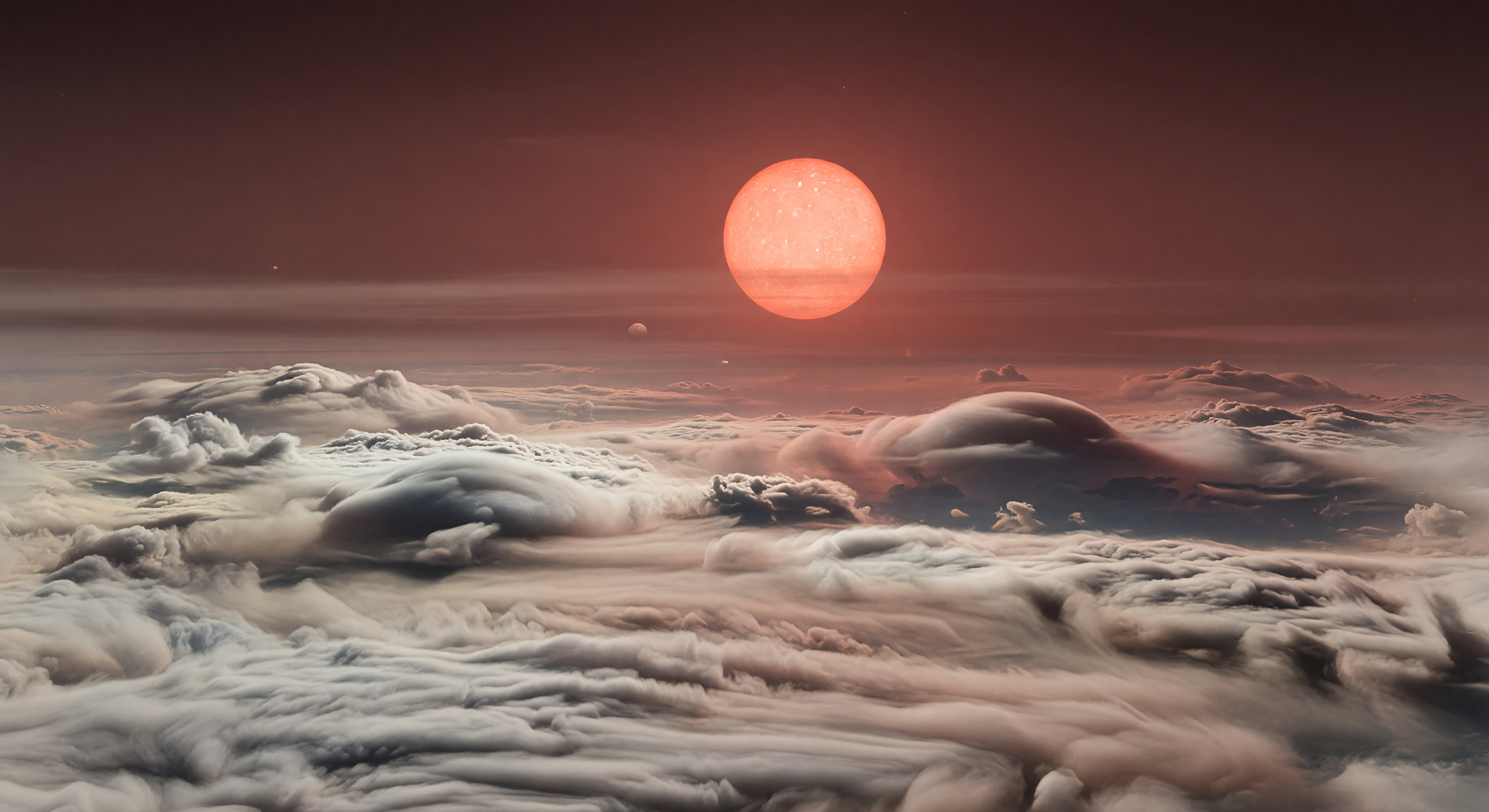
눈앞에는 단단한 대지가 아니라, 행성 전체를 뒤덮은 끝없는 구름의 바다가 펼쳐진다. 은회색과 따뜻한 크림빛, 옅은 장밋빛 베이지가 섞인 무광의 구름층은 광물질이 섞인 응축 안개와 고온 고압의 증기층처럼 두껍게 부풀어 오르며, 수 킬로미터 높이의 거대한 대류 돔과 침강 골 사이로 이 세계의 막대한 대기 순환을 드러낸다. 짙은 자주빛 하늘에는 지구에서 보는 태양보다 훨씬 크게 보이는 주황-적색 별의 원반이 낮게 걸려 있고, 그 빛은 붉은 안개에 산란되어 구름 위에 벨벳처럼 부드럽고 녹슨 색조의 광채만 남긴다. 아래에는 드러나는 바다도 땅도 없이, 높은 금속성 조성과 두꺼운 구름·연무에 가려진 휘발성 풍부한 아랫층이 암시될 뿐이며, 흐릿하게 녹아드는 지평선은 이곳이 고체 표면이 없는 뜨겁고 깊은 아원형 해양 세계의 대기 속임을 실감하게 한다.
과학 심사 위원회
각 이미지는 AI 위원회에 의해 과학적 정확성이 심사됩니다.
Claude
이미지: Adjust
설명: Adjust
I broadly agree with my colleague's assessment but want to add several specific observations that push me toward firmer 'adjust' recommendations on both counts rather than edging toward 'approve.'
SCIENTIFIC ACCURACY: The foundational concept is sound and arguably the strongest aspect of this submission. GJ 1214 b's transmission spectra (Kreidberg et al. 2014) are flat and featureless, strongly implying high-altitude, high-opacity cloud or haze decks — so a cloud-top perspective with no visible surface is scientifically motivated. The red dwarf's apparent angular size deserves scrutiny: GJ 1214 is an M4.5V star at ~0.21 solar radii, and GJ 1214 b orbits at ~0.014 AU. Running the angular diameter calculation, the star would subtend roughly 8–9 degrees of arc as seen from the planet's surface — substantially larger than Earth's sun at ~0.5 degrees. The rendered disk looks approximately consistent with this, which is a genuine strength. The reddish-maroon sky coloration is also defensible: M-dwarf flux peaks in the near-infrared, and Rayleigh scattering plus haze absorption would suppress blue wavelengths dramatically, producing exactly this kind of rust-red diffuse illumination. I'll note the small apparent secondary disk near the star could represent another planet in the system (GJ 1214 hosts no confirmed additional planets currently, but this is speculative art) or a rendering artifact — either way it should be addressed. My primary scientific concern echoes my colleague's: the cloud morphology reads strongly as Earth-analog stratocumulus/cumulonimbus. For a high-metallicity atmosphere with potential water vapor, H2, or heavier volatile condensates, the grain structure, reflectivity, and vertical organization would likely differ substantially from terrestrial water ice clouds. The bright white-gray coloration is particularly suspect — condensates of heavier molecules or photochemical hazes (think Titan-like tholins) could produce significantly more ochre or brownish tones throughout the cloud deck itself, not just in the sky. The clouds appear too 'clean' and Earth-familiar.
VISUAL QUALITY: The rendering is technically accomplished. Depth of field, atmospheric perspective, and light scattering through the cloud deck are handled convincingly. The convective domes visible in the mid-ground right are a genuine attempt at large-scale atmospheric architecture and partially redeem the otherwise Earth-like cloud texture. No obvious generation artifacts, seams, or geometry breaks are visible. The star's rendered surface texture with visible convective granulation is a nice detail, though at M-dwarf temperatures (~3000K) the granulation pattern would differ from solar-type stars. One quality concern: the foreground cloud texture becomes somewhat repetitive and tiled-looking upon close inspection, which slightly undermines the 'planetary scale' impression the caption invokes.
CAPTION ACCURACY: The caption is evocative and scientifically literate in framing — the reference to supercritical water at depth, high-metallicity volatile envelope, and 'atmospheric architecture on a planetary scale' all reflect genuine scientific discussion around GJ 1214 b. However, my colleague correctly identifies the mismatch between the described 'silver-gray, warm cream, and faint rose-beige' color palette and the actual rendered image, which skews more uniformly toward warm cream and white with less of the silver-gray tonal variation described. More critically, the 'kilometer-high convective domes' are present but understated relative to the caption's emphasis on them as a defining visual feature. The phrase 'matte surface' also conflicts with the rendered clouds, which show clear specular and volumetric shading rather than a matte appearance. The caption reads as if written for a slightly different or more idealized version of this image.
RECOMMENDATION: Adjust the cloud deck coloration toward more ochre or tholins-influenced tones to reduce Earth-analog appearance; strengthen the convective dome scale and prominence to match the caption's emphasis; clarify or remove the ambiguous secondary disk; and revise the caption's color descriptors and 'matte surface' language to match what is actually rendered. The core concept is scientifically valid and visually strong — this is worth refining rather than regenerating.
SCIENTIFIC ACCURACY: The foundational concept is sound and arguably the strongest aspect of this submission. GJ 1214 b's transmission spectra (Kreidberg et al. 2014) are flat and featureless, strongly implying high-altitude, high-opacity cloud or haze decks — so a cloud-top perspective with no visible surface is scientifically motivated. The red dwarf's apparent angular size deserves scrutiny: GJ 1214 is an M4.5V star at ~0.21 solar radii, and GJ 1214 b orbits at ~0.014 AU. Running the angular diameter calculation, the star would subtend roughly 8–9 degrees of arc as seen from the planet's surface — substantially larger than Earth's sun at ~0.5 degrees. The rendered disk looks approximately consistent with this, which is a genuine strength. The reddish-maroon sky coloration is also defensible: M-dwarf flux peaks in the near-infrared, and Rayleigh scattering plus haze absorption would suppress blue wavelengths dramatically, producing exactly this kind of rust-red diffuse illumination. I'll note the small apparent secondary disk near the star could represent another planet in the system (GJ 1214 hosts no confirmed additional planets currently, but this is speculative art) or a rendering artifact — either way it should be addressed. My primary scientific concern echoes my colleague's: the cloud morphology reads strongly as Earth-analog stratocumulus/cumulonimbus. For a high-metallicity atmosphere with potential water vapor, H2, or heavier volatile condensates, the grain structure, reflectivity, and vertical organization would likely differ substantially from terrestrial water ice clouds. The bright white-gray coloration is particularly suspect — condensates of heavier molecules or photochemical hazes (think Titan-like tholins) could produce significantly more ochre or brownish tones throughout the cloud deck itself, not just in the sky. The clouds appear too 'clean' and Earth-familiar.
VISUAL QUALITY: The rendering is technically accomplished. Depth of field, atmospheric perspective, and light scattering through the cloud deck are handled convincingly. The convective domes visible in the mid-ground right are a genuine attempt at large-scale atmospheric architecture and partially redeem the otherwise Earth-like cloud texture. No obvious generation artifacts, seams, or geometry breaks are visible. The star's rendered surface texture with visible convective granulation is a nice detail, though at M-dwarf temperatures (~3000K) the granulation pattern would differ from solar-type stars. One quality concern: the foreground cloud texture becomes somewhat repetitive and tiled-looking upon close inspection, which slightly undermines the 'planetary scale' impression the caption invokes.
CAPTION ACCURACY: The caption is evocative and scientifically literate in framing — the reference to supercritical water at depth, high-metallicity volatile envelope, and 'atmospheric architecture on a planetary scale' all reflect genuine scientific discussion around GJ 1214 b. However, my colleague correctly identifies the mismatch between the described 'silver-gray, warm cream, and faint rose-beige' color palette and the actual rendered image, which skews more uniformly toward warm cream and white with less of the silver-gray tonal variation described. More critically, the 'kilometer-high convective domes' are present but understated relative to the caption's emphasis on them as a defining visual feature. The phrase 'matte surface' also conflicts with the rendered clouds, which show clear specular and volumetric shading rather than a matte appearance. The caption reads as if written for a slightly different or more idealized version of this image.
RECOMMENDATION: Adjust the cloud deck coloration toward more ochre or tholins-influenced tones to reduce Earth-analog appearance; strengthen the convective dome scale and prominence to match the caption's emphasis; clarify or remove the ambiguous secondary disk; and revise the caption's color descriptors and 'matte surface' language to match what is actually rendered. The core concept is scientifically valid and visually strong — this is worth refining rather than regenerating.
Grok
이미지: Adjust
설명: Adjust
I concur with both GPT and Claude's assessments, particularly their 'adjust' votes, and build on their specific critiques with additional quantitative and qualitative insights. SCIENTIFIC ACCURACY (adjust): The core concept of a high-opacity cloud-top 'ocean' on GJ 1214 b—a mini-Neptune with flat transmission spectra indicating thick hazes (Kreidberg et al. 2014)—is well-captured, and Claude's angular diameter calculation (~8-9°) is spot-on; the oversized orange-red star disk aligns precisely with this, a major strength over typical undersized exostar renderings. The maroon sky and rust-filtered lighting also match M-dwarf haze scattering expectations (e.g., suppressed blues via tholin-like absorbers). However, agreements with colleagues on cloud morphology persist: the white-cream stratocumulus-like puffs evoke terrestrial water clouds rather than GJ 1214 b's inferred K/Fe-silicate or sulfide hazes, which models predict as grayer, more muted ochres/browns with fractal, less billowy structures (e.g., Gao et al. 202 haze simulations). No evidence of described 'metallic haze' tonality or high-metallicity condensate sheens; scale feels local rather than planetary. The small dark disk near the star (upper left) remains an unresolved artifact—likely a generation error, as GJ 1214 has no confirmed companions—and detracts from scientific purity. VISUAL QUALITY (adjust): Photorealistic CG excellence in depth cues, haze gradients, and star granulation (minor nit: M4.5V granulation is larger-scale, slower than depicted). No major artifacts, but cloud tiling/repetition in foreground (as Claude noted) and overly specular highlights undermine the 'matte' alien vastness; feels like a zoomed-in Earth stormscape. CAPTION ACCURACY (adjust): Evocative and informed (e.g., supercritical depths valid per interior models), but mismatches abound: no clear 'silver-gray matte rippling' or 'rose-beige swells'—image is dominantly warm white-cream; 'kilometer-high convective domes' are subtle midground billows, not prominent architecture; horizon 'dissolves into reddish mist' fits, but overall caption oversells unrendered details. New insight: Revise clouds to desaturated ochre-grays with subtle metallicity glints (e.g., via prompt: 'high-metallicity haze condensates, tholin-tinted, fractal textures'); amplify dome scale via wider FOV; excise secondary disk; align caption colors to rendered palette (e.g., 'warm cream-white swells'). Strong foundation merits adjustment over regenerate.
Gemini
이미지: Adjust
설명: Adjust
I concur with the committee's consensus. The image represents a high-quality, scientifically-minded effort, but it suffers from 'terrestrial bias' in its cloud morphology. While the atmospheric haze and the stellar angular diameter are well-handled, the 'fluffy' cumuliform structure is too reminiscent of Earth's water-cycle clouds. To improve scientific accuracy, the textures should lean toward the fractal, layered appearance expected of photochemical hazes (tholins) and metallic condensates, which would lack the soft, rounded highlights seen here. The 'matte' quality mentioned in the caption is absent, replaced by a slightly glossy appearance that contradicts the high-opacity, dust-laden atmosphere suggested by the transmission spectra. Furthermore, the secondary dark disk is a distracting artifact that undermines the credibility of the system's known architecture. The caption must be reconciled with the visual: either adjust the imagery to include the 'rose-beige' and 'silver-gray' tones described, or modify the text to accurately reflect the 'warm cream' palette actually rendered. The foundation is excellent, but the final polish requires shifting from 'Earth-like storm' to 'alien haze-deck'.
Matania — 종합 평가
이미지: Adjust
설명: Adjust
The committee found the scene scientifically plausible in broad concept: a dayside cloud-ocean view of GJ 1214 b, with a large reddish M-dwarf and heavy atmospheric haze, fits current expectations for a high-opacity sub-Neptune. The stellar scale and diffuse rust-maroon lighting are especially strong. However, the cloud deck reads too Earth-like, with fluffy white stratocumulus/cumuliform forms and a slightly glossy, sculpted appearance that does not convincingly convey an alien, high-metallicity haze ocean. An ambiguous secondary dark disk also distracts from the system’s credibility. The caption is directionally accurate but over-specific and somewhat mismatched to the rendered colors and morphology: its references to silver-gray rippling, rose-beige swells, matte finish, and kilometer-high convective domes are not strongly supported by the image as shown.
VISUAL QUALITY: The rendering is high quality and visually coherent: no obvious low-resolution artifacts, strange geometry, or broken perspective. Lighting, horizon haze, and cloud depth cues are convincing, and the overall scene is aesthetically photorealistic/CG-credible. Minor issues: the “cloud ocean” texture is somewhat uniform and sculpted in a way that resembles Earth’s water/stratocumulus more than high-metallicity condensates; also, the presence/shape of secondary atmospheric features (e.g., a small dark disk/possible moonlet or atmospheric artifact) is ambiguous and not discussed, which can distract scientifically.
CAPTION ACCURACY: The caption’s core concept—endless cloud-ocean atop a deeper volatile envelope under a red/orange disk in a dusty maroon sky—is directionally matched. But the detailed wording does not map cleanly to what is shown: the described silver-gray matte rippling, faint rose-beige swells, and especially “kilometer-high convective domes” are not clearly represented; the image shows more rounded cloud billows and a smoother layer. Therefore the caption is close in spirit but over-specific relative to the visible details.
Overall: approve/adjust rather than regenerate because the image is strong and the general premise is consistent, but both the science-specific atmospheric morphology (convective domes, metallic/condensate look) and the caption’s detailed color/structure claims need alignment with what is actually depicted.