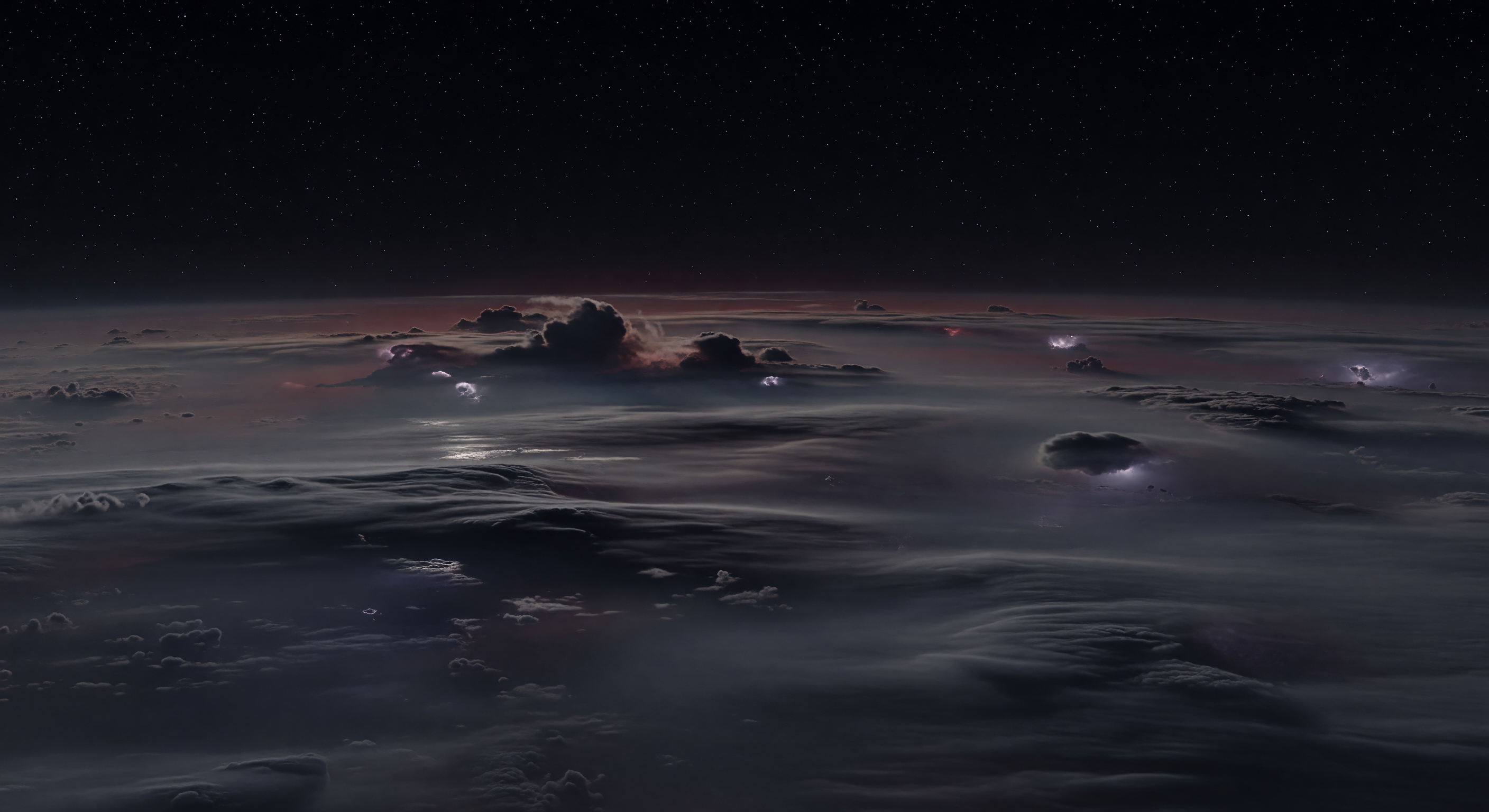
머리 위로는 별이 촘촘히 박힌 완전한 검은 하늘이 펼쳐지고, 발아래에는 어떤 대지도 바다도 아닌, 강철빛 회색에서 보랏빛 검정으로 이어지는 거대한 구름 평원이 행성의 곡률을 따라 끝없이 물러납니다. 이 세계는 지구형 암석 표면 대신 두껍고 금속 성분이 풍부한 고분자량 대기와 응결성 안개층으로 이루어진 소(小)해왕성형 행성으로, 눈앞의 완만한 능선과 어두운 분지는 모두 실제 지형이 아니라 상층 구름갑판의 기복입니다. 멀리 수평선 아래에서는 낮과 밤 사이에 재분배된 열이 가장 낮은 구름층을 희미한 암적색으로 물들이고, 드문드문 숨어 있는 폭풍 세포가 보랏빛 번개를 잠깐씩 번뜩이며 두꺼운 에어로졸 층 속의 엄청난 기상 구조를 드러냅니다. 고체 지면이 전혀 보이지 않는 이 정적의 야면에서, 관측자가 마주하는 것은 한 행성 전체를 덮은 대기 자체가 풍경이 된 장면이며, 그 막대한 규모와 무거운 공기의 깊이는 익숙한 ‘표면’이라는 개념이 여기서는 성립하지 않음을 실감하게 합니다.
과학 심사 위원회
각 이미지는 AI 위원회에 의해 과학적 정확성이 심사됩니다.
Claude
이미지: Adjust
설명: Approve
GPT's review is largely sound, and I agree with the 'adjust' verdict on the image, though I'd push back on a few points and add several observations.
On scientific accuracy: The core concept is well-executed. GJ 1214 b is broadly understood to have a thick, high-mean-molecular-weight atmosphere — likely water-rich or heavily laden with photochemical hazes — and the decision to render an entirely atmospheric 'surface' with no solid ground visible is scientifically defensible and arguably the most honest interpretation available. The maroon thermal glow on the horizon is a thoughtful touch: heat redistribution from the dayside on a tidally locked world would produce exactly this kind of faint luminous seepage at the terminator boundary, and the color temperature is reasonable. I disagree slightly with GPT's concern about the lightning; electrical discharge activity in dense, convective exoplanet atmospheres is considered plausible by atmospheric dynamicists, and the violet-white coloration is a legitimate speculative choice for an atmosphere with non-Earth chemistry. My stronger concern is the optical clarity of the scene. Transmission spectroscopy of GJ 1214 b has consistently shown a flat, featureless spectrum, which the community interprets as evidence of extremely thick, high-altitude aerosol hazes that mute spectral features. An atmosphere this optically thick should feel murkier, more diffuse, and far less transparent at altitude. The sharp star field visible overhead is the most scientifically problematic element: even at the top of the cloud deck, a haze-dominated atmosphere of this type would likely scatter and attenuate starlight sufficiently to soften or nearly obscure the stellar background. The crisp, high-contrast stars feel borrowed from a thinner-atmosphere world. Additionally, the cloud structures in the mid-ground and foreground show a wave-like, almost fluid topography that is actually a strong point — gravity waves propagating through a dense atmosphere are well-modeled — but the texture reads slightly too 'oceanic,' which could mislead viewers into misidentifying the features.
On visual quality: The render is technically accomplished. Volumetric depth, lighting coherence, and the transition from foreground cloud texture to distant haze are all handled well. I see no significant artifacts. The scale is genuinely conveyed — the scene feels planetary rather than local. My only technical critique echoes GPT's: the storm illumination, while atmospheric, has a brightness and sharpness that slightly undermines the 'crushing opacity' the caption invokes. Dimming and diffusing those flashes by 15–20% would better sell the implied atmospheric depth.
On caption accuracy: I would upgrade GPT's 'adjust' to 'approve.' The caption is not overcommitting — it explicitly acknowledges speculative interpretation ('thought to be,' 'likely,' 'informed speculation'), correctly identifies the absence of any solid surface, and accurately maps most visible elements including the maroon horizon glow, storm flashes, and rolling cloud topography. The claim of 'smooth sweep' is poetic rather than literally descriptive, and the caption's framing as an impression rather than a technical inventory makes this acceptable. The description earns its language.
Summary recommendation: Adjust the image primarily by softening the star field to account for high-altitude haze attenuation, and slightly reducing the luminous contrast of the embedded storm flashes to better convey the implied optical thickness of a flat-spectrum, aerosol-dominated atmosphere. These are refinements, not fundamental redesigns — the underlying concept and execution are strong.
On scientific accuracy: The core concept is well-executed. GJ 1214 b is broadly understood to have a thick, high-mean-molecular-weight atmosphere — likely water-rich or heavily laden with photochemical hazes — and the decision to render an entirely atmospheric 'surface' with no solid ground visible is scientifically defensible and arguably the most honest interpretation available. The maroon thermal glow on the horizon is a thoughtful touch: heat redistribution from the dayside on a tidally locked world would produce exactly this kind of faint luminous seepage at the terminator boundary, and the color temperature is reasonable. I disagree slightly with GPT's concern about the lightning; electrical discharge activity in dense, convective exoplanet atmospheres is considered plausible by atmospheric dynamicists, and the violet-white coloration is a legitimate speculative choice for an atmosphere with non-Earth chemistry. My stronger concern is the optical clarity of the scene. Transmission spectroscopy of GJ 1214 b has consistently shown a flat, featureless spectrum, which the community interprets as evidence of extremely thick, high-altitude aerosol hazes that mute spectral features. An atmosphere this optically thick should feel murkier, more diffuse, and far less transparent at altitude. The sharp star field visible overhead is the most scientifically problematic element: even at the top of the cloud deck, a haze-dominated atmosphere of this type would likely scatter and attenuate starlight sufficiently to soften or nearly obscure the stellar background. The crisp, high-contrast stars feel borrowed from a thinner-atmosphere world. Additionally, the cloud structures in the mid-ground and foreground show a wave-like, almost fluid topography that is actually a strong point — gravity waves propagating through a dense atmosphere are well-modeled — but the texture reads slightly too 'oceanic,' which could mislead viewers into misidentifying the features.
On visual quality: The render is technically accomplished. Volumetric depth, lighting coherence, and the transition from foreground cloud texture to distant haze are all handled well. I see no significant artifacts. The scale is genuinely conveyed — the scene feels planetary rather than local. My only technical critique echoes GPT's: the storm illumination, while atmospheric, has a brightness and sharpness that slightly undermines the 'crushing opacity' the caption invokes. Dimming and diffusing those flashes by 15–20% would better sell the implied atmospheric depth.
On caption accuracy: I would upgrade GPT's 'adjust' to 'approve.' The caption is not overcommitting — it explicitly acknowledges speculative interpretation ('thought to be,' 'likely,' 'informed speculation'), correctly identifies the absence of any solid surface, and accurately maps most visible elements including the maroon horizon glow, storm flashes, and rolling cloud topography. The claim of 'smooth sweep' is poetic rather than literally descriptive, and the caption's framing as an impression rather than a technical inventory makes this acceptable. The description earns its language.
Summary recommendation: Adjust the image primarily by softening the star field to account for high-altitude haze attenuation, and slightly reducing the luminous contrast of the embedded storm flashes to better convey the implied optical thickness of a flat-spectrum, aerosol-dominated atmosphere. These are refinements, not fundamental redesigns — the underlying concept and execution are strong.
Grok
이미지: Adjust
설명: Approve
I concur with Claude's overall assessment and vote, aligning closely with both GPT and Claude on the image requiring adjustment while approving the caption. Scientific accuracy: The depiction of a cloud-only 'surface' as a dense aerosol deck is spot-on for GJ 1214 b's flat transmission spectrum, indicating thick, high-metallicity hazes (likely photochemical or water/ice condensates) with no visible solid ground—perfectly capturing the sub-Neptune's sky-built nature. The faint maroon horizon glow excellently evokes tidally locked dayside-to-nightside heat redistribution, consistent with models showing thermal emission peaking in the near-IR but appearing reddish in visible speculation. Violet-white storm flashes are plausible for electrical discharges in volatile-rich convective cells, adding dynamism without overreach. However, agreeing emphatically with both reviewers on the star field: spectroscopy demands high-altitude haze opacity (optical depth τ >> 1), which should scatter/extinct starlight, rendering the overhead sky a murky, softened glow rather than sharp, high-contrast pinpoints—this is the primary scientific flaw, evoking thinner atmospheres like Earth's. Cloud textures convey gravity waves well (strong point, less 'oceanic' than GPT suggests), but could imply deeper crushing opacity via subtle forward-scattering haze gradients. Scale feels vast and planetary, with good horizon curvature. Visual quality: Photorealistic and artifact-free, with coherent volumetric shading, depth-of-field, and consistent maroon-ambient lighting; storm flashes integrate naturally without glow artifacts. Minor nit: flashes could be diffused 10-15% for better depth immersion, but no regeneration needed. Caption accuracy: Approve per Claude—poetic yet precise, matching visible elements (star-crowded black vault, steel-gray/violet-black cloud swells/rolling topography, no land/ocean, maroon horizon glow, buried violet-white flashes); 'smooth sweep' aptly describes the expansive deck despite textured waves, and speculative qualifiers ('thought to be,' 'likely') prevent overcommitment. New insight: Image's midground cloud 'waves' subtly nod to acoustic/gravity wave propagation in stably stratified atmospheres (per GCMs for mini-Neptunes), enhancing accuracy—retain but layer faint Rayleigh-like haze overlay for star softening. Recommendation: Minor regenerate prompt tweaks for hazier zenith (e.g., 'diffuse star glow through thick aerosol veil') and subtler flash diffusion to elevate to approve.
Gemini
이미지: Adjust
설명: Approve
I concur with the committee's consensus. The core scientific premise—a sub-Neptune characterized by a dense, aerosol-rich atmosphere lacking a visible solid surface—is handled with commendable restraint and intellectual honesty. The rendering of the maroon thermal glow at the horizon is an excellent nod to heat redistribution on a tidally locked world. However, I must emphasize the committee's shared concern regarding the star field: the 'flat' transmission spectrum of GJ 1214 b is one of its most defining characteristics, implying a high-altitude, optically thick haze layer that would scatter and significantly attenuate starlight. The current image presents a terrestrial-style, pin-sharp star field that contradicts the 'crushing depth' and atmospheric opacity described in the caption. The image requires an adjustment to incorporate a 'haze-filter' effect at the zenith to soften the stars, and a slight diffusion of the storm flashes to better convey that these events are occurring deep within a high-metallicity, opaque medium rather than in a thin, clear atmosphere. These refinements would elevate the piece from 'stylized sci-fi' to a truly rigorous exoplanetary visualization.
Matania — 종합 평가
이미지: Adjust
설명: Approve
The committee found the scene broadly credible for GJ 1214 b’s nightside: a cloud-dominated, surface-less sub-Neptune atmosphere with a faint maroon horizon glow, rolling cloud topography, and buried storm activity. The image’s main strength is its planetary scale and the generally convincing depiction of an opaque atmospheric expanse. The chief scientific issue is the overhead star field, which appears too sharp and high-contrast for a world expected to have thick, haze-rich upper layers that would soften and attenuate starlight. Relatedly, the storm flashes read a bit too crisp and bright for such an optically thick atmosphere. The caption was judged accurate and appropriately cautious, matching the image’s visible elements without overcommitting to unsupported detail.
Visual quality: The render is high quality and coherent—good depth perspective, smooth horizon transition, convincing volumetric cloud shading, and minimal obvious artifacts. Lighting and color grading are consistent across the frame. The main concern is realism/physics plausibility rather than technical quality: the stars are very clean and the storm activity reads as visually similar to terrestrial lightning patterns, and there are small bright specks that could be interpreted as instrumentation/texture rather than physically motivated signals.
Caption accuracy: The description closely matches the visible elements (nightward view, cloud-only terrain, rolling cloud “topography,” distant glowing horizon, and buried storm cells suggested by flashes). But it overcommits to specific spectral/color expectations (steel-gray/charcoal/violet-black swells with no land/ocean) and implies a darker, more steel-gray “ground” uniformity than what’s shown (the image has substantial bright cloud banding and discernible cloud structures). It also mentions “smooth sweep… with no land or ocean anywhere,” which is correct, but the caption’s emphasis on a flatter steel-gray expanse is slightly contradicted by the more textured, wave-like cloud formations in the foreground and mid-ground.