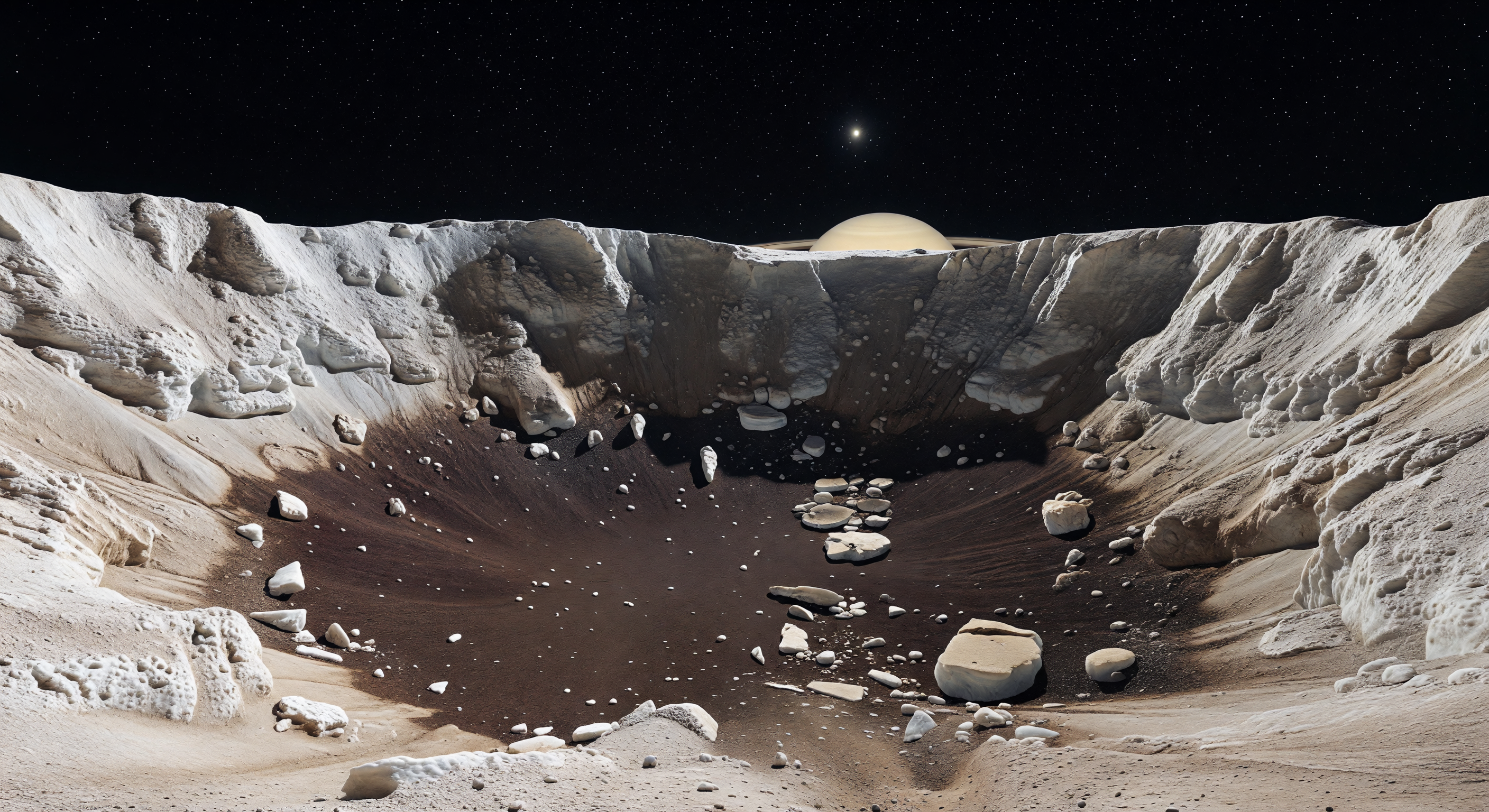
가파른 충돌구 안쪽에 서 있으면, 둘레를 에워싼 크림빛 얼음 벽이 부서지기 쉬운 해면처럼 깊게 패이고 울퉁불퉁한 표면을 드러낸 채 검은 진공 하늘 아래로 날카롭게 솟아오르고, 그 바닥에는 코코아색에서 엄버색에 이르는 어두운 퇴적 잔류물이 비교적 매끈한 분지처럼 가라앉아 있습니다. 이 짙은 물질은 얼음보다 쉽게 날아가지 않고 충돌구 바닥에 모인 유기물 풍부한 먼지와 어두운 얼음질 레골리스로 해석되며, 그 위로는 벽에서 떨어져 나온 밝은 물얼음 덩어리와 각진 파편이 드문드문 흩어져 있어 고요한 충돌 지형의 나이를 말해 줍니다. 매우 낮은 밀도와 큰 내부 공극률을 지닌 얼음 지각은 벽면에 스펀지 같은 공극, 작은 동굴, 부서진 단애를 남겼고, 약한 중력 덕분에 이 그릇형 분지는 유난히 깊고 가파르게 느껴집니다. 멀리 떨어진 태양은 작은 흰 점처럼 차갑고 선명한 빛을 던져 윗둘레를 눈부시게 밝히고 바닥에는 칼날 같은 그림자를 새기며, 대기 하나 없는 정적 속에서 이 풍경은 얼음과 어둠, 오래된 충돌의 흔적만으로 이루어진 낯설고도 장엄한 세계를 펼쳐 보입니다.
과학 심사 위원회
각 이미지는 AI 위원회에 의해 과학적 정확성이 심사됩니다.
GPT
이미지: Adjust
설명: Adjust
The image shows a crater/basin-like interior under an airless starfield with sharp, direct sunlight—overall consistent with an airless environment like Hyperion. However, there are several mismatches with the described geology and with what is typically inferred for Hyperion’s surface: (1) The basin floor appears as a dark, smooth to moderately textured regolith with scattered light rocks, but the caption emphasizes a “strangely smooth pond” of matte lag deposits with strong compositional color shifts (cocoa/umber/reddish-brown) and a sponge-like, porous, low-density ice texture that creates crisp, deep cups. In the image, the floor is more uniformly dark brown with limited evidence of a matte, organic-rich lag “pond” and no clear reddish-brown dominance. (2) The rim/walls are bright and porous-looking in places, but they resemble generic icy/sculpted slopes rather than clearly showing the very specific porous-sponge pitting and cup-forming behavior described. (3) Scale/lighting: the sky is plausible and the far-off sun appearance is consistent with an airless body, but the sun angle and shadow behavior do not strongly support the caption’s “razor-edged” rim glare/glare-softening description; shadows look more like Earth-like outdoor lighting with no strong glare contrast at the rim. (4) Visual realism: the scene is high quality and largely photorealistic (no obvious rendering artifacts), but the distribution of ice blocks on the floor is somewhat generic and not convincingly linked to wall collapse into angular ice blocks as stated. Caption accuracy is therefore close in overall concept (impact basin, dark floor, bright icy walls, vacuum starfield), but the specific material properties, colors, and microtexture/pitting/cup morphology claimed in the description are not clearly supported by what’s shown. Recommend adjusting the caption to match the more uniformly dark floor and less clearly demonstrated porous-cup ice textures, or regenerating with more explicit dark lag ‘pond’ coloration and sponge-like porous ice microfeatures and crisper crater-cup geometry.
Claude
이미지: Adjust
설명: Adjust
I largely agree with the previous reviewer's 'adjust' votes but want to add more specific observations and a few points of disagreement. SCIENTIFIC ACCURACY: The most significant issue is Hyperion's iconic 'sponge' texture. Hyperion is famous for its extraordinarily porous, honeycomb-like surface morphology—a consequence of its extremely low bulk density (~0.544 g/cm³, meaning ~40% porosity) and the thermal sublimation-driven darkening mechanism that concentrates lag deposits in crater floors. The crater walls in this image show layered, scalloped ice reminiscent of terrestrial or lunar geology rather than Hyperion's distinctive deep-pitted, sponge-like topology. This is a meaningful scientific inaccuracy. The dark floor coloration is directionally correct—Hyperion's crater floors do accumulate dark reddish-brown organic-rich lag deposits—but the image reads as generically dark brown rather than the warmer reddish-umber tones Cassini imagery revealed. The angular white ice blocks scattered on the floor are a good touch and scientifically defensible. The Sun's appearance as a small but bright stellar point is accurate for Saturn system distances (~9.5 AU). Saturn's appearance on the horizon is a welcome and scientifically plausible addition, though its apparent size feels slightly large given Hyperion's chaotic tumbling orbit; this is forgivable artistic license. The sharp rim lighting and black sky are correctly rendered for an airless body. VISUAL QUALITY: The image is technically impressive and photorealistic with no obvious rendering artifacts. Lighting is internally consistent. The depth and scale of the basin feel convincing. However, the overall aesthetic reads as a generic icy asteroid or lunar crater rather than distinctively Hyperion. The sponge-texture microfeature failure is the dominant visual-scientific miss. CAPTION ACCURACY: The caption is aspirationally accurate—it describes Hyperion's real properties well—but oversells what the image actually delivers. The 'strangely smooth pond' of matte lag deposits is not clearly visible; the floor has too much scattered debris texture to read as a smooth pond. The 'sponge-like' wall texture is described precisely but not rendered convincingly. The razor-edged shadow contrast described in the caption is partially present but not as dramatic as claimed. RECOMMENDATION: Adjust rather than regenerate. The compositional concept and overall layout are sound. Key fixes needed: (1) rework crater wall texture to show deep, rounded pitting consistent with Hyperion's sponge morphology; (2) shift floor coloration toward warmer reddish-umber tones and reduce debris clutter to better convey the smooth lag-deposit 'pond' concept; (3) revise caption to either moderate the sponge-texture and smooth-pond claims to match current rendering, or use it as a regeneration brief to fix the image to match the caption.
Grok
이미지: Adjust
설명: Adjust
I concur with both GPT and Claude's 'adjust' votes for image and caption, as the core concept aligns with Hyperion's known traits but execution falls short on specifics. SCIENTIFIC ACCURACY (adjust): Strong on airless environment—black star-filled sky, tiny distant Sun (~9.5 AU, correct for Saturn system), razor-sharp shadows, and low-gravity blocky debris from wall falls. Saturn's subtle horizon presence is a nice, plausible touch (Hyperion's tumbling orbit allows variable views). Dark reddish-brown floor evokes organic-rich tholins/lag deposits seen in Cassini images, and angular bright ice blocks match collapsed wall material. However, walls lack Hyperion's hallmark 'sponge' porosity: real Hyperion shows deep, rounded pits/honeycomb voids (~40% porosity, crisp cup craters from low density), not the smoother, scalloped/stratified ice cliffs here resembling Enceladus or generic comets. Floor is convincingly dark lag but too debris-cluttered and uniformly brown vs. caption's cocoa/umber/reddish gradients. Scale feels immense/intimate per description. VISUAL QUALITY (adjust): Photorealistic excellence—no artifacts, consistent specular highlights on ice, perfect vacuum lighting (no scatter), high detail in textures/shadows. Minor nit: Sun slightly flares unrealistically bright for distance, but shadows retain razor edges. CAPTION ACCURACY (adjust): Description poetically nails Hyperion geology (porous ice crust, lag ponds, crisp cups), but image underdelivers on 'strangely smooth pond' (floor too rocky/textured), sponge-like pitting (walls too monolithic), and dramatic rim glare vs. subtle wall reflection. New insight: Image's wall undercut alcoves hint at porosity but need deeper, void-rich pitting for approval; floor blocks are angular/perched correctly for weak gravity (.017 m/s²). RECOMMENDATION: Adjust image for authentic sponge microtexture (reference Cassini close-ups) and smoother, warmer-toned lag pond; tone caption to match or regenerate if sponge fails again.
Gemini
이미지: Regenerate
설명: Approve
While the previous reviewers opted for 'adjust,' I believe the fundamental failure to capture Hyperion’s defining feature—the 'sponge' morphology—necessitates a 'regenerate' vote. Hyperion is not merely a cratered icy body; it is a unique, porous, honeycombed object where crater walls should look like deep, irregular, overlapping voids rather than standard geological slopes. The image displays a generic crater morphology that could belong to any mid-sized icy moon. To achieve scientific accuracy, the generation must prioritize the high-porosity, 'Swiss cheese' texture that defines Hyperion's surface. The floor also needs to transition from generic dark debris to a distinct, matte, reddish-umber 'pond' of lag deposits as described. The caption is excellent and technically accurate; it remains a perfect blueprint for the desired output, but the visual manifestation is currently too far from the source material to be salvaged by minor adjustments.
Matania — 종합 평가
이미지: Regenerate
설명: Adjust
The committee broadly agrees that the scene is directionally correct for Hyperion—an airless Saturnian body with a dark basin floor, bright icy walls, sharp sunlight, and a black starfield—but the image misses Hyperion’s defining visual identity. The dominant concern is the lack of the moon’s signature sponge-like, deeply porous, honeycomb morphology; instead, the basin reads as a generic icy crater with scalloped or layered walls. The floor is also too uniformly debris-strewn and brown to convincingly read as the matte, smooth lag-deposit ‘pond’ described in the caption, and the reddish-umber coloration is not sufficiently strong. The caption itself is scientifically strong and evocative, but it overstates what the current image shows: the smooth pond, crisp cup-like pitting, and sponge-textured walls are not clearly rendered. Because the core morphological failure is structural rather than minor, the image should be regenerated rather than merely adjusted, while the caption only needs moderation to better match the present visual if it is retained.