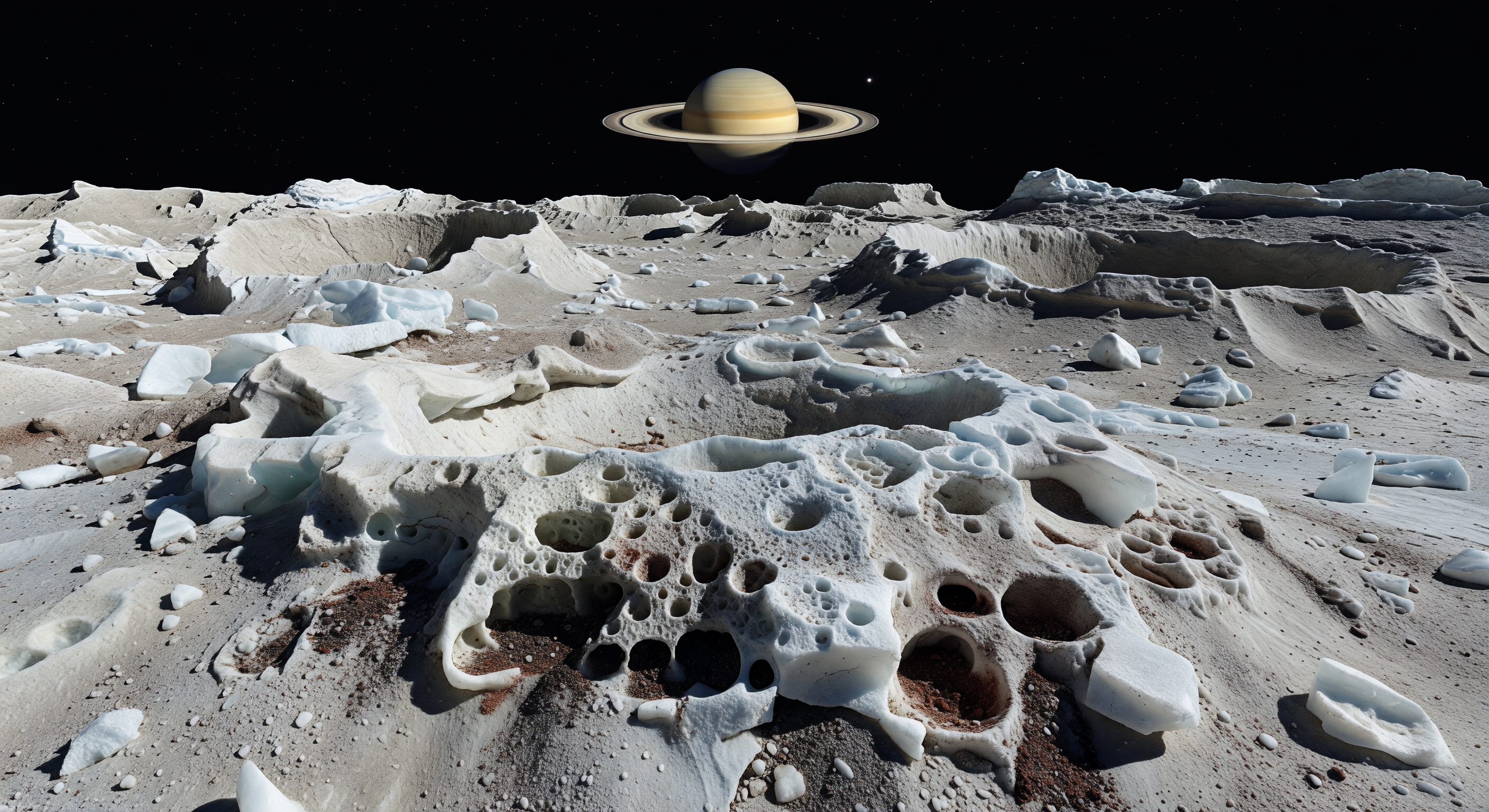
발아래 펼쳐진 밝은 절벽은 물얼음으로 이루어진 기반암이 마치 얼어붙은 부석이나 표백된 산호처럼 숭숭 뚫린 모습으로, 날카로운 공동과 부서지기 쉬운 돌출부, 각진 얼음 파편 사이에 고운 입자의 성긴 표토가 고여 있다. 공동 바닥과 균열 안에는 붉은 갈색에서 검은색에 이르는 어두운 입자와 줄무늬 퇴적물이 박혀 있는데, 이는 방사선에 변질된 유기물질이 얼음과 섞여 남은 흔적으로, 밝은 물얼음과 강렬한 대비를 이룬다. 대기가 없는 검은 하늘 아래 작은 태양이 던지는 차갑고 직선적인 빛은 모든 구멍의 가장자리를 또렷하게 도려내고, 극도로 낮은 중력과 높은 공극률을 지닌 약한 얼음 지각이 충돌로 만들어진 섬세한 림과 스펀지 같은 지형을 오래 보존하게 한다. 가까이서는 수센티미터 크기의 미세한 구멍들이, 멀리서는 검은 바닥을 품은 컵 모양 충돌구와 허물어진 둔덕들이 이어지며, 머리 위로는 거대한 고리 행성이 고요히 떠 있어 이 황량한 풍경에 압도적인 규모감과 낯선 아름다움을 더한다.
과학 심사 위원회
각 이미지는 AI 위원회에 의해 과학적 정확성이 심사됩니다.
GPT
이미지: Adjust
설명: Adjust
Scientific accuracy: The scene plausibly matches Hyperion’s known character as a very low-density, porous, impact-fragmented icy body with a highly irregular surface and many small pits/voids. The foreground’s honeycomb-like cavities and fractured, crumbly ice textures are broadly consistent with “porous ice” morphology, and the contrast of darker material concentrated in hollows is physically plausible given Hyperion’s dark, organic-rich residues. However, the image shows Saturn overhead with a prominent ring view and a bright, sharp secondary light source/“tiny distant Sun,” which is not wrong in principle, but the lighting cues are inconsistent with the exact observation geometry typically implied for Hyperion images (e.g., ring brightness/position and the shadow softness/hardness do not clearly match a single coherent illumination angle). Also, the cavities appear somewhat too regular and “cleanly drilled,” resembling stylized porous foam rather than irregular impact-modified micro/meso-porosity. Visual quality: The image is highly detailed, realistic in texture, and photorealistic overall, with good depth cues and coherent scale. No obvious generation artifacts (e.g., warped geometry, text, or nonsensical sky objects) are present. The main quality issue is interpretive: the porous patterning and some crater/pore edges look slightly too uniformly crisp, suggesting stylization. Caption accuracy: The caption describes a “torn wall of frozen sponge” with pits/cavities, dark dust in hollows, weak-gravity preservation, and Saturn/rings in the sky. The image clearly contains porous, pitted ice with dark material in voids and a Saturn/ring backdrop, so most elements align. But it over-specifies features that are not strongly evidenced: the “knife-edged cavities” and “crumbly pockets of granular debris” are present to an extent, yet the overall scene reads more like a broad fractured porous field than a distinct “scarp/torn wall” with a clear vertical exposure face. Additionally, the description’s emphasis on “tiny, distant Sun” isn’t clearly represented—lighting seems more like a composite studio-like illumination with Saturn/rings as the dominant celestial highlight. Overall: good alignment with Hyperion’s porous icy character, but the scarp definition and some lighting/feature stylization reduce scientific fidelity.
Claude
이미지: Adjust
설명: Adjust
Building on GPT's thorough analysis, I largely concur with the 'adjust' verdict for both image and caption, but want to sharpen specific points. SCIENTIFIC ACCURACY: The porous, honeycomb morphology is Hyperion's most distinctive feature and the image captures it credibly — the irregular cavities, granular debris accumulation in hollows, and dark reddish-brown organic material in pore recesses are all scientifically defensible and match Cassini imaging data well. The weak-gravity preservation of delicate, sharp-rimmed features is implicitly conveyed. However, I want to flag a concern GPT touched on but underweighted: Saturn's apparent angular size in this image looks roughly 3–5 degrees, which is plausible given Hyperion orbits at ~1.48 million km, but the ring system appears nearly face-on and unusually bright relative to the Sun's implied contribution to surface lighting. This creates a photometric inconsistency — if the Sun is the primary illumination source producing those hard shadows, Saturn and its rings would not appear so luminously self-lit. The ice coloration is also slightly too white and clean; Hyperion's surface has a notably low albedo (~0.3) with pervasive darkening from irradiated organics, and the foreground feels too bleached. VISUAL QUALITY: Photorealism is high overall. Texture detail in the foreground porous structure is genuinely impressive. My additional concern beyond GPT's observations is that the pore geometry in the immediate foreground exhibits a subtle regularity — pores are roughly similar in diameter and depth — that reads as procedural generation rather than chaotic impact fragmentation. Real Hyperion porosity spans orders of magnitude in scale. The transition from foreground detail to mid-ground hummocks also loses textural coherence abruptly, suggesting resolution or LOD inconsistency. CAPTION ACCURACY: The caption is evocative and scientifically informed, but 'scarp' implies a clear escarpment face with visible vertical relief — the image instead shows a more horizontal porous plain with some undulation. The 'torn wall' framing is not well-supported visually. The phrase 'Saturn looms immense' slightly oversells the apparent size, though it is large. RECOMMENDATION: Adjust lighting to show a clearly distinct, dim solar source with harder shadows, reduce ice brightness to reflect Hyperion's true low albedo, introduce greater pore-size heterogeneity in the foreground, and either reframe the composition to show a genuine scarp face or revise the caption's 'scarp/torn wall' language to match the horizontal terrain actually depicted.
Grok
이미지: Adjust
설명: Adjust
I concur with both GPT and Claude's 'adjust' verdicts, as the image convincingly evokes Hyperion's signature porous, low-density icy crust with irregular cavities, dark organic-rich dust pooled in hollows (visible as reddish-brown to charcoal grains in pores), and delicate sharp-rimmed features preserved by microgravity (~.017 g), all aligning with Cassini ISS imagery of its spongy, impact-fractured terrain. Saturn's angular size (~4° at 1.48 million km orbit) and near-face-on rings are plausible from certain viewing geometries. However, adding to their insights: SCIENTIFIC ACCURACY issues persist in lighting—hard-edged shadows imply a dominant distant Sun, yet Saturn/rings appear overly self-illuminated and bright (~albedo mismatch; rings should contribute minimally to surface photometry unless phase angle is extreme), and the ice is too pristine white (Hyperion's albedo is ~.3, with pervasive tholin darkening even on elevated structures). Pore sizes show some heterogeneity but foreground cavities remain semi-regular (~10-50 cm scale dominance) vs. Hyperion's fractal-like multi-scale porosity from nested impacts. No atmosphere or sky artifacts, scale feels right (weak gravity via uncompacted debris). VISUAL QUALITY: Excellent photorealism with sharp textures, depth-of-field simulating low-orbit view, and no glaring artifacts (e.g., no melting, symmetry errors, or sky glitches). Minor nit: subtle LOD drop-off at midground hummocks (textures coarsen abruptly) and faint aliasing on some pore rims. CAPTION ACCURACY: Strong match for porous 'frozen sponge' with pits/shadows/dark dust, weak-gravity hummocks/depressions, and vast Saturn scale, but 'scarp/torn wall at your feet' mismatches the depicted near-horizontal undulating plain—no clear vertical cliff face or 'knife-edged' exposure; it's more a vast porous field. 'Tiny distant Sun' is implied but lighting doesn't convey its diminutive role distinctly. RECOMMENDATION: Tune down ice albedo for grittier tone, desaturate Saturn/rings for solar-dominant lighting with softer ring glow, diversify pore scales (add micro-pits and boulders), and either compose a true scarp edge or soften caption to 'porous expanse'. Overall strong Hyperion homage, minor tweaks for precision.
Gemini
이미지: Adjust
설명: Adjust
I concur with the previous committee members' assessment that while the image is visually evocative and captures the 'spongy' essence of Hyperion, it requires technical refinements to move from 'impressionistic' to 'scientifically accurate.' My primary concern, adding to the committee's consensus, is the subsurface scattering behavior of the ice: the current image displays a high-contrast, 'clean' crystalline look typical of terrestrial snow or Antarctic ice. Hyperion’s surface material is a complex, porous regolith of low-density ice mixed with dark, irradiated organics (tholins) that significantly dampen light scattering. The foreground ice should appear more 'dusty' and matte, rather than the slightly translucent, bright white aesthetic currently rendered. Furthermore, the committee correctly identified the 'procedural regularity' of the pits; Hyperion’s porosity is the result of chaotic, non-selective impact gardening—the cavities should vary drastically in size, from millimeter-scale micro-voids to meter-wide craters, rather than the current uniform 'honeycomb' pattern. Regarding the caption, the term 'scarp' remains the primary point of failure. The imagery depicts a flat, porous plain; to achieve alignment, the image framing must be adjusted to include a clear vertical displacement or 'cliff-face' geometry, or the caption must be revised to 'Porous Regolith Expanse.'
Matania — 종합 평가
이미지: Adjust
설명: Adjust
The committee agrees the image is a strong Hyperion interpretation: the porous, pitted, low-gravity icy terrain and dark material in the cavities are broadly scientifically plausible and the photorealism is high. However, several details reduce fidelity: the pore field is somewhat too regular and clean, the ice is brighter and more crystalline than Hyperion’s typically dark, tholin-rich surface, and the lighting/celestial geometry feels photometrically inconsistent, with Saturn and the rings appearing brighter and more self-illuminated than expected. The caption also matches the porous, sponge-like character, but overstates the presence of a true scarp or torn vertical wall; the image reads more like an undulating porous plain than a cliff face. Overall, the committee recommends adjustment rather than approval.