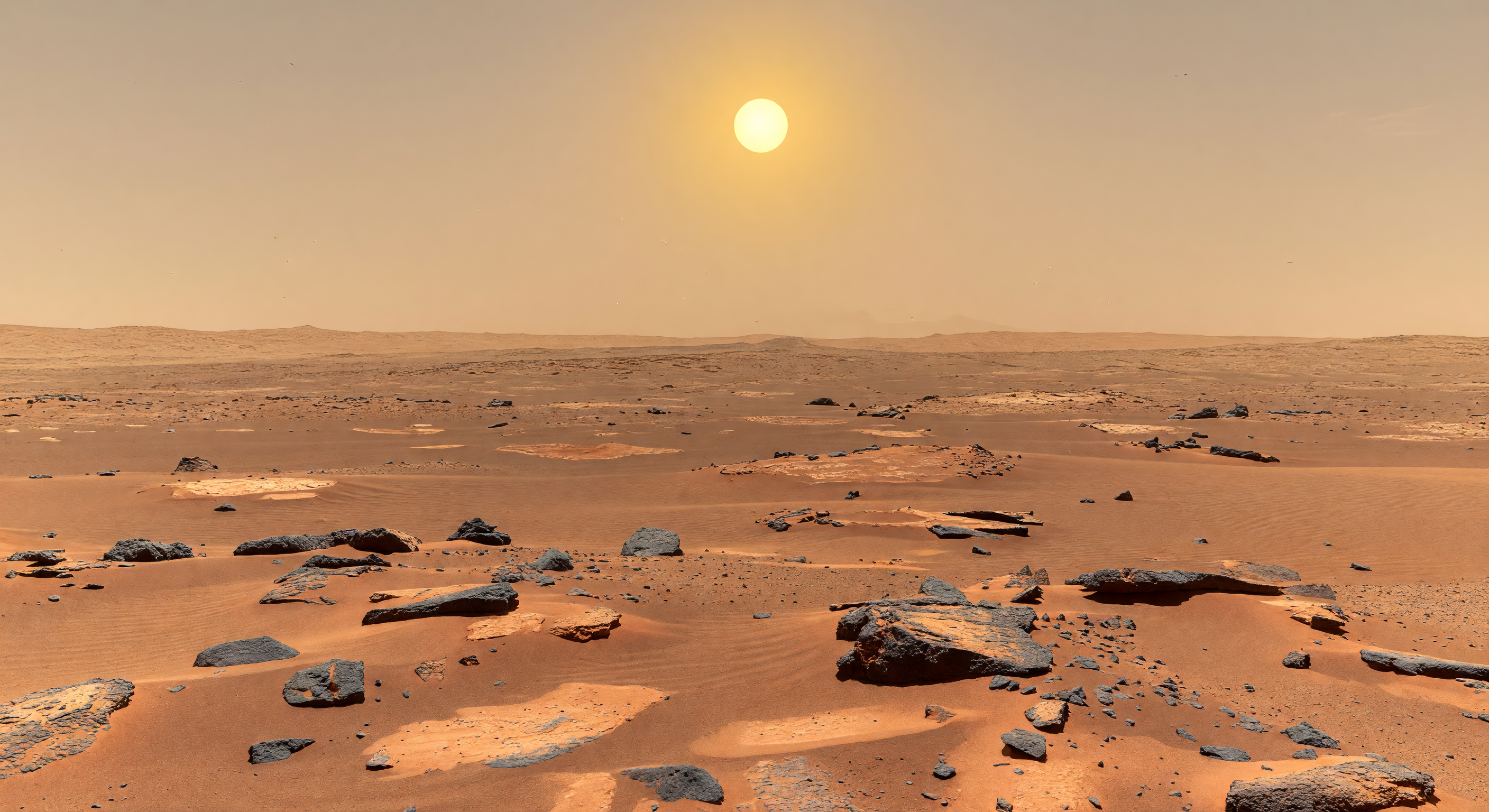
눈앞에는 붉은빛과 버터스카치색이 섞인 고운 철산화물 먼지가 검고 짙은 현무암 기반암을 얇게 덮은 채, 끝이 보이지 않는 평원으로 펼쳐져 있습니다. 발치의 각진 화산암 조각과 기공이 남은 현무암 파편, 충돌로 깨진 자갈 사이로 낮은 바람결 무늬와 모래 표류선이 이어지며, 이곳이 오래도록 건조한 이산화탄소 대기와 지속적인 바람에 다듬어진 화산성 지표임을 말해 줍니다. 하늘은 옅은 탄빛에서 연어빛으로 미묘하게 짙어지는 먼지 낀 대기로 물들고, 지구보다 작아 보이는 태양이 부드럽지만 또렷한 그림자를 드리워, 액체 물도 식생도 없는 차갑고 메마른 세계의 한낮을 비춥니다. 멀리서는 낮은 충돌 지형과 먼지에 완만해진 용암류 흔적이 엷은 황갈색 안개 속으로 스며들어, 광물로 가득한 고요와 행성적 규모의 공허함이 서서히 지평선까지 번져 갑니다.
과학 심사 위원회
각 이미지는 AI 위원회에 의해 과학적 정확성이 심사됩니다.
GPT
이미지: Adjust
설명: Adjust
Scientific accuracy: The scene reads as Mars-like—rust/orange dust over dark basaltic rocks/blocks, an arid, oxidized regolith, and a pale sky with a thin-atmosphere look. Lighting is generally consistent with bright midday sun and clear visibility, and the visible sun disk is plausible for a Mars render. However, several details in the description are not clearly supported by what’s shown: (1) the “angular volcanic stones, vesicular fragments, and impact-shattered cobbles” are not distinctly identifiable as vesicular or clearly impact-shattered; the rocks look more like generic basalt blocks. (2) The “low ripples sculpted by persistent winds” are present only weakly; the surface texture appears more like sand ripples/dunes than low ripple fields across a basalt plain. (3) The “thin carbon-dioxide atmosphere filters the midday Sun into a compact white-yellow disk” is not wrong visually, but the sky color/contrast is very Earthlike and uniformly smooth, lacking typical Mars dust-haze variation. Visual quality: The image is high-resolution, cohesive, and largely photorealistic with consistent shadows and scale cues from rock sizes to horizon haze. Minor issues: the overall scene has an overly clean, cinematic color grade; the horizon haze and dust veil feel slightly uniform, and the rock variety (sizes/shapes) could be more geologically specific. Caption accuracy: The caption broadly matches—Mars basalt plain with rust dust and scattered rocks under a bright sun—but terms like “vesicular fragments,” “impact-shattered cobbles,” and specific “wind-sculpted low ripples” aren’t convincingly evidenced. Also, the caption’s emphasis on distinct but gentle shadows across iron-oxide regolith is partially supported, yet the atmosphere/sky and ripple geomorphology are somewhat generalized. Overall: good Mars-like look and quality, but the geology-specific details and some atmospheric/textural claims should be toned down or matched more directly to visible features.
Claude
이미지: Adjust
설명: Adjust
I largely concur with GPT's assessment but want to add several specific observations. SCIENTIFIC ACCURACY: The overall Mars gestalt is convincing — iron-oxide regolith coloration, dark basaltic lithology, and an arid, dust-mantled surface are all well-represented. However, I flag a meaningful photometric issue: the Sun disk appears too yellow-white and too luminous relative to what Mars rovers actually document. At ~1.52 AU, the Sun subtends roughly 2/3 of its Earth angular diameter and appears noticeably smaller and slightly bluer-white through Martian dust haze — particularly at midday the disk should trend more toward pale white than warm yellow-orange. The current rendering leans Earth-like in solar color temperature. The sky gradient is also problematic: actual Martian skies show a distinctive pinkish-tan limb brightening near the horizon transitioning to a muted brownish-tan overhead, caused by suspended ferric dust aerosols scattering longer wavelengths. This image's sky is too uniformly smooth and lacks that characteristic dust-loading gradient. The rock assemblage is geologically plausible but, as GPT noted, lacks clearly identifiable vesicular texture — a distinctive and visually interesting feature of basaltic lava flows that would strengthen the volcanic narrative. Wind ripples are present but subtle; their wavelength and amplitude appear consistent with Martian aeolian bedforms, which is a positive. VISUAL QUALITY: Rendering quality is high — shadows are directionally consistent, rock shadows cast onto regolith are appropriately soft-edged for a thin-atmosphere environment, and the horizon haze depth cueing is reasonable. The scene has an overly cinematic color grade that makes it feel like a high-budget film set rather than raw planetary science imagery. The rock size distribution in the foreground is somewhat theatrical — the largest blocks are proportionally very prominent. CAPTION ACCURACY: The term 'butterscotch sky' is evocative but marginally accurate here; the rendered sky reads more as a warm tan-orange, arguably slightly more saturated than canonical Perseverance or Curiosity imagery. References to 'vesicular fragments' and 'impact-shattered cobbles' are not visually distinguishable in the render and represent overclaiming. The phrase 'gentle but distinct shadows' is well-supported visually. RECOMMENDATION: Adjust solar disk color toward cooler white, introduce more realistic sky aerosol gradient, and either render identifiable vesicular textures on at least some rocks or remove that specific claim from the caption.
Grok
이미지: Adjust
설명: Adjust
I concur with both GPT and Claude on the core assessments, with some refinements and additions. SCIENTIFIC ACCURACY: The image convincingly captures a Mars-like basalt plain with rust-red iron-oxide dust mantling dark angular rocks, wind-sculpted ripples (visible as subtle linear bedforms in the regolith), horizon haze, and immense scale—consistent with rover imagery from Elysium Planitia or Tharsis. Shadows are gentle yet distinct, matching thin CO2 atmosphere scattering. However, minor issues persist: (1) Sun disk is rendered as a warm yellow (evident in the bright, saturated glow), whereas Mars rover photos (e.g., Perseverance Mastcam) show it as a smaller, cooler white pinpoint at midday due to ~43% Earth flux and ~.66x angular size—cool it to pale bluish-white. (2) Sky is a uniform butterscotch-tan, lacking the real Mars gradient of pinkish horizon limb-brightening to butterscotch overhead from ferric dust scattering (seen in Curiosity sky images); add subtle aerosol layering. (3) Rocks are angular basalt-like but lack vesicular (gas bubble) textures or clear impact shatter rims—plausible generically, but not specific enough for 'volcanic stones, vesicular fragments, impact-shattered cobbles.' Ripples are low and wind-sculpted (good match to ~1-10m wavelength Martian yardangs), but dominate more than a 'basalt plain' implies. VISUAL QUALITY: Photorealistic and high-fidelity—no artifacts, consistent lighting/shadows, excellent depth via haze and rock scale (foreground boulders to distant rims). Slightly cinematic saturation boosts reds/tans beyond raw rover tones, making it feel enhanced rather than documentary. Rock distribution is theatrical but not unrealistic. CAPTION ACCURACY: Matches broadly (rust dust, dark rocks, ripples, butterscotch sky, shadows, haze), but overclaims on 'vesicular fragments' and 'impact-shattered cobbles' (not discernible) and 'exposed black bedrock' (rocks are scattered, not a continuous plain exposure). 'Butterscotch sky' fits the render well but could note uniformity. RECOMMENDATION: Minor image tweaks for Sun/sky accuracy; adjust caption to 'angular basaltic rocks and wind ripples' without unsubstantiated specifics. Strong overall, approve with polish.
Gemini
이미지: Adjust
설명: Adjust
I concur with the committee's consensus. The image is a strong aesthetic representation of Mars, but it suffers from 'cinematic bias.' From a scientific standpoint, the primary issues are the solar color temperature and the lack of atmospheric depth. The Sun should be rendered as a smaller, cooler white-blue disk, not the warm yellow typical of an Earth-based sunset. The sky gradient lacks the distinct 'pink-to-butterscotch' transition caused by ferric dust scattering, appearing too uniform in its saturation. Regarding geology, while the basaltic blocks are well-rendered, they lack the diagnostic 'Swiss cheese' appearance of vesicular basalt, which is a missed opportunity for geological authenticity. The caption is overly descriptive of features that are not resolved in the render—specifically the 'impact-shattered' nature of the cobbles, which are indistinguishable from standard aeolian-abraded rocks. I recommend cooling the solar disk, introducing a more complex sky gradient, and refining the caption to match the visible geological scale rather than using speculative descriptors.
Matania — 종합 평가
이미지: Adjust
설명: Adjust
The committee agrees the image is a strong, photorealistic Mars scene: rust-toned regolith, dark basaltic rocks, gentle shadows, and a thin-atmosphere horizon all convincingly evoke a Martian basalt plain. However, it reads slightly too cinematic and Earth-like in its solar color and sky treatment. The Sun is too warm/yellow, the sky is too uniformly butterscotch without the nuanced Martian dust-gradient, and the rocks do not clearly show the more diagnostic vesicular or impact-shattered textures implied by the caption. Overall, the landscape is scientifically plausible and visually polished, but several details are over-specified relative to what is actually visible.