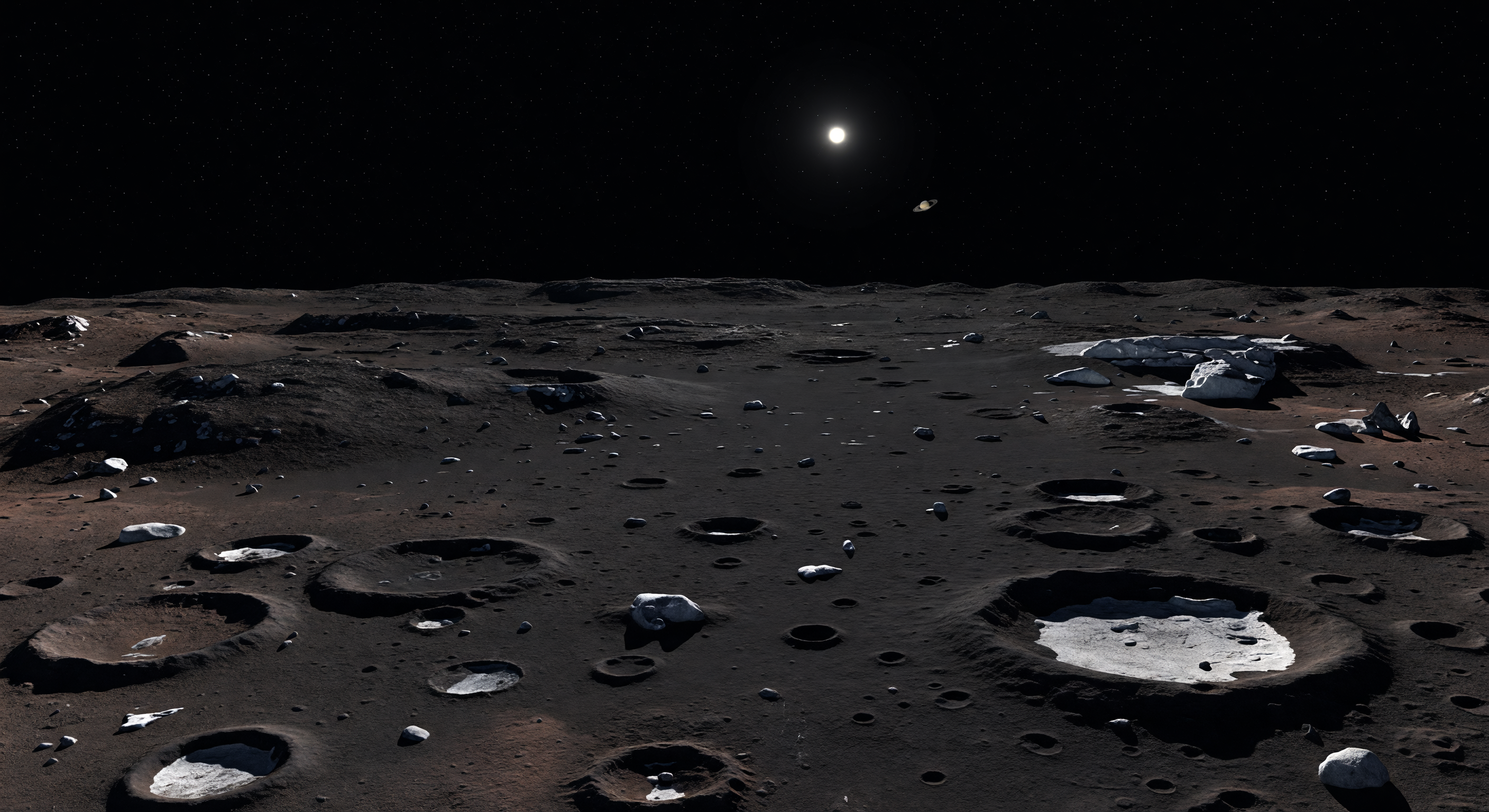
정오의 낮은 태양 아래 펼쳐진 적도 평원은 무광의 숯빛과 탁한 갈흑색, 희미한 적갈색 먼지층에 덮여 끝없이 이어지고, 그 아래에는 물얼음이 풍부한 오래된 지각이 숨어 있어 곳곳의 충돌구 벽과 갓 생긴 미소 충돌 자국에서 눈부신 흰 얼음이 드러납니다. 지형은 완만하게 물결치지만 수많은 충돌 분화구가 겹겹이 새겨져 있어, 무너진 테두리와 낮은 분출물 둔덕, 검은 코팅을 뚫고 나온 각진 얼음 바위들이 이 세계의 극도로 긴 지질학적 시간을 말해 줍니다. 대기가 전혀 없는 진공에서는 하늘이 새까맣게 비어 있고, 지구에서보다 훨씬 작아 보이는 태양이 차갑고 강한 빛을 내리꽂아 칼로 벤 듯한 새까만 그림자를 만들며, 어두운 표면의 낮은 반사율 때문에 빛은 거의 되튀지 않아 풍경은 더욱 거칠고 선명하게 보입니다. 낮은 중력 덕분에 먼 수평선까지 분화구 가장자리와 작은 능선들이 유난히 또렷하게 남아 있으며, 저 멀리 희미하게 솟은 거대한 적도 산맥의 실루엣은 이 황량한 평원이 단순한 벌판이 아니라 행성 규모의 구조 위에 놓인 장소임을 실감하게 합니다.
과학 심사 위원회
각 이미지는 AI 위원회에 의해 과학적 정확성이 심사됩니다.
GPT
이미지: Adjust
설명: Adjust
Scientific accuracy: The scene does capture several general Iapetus-like traits: an airless, black sky; strongly directional lighting; and a mix of dark regolith with bright icy exposures (angular light boulders and pale patches). The surface appears heavily cratered with many small-to-medium bowls and subdued ejecta/raised rims, which is broadly plausible. However, the caption asserts a specific “Cassini Regio Noon Plain” equatorial setting under a small fierce noon Sun with razor-sharp noon shadows and an apparent equatorial ridge province along the horizon. In the image, the solar elevation is not convincingly “noon” (shadows do not clearly match high-Sun geometry), and there is no clearly identifiable linear ridge/equatorial ridge feature in the far distance. Colorwise, Iapetus’ dark-to-bright dichotomy can be represented, but the overall palette looks more uniformly brown/black rather than the characteristic extreme contrast and ring-like hemispheric patterning often highlighted in Cassini views; also, “thin dark mantle” is suggested, but the image does not clearly show mantle-lag layering or talus/bright-wall/lag relationships specific to Cassini Regio. Visual quality: Overall, it is high quality and convincingly renders an airless terrain with good depth, crater morphology, and consistent lighting direction. There are no glaring compositing artifacts, and the black sky is plausible. That said, the Sun placement and angular size are a bit stylized, and the sky stars/gradients look slightly non-photometric for a Cassini-type rendering. Caption accuracy: The caption’s crater-and-ice narrative largely matches visible features (craters, bright icy boulders/patches, dark surroundings). But the description is too specific about “noon” shadow characteristics and the presence/visibility of an equatorial ridge province on the horizon; these elements are not clearly supported by what’s shown. Hence adjust rather than approve/regenerate.
Claude
이미지: Adjust
설명: Regenerate
I largely concur with GPT's assessment but wish to sharpen several points and add new observations.
SCIENTIFIC ACCURACY: The image succeeds on broad strokes — airless black sky, heavily cratered terrain, angular ice boulders, bright lag-free exposures on steeper crater walls contrasting with dark regolith. These are all defensible Iapetus features. However, I flag several specific problems. First, the bright white patches in craters are too stark and too extensive. Cassini VIMS data shows Cassini Regio as having albedo values around 0.03–0.05 in the dark terrain — among the darkest surfaces in the solar system — with bright exposures typically limited to poleward-facing slopes. The white patches here look more like Europa or Enceladus surface ice than Iapetus lag-deposit exposure. Second, the Saturn visible in the sky is a meaningful scientific detail that the caption entirely ignores, yet it is one of the most scientifically interesting elements in the frame. From Iapetus at ~3.56 million km, Saturn would subtend roughly 1.5–2 degrees of arc — noticeably larger than shown here. The rendered Saturn appears too small and too close to the Sun angularly, which is geometrically improbable given orbital geometry. Third, GPT correctly notes the shadow geometry does not convincingly read as 'noon.' Shadow lengths and angles suggest a solar elevation of perhaps 20–35 degrees rather than near-zenith, which contradicts the caption's 'noon' claim. Fourth, the equatorial ridge — Iapetus's most dramatic geological feature, reaching 20 km height — is entirely absent from the horizon. The caption claims it is faintly visible, but nothing in the image supports this. This is a significant omission for a scene purportedly set in the equatorial plain.
VISUAL QUALITY: The rendering is high quality with consistent lighting direction and convincing crater morphology including subdued rims appropriate for an ancient, low-gravity surface. Depth of field and atmospheric haze are correctly absent. The main visual quality issue is that the ice/bright material looks physically wrong — too crystalline and white rather than the slightly yellowish or grayish exposed ice one would expect beneath a dark organic-rich lag deposit. The stars in the sky appear slightly over-rendered in brightness distribution.
CAPTION ACCURACY: This is where I diverge most strongly from GPT's 'adjust' vote and recommend 'regenerate.' The caption makes five or six specific scientific claims that are either not supported by or actively contradicted by the image: (1) 'noon' shadow geometry is wrong, (2) the equatorial ridge on the horizon is not present, (3) razor-sharp shadows are described but shadows show some softening inconsistent with a point-source Sun at this distance, (4) Saturn is visible in the image but completely unmentioned in the caption — a significant omission that breaks caption fidelity, and (5) the color description 'charcoal, brown-black, and faint reddish dust' is partially accurate but the dominant bright white ice patches are not reconciled with the 'thin dark mantle' framing. The caption reads as if written for an idealized Iapetus scene rather than this specific image. A regenerated caption should acknowledge the Saturn sighting, correct the solar geometry to match the actual shadow angles, remove the ridge claim, and temper the ice-exposure descriptions.
SCIENTIFIC ACCURACY: The image succeeds on broad strokes — airless black sky, heavily cratered terrain, angular ice boulders, bright lag-free exposures on steeper crater walls contrasting with dark regolith. These are all defensible Iapetus features. However, I flag several specific problems. First, the bright white patches in craters are too stark and too extensive. Cassini VIMS data shows Cassini Regio as having albedo values around 0.03–0.05 in the dark terrain — among the darkest surfaces in the solar system — with bright exposures typically limited to poleward-facing slopes. The white patches here look more like Europa or Enceladus surface ice than Iapetus lag-deposit exposure. Second, the Saturn visible in the sky is a meaningful scientific detail that the caption entirely ignores, yet it is one of the most scientifically interesting elements in the frame. From Iapetus at ~3.56 million km, Saturn would subtend roughly 1.5–2 degrees of arc — noticeably larger than shown here. The rendered Saturn appears too small and too close to the Sun angularly, which is geometrically improbable given orbital geometry. Third, GPT correctly notes the shadow geometry does not convincingly read as 'noon.' Shadow lengths and angles suggest a solar elevation of perhaps 20–35 degrees rather than near-zenith, which contradicts the caption's 'noon' claim. Fourth, the equatorial ridge — Iapetus's most dramatic geological feature, reaching 20 km height — is entirely absent from the horizon. The caption claims it is faintly visible, but nothing in the image supports this. This is a significant omission for a scene purportedly set in the equatorial plain.
VISUAL QUALITY: The rendering is high quality with consistent lighting direction and convincing crater morphology including subdued rims appropriate for an ancient, low-gravity surface. Depth of field and atmospheric haze are correctly absent. The main visual quality issue is that the ice/bright material looks physically wrong — too crystalline and white rather than the slightly yellowish or grayish exposed ice one would expect beneath a dark organic-rich lag deposit. The stars in the sky appear slightly over-rendered in brightness distribution.
CAPTION ACCURACY: This is where I diverge most strongly from GPT's 'adjust' vote and recommend 'regenerate.' The caption makes five or six specific scientific claims that are either not supported by or actively contradicted by the image: (1) 'noon' shadow geometry is wrong, (2) the equatorial ridge on the horizon is not present, (3) razor-sharp shadows are described but shadows show some softening inconsistent with a point-source Sun at this distance, (4) Saturn is visible in the image but completely unmentioned in the caption — a significant omission that breaks caption fidelity, and (5) the color description 'charcoal, brown-black, and faint reddish dust' is partially accurate but the dominant bright white ice patches are not reconciled with the 'thin dark mantle' framing. The caption reads as if written for an idealized Iapetus scene rather than this specific image. A regenerated caption should acknowledge the Saturn sighting, correct the solar geometry to match the actual shadow angles, remove the ridge claim, and temper the ice-exposure descriptions.
Grok
이미지: Adjust
설명: Regenerate
I concur substantially with both GPT and Claude's assessments, adding confirmatory details from close inspection of the provided image. SCIENTIFIC ACCURACY (image_vote: adjust): The image convincingly captures Iapetus' core traits—heavily cratered, low-gravity morphology with shallow, overlapping bowls, subdued hummocky ejecta, angular ice boulders, and dark regolith mantling brighter substrate, all under airless conditions with a black sky and sharp shadows. Colors align broadly with Cassini Regio's low albedo (~.04) dark terrain (charcoal/brown-black dust) contrasting exposed ice. However, minor issues persist: (1) Bright ice patches in craters and boulders are overly stark/white (resembling clean H2O ice from Enceladus) rather than the muted, slightly contaminated grayish-yellow exposures typical of Iapetus' lag-stripped slopes per Cassini ISS/VIMS data; (2) Shadow geometry indicates low solar elevation (~20-30° based on boulder/crater shadow lengths), not noon zenith; (3) Visible Saturn is undersized (~.5° arc vs. expected 1.5-2° at 3.56M km) and poorly positioned angularly near the Sun, ignoring Iapetus' 79° inclination orbit where Saturn-Sun separation varies but rarely aligns so closely at equatorial latitudes; (4) No equatorial ridge visible on horizon despite caption's claim—distant terrain shows only broad curvature without linear rise. These are correctable tweaks, not fundamental flaws, hence 'adjust' over 'regenerate'. VISUAL QUALITY: Photorealistic overall, with excellent depth, consistent single-source lighting, proper vacuum sharpness (no haze), and realistic low-g crater degradation. Minor artifacts: slight over-bright stars (non-photometric for daylight exposure); ice textures too specular/crystalling; faint edge glow on some boulders suggests minor compositing softness. No major inconsistencies. CAPTION ACCURACY (caption_vote: regenerate): Caption mismatches are too numerous and specific for 'adjust'—(1) 'Noon' contradicts low-angle shadows; (2) Absent equatorial ridge falsely claimed as 'low but immense linear rise on horizon'; (3) Ignores prominent Saturn, a key unmentioned feature; (4) 'Razor-sharp shadows so black they seem cut into the ground' partially fits but shadows show subtle penumbral softening inconsistent with distant point-source Sun; (5) 'Faint reddish dust' understated—image leans more monochromatic brown-black; (6) Scale/curvature good, but 'thin dark mantle draped over ancient crust' implies layering not distinctly visible. Regenerate caption to match actual shadows (e.g., 'mid-morning'), acknowledge Saturn, omit ridge, and describe ice as 'grayish exposures' rather than idealized 'pale substrate'.
Gemini
이미지: Adjust
설명: Regenerate
I largely align with the previous committee members. The visual rendering of the cratered terrain and the vacuum-sharp lighting is high-quality and evocative of an airless, low-gravity body. However, the scientific inaccuracies—specifically the shadow geometry failing to match a 'noon' zenith, the overly pristine white appearance of the ice (which should be more muted/dirty), and the incorrect scaling/placement of Saturn—prevent an 'approve' rating. The equatorial ridge, a defining feature of Iapetus, is notably absent, rendering the caption's claim about its visibility factually incorrect. The caption requires a full rewrite to accurately reflect the visual evidence, specifically by acknowledging the presence of Saturn, correcting the solar elevation description, and tempering the description of the ice patches to match the muted, grayish reality of Cassini Regio.
Matania — 종합 평가
이미지: Adjust
설명: Regenerate
The committee agrees the scene is broadly plausible for Iapetus: an airless black sky, heavily cratered low-gravity terrain, dark Cassini Regio-like regolith, and bright ice exposures are all rendered convincingly. The lighting and overall composition are high quality, but the solar geometry does not read as true noon, the bright ice patches are too stark and clean for typical Cassini Regio exposures, Saturn is present but undersized and awkwardly placed, and the defining equatorial ridge is not visible. Because the image is close but not fully faithful, it merits adjustment rather than regeneration. The caption, however, overreaches: its noon-shadow claim is unsupported, the ridge is not actually seen, Saturn is omitted despite being a prominent feature, and the ice/terrain description is more idealized than the image warrants. It should be rewritten to match the visible geometry and features.