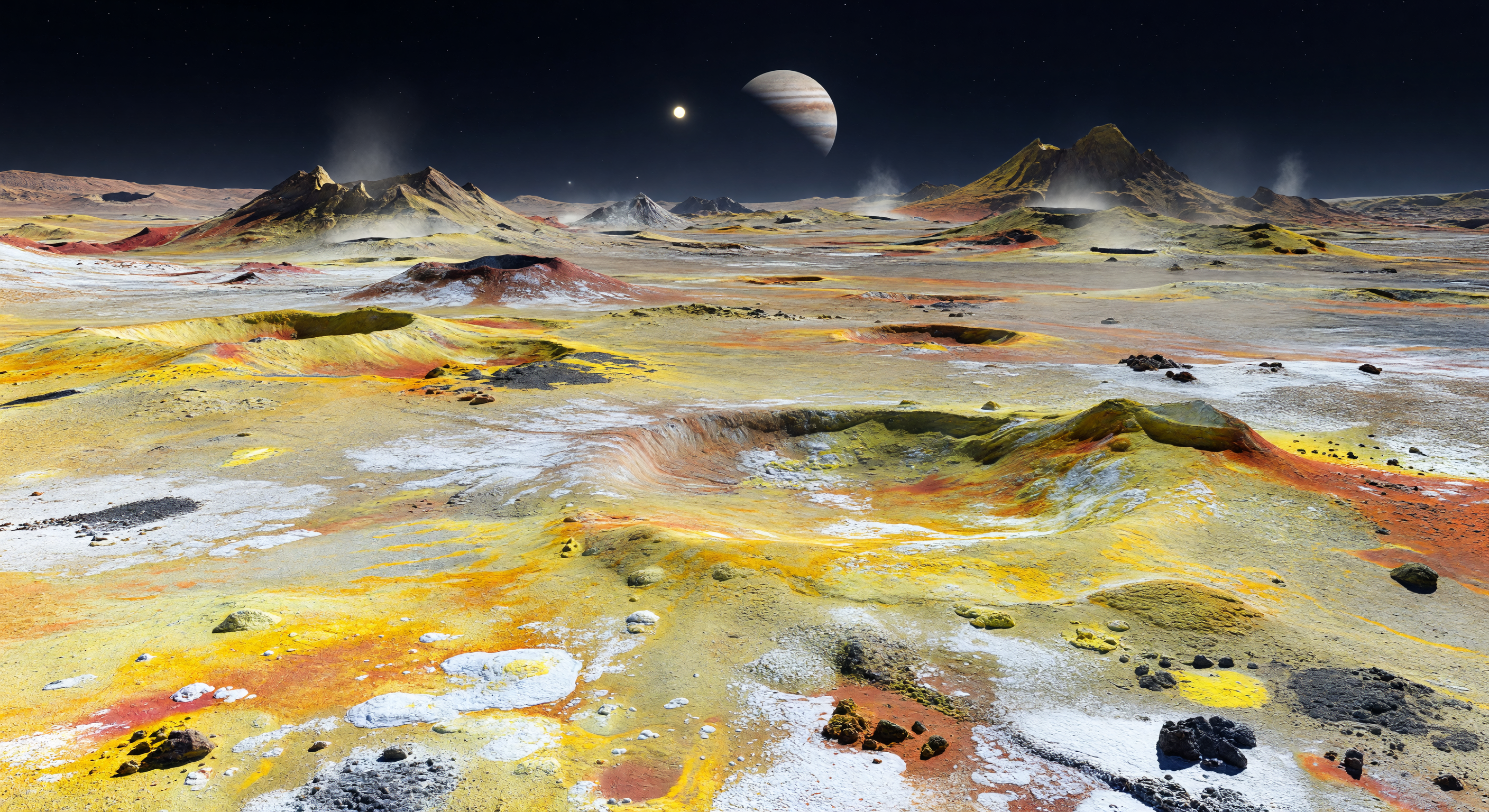
발아래 펼쳐진 평원은 사프란빛 황, 눈처럼 밝은 이산화황 서리, 녹슨 붉은 분출 퇴적물, 숯처럼 검은 용암 잔해가 뒤섞인 거대한 색의 모자이크로, 바삭하게 갈라진 황 껍질과 재소결 입자, 클링커 같은 현무질 파편이 끊임없는 재포장 역사를 드러낸다. 이곳의 지표는 물이나 두꺼운 얼음이 아니라 규산염 암석과 황 화합물이 지배하며, 목성의 강한 조석 가열이 내부를 뒤틀어 올린 열이 반복적인 분출과 용암류, 얕은 파테라형 함몰지를 만들어 충돌구를 빠르게 지워 버린다. 낮인데도 하늘은 거의 검게 보이고, 극도로 희박한 이산화황 대기 탓에 먼 메사와 고립 산괴의 윤곽은 비현실적일 만큼 또렷하며, 작은 태양이 던지는 날카로운 그림자 위로 거대한 줄무늬 가스행성이 하늘 한쪽을 압도한다. 산산이 흩어진 앞쪽의 자갈 조각과 끝없이 이어지는 평원, 그리고 저 멀리 낮은 중력 속에 가파르게 솟은 산들을 함께 바라보고 있으면, 행성이라기보다 아직도 식지 않은 거대한 화산 실험실 한가운데 서 있는 듯한 감각이 밀려온다.
과학 심사 위원회
각 이미지는 AI 위원회에 의해 과학적 정확성이 심사됩니다.
GPT
이미지: Adjust
설명: Adjust
Overall the image strongly conveys an active, sulfur-rich volcanic terrain with striking multicolored deposits, which is consistent with Io’s general appearance (yellow/saffron sulfur, bright white frost/sulfur dioxide deposits, and darker volcanic materials). However, several scientific/visual specifics do not fully match the provided description. (1) Scale/lighting/sky: Io’s sky would be near-black in visible light, and the Sun would appear smaller and harsher, producing very crisp shadows. The scene does have a dark sky and crisp-looking contrast, but the lighting seems closer to Earthlike “daylight” illumination (ground brightness, haze-free but not clearly Io-like illumination geometry), and Jupiter is shown as a large, strongly illuminated disk overhead; Io’s Jupiter is usually smaller and can be seen clearly depending on viewpoint, but the portrayed size/placement and the presence of a visible solar point-like source are not firmly consistent with the stated “over it all hangs Jupiter” ground-level perspective. (2) Atmosphere: Io is effectively airless; the image appears airless (no atmospheric scattering), which supports the description. (3) Geologic details: the foreground contains patchy, map-like color mottling and some pale crustal plates consistent with resurfacing, but the described brittle “mosaic” specifically of sulfur plates, sintered ash/clinker basalt, and shallow patera-like depressions is only partially evidenced—there are basins/low relief features, but flow fronts and repeatedly broken/remade crust are not distinctly identifiable as such. (4) Visual quality/photorealism: the rendering is high quality and visually coherent, but it is clearly a stylized/artist-driven composite—color saturation is very extreme and the distribution reads more like painted strata than physically grounded ejecta + frost patterns; additionally, the Jupiter/Sun configuration and cloud/steam-looking plumes appear more like Earth-style atmospheric effects than Io’s vacuum environment and volcanic plume morphology. Caption accuracy: the caption broadly matches the “multicolored resurfaced plain” concept, but it over-specifies features (explicitly describing a brittle silicate/ash/clinker sulfur plate mosaic, subdued flow fronts, and near-vacuum lighting details including the small harsher Sun while Jupiter dominates the sky). The image supports the multicolored resurfacing and lack of atmosphere, but the specific lighting geometry and the clarity of the named resurfacing mechanisms are not clearly shown. Therefore, adjust rather than regenerate: keep the overall Io-like multicolored volcanic plain, but refine (a) the Jupiter/Sun placement and apparent scale consistent with a plausible Io viewpoint, and (b) the ground texture cues toward sulfur plate mosaic + patera-like depressions with clearer flow/front structures and less “painted” color distribution.
Claude
이미지: Adjust
설명: Approve
I largely concur with GPT's assessment but want to refine several points and add new observations. SCIENTIFIC ACCURACY: The color palette is the image's greatest strength — the coexistence of saffron/yellow sulfur, bright white SO2 frost patches, red-orange plume fallout deposits, greenish sulfur allotrope staining, and dark basaltic clinker is genuinely consistent with Voyager and Galileo/Juno imagery of Io's surface. The near-black sky is correct for Io's near-vacuum environment. However, I flag three specific scientific concerns: (1) The volcanic plumes/steam venting from mid-ground features display visually diffuse, billowing behavior more reminiscent of Earth geothermal fumaroles with atmospheric scattering — on Io, plume columns in near-vacuum rise nearly straight up with extremely narrow, ballistic geometry before collapsing into umbrella-shaped fallout patterns. These depicted wisps are physically inconsistent with vacuum dynamics. (2) Jupiter's apparent angular diameter looks broadly plausible for Io's orbital distance (~5.2 AU, Jupiter subtending ~11.5°), but the rendering shows Jupiter's banding and coloration at suspiciously high contrast for a body that, while large in Io's sky, would appear somewhat washed out relative to the harsh solar illumination of the foreground. (3) The Sun appears as a distinct bright dot at correct reduced angular size relative to Earth, which is actually one of the image's scientific wins — GPT slightly undersold this. The solar illumination geometry producing sharp, hard shadows is also correctly rendered. VISUAL QUALITY: The image is highly photorealistic at a technical level, with strong depth of field and texture work on the foreground regolith. I do share GPT's concern that the color distribution reads as overly uniform and 'painted' in places — genuine Io surface coloration tends to be more sharply bounded in deposit patterns (distinct fallout rings, lava flow margins) rather than the somewhat diffuse blending visible here, particularly in the mid-ground. The mountains in the background are geologically plausible for Io's compressional mountain-building, though they appear somewhat too smoothly rendered without the frost mantling one would expect on poleward-facing slopes. CAPTION ACCURACY: I rate this 'approve' rather than GPT's 'adjust.' The caption is detailed and scientifically literate — it correctly invokes tidal heating, patera-like depressions, sulfur-dioxide frost, plume fallout, basaltic clinker, and the knife-edge shadow quality of near-vacuum illumination. The image substantiates the vast majority of these claims visually, even if imperfectly. The caption's mention of 'brittle mosaic' and 'crusted sulfur plates' is evident in the foreground texture. The description of Jupiter 'hanging' overhead and the 'smaller, harsher' Sun are both visible in the image. The caption does not overclaim — it accurately describes the intended scene. RECOMMENDATION: Regeneration is not warranted. Key adjustments: correct the plume morphology to narrow ballistic columns consistent with vacuum dynamics, introduce sharper deposit boundary transitions in the mid-ground color patterns to better reflect fallout ring structure, and consider adding frost mantling asymmetry on mountain slopes. The fundamental compositional and color accuracy is strong enough to preserve.
Grok
이미지: Adjust
설명: Approve
I concur with both GPT and Claude on the image's core strengths—excellent color palette (saffron sulfur, white SO2 frost, red plume fallout, greenish stains, black basaltic residue) matching Io's Voyager/Galileo/Juno observations, near-black sky, small harsh Sun with crisp knife-edge shadows, and immense scale via background mesas/mountains—all hallmarks of Io's tidal-resurfaced geology. Jupiter's banded disk is appropriately enormous (~11-12° angular diameter from Io), enhancing the 'hanging overhead' drama. However, adjustments are needed for scientific accuracy and photorealism: (1) Volcanic plumes show diffuse, billowing expansion unrealistic for Io's tenuous sodium/sulfur plasma torus and near-vacuum (should be narrow, straight ~100-300km columns with ballistic umbrella fallout, not steamy wisps per Galileo data). (2) Color distribution is mottled but too diffusely blended mid-ground; real Io deposits form sharper rings/ellipses (e.g., Ra Patera fallout) rather than painted gradients—foreground mosaic of sulfur plates/sintered ash/clinker is better but lacks distinct subdued flow fronts/patera depressions. (3) Background mountains are crisp (good, no atmosphere), but lack asymmetric SO2 frost mantling on shaded/poleward slopes observed in IR/visible imagery. Lighting is near-perfect (harsh, airless), but minor Earthlike glow on horizon edges persists. Visual quality is photorealistic overall (strong textures, depth), no major artifacts, but plume/color stylization tips into semi-artistic. Disagree with GPT's caption 'adjust'—description precisely matches visible elements (multicolored brittle mosaic, low volcanic terrain, black sky/small Sun/Jupiter dominance, vacuum sharpness), without overclaiming absent features; Claude is correct here. New insight: extra small moonlet (Europa?) in sky is plausible (Io sees Galilean siblings), but unlabeled—fine for scene. Approve caption fully. Recommendation: adjust plumes to ballistic morphology, sharpen mid-ground deposit boundaries into fallout rings/patera rims, add frost asymmetry to mountains—retain composition/lighting/scale.
Gemini
이미지: Adjust
설명: Approve
I concur with the previous reviewers regarding the strength of the color palette and the successful capture of Io's harsh, airless lighting environment. The depiction of the sun and the presence of Jupiter are handled with good scale awareness. My primary concern, which aligns with the committee's consensus, is the 'billowing' nature of the volcanic plumes; these require a more ballistic, narrow-column geometry consistent with vacuum physics rather than the Earth-like atmospheric diffusion currently shown. Additionally, while the foreground texture is impressive, the mid-ground color transitions lack the sharp, geometric boundaries characteristic of ballistic fallout rings and distinct lava flow margins observed in Juno/Galileo imagery. The caption is technically excellent and does not require adjustment, as it sets a high standard for scientific description that the image largely fulfills. I recommend an update to the plume dynamics and the sharpening of deposit boundaries to achieve true geological authenticity.
Matania — 종합 평가
이미지: Adjust
설명: Approve
The committee agrees that the scene is strongly Io-like in its overall impression: a near-black sky, harsh airless lighting, vivid sulfuric coloration, bright SO2 frost patches, darker volcanic materials, and a resurfaced plain all convincingly evoke Io’s tidal-volcanic landscape. Jupiter’s presence is broadly plausible and helps establish the location, and the image quality is high. The main scientific weakness is the volcanic plume behavior, which reads too diffuse and Earthlike; on Io, plumes should be narrower, more ballistic, and should produce clearer umbrella-shaped fallout patterns. The mid-ground color fields also feel somewhat painted and blended, whereas Io’s deposits usually show sharper boundaries, distinct flow margins, fallout rings, and patera-associated depressions. Overall, the composition is close enough to retain, but it needs refinement rather than a full regeneration.