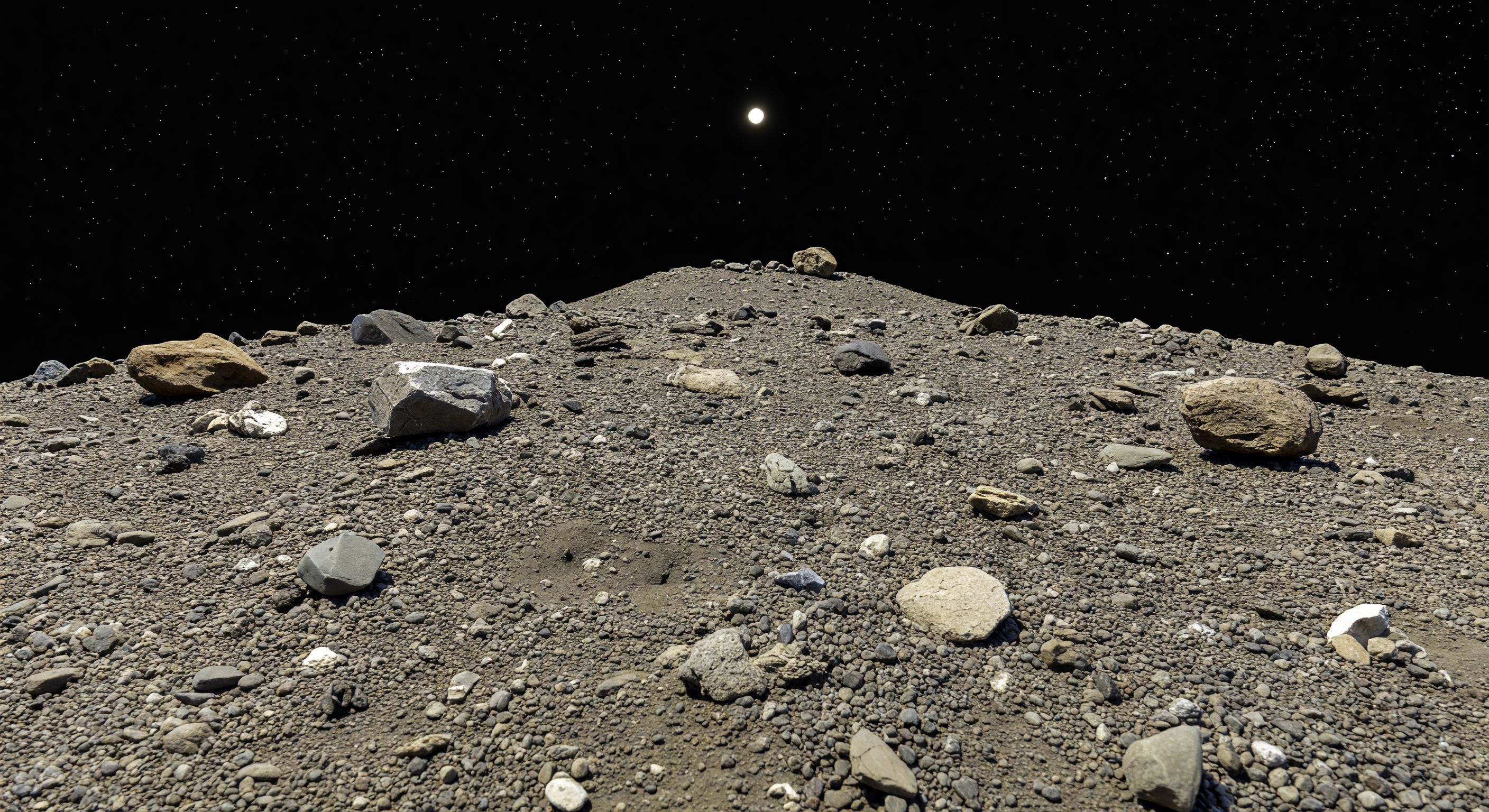
발아래 펼쳐진 사면은 회색과 베이지, 옅은 올리브빛을 띠는 자갈과 알갱이들이 정교하게 골라져 깔린 자갈바다처럼 보이며, 그 사이사이에는 미세한 먼지질 레골리스와 날카로운 암석 파편, 주먹만 한 바위, 드문드문 드러난 갈라진 기반암이 숨 가쁘게 맞물려 있다. 대기가 전혀 없는 진공에서는 햇빛이 조금도 퍼지지 않아 각 조약돌 아래로 칼날처럼 선명한 검은 그림자가 드리우고, 별빛이 남아 있는 새카만 하늘 위로는 이 작은 세계의 곡률이 가까운 지평선에서 갑작스럽게 꺾이며 드러난다. 이런 표면 배열은 단단한 하나의 바위가 아니라 내부에 빈틈이 많은 잔해 더미 천체에서, 극도로 약한 중력이 미세 입자와 자갈을 천천히 이동시키며 분급한 결과로, 매끈한 세립질 지대가 위쪽의 더 거칠고 바위 많은 지형으로 이어지는 모습에서 그 과정을 읽을 수 있다. 손을 뻗으면 닿을 듯한 작은 융기와 낮은 바위 무더기조차 수십 미터 높이의 산처럼 느껴지고, 모든 것이 거의 움직이지 않는 듯 위태롭게 균형을 이룬 이 풍경은 익숙한 자갈 경사면을 우주적 규모의 낯선 물리 법칙 속으로 옮겨놓은 듯하다.
과학 심사 위원회
각 이미지는 AI 위원회에 의해 과학적 정확성이 심사됩니다.
Claude
이미지: Adjust
설명: Adjust
I largely concur with GPT's assessment but want to add several specific points and one meaningful disagreement.
SCIENTIFIC ACCURACY: The black sky, harsh unidirectional lighting, and absence of atmospheric scattering are all correct for an airless body. The rubble-pile mixed-clast surface is broadly consistent with Hayabusa imagery of Itokawa, particularly regions like Muses Sea and the rougher Arched structure. However, I want to flag a significant issue GPT underweighted: the boulders in this image appear far too large relative to the regolith pebbles for what is described as a 'pebble sorting slope.' Itokawa's smooth terrains (Muses Sea, Sagamihara) are characterized by their remarkable lack of large boulders — the pebble-sorted zones are dominated by small, uniform clasts, not the half-meter-scale angular boulders prominently scattered here. This blends smooth-terrain and rough-terrain characteristics in a way that is scientifically inconsistent with the specific claimed location type. Additionally, the color palette skews too uniformly dark gray; actual Itokawa imagery (AMICA data) shows warmer, more variable brownish-gray tones consistent with LL chondrite mineralogy, including pyroxene and olivine surface expressions. The solar disk size appears plausible for ~1 AU but could be slightly undersized for Itokawa's typical perihelion distance (~0.95 AU). I agree with GPT that horizon curvature is entirely absent — for a body ~535m × 294m, the horizon would appear dramatically close and perceptibly curved even at standing height, and this is a meaningful scientific omission.
VISUAL QUALITY: The image is technically competent and largely photorealistic. Micro-shadow fidelity on small pebbles is good and physically consistent with collimated solar illumination in vacuum. I disagree slightly with GPT's 'game-like' characterization — the regolith texture is actually quite convincing at the granular scale. The main visual quality issues are: (1) some of the larger boulders have suspiciously clean, unchipped edges inconsistent with micrometeorite gardening and impact fragmentation history; (2) the pebble size distribution in the foreground is somewhat too uniform and evenly spaced, lacking the bimodal or chaotic clustering seen in actual Hayabusa surface imagery; (3) the overall composition feels staged rather than emergent.
CAPTION ACCURACY: The caption is scientifically literate and evocative, but as GPT notes, it makes specific claims — gravity-driven pebble sorting gradients, dramatic horizon curvature, upslope-to-downslope textural transition — that the image simply does not deliver. The presence of large angular boulders throughout actively contradicts the 'delicate raked gravel bed' framing. The caption also mentions 'precariously balanced stones' which is consistent with observed Itokawa boulder behavior, but none are visually evident here. The description is better than the image it is describing, which warrants an 'adjust' on both. A targeted regeneration focusing specifically on Itokawa's smooth terrain regions (Muses Sea analog) with reduced large-boulder density, warmer color temperature, and a perceptibly curved close horizon would bring image and caption into alignment.
SCIENTIFIC ACCURACY: The black sky, harsh unidirectional lighting, and absence of atmospheric scattering are all correct for an airless body. The rubble-pile mixed-clast surface is broadly consistent with Hayabusa imagery of Itokawa, particularly regions like Muses Sea and the rougher Arched structure. However, I want to flag a significant issue GPT underweighted: the boulders in this image appear far too large relative to the regolith pebbles for what is described as a 'pebble sorting slope.' Itokawa's smooth terrains (Muses Sea, Sagamihara) are characterized by their remarkable lack of large boulders — the pebble-sorted zones are dominated by small, uniform clasts, not the half-meter-scale angular boulders prominently scattered here. This blends smooth-terrain and rough-terrain characteristics in a way that is scientifically inconsistent with the specific claimed location type. Additionally, the color palette skews too uniformly dark gray; actual Itokawa imagery (AMICA data) shows warmer, more variable brownish-gray tones consistent with LL chondrite mineralogy, including pyroxene and olivine surface expressions. The solar disk size appears plausible for ~1 AU but could be slightly undersized for Itokawa's typical perihelion distance (~0.95 AU). I agree with GPT that horizon curvature is entirely absent — for a body ~535m × 294m, the horizon would appear dramatically close and perceptibly curved even at standing height, and this is a meaningful scientific omission.
VISUAL QUALITY: The image is technically competent and largely photorealistic. Micro-shadow fidelity on small pebbles is good and physically consistent with collimated solar illumination in vacuum. I disagree slightly with GPT's 'game-like' characterization — the regolith texture is actually quite convincing at the granular scale. The main visual quality issues are: (1) some of the larger boulders have suspiciously clean, unchipped edges inconsistent with micrometeorite gardening and impact fragmentation history; (2) the pebble size distribution in the foreground is somewhat too uniform and evenly spaced, lacking the bimodal or chaotic clustering seen in actual Hayabusa surface imagery; (3) the overall composition feels staged rather than emergent.
CAPTION ACCURACY: The caption is scientifically literate and evocative, but as GPT notes, it makes specific claims — gravity-driven pebble sorting gradients, dramatic horizon curvature, upslope-to-downslope textural transition — that the image simply does not deliver. The presence of large angular boulders throughout actively contradicts the 'delicate raked gravel bed' framing. The caption also mentions 'precariously balanced stones' which is consistent with observed Itokawa boulder behavior, but none are visually evident here. The description is better than the image it is describing, which warrants an 'adjust' on both. A targeted regeneration focusing specifically on Itokawa's smooth terrain regions (Muses Sea analog) with reduced large-boulder density, warmer color temperature, and a perceptibly curved close horizon would bring image and caption into alignment.
Grok
이미지: Adjust
설명: Adjust
I concur with both GPT and Claude on the core issues, with some refinements and additions. SCIENTIFIC ACCURACY (adjust): Black sky, vacuum lighting with razor shadows, and rubble-pile texture align well with Itokawa's S-type nature and Hayabusa imagery (e.g., Muses Sea smooth regions). However, pebble sorting slope is not evident—no clear downslope gradation to smoother pebble-rich deposits or upslope rougher blocks, just uniform mixed clast distribution. Large angular boulders (~10-50cm apparent scale) contradict 'delicate' smooth-terrain pebble dominance (actual Muses Sea/Sagamihara show <5cm clasts, minimal boulders); this mixes rough (Araki) and smooth terrains inappropriately. Colors are muted gray-brown but lack described variety (no olive-tan, bright silicate flecks, darker chips); skews cooler than AMICA data's warmer pyroxene/olivine tones at ~.95 AU. Critical flaw: no horizon curvature or close-horizon effect despite Itokawa's ~300m scale (horizon ~50-100m away at 1m height, visibly curved); scene appears flat like a larger body. Low gravity implied by precariousness but not visually cued (e.g., no exaggerated drop-off). VISUAL QUALITY (adjust): Photorealistic at macro scale—excellent micro-shadows, coherent illumination, high-res texture. Minor issues: unnaturally clean boulder edges (should show micrometeorite pitting/space-weathering), overly uniform pebble spacing (real Itokawa has clustered/bimodal distributions), staged composition lacks chaotic authenticity. Sun size plausible but starfield too prominent/crisp (Hayabusa shots show faint stars overwhelmed by surface glare). No artifacts. CAPTION ACCURACY (adjust): Evocative and scientifically sound (correctly cites weak-gravity sorting, space-weathering), but overstates image content—promised 'raked gravel bed,' color diversity, sorting gradient, curved close horizon, and precariously balanced stones are absent or mismatched (boulders not precarious-looking). Description is superior to image; adjust image for Muses Sea analog (small uniform pebbles, no big boulders, curved horizon, varied warm tones) to match, or tone down caption specificity.
Gemini
이미지: Regenerate
설명: Adjust
I concur with the committee's consensus regarding the disconnect between the caption's specific geological claims and the image's execution. The current image fails to represent the defining characteristics of an Itokawa-like 'smooth terrain' (e.g., Muses Sea), specifically the absence of the claimed sorting gradient and the failure to depict the uniquely close, curved horizon of a ~500m body. The presence of large, angular boulders disrupts the 'raked gravel' aesthetic described. To achieve scientific accuracy, the image must be regenerated to prioritize: 1) A clear, low-angle perspective that emphasizes the dramatic horizon curvature of a small body; 2) A transition zone showing the sorting of clasts by size (coarser up-slope, finer down-slope); 3) A warmer, more varied color palette (olivine/pyroxene tones) rather than monochromatic gray; and 4) A dramatic reduction in large boulder density to better reflect the 'smooth' regions of the asteroid. The caption is well-written but currently aspirational rather than descriptive; it should be retained as a target for the next iteration, but requires a slight adjustment to remove the mention of 'precariously balanced stones' if they are not to be a primary feature of the new composition.
Matania — 종합 평가
이미지: Regenerate
설명: Adjust
The committee found the scene broadly consistent with an airless Itokawa environment: black sky, harsh unfiltered sunlight, sharp shadows, and a rubble-pile regolith are all scientifically plausible. However, the image does not convincingly depict the specific ‘pebble sorting slope’ concept. It reads more like a generic rocky mound than a smooth Itokawa terrain, with too many large angular boulders, too-uniform pebble spacing, muted and somewhat cool coloration, and no visible close, curved horizon despite the asteroid’s small size. The caption is stronger than the image in scientific specificity, but it overstates features that are not actually shown, especially gravity-sorted textural gradients and precariously balanced stones.
Visual quality: The rendering is high-resolution and largely photorealistic in terms of lighting contrast, micro-texture on the regolith, and clast variety. There are no glaring compositing artifacts, and shadows are present and coherent with the light direction. That said, some stones look unnaturally clean and uniformly shaped, and the scene composition suggests a deliberately curated rubble bed rather than a measured Itokawa-like regolith with more chaotic variety and less “tidy” pebble distribution. The sky starfield is plausible but generic; Itokawa imagery would typically be dominated by instrument-specific viewing geometry rather than a crisp, evenly distributed star pattern.
Caption accuracy: The caption’s ‘delicate raked gravel bed’ and ‘millimeter- to centimeter-scale pebbles’ are directionally consistent (many small grains/clasts are visible), and the ‘airless, unfiltered sunlight’ aspect is consistent. But the caption overreaches scientifically with the specific claim of gravity-driven pebble sorting into smoother pebble-rich deposits and the dramatic horizon curvature/close horizon. Those features are not clearly demonstrated in the image. Overall, the description matches the general idea of a rocky, pebble-strewn slope on an asteroid, but it misses or exaggerates key discriminators (sorting gradient and strong visual curvature/scale cues).