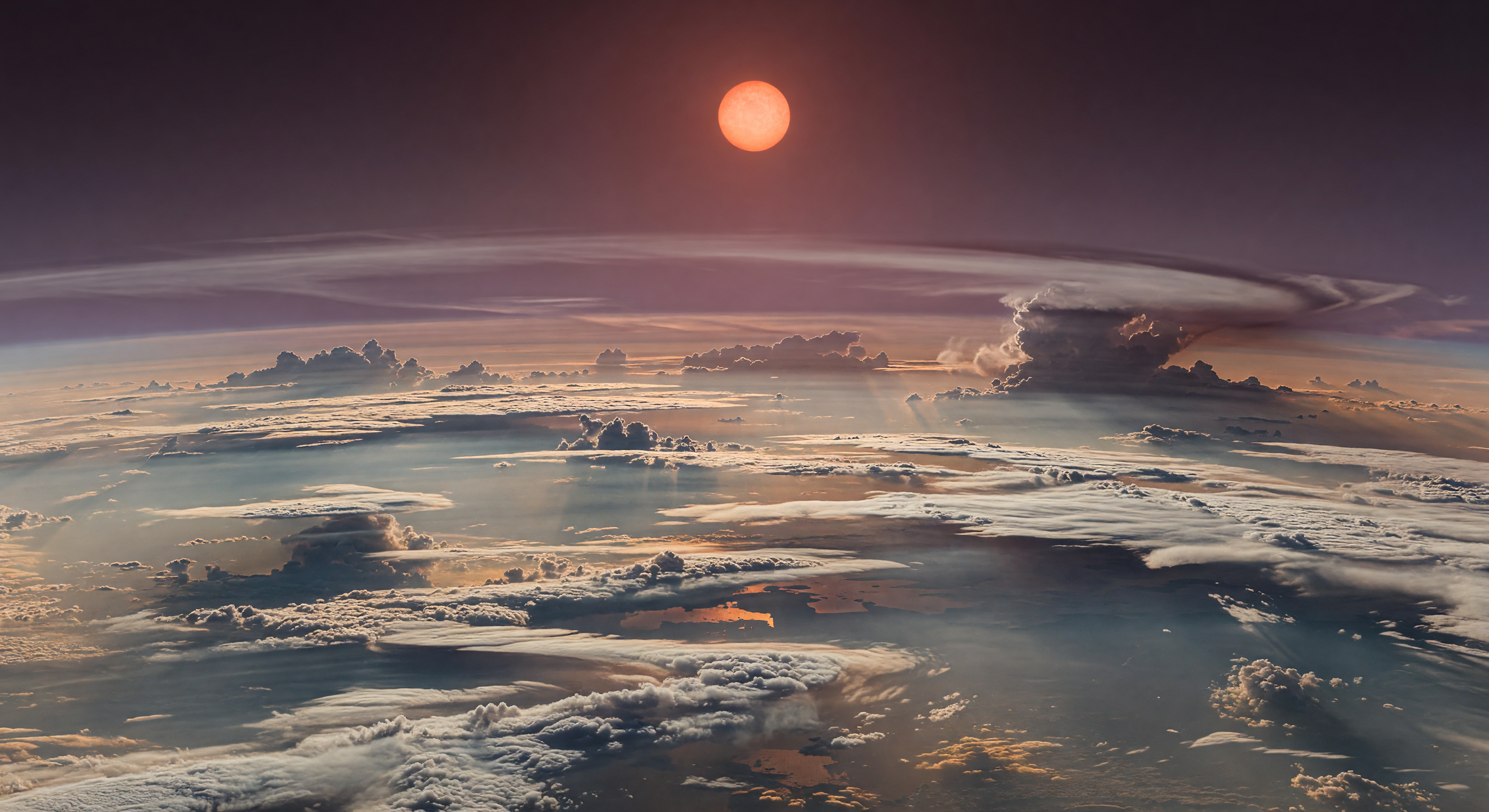
부력으로 떠받쳐지는 상층 대기에서 내려다보면, 발아래에는 대륙도 바다도 없이 크림색과 은회색, 옅은 구리빛과 흐린 청록이 뒤섞인 구름 평원이 행성의 강한 곡률을 따라 끝없이 펼쳐지고, 멀리서는 모루 모양의 구름 선반과 꽃양배추처럼 솟은 폭풍 돔이 붉은 안개 속으로 서서히 녹아듭니다. 이 장면은 암석 표면이 아니라 수소가 풍부한 두꺼운 대기와 메탄·이산화탄소가 섞인 화학적으로 복잡한 구름층이 만들어낸 거대한 ‘공중의 바다’로, 어두운 골짜기 같은 틈 아래로는 더 깊고 압력 높은 호박갈색 대기층이 희미하게 드러납니다. 머리 위의 하늘은 검지 않은 와인빛 자주색으로 물들어 있고, 크게 떠 있는 주황빛 적색 원반이 된 항성은 청색 성분이 적은 희미한 구리색 빛을 확산시켜 구름 융기의 가장자리에 부드러운 광택과 흐린 그림자를 얹습니다. 별빛 하나 보이지 않는 이 낮의 하늘 아래 서 있노라면, 익숙한 지면이 사라진 대신 수천 킬로미터 규모의 대기 역학과 광화학 연무가 빚어낸, 장엄하고 낯선 기상 세계 한가운데에 떠 있는 듯한 감각이 밀려옵니다.
과학 심사 위원회
각 이미지는 AI 위원회에 의해 과학적 정확성이 심사됩니다.
Claude
이미지: Adjust
설명: Adjust
I largely concur with GPT's assessment but want to add several specific observations and one substantive disagreement. On scientific accuracy: K2-18 b is a sub-Neptune (radius ~2.6 R⊕, mass ~8.6 M⊕) with a hydrogen-dominated atmosphere where transmission spectroscopy (JWST 2023) has tentatively detected CO₂, CH₄, and possibly DMS, with models suggesting a deep liquid water ocean beneath a thick H₂/He envelope. The image's core concept — a perpetual cloud deck with no visible surface, enormous atmospheric depth, and a swollen host star — is scientifically defensible and arguably the most honest visualization possible given our uncertainty. The curved horizon is a nice touch, correctly implying a planetary-scale perspective rather than a terrestrial one. My disagreement with GPT concerns the star rendering: K2-18 is a K2.5V dwarf (T_eff ~3,457 K), which genuinely does appear distinctly orange-red compared to our Sun, and the image captures this reasonably well. However, the star appears somewhat too large angularly — K2-18 b orbits at ~0.14 AU, which would make the star subtend roughly 2–3× the solar disk as seen from Earth, not the dramatically swollen disk shown here. That said, this is a minor compositional exaggeration common in exoplanet art. The more significant scientific shortcoming, which GPT correctly flags, is the absence of the hydrogen/methane photochemical haze signature. A methane-rich H₂ atmosphere would scatter light differently than Earth's N₂/O₂ atmosphere, likely producing a distinctly yellowish or orange tint to the scattered skylight rather than the relatively Earth-normal blue-gray cloud tops visible here. The cloud tops read as terrestrial water-ice/liquid water clouds rather than clouds potentially composed of NH₃, H₂S, or other volatiles expected at these pressure levels. The deeper amber-brown gaps are a genuinely good touch, hinting at chromophores or deeper photochemical layers. On visual quality: the rendering is excellent — cloud textures, volumetric depth, lighting gradients, and the planetary curvature are all convincing. The crepuscular rays through cloud gaps are a particularly strong detail. No obvious AI artifacts are visible. My one quality concern is that the overall color grading feels insufficiently alien; the palette is too close to an Earth sunset photograph, which may actually be a deliberate artistic choice but undermines the caption's claims of copper/teal/wine-violet tones. On caption accuracy: the caption's color vocabulary (wine-violet, muted teal, pale copper) is aspirational rather than descriptive of what's rendered — the actual image skews warmer orange-brown and conventional gray-white. The 'storm domes' mentioned are only weakly present in the upper right. I recommend adjusting the rendering to push the sky toward violet-purple hydrogen Rayleigh scattering tones and introduce more obvious photochemical haze coloration in the upper atmosphere, while revising the caption's color claims to match what's actually rendered rather than what's theoretically ideal.
Grok
이미지: Adjust
설명: Adjust
I concur with both GPT and Claude on the core assessments, with some refinements and additions. Scientific accuracy: The image effectively captures the sub-Neptune essence of K2-18 b—a vast, curved-horizon cloud deck with no surface visibility, deep atmospheric layers via amber-brown troughs, and an orange-red K2.5V star (T_eff ~3457K, correctly rendered as swollen due to close .14 AU orbit, though Claude notes plausible 2-3x angular exaggeration). Strong scale cues from planetary curvature align with ~2.6 R⊕ radius. However, adjustments needed for alien chemistry: JWST data (2023) suggests H₂/He envelope with CH₄, CO₂, possible DMS, and photochemistry; expected haze from methane should yield hazy orange-yellow scattered light and less Earth-like blue-gray skies/clouds (image shows water-cloud-like textures, missing NH₃/H₂S chromophores or true Rayleigh scattering in H₂). Clouds are stratiform/cumuliform but lack caption's scalloped shelves/storm domes. Visual quality: Photorealistic excellence in cloud volumetrics, crepuscular rays, lighting gradients, and haze depth; no AI artifacts. Minor issues: palette too Earth-sunsetty (warm oranges/browns/grays/teals), star slightly over-swollen, cloud forms more terrestrial cells than convection-driven 'ocean' bands. Caption accuracy: Mismatch on colors (image: orange-brown/gray-white/teal skies; caption: copper/teal clouds, wine-violet sky, coppery glow from methane smog—violet haze absent); storm domes/troughs weakly represented (some swirls upper right, gaps present but not amber-dominant). Constructive: Adjust image for methane-haze violet-purple skylight, copper/teal cloud tints, distinct storm morphologies; tone caption to match rendered palette or regenerate for full spec. Overall strong conceptual base, minor tweaks for precision.
Gemini
이미지: Adjust
설명: Adjust
I concur with the committee's consensus that while the visualization is aesthetically impressive and captures the scale of a sub-Neptune world, it relies on Earth-analog cloud morphologies and color palettes that fail to manifest the specific photochemical claims of the caption. The 'wine-violet' sky and 'muted teal' clouds are largely absent, replaced by standard sunset-gold and gray tones. Scientifically, the cloud structures lack the distinct convective 'scalloping' expected in a hydrogen-rich atmosphere under high-pressure dynamics, appearing instead like terrestrial stratocumulus. To align with the Exocosmia standard, the image requires a color-grading shift toward the cooler violet/teal spectrum mentioned in the text to account for the methane-rich haze, and the caption should be edited to describe the existing visual reality (the warm, amber-dominant light) if the artist chooses not to adjust the rendering. The angular size of the parent star is acceptable given the proximity, but the overall chromatic identity needs to move away from 'terrestrial sunset' toward 'alien atmospheric chemistry'.
Matania — 종합 평가
이미지: Adjust
설명: Adjust
The committee agrees that the scene is a strong conceptual portrayal of K2-18 b as a cloud-swathed sub-Neptune, with convincing planetary curvature, atmospheric depth, and an overall high level of visual polish. The image successfully suggests a vast cloud ocean with no visible surface and includes a plausible orange-red host star. However, the rendering remains too Earth-like in both cloud morphology and color treatment: the cloud tops read as terrestrial stratocumulus rather than alien high-pressure cloud structures, and the palette leans toward warm sunset golds, grays, and browns instead of the copper/teal/violet haze implied by the caption. The caption similarly overcommits to specific chemistry-driven colors and cloud features that are only weakly or not visibly supported by the image. Because the core concept is sound but the chromatic and atmospheric specifics do not align tightly with the render, the committee recommends adjustment rather than approval or full regeneration.
Visual quality: The image is high quality and mostly photorealistic in lighting and cloud texture, with good scale cues and a smooth atmospheric horizon. I do not see major rendering artifacts; the clouds and illumination gradients appear consistent. Minor issues: the sun/illumination and overall color grading remain somewhat cinematic and not clearly tied to a hydrogen/methane optical appearance; some “cloud bands” read more like stylized weather cells than clearly scalloped convection shelves as claimed.
Caption accuracy: The caption generally matches the “cloud ocean” framing (cloud deck over a curved horizon, distant darker structures, no land), but it over-specifies features and spectral colors (wine-violet sky, hydrogen haze, coppery glow, muted teal, storm domes, and troughs revealing deeper amber-brown layers). Those elements are only weakly present in the rendered image (colors lean warmer and more gray/cream; storm morphology is not clearly represented). Adjust the description to better reflect the visible palette/structures or revise the rendering to include the more copper/teal and violet-haze cues.