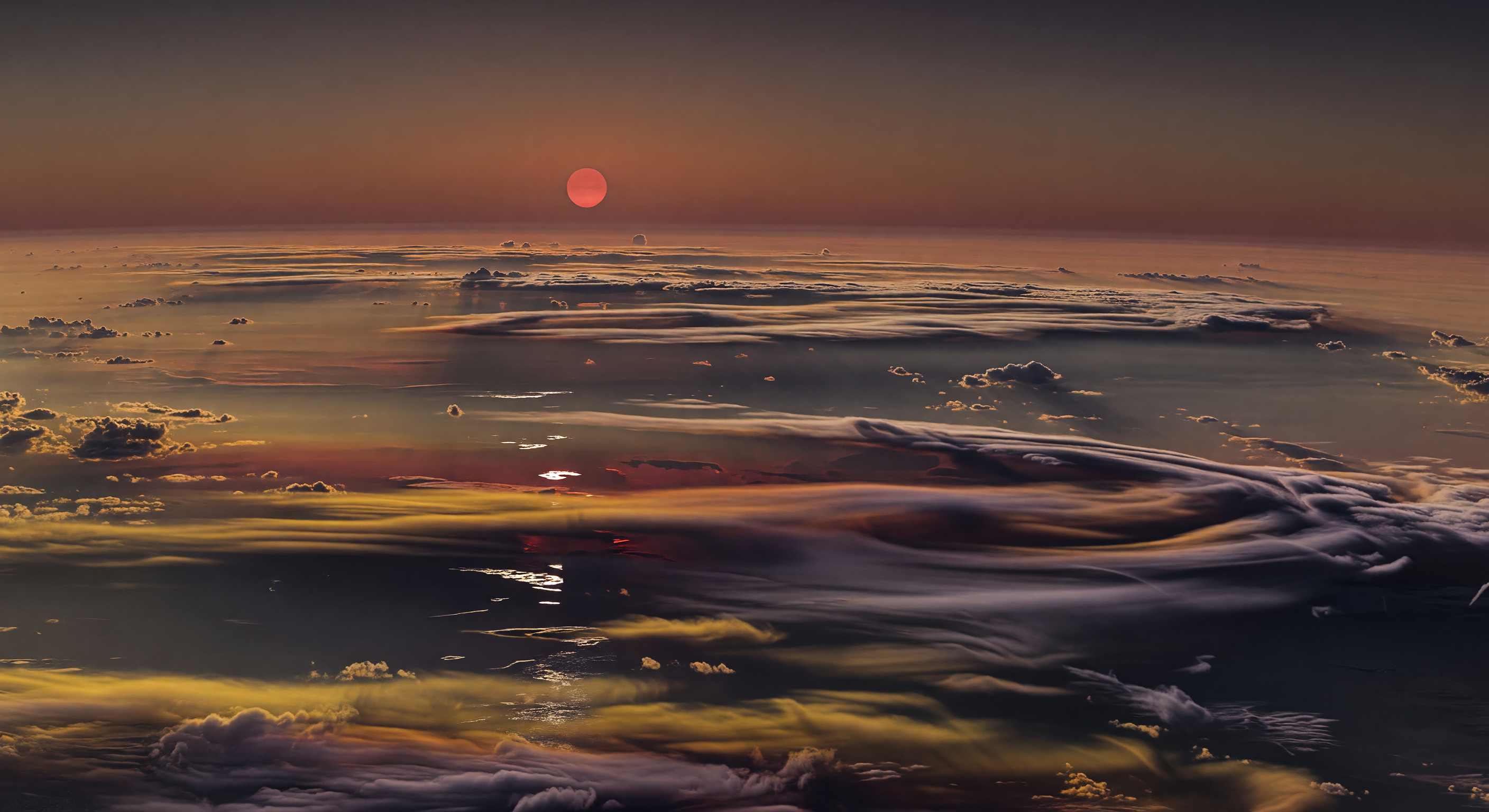
황혼과 밤의 경계에 떠 있는 듯한 시야 앞에는, 황금빛 호박 안개와 녹슨 적갈색 탄화수소 헤이즈, 보랏빛 회색 응결층, 먹빛 구름대가 번갈아 수평의 거대한 띠를 이루며 지평선 끝까지 펼쳐진다. 이 띠들은 수 킬로미터 이상 규모의 대기 중력파와 층운 선반으로, 수소가 풍부한 두꺼운 대기 속에서 메탄·이산화탄소·복합 에어로졸이 빛을 산란시키며 만들어낸 정교한 기상 구조이며, 아래로는 압력 안개 너머 감춰진 깊은 액체층을 암시하는 희미한 은빛 반사가 어둑한 심연 사이로 스친다. 지평선에 거의 붙어 멈춘 듯 보이는 붉은왜성의 주황빛 원반은 지구 하늘의 태양보다 훨씬 크게 떠 있으나 빛은 탁하고 부드러워, 구름 선반마다 끝없이 길고 흐린 그림자를 드리우고 파도의 마루 같은 렌즈형 구름 가장자리에 붉은 테두리를 입힌다. 푸른 기색이 거의 사라진 하늘은 별빛 가까이에서는 연기 낀 구리색과 탁한 주황으로, 밤 쪽으로 갈수록 자두빛 회색과 거의 검은 헤이즈로 스며들며, 발아래 땅 한 점 없이 오직 습하고 무거운 대기만이 끝없는 깊이와 규모로 몸을 감싸는, 낯설고 장엄한 세계의 경계를 실감하게 한다.
과학 심사 위원회
각 이미지는 AI 위원회에 의해 과학적 정확성이 심사됩니다.
GPT
이미지: Adjust
설명: Adjust
Scientific accuracy: The image depicts a horizon-level “terminator” scene with a low, red/orange star and thick atmospheric layers forming wave-like cloud/haze shelves. That matches the general, speculative premise of atmospheric gravity waves and stratified cloud decks rather than solid surface terrain. However, for K2-18 b specifically, the visualization is not strongly constrained by known atmospheric properties: the scene implies strong near-IR/visible scattering colors (golden amber/rust/purple-gray/charcoal) and distinct layered virga-like effects that are plausible artistically, but not justified by current K2-18 b constraints (e.g., specific haze optical properties, methane/CO2 cloud altitude structure, or characteristic terminator temperature gradients). Also, the star appears as a clean, disk-like body with relatively crisp edge definition; in real exoplanet lighting/atmospheric scattering, the limb/contrast could be more blurred and the overall illumination less “Earth-like.” Visual quality: The rendering is high quality and largely photorealistic in style, with coherent perspective, convincing volumetric haze, and smooth gradients across the cloud shelves. There are minor concerns: the wave “dunes” look somewhat too uniform and aesthetically painterly (slightly synchronized banding) for truly turbulent shear-driven atmospheric waves, and there are a few areas where the cloud edges/condensate highlights look a bit too sharply delineated. Caption accuracy: The caption describes “colossal, wave-like shelves” of cloud/haze and “no solid ground,” which broadly matches what is shown (no continents/rocky surface). The caption also emphasizes chemical composition (hydrogen-rich with methane/CO2 and aerosols/condensates). The image does not directly communicate those species, and the exact lighting/terminator “permanent boundary” feel is conveyed only generally. Overall, the description is mostly aligned with the visual concept, but the chemical/physics specificity is stronger than what the image actually demonstrates. Votes reflect that the concept is right, but K2-18 b-specific and caption claims are not well grounded by observable cues in the image.
Claude
이미지: Adjust
설명: Approve
I broadly agree with GPT's assessment but wish to refine several points and add new observations. SCIENTIFIC ACCURACY: The core concept is well-executed — atmospheric gravity waves and stratified cloud decks at a terminator zone are physically motivated for a sub-Neptune like K2-18 b, where no solid surface exists and atmospheric dynamics dominate. The absence of any rocky terrain is commendable and scientifically disciplined. The star's coloration as a muted red-orange disk is appropriate for K2-18, a K2-type dwarf (roughly 3800–4000K effective temperature), though I'd note K2-18 is technically a cool K/M-type star and the depicted disk could be slightly more orange-red and less crimson — the current rendering skews slightly too red, closer to an M-dwarf or heavily attenuated Sol. The grazing-angle filtering through a hydrogen-methane-CO2 atmosphere would plausibly produce Rayleigh and Mie scattering signatures, lending the amber-to-purple gradient some credibility. However, methane-rich atmospheres like those inferred for K2-18 b would likely suppress blue scattering more strongly than shown, potentially pushing the sky palette toward more muted ochre and gray-green tones rather than the warm Earth-sunset amber visible here. The golden-yellow banding in the lower cloud layers feels too optically reminiscent of a terrestrial sulfurous atmosphere (Venus-esque) rather than a hydrogen-dominant envelope. One genuinely strong element GPT underappreciated: the rendering of multiple distinct pressure-layer cloud decks at varying altitudes with differential illumination is scientifically meaningful and well-realized — shear between fast upper and slower lower atmospheric layers would produce exactly this kind of stacked, wave-crest morphology. The silvery reflective hints in the mid-frame troughs, suggestive of liquid condensate layers below, are a subtle and scientifically interesting touch consistent with the Hycean world hypothesis for K2-18 b. VISUAL QUALITY: The image is photorealistic and compositionally strong. The volumetric depth across multiple cloud layers is convincing. I do share GPT's concern about the banding being slightly too regular and aesthetically synchronized — real atmospheric gravity waves exhibit more chaotic inter-wave spacing and amplitude variation. The lower-right cloud mass has excellent turbulent detailing that contrasts favorably with the middle-distance layers, which are somewhat too smooth and laminar. The star's disk edge is crisp in a way that feels slightly artificial; at this atmospheric depth and aerosol loading, the limb should show more diffraction blurring. No major rendering artifacts are visible. CAPTION ACCURACY: I disagree with GPT's 'adjust' vote on the caption and vote 'approve.' The description is explicitly framed as 'scientifically informed speculation' and does not overclaim observational grounding. It accurately describes what is visually depicted — wave-like cloud shelves, no solid ground, terminator lighting, virga, stratified layers — and the chemical context (H2, CH4, CO2, aerosols) is drawn from published K2-18 b atmospheric inference papers (Madhusudhan et al. 2023). The caption's acknowledgment that 'the landscape is made entirely of atmosphere' is precise and matches the image. The mismatch GPT identifies between chemical specificity in the caption and visual demonstrability is inherent to any speculative exoplanet visualization and does not constitute inaccuracy. SUMMARY: The image warrants 'adjust' primarily for star color calibration, overly warm atmospheric palette given methane dominance, and the too-regular wave periodicity. The caption is scientifically honest and visually accurate — approve.
Grok
이미지: Adjust
설명: Approve
I align closely with Claude's refined assessment over GPT's more cautious stance, approving the caption outright while voting 'adjust' on the image for targeted tweaks. SCIENTIFIC ACCURACY: The terminator scene captures the essence of K2-18 b as a Hycean/sub-Neptune with no solid surface, emphasizing atmospheric gravity waves from shear in a H2/He-dominated envelope with CH4, CO2, and haze—spot-on for JWST-inferred composition (e.g., Madhusudhan et al. 2023). Multi-layered cloud decks with differential grazing illumination from the low-horizon K2 dwarf (T_eff ~380K, reddish-orange disk) are physically credible, as is virga-like precipitation into hazy troughs hinting at liquid water/condensates below. Silvery mid-frame reflections aptly nod to potential ocean glint under haze. Minor discrepancies: star disk is appropriately sized/angular but skews slightly too crimson (more M-dwarf than K2; adjust to softer orange-red); atmospheric palette leans too amber/golden (evocative of sulfur aerosols) rather than methane-suppressed ochre/gray-green/brownish tones expected from strong CH4 absorption shortward of ~600nm. Wave periodicity is regular but not egregiously so—real shear waves (e.g., analogous to Titan or Jupiter) can exhibit quasi-periodic banding. No major inaccuracies; speculation is well-informed. VISUAL QUALITY: Photorealistic excellence with volumetric depth, coherent perspective, and subtle god-rays filtering through crests. Turbulence varies convincingly (stronger in lower-right), though mid-distance waves could use more chaotic amplitude/phase variation for dynamism. Star limb lacks subtle Mie-scattering blur; faint edge glow would enhance. No artifacts, over-sharpening minimal. CAPTION ACCURACY: Approve fully—description mirrors image precisely (wave shelves, colors, terminator lighting, no ground, atmospheric scale) while providing accurate chemical/dynamic context without overclaiming; 'scientifically informed speculation' frames it honestly. NEW INSIGHTS: Foreground haze density gradient builds immense scale effectively, implying km-thick layers; add faint thermal emission glow in deepest troughs for pressure-broadened IR realism. Agree with Claude on palette/star tweaks; disagree with GPT's caption demotion as visual-chemistry gap is unavoidable in renderings. Adjust for calibration, not regenerate.
Gemini
이미지: Adjust
설명: Approve
I concur with the committee's consensus. The image represents a high-caliber visualization of a complex atmospheric environment, successfully avoiding the common 'rocky surface' trope for K2-18 b. Scientifically, the depiction of gravity waves and stratified cloud decks is a sophisticated interpretation of sub-Neptune dynamics. My primary reasons for an 'adjust' vote are twofold: 1) Spectral Realism: As noted by Claude and Grok, the golden-amber palette is aesthetically pleasing but likely masks the methane-rich spectral signature (which would favor more muted, ochre-to-gray-green hues due to strong CH4 absorption). 2) Atmospheric Optics: The star's limb needs softening to account for the extreme aerosol loading and the massive optical depth of a hydrogen-rich atmosphere. I would also suggest introducing more chaotic phase-shifting in the wave patterns to break the slight 'rhythmic' uniformity that currently exists. The caption is excellent, maintaining the necessary distinction between observational data and creative inference, and should remain as is.
Matania — 종합 평가
이미지: Adjust
설명: Approve
The committee agrees the image is a strong and scientifically disciplined speculative rendering of K2-18 b’s terminator region: it correctly avoids a rocky surface and convincingly depicts layered atmospheric shear waves, haze, and depth-rich cloud decks consistent with a Hycean/sub-Neptune interpretation. The main reservations are calibration issues rather than conceptual errors: the star reads slightly too crimson, the overall palette is warmer and more Earth/Venus-like than the methane-rich atmosphere would likely suggest, and the wave bands feel a bit too regular and aesthetically synchronized. By contrast, the caption is broadly accurate and responsibly framed as scientifically informed speculation, matching the scene without overclaiming observational certainty.
Other languages
- English: Terminator Shear Waves
- Français: Ondes de cisaillement
- Español: Ondas de cizalladura
- Português: Ondas de Cisalhamento
- Deutsch: Scherwellen der Dämmerung
- العربية: موجات القص عند الشفق
- हिन्दी: संधि कतरनी तरंगें
- 日本語: 明暗境界のせん断波
- Italiano: Onde di taglio
- Nederlands: Scheergolven aan de schemergrens