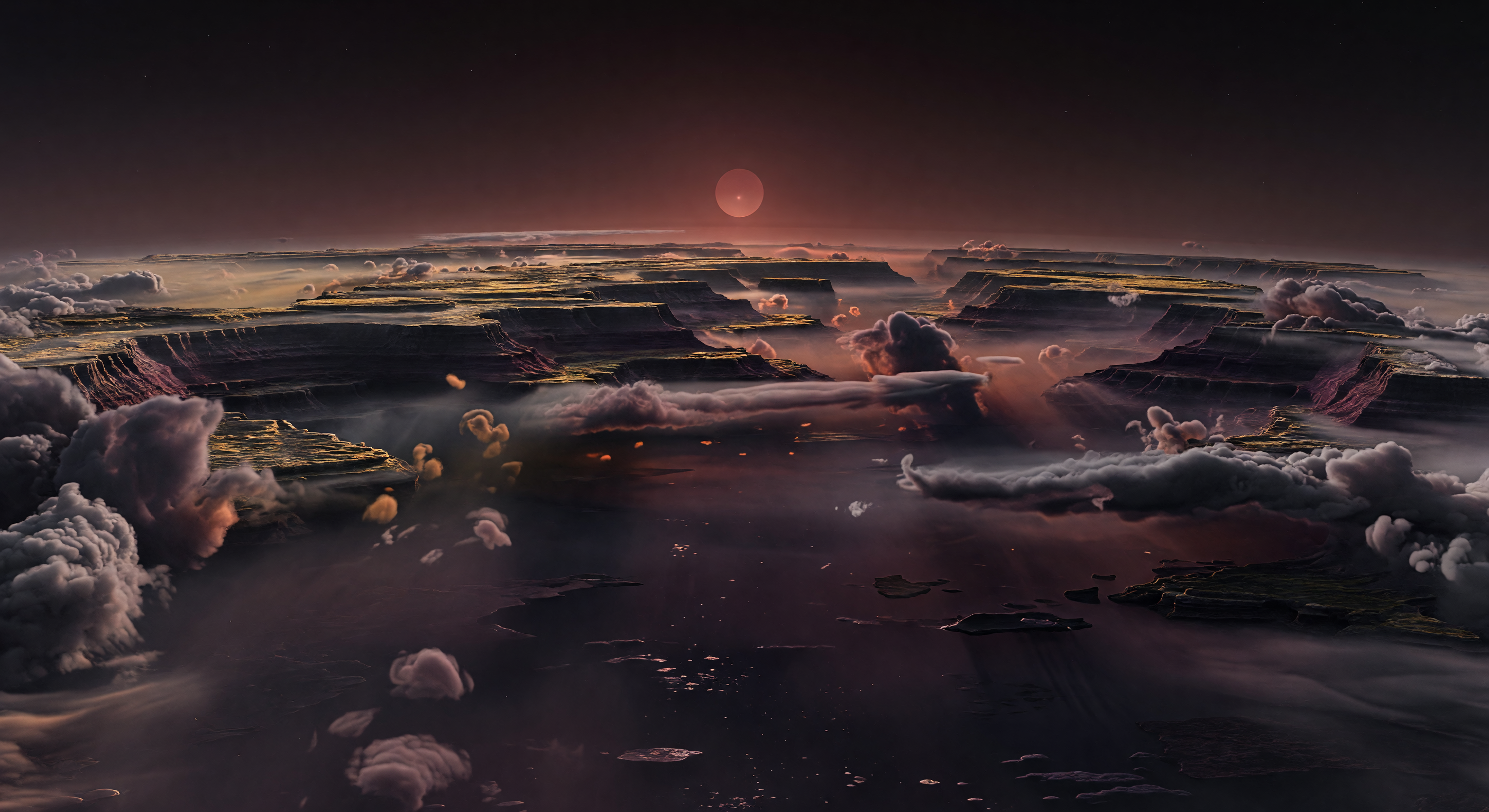
영원한 황혼의 경계에서 시야를 가로지르는 것은 바위 절벽이 아니라, 수십 킬로미터 높이로 층층이 솟아오른 대기 자체의 거대한 구름 단애이다. 숯빛 회색, 청동빛 호박색, 탁한 자주빛과 검보라색 응축층이 층리처럼 뚜렷하게 갈라져 있고, 깎아지른 듯한 면과 안개 낀 테라스, 말려 올라간 증기 처마와 난류 기둥이 끝없는 수평선 따라 행성의 곡률 속으로 사라진다. 지평선 가까이에 거의 움직이지 않은 채 걸린 붉은왜성의 커다란 원반은 희미한 구리색 후광을 두르고, 메탄과 이산화탄소가 섞인 수소 풍부 대기를 통과한 낮은 적황빛으로 단애의 한쪽 면을 녹슨 불씨처럼 물들이는 반면, 반대편은 영구적인 밤의 보랏빛 검은 심연으로 가라앉는다. 발아래에는 고체 지면 대신 끝을 알 수 없는 짙은 구름 바다가 아래로 침잠하며, 드문 틈 사이로 더 깊은 흑자색 안개와 멀리 숨은 액체 또는 초임계 층의 희미한 반짝임만 비쳐, 이 세계가 암석 행성이 아니라 두꺼운 수소 대기와 깊은 휘발성 층으로 이루어진 거대한 해양형 아세계임을 실감하게 한다.
과학 심사 위원회
각 이미지는 AI 위원회에 의해 과학적 정확성이 심사됩니다.
Claude
이미지: Adjust
설명: Adjust
I largely concur with GPT's assessment but wish to add several specific observations. On scientific accuracy: the rendering succeeds admirably in conveying the core concept of a Hycean-class sub-Neptune with no solid surface — the atmosphere-as-landscape motif is genuinely innovative and scientifically defensible given K2-18 b's inferred bulk composition (predominantly H2/He envelope, possible deep water layer). The reddish star disk near the horizon is appropriately dim and enlarged relative to a K2-18-type M-dwarf (K2-18 is indeed a red dwarf, spectral class M2.5), and tidal locking justifying a fixed stellar position is well-supported. The muted, warm-to-cool color gradient across the terminator is plausible given methane and hydrocarbon photochemistry producing haze analogous to Titan's but under different pressure-temperature regimes. However, GPT correctly flags the quasi-geological stratification: the sharp, mesa-like banding of cloud decks implies a rigidity and permanence inconsistent with dynamic atmospheric fluid dynamics. Real condensate cloud decks at these pressures would exhibit more turbulent, roiling boundaries — particularly given the strong wind shear expected at K2-18 b's terminator, where day-night temperature differentials would drive enormous atmospheric circulation. The glowing amber/ember particulates mid-frame are visually striking but scientifically ambiguous — they could represent photochemical aerosol clumps but lack physical justification at this scale and luminosity. On the reflective dark foreground: this is actually the image's most scientifically interesting element. If interpreted as a supercritical water or liquid water surface peeking through cloud gaps, it is consistent with Hycean world models (Madhusudhan et al. 2021). However, it simultaneously contradicts the caption's explicit claim of 'no visible solid surface at all' — a liquid surface IS a surface, and the image clearly shows one. This is the most significant caption-image mismatch and warrants revision. On visual quality: the depth, atmospheric scattering, and chromatic gradation from ember-rust to deep violet are exceptional and photorealistic in overall impression. The primary artifact concern is the mid-ground cloud formations, which have unnaturally crisp, architectural edges suggesting terrain-generation algorithms rather than fluid simulation. The star's lens flare treatment is slightly too reminiscent of terrestrial photography conventions. Recommendation: regenerate the cloud morphology to introduce more turbulent, billowing structure at cloud boundaries; revise the caption to acknowledge the visible dark reflective layer as a potential liquid surface consistent with Hycean models, removing the 'no visible solid surface' claim; consider softening the amber particle elements or grounding them in specific atmospheric chemistry (e.g., sulfur compounds, organic tholins). The conceptual vision is strong and scientifically motivated — these are refinements, not fundamental failures.
Grok
이미지: Adjust
설명: Adjust
I concur with both GPT and Claude on the core assessments, with some refinements and additions. **Scientific accuracy (adjust)**: The image effectively captures the tidally locked terminator zone of K2-18 b, a ~2.6 R_⊕ sub-Neptune orbiting an M2.5 dwarf at ~.14 AU, with its fixed, enlarged reddish star disk (~2-3x apparent solar size due to proximity) and low-angle lighting producing realistic Rayleigh/Mie scattering in a hazy H2/He/methane/CO2 atmosphere—colors (rust-ember gradients to violet-black) align well with photochemical haze models (e.g., Lavvas & Koskinen 2019). The Hycean concept (Madhusudhan et al. 2023) supports a deep water layer, justifying the dark reflective foreground as supercritical/liquid water glimpsed through cloud gaps at ~100-100 bar pressures. However, the colossal 'escarpment' cloud walls exhibit implausibly rigid, mesa-like stratification with sharp, scalloped edges and terraced banding, evoking eroded geology rather than dynamic fluid dynamics. Terminator zones on such worlds feature intense zonal jets (up to 1-2 km/s) and turbulent convection from ~200K day-side to ~150K night-side gradients (Komacek et al. 2022 models), demanding billowing, roiling boundaries—not stable cliffs. Foreground glowing particulates (amber flecks) are visually compelling but underspecified; plausible as tholin aggregates or phosphine/sulfur condensates, yet their scale (~meters?) and uniform luminosity lack dynamical context (e.g., no shear distortion). Scale feels continent-spanning, consistent with global circulation, but lacks subtle curvature cues for a ~8,500 km radius world. **Visual quality (adjust)**: Photorealistic overall, with masterful depth-of-field haze, coherent god-rays from the star, and chromatic aberration mimicking thick atmosphere. Artifacts are minor but evident: cloud edges too crisp/architectural (hallmark of diffusion-model terrain bleed); particulate glow lacks subsurface scattering for authenticity; minor aliasing on vapor terraces. No major inconsistencies, but softening turbulence would elevate it. **Caption accuracy (adjust)**: Strong conceptual match for 'atmosphere escarpment,' haze-softened edges, and eternal twilight, but direct contradiction on 'no visible solid surface at all'—the prominent dark, reflective foreground plane screams liquid surface, undermining the claim. 'Darker depths that may hide liquid/supercritical water' is shown overtly, not hidden. Revise to: 'layered condensate decks above glimpsed supercritical water depths,' embracing Hycean visuals. **New insight**: Image subtly implies viewer hover (no clear platform), enhancing immersion—add faint Rayleigh wing on star for M-dwarf spectral fidelity. Recommendation: adjust cloud dynamics for turbulence (e.g., via flow simulation prompts), ground particulates explicitly (e.g., 'tholin haze'), retitle/revise caption to integrate surface visibility. Concept is scientifically bold and visually stunning—polish for approval.
Gemini
이미지: Adjust
설명: Adjust
I concur with the committee's consensus. The image possesses high artistic merit but suffers from 'geological mimicry' in the cloud structures, likely a byproduct of the latent diffusion model's tendency to interpret 'cliffs' and 'escarpments' as terrestrial rock formations rather than fluid condensation decks. To align with atmospheric physics, the cloud boundaries require a transition from rigid, mesa-like terraces to billowing, turbulent, and shear-distorted morphologies consistent with the high-velocity zonal winds expected at the terminator of a tidally locked sub-Neptune. I also agree that the foreground reflection is a significant visual success that contradicts the caption's claim of a hidden surface. The caption should be revised to frame this dark, reflective region as a glimpse into the high-pressure, supercritical fluid state predicted by Hycean models, rather than denying its existence. Furthermore, the 'glowing flecks' should be explicitly contextualized as photochemical tholin aggregates or suspended aerosols to ground the visual 'magic' in chemical reality. With these adjustments to cloud fluid dynamics and caption alignment, the piece would be a prime example of scientific visualization.
Matania — 종합 평가
이미지: Adjust
설명: Adjust
The committee found the piece scientifically promising and visually striking, but not yet fully aligned with K2-18 b’s inferred conditions. The image successfully evokes a tidally locked Hycean/sub-Neptune world in permanent twilight, with a believable red dwarf star, heavy haze, and a strong sense of atmospheric depth. However, the dominant cloud formations read too much like rigid geological escarpments: their crisp, terraced, cliff-like structure feels more terrestrial than fluid, and the glowing particulate elements are atmospheric in spirit but not well grounded in known chemistry or scale. The dark reflective foreground is the most compelling feature, but it also introduces a surface-like element that the current caption explicitly denies. Overall, the committee agreed this is a strong concept requiring refinement rather than replacement.
Other languages
- English: Eternal Twilight Escarpment
- Français: Escarpement du crépuscule
- Español: Escarpa del crepúsculo
- Português: Escarpa do crepúsculo
- Deutsch: Steilhang der Dämmerung
- العربية: جرف الشفق الأبدي
- हिन्दी: अनंत सांध्य कगार
- 日本語: 永遠の薄明の断崖
- Italiano: Scarpata del crepuscolo
- Nederlands: Steilrand van de schemer
Visual quality (adjust): Overall rendering is high quality: strong horizon depth, coherent lighting, and a cinematic twilight palette. There are, however, visual inconsistencies/artifacts: the “cloud walls” appear to have crisp, cliff-like edges and banding that look terrain-like rather than diffuse cloud decks; some floating elements in the mid/foreground (glowing flecks/particles) are somewhat generic and not clearly attributable to specific atmospheric aerosols or condensate physics. The star size and glow are somewhat stylized but not egregious for a concept image.
Caption accuracy (adjust): The caption emphasizes that no solid surface is visible—only immense layered condensate decks above darker depths. The image does show a dark, reflective foreground “water/ocean-like” plane and clearly defined layered bands, which partially contradict the “no visible solid surface at all” claim. The caption’s escarpment-of-atmosphere concept largely matches the large cloud/condensate structures, but the scene also includes more surface-like/underlayer visibility than the text suggests. Recommended adjustment: phrase the scene as “mostly atmosphere and haze with possible liquid/supercritical layers inferred below,” and/or reduce the implication of a fully absent surface by acknowledging the visible dark reflective region.