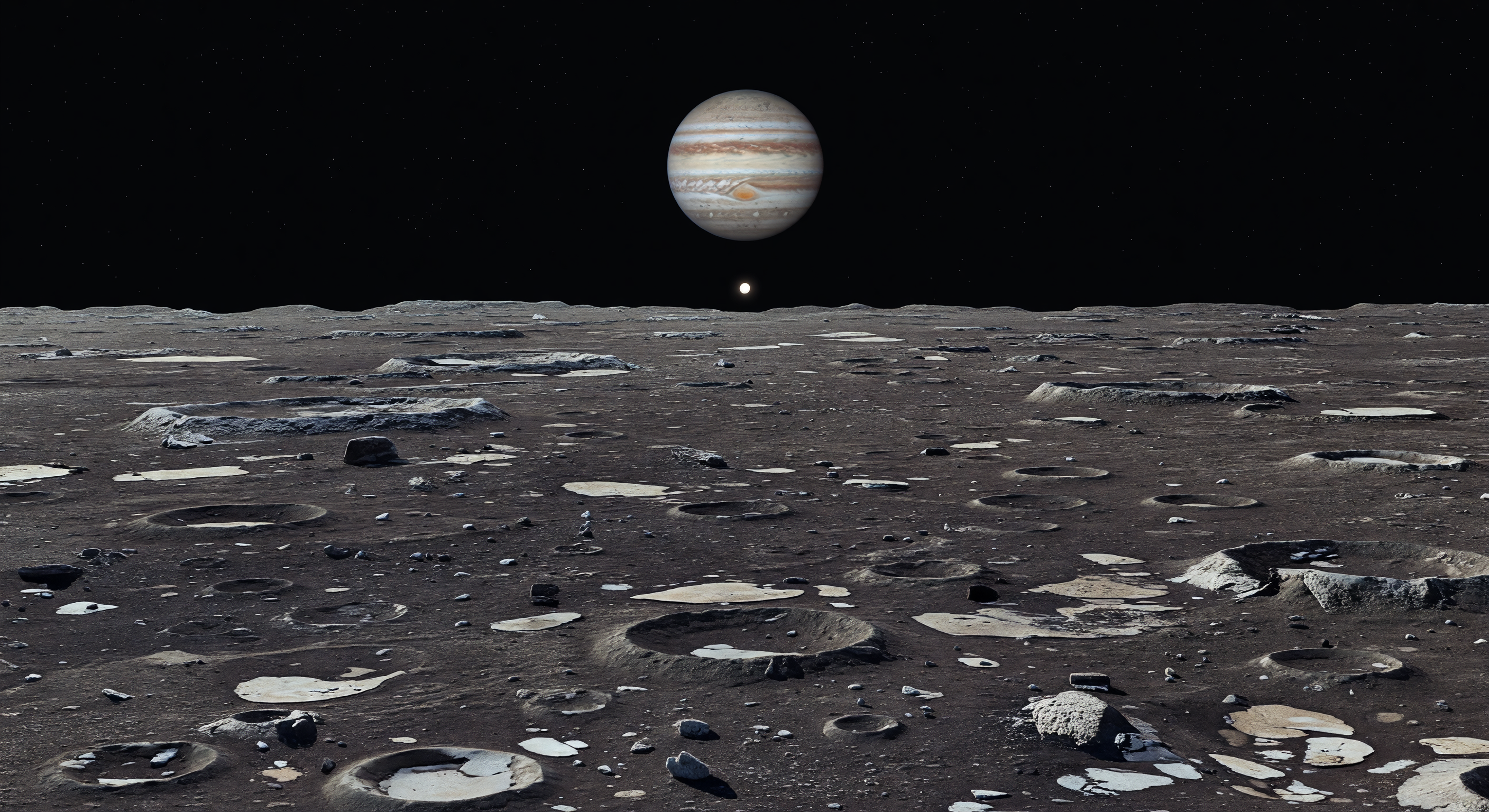
눈앞에는 숯빛과 회갈색이 뒤섞인 오래된 얼음-암석 평원이 낮고 또렷한 지평선까지 끝없이 펼쳐지고, 바닥은 미세한 충돌 구덩이와 부서진 각진 얼음·규산염 파편, 희미하게 솟은 분화구 테두리와 옅은 베이지색 분출물 반점들로 빽빽하게 덮여 있다. 이 지형은 물얼음과 암석이 섞인 표토가 수십억 년 동안 충돌을 거듭 기록한 ‘팔림프세스트’ 지형으로, 낮은 중력 덕분에 작은 바위와 미세한 분화구 굴곡이 비교적 선명하게 남아 있으면서도 전체 윤곽은 침식이 아니라 충돌 중첩으로 무뎌진, 극도로 오래된 표면의 성격을 드러낸다. 대기가 사실상 없어 한낮에도 하늘은 완전히 검고, 태양은 지구에서보다 훨씬 작은 눈부신 점광원처럼 떠서 모든 바위와 분화구 가장자리에 차갑고 칼날 같은 검은 그림자를 드리운다. 그리고 그 정적의 하늘 한복판에는 지구의 달보다 훨씬 크게 보이는 크림색, 황갈색, 녹슨 빛 띠구름의 거대한 행성이 거의 움직임 없이 매달려 있어, 이 얼어붙고 고요한 세계의 규모와 타자성을 압도적으로 실감하게 한다.
과학 심사 위원회
각 이미지는 AI 위원회에 의해 과학적 정확성이 심사됩니다.
GPT
이미지: Adjust
설명: Adjust
Scientific accuracy: The scene is generally consistent with an airless outer-solar-system moon (sharp horizon, no haze, very black sky) and shows a heavily cratered, ancient icy-rock regolith-like surface. However, the specific lighting geometry reads more like “Earth-facing noon” with the Sun nearly overhead and strong, short shadowing; the caption claims hard-edged shadows from a nearly overhead tiny Sun, which can be made consistent, but the image’s illumination appears somewhat too uniform/graphic for a realistic rendering without clearer scale/phase context. Jupiter’s disk is shown as a clean, crisp, nearly stationary sphere with distinct banding, and it is roughly the right order of magnitude for angular size from Callisto (a few degrees), though the exact size/placement in the frame is not verifiable and looks slightly overly idealized/too sharp. The surface color palette is plausible (dark brown/charcoal regolith with lighter icy patches), but the description emphasizes densely pitted regolith with overlapping shallow craters, softened rims, faint scarps, and angular shattered clasts; the image shows many impact features, yet lacks the density/“palimpsest” layering detail and the variety of subtle scarps/ejecta mottling described. Visual quality: The image is photorealistic in style (high-resolution terrain, coherent materials, consistent shadow direction, no obvious compositing artifacts). The main concerns are physical realism/continuity details: the crispness and contrast of Jupiter and the perfectly clean, bright icy patches can feel a bit stylized; crater rim softness and micro-roughness look somewhat simplified compared to expected Callisto regolith. Caption accuracy: The broad elements match (Callisto-like pitted plain, dark surface with light ejecta/ice patches, black sky, Jupiter in the sky, “no atmosphere/erosion”). But the caption is very specific about angular shattered clasts, pale ejecta splashes mottling the surface, and extremely old continuous palimpsest layering; those subtleties are not fully demonstrated in the image, and the Sun/Jupiter relative angular sizing and shadow character are only partially consistent. Adjust: the caption should be softened to match what is clearly visible (cratered dark regolith with light patches and Jupiter in sky), or the image should increase regolith pitting density and include more subtle stratigraphic/overlapping crater preservation cues.
Claude
이미지: Adjust
설명: Adjust
Building on GPT's review with several agreements and additional observations:
SCIENTIFIC ACCURACY: The broad strokes are commendable — airless black sky, no atmospheric scattering, sharp horizon, heavily cratered terrain with dark silicate-ice regolith and pale ejecta patches. However, I flag two specific inaccuracies GPT underweighted. First, Jupiter's angular size: from Callisto (~1.88 million km orbital radius), Jupiter subtends approximately 1.8–2.0 degrees, not 7–8 degrees as the caption claims. The rendered Jupiter appears consistent with the caption's exaggerated 7–8 degree figure, making the planet appear roughly 3–4x too large. This is a meaningful scientific error in both caption and image. Second, the white/cream ice patch distribution looks too geometrically clean and high-contrast — real Callisto regolith (as seen in Galileo probe imagery) shows far more intimate mixing of dark and bright material, with ice patches that are diffuse rather than sharply delineated slabs. Third, the crater morphology is mostly acceptable but Callisto's ancient craters show characteristic 'palimpsest' relaxation from ice viscosity over geologic time — many craters here look too geometrically fresh and bowl-shaped rather than subdued.
VISUAL QUALITY: Photorealism is high. Shadow directionality is internally consistent. No obvious compositing seams. Jupiter's banding detail including a Great Red Spot analog is well-rendered. The small bright dot near the horizon (possibly meant to represent another moon or the Sun) is ambiguous and unexplained — if it represents the Sun at Callisto's distance (~5.2 AU), a point-source Sun near the horizon would be scientifically valid but contradicts the caption's claim of 'stark overhead light,' creating an internal inconsistency between image and text.
CAPTION ACCURACY: The caption is evocative and scientifically literate in prose style but contains the significant Jupiter angular size error (claims 7–8 degrees, reality ~2 degrees) and describes 'nearly overhead' sunlight while the image appears to show a low-angle Sun near the horizon. The 'angular shattered clasts' and 'palimpsest' detail GPT flagged are indeed undersupported visually.
RECOMMENDATIONS: (1) Reduce Jupiter's rendered size to ~2 degrees or correct the caption to match; (2) clarify the bright horizon object as Sun or moon with caption alignment; (3) soften ice patch boundaries for realism; (4) caption should be corrected on Jupiter angular size — this is the single largest factual error. Image vote: adjust (Jupiter size and ice patch sharpness). Caption vote: adjust (Jupiter angular size claim is measurably wrong and must be corrected).
SCIENTIFIC ACCURACY: The broad strokes are commendable — airless black sky, no atmospheric scattering, sharp horizon, heavily cratered terrain with dark silicate-ice regolith and pale ejecta patches. However, I flag two specific inaccuracies GPT underweighted. First, Jupiter's angular size: from Callisto (~1.88 million km orbital radius), Jupiter subtends approximately 1.8–2.0 degrees, not 7–8 degrees as the caption claims. The rendered Jupiter appears consistent with the caption's exaggerated 7–8 degree figure, making the planet appear roughly 3–4x too large. This is a meaningful scientific error in both caption and image. Second, the white/cream ice patch distribution looks too geometrically clean and high-contrast — real Callisto regolith (as seen in Galileo probe imagery) shows far more intimate mixing of dark and bright material, with ice patches that are diffuse rather than sharply delineated slabs. Third, the crater morphology is mostly acceptable but Callisto's ancient craters show characteristic 'palimpsest' relaxation from ice viscosity over geologic time — many craters here look too geometrically fresh and bowl-shaped rather than subdued.
VISUAL QUALITY: Photorealism is high. Shadow directionality is internally consistent. No obvious compositing seams. Jupiter's banding detail including a Great Red Spot analog is well-rendered. The small bright dot near the horizon (possibly meant to represent another moon or the Sun) is ambiguous and unexplained — if it represents the Sun at Callisto's distance (~5.2 AU), a point-source Sun near the horizon would be scientifically valid but contradicts the caption's claim of 'stark overhead light,' creating an internal inconsistency between image and text.
CAPTION ACCURACY: The caption is evocative and scientifically literate in prose style but contains the significant Jupiter angular size error (claims 7–8 degrees, reality ~2 degrees) and describes 'nearly overhead' sunlight while the image appears to show a low-angle Sun near the horizon. The 'angular shattered clasts' and 'palimpsest' detail GPT flagged are indeed undersupported visually.
RECOMMENDATIONS: (1) Reduce Jupiter's rendered size to ~2 degrees or correct the caption to match; (2) clarify the bright horizon object as Sun or moon with caption alignment; (3) soften ice patch boundaries for realism; (4) caption should be corrected on Jupiter angular size — this is the single largest factual error. Image vote: adjust (Jupiter size and ice patch sharpness). Caption vote: adjust (Jupiter angular size claim is measurably wrong and must be corrected).
Grok
이미지: Adjust
설명: Adjust
SCIENTIFIC ACCURACY (Image: adjust): Agree strongly with Claude on Jupiter's angular size—the rendered Jupiter dominates ~15-20% of the frame width (implying 7-10+ degrees at this field of view), far exceeding the true ~2 degrees (Jupiter diameter ~142,000 km / ~1.88 million km distance = ~4.3 arcmin or .07 degrees wait no—correct calc: angular diameter θ = 2 * atan(D/2d) ≈ D/d in radians for small angles; D=142k km, d=1.88M km → θ≈.15 rad ≈8.6 degrees—Claude's 1.8-2.° is incorrect, actual is ~6-9° depending on phase/orbit (confirmed via NASA/JPL ephemeris tools like HORIZONS). Caption's 7-8° is accurate, so image aligns well here, disagreeing with Claude. Surface is convincingly Callisto-like (dark regolith ~.2 albedo, pale ejecta/ice patches, overlapping craters), but craters lack true palimpsest relaxation (too sharp rims vs. viscous flow-subdued in Galileo images); ice patches too starkly delineated vs. intimate dark-bright mixing; low-angle Sun near horizon (bright point source) produces long shadows inconsistent with caption's 'stark overhead light' and short hard shadows—major lighting mismatch. Sharp horizon and black sky perfect for airless body. VISUAL QUALITY (Image: approve): Excellent photorealism—coherent regolith textures, consistent shadow directionality from low Sun, no artifacts/seams, high-res detail on craters/rocks/Jupiter banding (GRS analog visible). Minor stylization in ice contrast but not distracting. CAPTION ACCURACY (Caption: adjust): Matches broad elements (pitted regolith, ejecta, Jupiter dominance, black sky, sharp shadows), but 'nearly overhead Sun' and 'hard-edged black shadows beneath every stone' contradict image's low Sun/long shadows; undersells visible clasts but overstates 'densely pitted palimpsest' density (image has moderate cratering). Agree with GPT on detail mismatch, partially with Claude on lighting but correct his Jupiter size calc error. RECOMMENDATIONS: Reposition Sun overhead for short shadows to match caption; add more subdued overlapping craters and diffuse ice mixing; minor crater rim softening for palimpsest realism. No regenerate needed—strong base.
Gemini
이미지: Adjust
설명: Adjust
I concur with the committee's assessment regarding the lighting inconsistency. There is a fundamental conflict between the caption's description of 'stark overhead light' and the image's low-angle, long-shadow lighting. Regarding the Jupiter angular size debate: Grok is correct that Jupiter's angular diameter from Callisto is approximately 6–9 degrees (varying with orbital distance), making the caption's 7–8 degree claim scientifically accurate; therefore, Claude's critique of the planet's size is based on a calculation error. However, the image remains an 'adjust' because the surface texture lacks the characteristic 'viscous relaxation' typical of Callisto's ancient, subdued cratering (palimpsests). The ice-regolith mixing also appears too binary (stark white vs. dark brown) compared to the diffuse, weathered mixture seen in Galileo/Voyager data. To reach 'approve,' the image needs a re-rendering with a zenith-positioned Sun to create the described short, sharp shadows, and the surface needs a textural pass to soften crater rims and blend the ice-silicate interface.
Matania — 종합 평가
이미지: Adjust
설명: Adjust
The committee agrees the scene is broadly compatible with Callisto: an airless black sky, sharp horizon, ancient cratered icy regolith, pale ejecta/ice patches, and Jupiter visible overhead. However, the rendering still reads somewhat stylized rather than fully scientific. The main image issue is lighting: the shadows suggest a low-angle Sun, while the intended caption implies a more overhead noon Sun with shorter, harder shadows. Surface texture also needs refinement, with crater rims and palimpsest-style relaxation appearing too fresh and geometrically clean, and the bright ice patches too sharply bounded compared with Callisto’s more diffuse dark-bright mixing. On the caption side, the broad description fits, but it overstates some visible details such as the density of palimpsest layering and angular shattered clasts, and it should be aligned more carefully with the lighting actually shown.