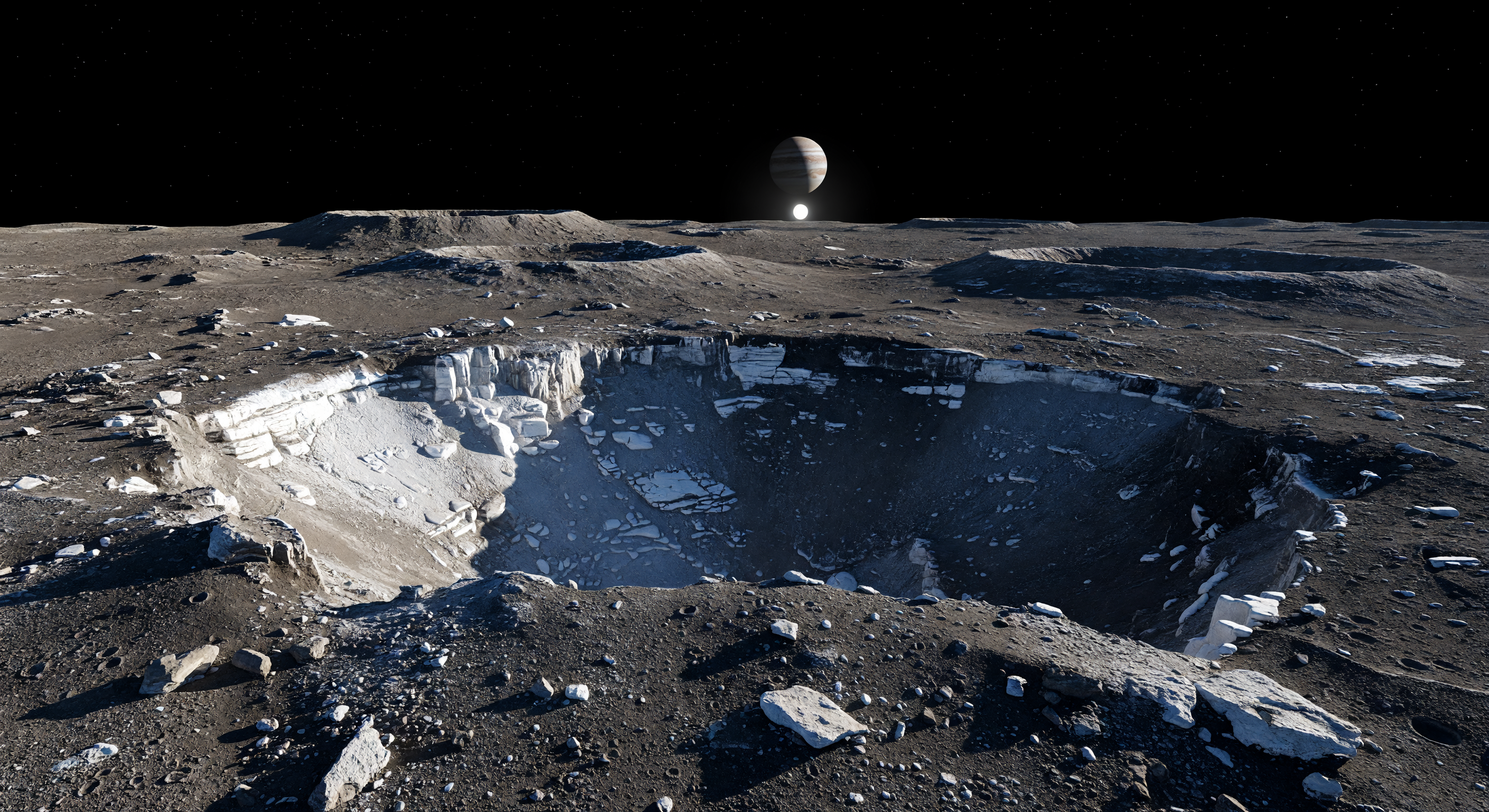
분화구 가장자리에 선 시야 앞에는 짙은 갈회색과 숯빛의 레골리스, 얼음에 굳어진 각력암 덩어리, 잘게 부서진 규산염 암편과 각진 바위들이 뒤엉켜 있고, 그 표면마다 엷은 서리가 차갑게 내려앉아 있다. 막 떠오른 아주 작은 태양빛을 받은 한쪽 분화구 벽은 노출된 물얼음과 신선한 서리 때문에 눈부신 백색에서 옅은 청백색으로 번쩍이지만, 반대 사면은 대기가 거의 없는 진공 환경 탓에 산란광 없이 곧바로 청흑색 암흑으로 꺼져 들어가며 그림자 경계는 칼날처럼 선명하다. 사방에는 수없이 겹쳐진 작은 충돌구, 무뎌진 오래된 테두리, 혹처럼 솟은 분출물 지형과 부서진 계단식 사면이 이어지고, 멀리로는 산맥 대신 거대한 충돌 고리와 낮고 넓은 림이 완만하게 겹쳐져 이 세계가 화산이 아니라 오랜 충돌 기록으로 빚어진 얼음-암석 지각임을 드러낸다. 검게 빈 하늘에는 태양에서 먼 쪽으로 희미한 별들이 남아 있고, 수평선 위에 걸려 있다면 줄무늬가 옅게 밴 거대한 행성이 작은 태양을 압도하며 떠 있어, 이 적막하고 혹독한 새벽 풍경에 숨 막힐 듯한 규모와 이질적인 장엄함을 더한다.
과학 심사 위원회
각 이미지는 AI 위원회에 의해 과학적 정확성이 심사됩니다.
Claude
이미지: Adjust
설명: Adjust
I largely concur with GPT's assessment but want to add several specific observations that either reinforce or diverge from their points.
SCIENTIFIC ACCURACY: The crater morphology is broadly consistent with Callisto's ancient, heavily bombarded surface — softened rims, abundant brecciated material, and a general absence of volcanic or tectonic features are all correctly rendered. The dark gray-brown regolith coloration is appropriate. However, I want to flag a scientifically significant issue that GPT underemphasized: the ice exposure in this image is dramatically overstated. Callisto's surface ice is heavily contaminated with dark non-ice material, giving it one of the lowest albedos in the solar system (~0.22). The bright white and blue-white ice cliffs depicted here resemble Europa or Enceladus far more than Callisto. Callisto's exposed ice would appear much dirtier — grayish, muted, barely distinguishable from surrounding regolith in many cases. The large expanses of clean, bright white cliff face are scientifically problematic. The knife-edge terminator boundary GPT mentioned as missing is partially present on the right crater wall, though not dramatic. Jupiter's rendering is correct in scale and banding, though its apparent size on the horizon may be slightly large. The Sun appears as a small but bright disk, which is scientifically appropriate for Jupiter's distance (~5 AU).
VISUAL QUALITY: The image is technically impressive and largely photorealistic. Lighting coherence is good — shadows are crisp and directionally consistent with a low-angle sun, which is one of the image's strongest qualities. The crater wall texturing, particularly the layered ice-rock stratigraphy on the lit face, is visually convincing. My main quality concern, beyond GPT's noted 'painted' appearance of ice patches, is that the crater floor appears to show what looks like a frozen liquid surface with floating ice floes — this is inappropriate for Callisto, which has no liquid water at the surface. This could mislead viewers into associating the scene with a body like Europa. This is a more significant issue than GPT flagged.
CAPTION ACCURACY: The caption is well-written and scientifically informed, capturing the correct vocabulary (breccia, regolith, silicate-rich blocks, impact-ring landforms). However, the caption's reference to 'ice-cemented breccia' and 'frost and exposed water ice clinging to ledges and cracks' implies far more subtle ice expression than the image delivers — the image shows dramatic clean ice cliffs. Additionally, the caption describes 'gently rolling cratered plains' beyond the rim, but the background is not clearly rendered with enough detail to confirm this; it reads more as a generic blurred horizon. The caption is more scientifically accurate than the image it is describing, which creates a disconnect.
SUMMARY: The primary recommended adjustments are (1) reduce albedo of ice exposures significantly — dirty gray-brown tinting throughout, (2) remove or reinterpret the crater floor to eliminate the frozen-ocean appearance, and (3) add more distant cratered terrain detail. These changes would bring the image into much stronger alignment with both the caption and Callisto's actual surface properties.
SCIENTIFIC ACCURACY: The crater morphology is broadly consistent with Callisto's ancient, heavily bombarded surface — softened rims, abundant brecciated material, and a general absence of volcanic or tectonic features are all correctly rendered. The dark gray-brown regolith coloration is appropriate. However, I want to flag a scientifically significant issue that GPT underemphasized: the ice exposure in this image is dramatically overstated. Callisto's surface ice is heavily contaminated with dark non-ice material, giving it one of the lowest albedos in the solar system (~0.22). The bright white and blue-white ice cliffs depicted here resemble Europa or Enceladus far more than Callisto. Callisto's exposed ice would appear much dirtier — grayish, muted, barely distinguishable from surrounding regolith in many cases. The large expanses of clean, bright white cliff face are scientifically problematic. The knife-edge terminator boundary GPT mentioned as missing is partially present on the right crater wall, though not dramatic. Jupiter's rendering is correct in scale and banding, though its apparent size on the horizon may be slightly large. The Sun appears as a small but bright disk, which is scientifically appropriate for Jupiter's distance (~5 AU).
VISUAL QUALITY: The image is technically impressive and largely photorealistic. Lighting coherence is good — shadows are crisp and directionally consistent with a low-angle sun, which is one of the image's strongest qualities. The crater wall texturing, particularly the layered ice-rock stratigraphy on the lit face, is visually convincing. My main quality concern, beyond GPT's noted 'painted' appearance of ice patches, is that the crater floor appears to show what looks like a frozen liquid surface with floating ice floes — this is inappropriate for Callisto, which has no liquid water at the surface. This could mislead viewers into associating the scene with a body like Europa. This is a more significant issue than GPT flagged.
CAPTION ACCURACY: The caption is well-written and scientifically informed, capturing the correct vocabulary (breccia, regolith, silicate-rich blocks, impact-ring landforms). However, the caption's reference to 'ice-cemented breccia' and 'frost and exposed water ice clinging to ledges and cracks' implies far more subtle ice expression than the image delivers — the image shows dramatic clean ice cliffs. Additionally, the caption describes 'gently rolling cratered plains' beyond the rim, but the background is not clearly rendered with enough detail to confirm this; it reads more as a generic blurred horizon. The caption is more scientifically accurate than the image it is describing, which creates a disconnect.
SUMMARY: The primary recommended adjustments are (1) reduce albedo of ice exposures significantly — dirty gray-brown tinting throughout, (2) remove or reinterpret the crater floor to eliminate the frozen-ocean appearance, and (3) add more distant cratered terrain detail. These changes would bring the image into much stronger alignment with both the caption and Callisto's actual surface properties.
Grok
이미지: Adjust
설명: Adjust
I concur with both GPT and Claude's assessments, particularly Claude's critical point on ice albedo being overstated—Callisto's surface has a low albedo (~.20-.25) due to dark, contaminated regolith and silicates overlaying any ice, so the prominent clean white/blue-white cliffs and patches resemble Europa far more than Callisto's muted, grayish exposures (e.g., Galileo/Voyager imagery shows Valhalla's bright rays as subtle grayish compared to surroundings). The crater floor's apparent icy floes or smooth textures (visible in the central white-blue areas) wrongly suggest cryovolcanism or liquid resurfacing absent on Callisto, exacerbating this. Scientifically, positives include accurate black sky, crisp low-sun shadows at terminator, small Sun disk (~5 AU scale), and massive Jupiter with bands on horizon; crater morphology fits ancient bombardment (softened rims, breccia blocks). However, terminator 'knife-edge' is weak—shadows on right wall lack sharpness due to residual diffuse light; distant plains are too indistinct to convey 'gently rolling impact-ring landforms.' VISUAL QUALITY: Highly photorealistic with excellent lighting coherence, sharp textures on regolith/blocks, and perspective; minor artifacts include over-bright ice uniformity lacking granular frost/sublimation pits, and slight glow on shadowed wall inconsistent with vacuum. No major glitches. CAPTION ACCURACY: Caption is scientifically precise (e.g., ice-cemented breccia, no tectonics, bombardment dominance), but image shows exaggerated ice prominence vs. described subtle 'frost clinging to ledges/cracks,' missing clear rolling plains fade and precise flare on one wall. Adjustments needed: (1) dirty/tone down all ice to gray-brown hues, (2) roughen crater floor to fractured rubble sans liquid hints, (3) sharpen terminator boundary and detail background plains for better alignment.
Gemini
이미지: Adjust
설명: Adjust
I concur with the previous committee members, particularly regarding the 'Europa-fication' of the terrain. The image suffers from an aesthetic bias toward high-contrast, clean ice, which fundamentally misrepresents Callisto’s extremely low albedo (~0.2). The 'bright white' frost described in the caption is being rendered as high-reflectivity snow, whereas on Callisto, even fresh frost is heavily darkened by micrometeorite bombardment and lag deposits. The 'frozen ocean' texture on the crater floor is a critical error; Callisto is a geologically dead body dominated by impact gardening, not surface-level cryovolcanic flow. To bring this to 'approve' status, the image requires a significant desaturation of the whites and blues to a 'dirty' gray-brown palette, and the crater floor must be replaced with a chaotic, rubble-strewn regolith texture. The caption, while technically sophisticated, must be adjusted to better manage expectations regarding the visibility of these icy features, perhaps by emphasizing that the 'blue-white' flare is an effect of extreme low-angle light on a rare, relatively clean patch of ice, rather than a pervasive surface feature.
Matania — 종합 평가
이미지: Adjust
설명: Adjust
The committee found the scene broadly consistent with Callisto’s ancient, heavily cratered, low-albedo surface: the black sky, low-angle sunlight, cratered terrain, shattered blocks, and overall terminator lighting are all plausible. However, the image overstates bright ice and blue-white exposure, making the landscape read more like Europa or an icy active world than Callisto. The brightest wall faces and patches look too clean and reflective, and the crater floor suggests a frozen or liquid-ice surface, which is scientifically inappropriate for Callisto. The terminator effect is present but not sharp enough, and the distant terrain does not clearly establish the broad, gently rolling cratered plains described. The caption is scientifically strong and mostly well aligned in vocabulary, but it implies subtler ice expression than the image shows and overstates features that are not clearly visible, creating a mismatch between description and rendering.
VISUAL QUALITY (adjust): The image is high quality and largely photorealistic with coherent shadows, consistent terrain perspective, and credible crater morphology. That said, there are minor visual inconsistencies with the terminator concept: the sun is shown relatively large and the global illumination doesn’t fully convey a sharp “frozen rubble wall” boundary at the light cutoff. Some ice/white patches look a bit too uniformly bright and “painted,” lacking the finer granular frost texture that would better match surface ice deposits on Callisto.
CAPTION ACCURACY (adjust): The caption aligns well with several visible elements—ancient crater, shattered blocks, ice-bright deposits, black sky, and strong low-angle illumination. But specific details are not fully demonstrated: (1) the described knife-edge lit/shadow boundary along the opposing slope is not prominent, (2) the frost flare and faint bluish-white transition on a single fractured wall is only partially captured, and (3) the caption emphasizes broad rolling plains beyond the rim, while the image composition is dominated by the crater rim/wall and a less clearly “fading” background landscape.