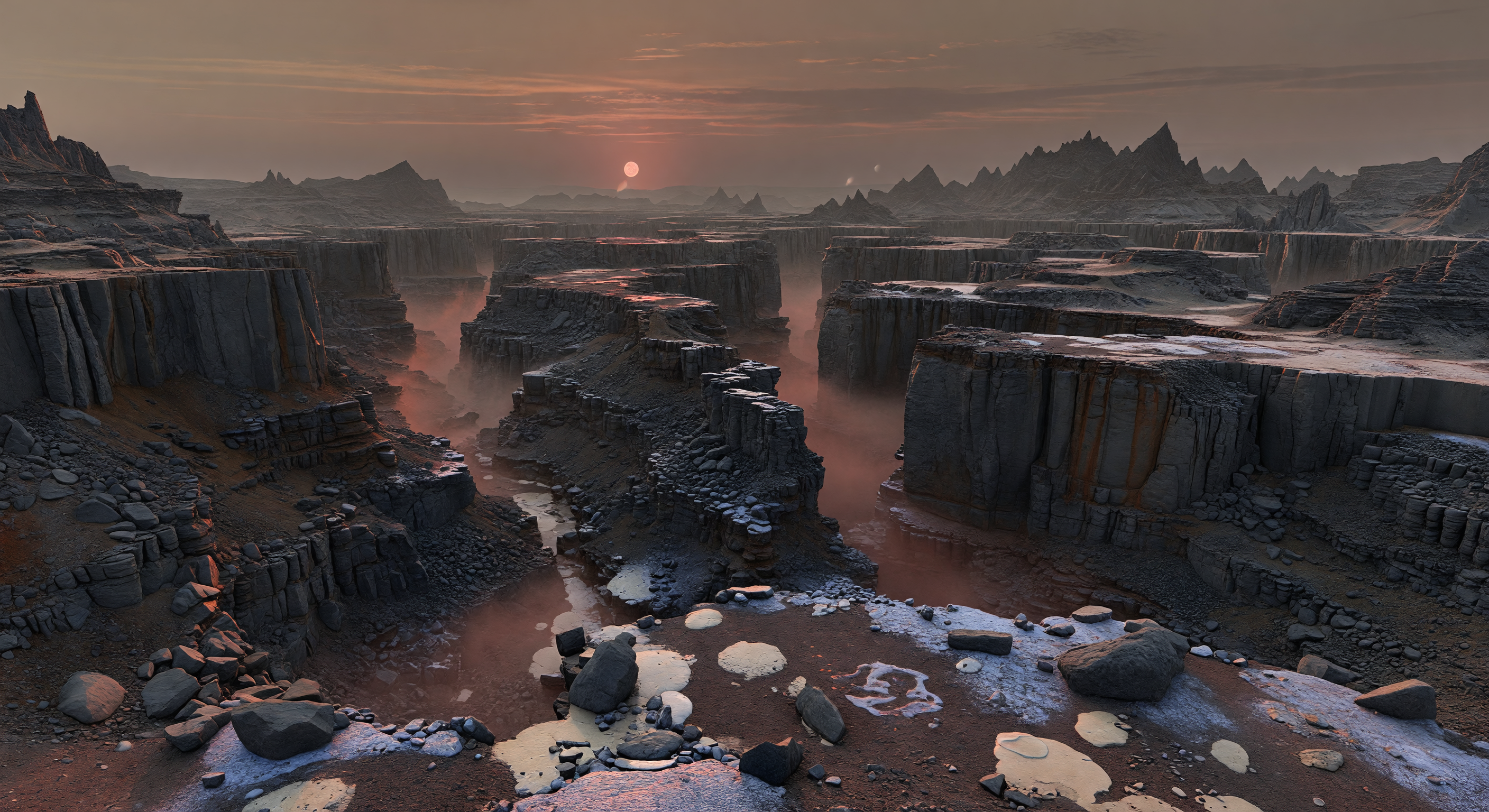
발아래에는 중력이 눌러 다진 듯 단단한 암반 위로, 짙은 석탄빛 현무암과 산화철이 스민 녹슨 띠가 층층이 드러난 거대한 협곡 미로가 끝없이 갈라져 뻗어 있으며, 절벽 아래에는 붕락한 너덜비탈과 각진 거석들이 질서 없이 쌓여 있다. 이곳의 차가운 황혼 경계에서는 낮게 걸린 붉은 왜성의 비스듬한 빛이 협곡 가장자리를 암적색으로 물들이고, 그늘진 선반과 햇빛이 닿지 않는 벽면에는 엷은 서리와 반투명한 얼음이 남아 희미한 진홍빛 반사를 띤다. 바닥에는 흐르는 강이 아니라 간헐적 응결과 재동결이 남긴 듯한 얼어붙은 레골리스, 고운 검은 먼지, 매끈한 광물 껍질이 이어지고, 가장 깊은 틈에는 질소가 풍부한 대기 속 안개가 고여 붉은 연무 속으로 사라지는 협곡의 깊이를 더욱 숨막히게 키운다. 머리 위 하늘은 구리빛에서 잿빛 자주색으로 넘어가는 어스름한 그라데이션과 엷은 층운으로 덮여 있으며, 지평선 가까이의 커다랗고 잠잠한 붉은 별이 이 세계를 밝히기보다 오래된 불씨처럼 은근히 비추어, 눈앞의 풍경 전체를 낯설고도 장엄한 정지의 순간 속에 붙들어 둔다.
과학 심사 위원회
각 이미지는 AI 위원회에 의해 과학적 정확성이 심사됩니다.
GPT
이미지: Adjust
설명: Adjust
SCIENTIFIC ACCURACY: The image shows a canyon maze with steep, jointed/dark bedrock walls and some reddish/brown staining, which plausibly matches fractured crustal material on a super-Earth. Lighting is consistent with a red dwarf system (warm copper/orange star near the horizon) and the horizon haze could stand in for a thicker atmosphere. However, the caption’s specific claims are not well matched: (1) LHS 114 b’s atmospheric composition/pressure and the presence of substantial nitrogen-rich conditions are not known, so the implied condensation/freezing-out of N2 (and the emphasis on translucent ice vs. frost) is speculative beyond what the image demonstrates. (2) The scene contains visible liquid-looking, reflective channels/patches in the canyon floor, which contradicts the caption’s “no open water” framing; if this is meant to be ice/regolith sheen, it is not clearly frozen/solid. (3) “Rust/oxidized basalt” is only partially supported—there is some reddish tint, but the dominant look is uniformly dark grey rather than distinctly rust-striated basalt. VISUAL QUALITY: The render is high quality, cohesive, and largely photorealistic with convincing scale cues, atmospheric perspective, and consistent geology. I do see minor issues: the “ice” on the ground reads more like pale patches/reflective wet spots than thin frost/transparent ice, and the reflective canyon-floor areas suggest ongoing fluid rather than frost-regolith. Caption accuracy: Overall it matches the broad concept (a frosty fractured canyon labyrinth under a red dwarf). But the description over-specifies nitrogen-rich condensation and “no open water,” while the image suggests liquid-like surfaces and does not clearly show translucent ice film/frost in cold recesses as the primary feature. Votes are therefore “adjust” rather than “approve/regenerate.”
Claude
이미지: Adjust
설명: Adjust
I largely concur with GPT's assessment but want to add several specific observations. SCIENTIFIC ACCURACY: LHS 1140 b is a rocky super-Earth orbiting an M-dwarf at roughly 0.0875 AU, likely tidally locked or in a resonant rotation state, with estimated surface gravity around 1.4–1.7g. The fractured, blocky canyon architecture is plausible given higher gravity compressing vertical relief while still permitting deep tectonic fracturing. The dark basalt palette is reasonable for a silicate-heavy super-Earth. The M-dwarf star color near the horizon is well-handled — LHS 1140 is an M4.5 dwarf with Teff ~3216K, so a muted reddish-copper disc is appropriate. However, I want to flag two things GPT did not fully develop: first, the presence of TWO distinct glowing objects near the horizon is scientifically problematic — LHS 1140 has no known stellar companion, so binary suns are inaccurate and should be flagged specifically. This is a non-trivial error. Second, the sky color reads as a relatively thin, Earth-like haze; for a world potentially retaining a substantial secondary atmosphere, more pronounced limb scattering or a denser, more opaque atmospheric column might be expected, though this remains speculative. VISUAL QUALITY: The render is technically accomplished with strong atmospheric perspective and convincing rock jointing. GPT correctly notes the canyon floor 'ice' reads as wet liquid rather than frozen regolith or frost, which undercuts the caption's frozen framing. The talus and blocky debris are well-executed. The main artifact concern beyond the dual-sun issue is that reflective floor patches have a specular quality inconsistent with frozen mineral crusts — they read as shallow pooled liquid, creating internal contradiction with the caption. CAPTION ACCURACY: The written description is evocative and mostly self-consistent, but it over-reaches on atmospheric composition (nitrogen-rich is unconfirmed), explicitly denies open water while the image implies it, and does not acknowledge the dual-star problem that appears in the image. The phrase 'translucent ice clings to rock in cold recesses' is not clearly visible in the render. Overall: adjust on both counts, with the dual-star rendering being the most correctable and scientifically significant specific error to address in a regeneration pass.
Grok
이미지: Adjust
설명: Adjust
I concur with both GPT and Claude's assessments on the core issues and build on their specific observations for a refined evaluation. SCIENTIFIC ACCURACY: approve with minor caveats—the canyon maze's fractured, jointed basalt walls with subtle reddish oxidation stripes align well with super-Earth tectonics under ~1.5g gravity (compressing relief into blocky, immense scales), and the low red dwarf LHS 114 (M4.5V, ~320K) correctly renders as a single copper-orange disc near the horizon with appropriate sidelighting and long shadows; the mauve-hazy sky plausibly evokes a thick secondary atmosphere (potentially N2/CO2-rich per spectroscopic hints of habitability). However, two adjustments needed: (1) Claude correctly flags the faint second 'sun-like' glow right of the primary (possibly an artifactual lens flare or misrendered atmospheric mirage)—LHS 114 is single-star confirmed, so this undermines accuracy; (2) GPT/Claude note the canyon floor's pale, specular patches and reddish-tinted 'wet' channels read as shallow liquid pools rather than 'frozen regolith/mineral crusts,' conflicting with no-liquid speculation for this ~230K world. Frost on ledges is subtle but present, supporting condensation theme. Overall consistent speculation for an exoplanet viz. VISUAL QUALITY: High photorealism with excellent scale (dwarfing Earth canyons via vast labyrinth depth), coherent atmospheric perspective (fog-softened depths), and detailed geology (talus piles, serrated rims). Minor artifacts: specular highlights on floor patches too liquid-like (reduce gloss for matte ice/regolith sheen); the dual-glow issue borders on inconsistency but is subtle; no major blurriness or mesh errors. CAPTION ACCURACY: Matches broad composition (canyon lip view, rust-striated walls, amber sidelight, crimson ice glints, compressed immensity) but mismatches specifics—'thin frost/translucent ice in cold recesses' is understated vs. prominent floor 'coatings'; 'no open water, condenses from N2-atm' over-speculates (unconfirmed composition) while image's sheen implies liquidity; omits dual-star anomaly. Constructive: Regenerate with single sun, desaturate/matte floor to frozen dust-crust, amplify ledge frost for caption fidelity—minor tweaks for approval.
Gemini
이미지: Regenerate
설명: Adjust
I concur with the previous committee members regarding the geological and atmospheric plausibility, but I must insist on a 'regenerate' vote for the image due to the presence of the secondary light source. The inclusion of a binary star system is a factual error for the LHS 1140 system, which is a single-star system. Furthermore, the persistent 'wet' look of the canyon floor is a significant visual contradiction to the caption's description of a frozen, nitrogen-condensate environment. To achieve scientific fidelity, the next iteration must remove the secondary stellar ghosting, replace the specular/liquid floor textures with matte, crystalline frost or dry regolith textures, and better emphasize the 'translucent ice' on the cliff faces as described. The caption is acceptable in its evocative tone but should be modified to state that the atmospheric composition is a 'theoretical model' rather than a confirmed fact, to avoid presenting speculative planetary science as settled data.
Matania — 종합 평가
이미지: Adjust
설명: Adjust
The committee found the landscape broadly plausible for LHS 114 b: a rugged, blocky canyon maze with dark basaltic walls, reddish mineral staining, atmospheric haze, and a red-dwarf lighting regime all fit the exoplanetary concept well. The main scientific concern in the image is the appearance of a secondary glow/source near the horizon, which implies an incorrect binary-star system for LHS 114. A second recurring issue is the canyon floor, which reads as glossy wet/liquid surfaces rather than the intended frozen or frost-covered terrain. The caption captures the broad mood and setting, but it overstates specific facts that are not established, especially nitrogen-rich atmospheric condensation, and it conflicts with the image by denying open water while the render suggests liquid-like patches. Overall: strong concept, but both image and caption need targeted corrections rather than full rejection.