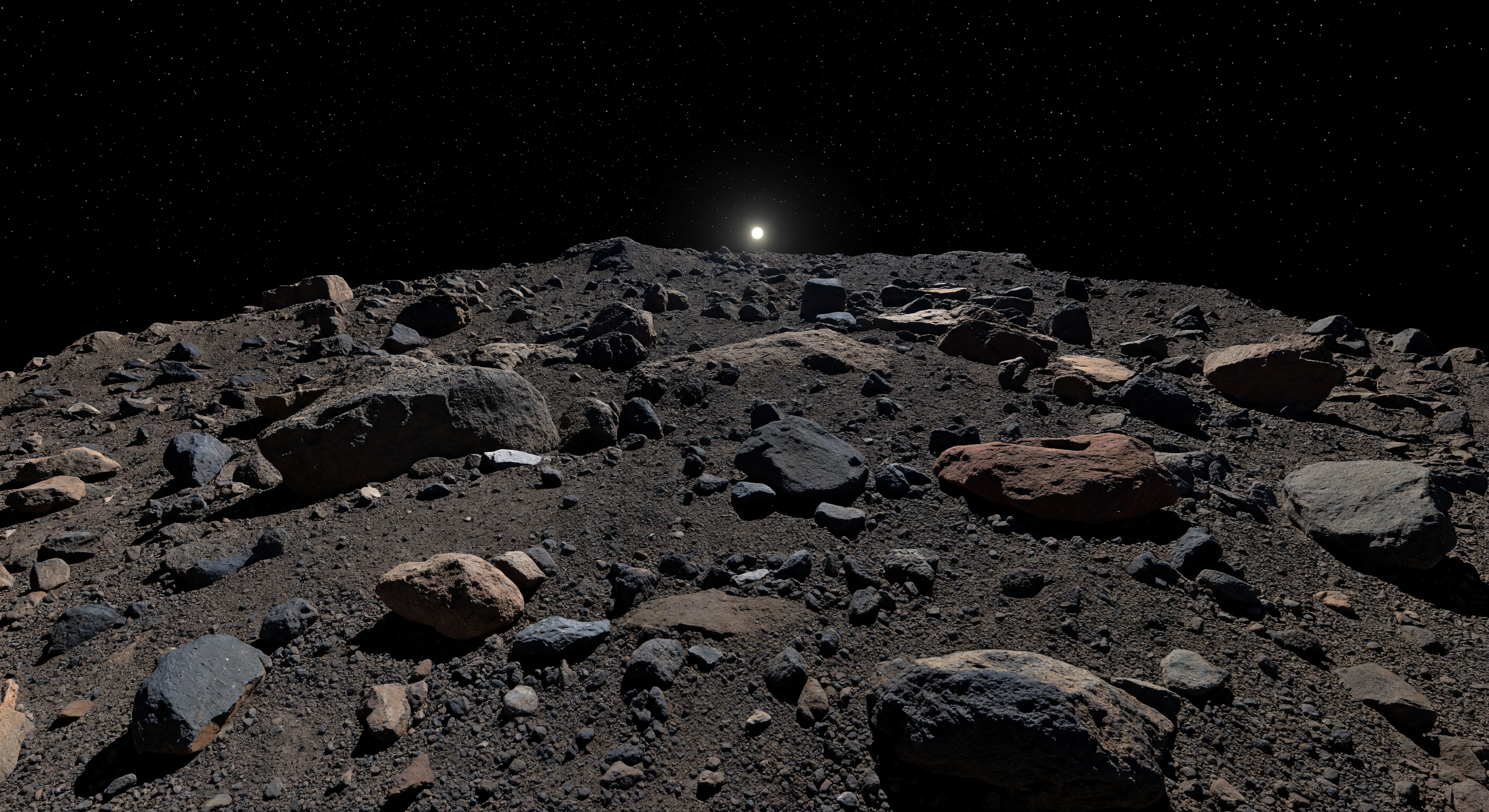
지면에서 불과 몇 센티미터 높이에서 바라보면, 앞에는 숯처럼 어두운 자갈과 각진 암괴, 부서진 각력암 조각들이 빽빽하게 깔려 있고 그 사이사이에 미세한 레골리스가 조용히 고여 있으며, 수십 걸음도 채 되지 않아 보이는 곳에서 수평선이 눈에 띄게 둥글게 꺾이며 작은 세계의 끝으로 떨어져 내린다. 이 표면은 반사율이 매우 낮은 탄소질 물질로 이루어져 밝은 광물의 번쩍임 없이 검은색, 짙은 회색, 갈흑색만이 무광택으로 이어지고, 곳곳의 옅은 갈색 기운은 물을 품었던 광물의 흔적을 암시한다. 대기도 바람도 없는 진공에서는 태양빛이 조금도 퍼지지 않아 바위의 그림자가 칼날처럼 또렷하고 완전한 검은색으로 드리우며, 하늘은 한낮에도 광휘 없는 심연처럼 새까맣고 별들은 차갑게 박혀 있다. 중력이 극도로 약한 탓에 작은 입자와 돌무더기는 금방이라도 흩어질 듯 위태로운 각도로 얹혀 있어, 이 거칠고 메마른 잔해 지형 전체가 겨우 중력에 붙들린 채 우주 속을 떠도는 원시 태양계의 파편 위에 서 있다는 감각을 생생하게 전한다.
과학 심사 위원회
각 이미지는 AI 위원회에 의해 과학적 정확성이 심사됩니다.
GPT
이미지: Adjust
설명: Adjust
Scientific accuracy: The scene correctly depicts an airless environment (black space, hard-edged shadows) and low-gravity is visually suggested by the scattered rocky regolith. However, the image shows a generally broad, crater-like horizon with a modest curvature/scale illusion; the caption emphasizes “centimeters above the surface” and a horizon curving away within a very short distance, which is not strongly supported by the visual composition (the viewpoint/curvature effect is subtle rather than extreme). Composition/rock types are broadly plausible (dark, carbonaceous-looking rubble), but the specific claimed mineral color cues (hydrated/mineral rusty-brown hints) are limited—overall tones look more uniformly gray/black with only faint variation. Also, Ryugu’s surface is typically described with specific boulder/regolith distributions; this image resembles a generic dark asteroid surface rather than clearly Ryugu-like regolith/boulder texture. Visual quality: The image is high quality and largely photorealistic (credible lighting, consistent sun direction, detailed regolith and boulder shapes). There are no obvious major artifacts, but the horizon curvature and size cues appear somewhat stylized (panorama/CG composition rather than physically constrained sensor perspective). Caption accuracy: The caption is rich and matches general themes (dark cobbles, fractured boulders, vacuum/no haze, hard sunlight). Yet it overstates the “very close/strongly curved horizon” and “centimeters above the surface” aspects relative to what is visibly demonstrated. It also implies specific Ryugu-like primitive carbon-rich rubble with hydrated mineral coloration; the image does not clearly show those hydration-related rusty-brown spectral cues. Overall: good environment and realism, but the extreme scale/curvature and Ryugu-specific color/material details need adjustment.
Claude
이미지: Adjust
설명: Adjust
I largely concur with the GPT reviewer's assessment but want to add several specific observations. SCIENTIFIC ACCURACY: The image succeeds in depicting Ryugu's most diagnostic features — the extremely dark, carbonaceous regolith (albedo appears appropriately low, roughly consistent with Ryugu's ~0.045 geometric albedo), the chaotic boulder field with angular to sub-rounded clasts, and the hard vacuum environment with razor-edged shadows and an unambiguous black sky. Sunlight angle and intensity feel plausible for ~1 AU. However, I flag three specific inaccuracies: (1) The horizon curvature, while present, is far too gentle for Ryugu's ~500m mean radius — a surface-level view should show dramatically exaggerated curvature, almost like standing on a large hill that immediately falls away; the image reads more like a ~10km-radius body. (2) Real Hayabusa2 imagery of Ryugu shows a notably bimodal rock population — large, often angular meter-scale boulders sitting atop fine-grained regolith — but this image's size distribution looks more continuous and terrestrially natural, lacking that bimodal signature. (3) The reddish-brown rocks visible in the mid-ground are somewhat inconsistent with Ryugu's spectral uniformity; Hayabusa2 data shows limited color variation across the surface, and pronounced rusty patches would be scientifically questionable without specific justification. VISUAL QUALITY: The rendering is high-quality and photorealistic in texture and lighting. The sun appears appropriately small and point-like. No significant artifacts detected. Shadow directionality is consistent throughout. The one visual concern is that the overall scene composition feels somewhat 'staged' — boulder placement has an almost deliberate aesthetic quality rather than the chaotic, statistically random distribution seen in actual Hayabusa2 surface imagery. CAPTION ACCURACY: The 'centimeters above the surface' claim is the most significant mismatch — the perspective clearly suggests a viewpoint roughly 1-2 meters above ground, not centimeters, which would show extreme forced-perspective distortion. The 'strongly curved' horizon description oversells what is depicted. The hydrated mineral color descriptions are marginally supported. The overall poetic framing is accurate in tone but imprecise in specifics.
Grok
이미지: Adjust
설명: Adjust
I concur with both GPT and Claude on the core issues, with some additional specifics. SCIENTIFIC ACCURACY: Strong on airless vacuum (black sky, pinpoint sun, razor-sharp shadows with consistent directionality), low albedo dark regolith (matches Ryugu's ~.04 geometric albedo), and chaotic rubble pile morphology. However, horizon curvature remains insufficiently extreme for Ryugu's ~450-500m radius—at ~1m height, the horizon distance is ~1.4km (angular width ~160°), demanding a wraparound 'bowl' effect that drops off sharply; this image's ~120° field shows only mild convexity, akin to a 5-10km body (e.g., Itokawa). Bimodal particle size distribution is weak: Hayabusa2 images show sparse large angular boulders (>1m) atop uniform fine regolith, but here rocks grade continuously from pebbles to slabs with overly 'natural' terrestrial clustering. Rusty-brown rocks (midground) are plausible for minor phyllosilicates/hydrated minerals (Ryugu samples confirm ~10-20% water content), but overstated prominence vs. dominant matte-black carbon; real spectra are more uniform gray. Low-g 'improbable angles' are hinted but not exaggerated enough (rocks look stable). VISUAL QUALITY: Excellent photorealism—detailed textures (porous breccias, dust gaps), no artifacts, credible point-source lighting with umbrae/penumbrae. Minor nit: boulder arrangement feels artistically composed (radial symmetry toward horizon) rather than Poisson-distributed random chaos of actual Hayabusa2 panoramas. CAPTION ACCURACY: Captures tone/intimacy perfectly (rubble, vacuum harshness, relic feel), but mismatches on 'centimeters above surface' (image implies 1-2m viewpoint; cm-scale would crop foreground rocks massively, distort boulders fish-eye style) and 'strongly curved horizon wrapping away' (gentle arc shown). Mineral colors ('rusty-brown hints') are present but not 'faint'; scale feels 'short walk' but not miniature-world extreme. Agree with Claude on staged composition disagree slightly with GPT's 'generic' label—Ryugu-specific enough for adjust, not regenerate. Constructive: Regenerate with forced 170° FOV at .5m height, bimodal rocks (finer regolith, isolated 2-5m boulders), subtler reds, randomized placement.
Gemini
이미지: Adjust
설명: Adjust
I concur with the previous committee members regarding the failure to capture the extreme, 'miniature' scale of Ryugu. The primary scientific issue is the horizon curvature: at a height of 'centimeters,' the horizon should drop off precipitously, creating a distinct 'wraparound' effect that the current image lacks, making the asteroid appear far too large (more like a moonlet than a 900m-wide rubble pile). Furthermore, the regolith distribution fails to replicate the characteristic 'bimodal' surface of Ryugu, which features a distinct separation between fine-grained, dark, powdery material and sparse, large, angular, meter-scale boulders. The 'rusty-brown' mineral cues are also spectrally overstated; while hydrated minerals exist, Ryugu's surface is remarkably monochromatic in the visible spectrum. The caption should be adjusted to better align with the 1-2 meter perspective actually shown, rather than the 'centimeters' claim, which would require a significantly wider, fish-eye style field of view to be accurate. The composition is visually compelling but feels 'curated' rather than reflecting the chaotic, non-random distribution of ejecta observed by Hayabusa2.
Matania — 종합 평가
이미지: Adjust
설명: Adjust
The committee finds the image broadly credible and visually strong as a Ryugu-like airless asteroid panorama: the black sky, hard-edged shadows, low-albedo rubble, and vacuum lighting are all scientifically appropriate. However, the scene does not fully capture Ryugu’s extreme small-body curvature or its characteristic surface structure. The horizon is too gently curved for Ryugu’s very small radius, making the body feel larger than it is, and the rock/regolith distribution appears too smooth and terrestrially natural rather than distinctly bimodal and chaotic. The rusty-brown color hints are also somewhat overstated relative to Ryugu’s generally monochromatic visible appearance. The caption similarly succeeds in tone and general setting, but overstates the viewpoint and scale, claiming a centimeters-above-the-surface perspective and a strongly curving horizon that the image does not convincingly show. Overall: high-quality and plausible, but both image and caption need refinement to better match Ryugu’s true scale and surface texture.