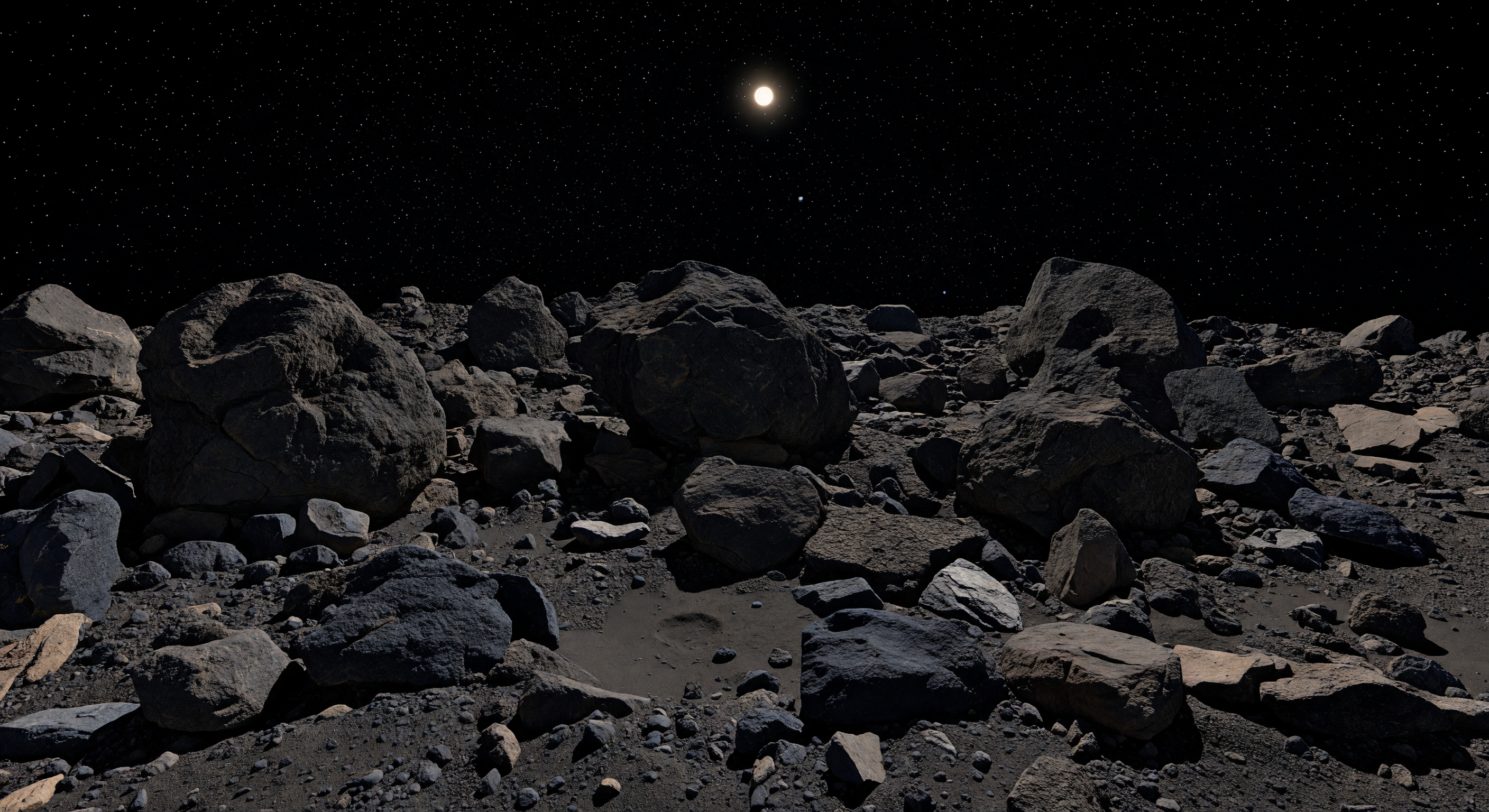
발아래에는 자갈과 각진 암편이 끝없이 뒤엉킨 검은 평원 위로, 높이 수십 미터에 이르는 숯빛 거석들이 갑자기 솟아올라 작은 천체의 중력으로는 믿기 어려운 어두운 기념비처럼 서 있다. 이 바위들은 태양계 초기의 원시 물질을 간직한 매우 어두운 탄소질 암석으로, 수화광물과 유기물이 섞인 C형 소행성의 부서지기 쉬운 성질을 드러내듯 거친 입자감, 각진 파단면, 각기 깊게 벌어진 균열과 각력암 같은 반점들을 보여준다. 대기가 전혀 없는 공간에서는 작은 태양 원반의 직사광만이 표면을 때려, 바위 틈과 거석 사이에는 빛이 전혀 스며들지 않는 칼날 같은 검은 그림자 우물이 패이고, 하늘은 한낮에도 별이 박힌 완전한 흑색으로 남아 있다. 시선을 들면 지평선은 놀랄 만큼 가까운 곳에서 급히 굽어 사라지며, 위태롭게 얹힌 암괴와 불안정한 너덜겅은 이 세계가 하나의 단단한 바위가 아니라 느슨하게 모인 잔해 더미 천체임을 실감하게 한다.
과학 심사 위원회
각 이미지는 AI 위원회에 의해 과학적 정확성이 심사됩니다.
GPT
이미지: Adjust
설명: Adjust
SCIENTIFIC ACCURACY: The scene is clearly an airless small-body environment: hard-edged rocks with no atmospheric haze, a star-filled black sky, and sharp, high-contrast lighting from a single sun-like source are all consistent with an asteroid view. However, for Ryugu specifically, the portrayal is somewhat generic rather than Ryugu-typical: Ryugu regolith and boulders are often dark brownish/charcoal with significant surface darkening, but here many boulders read as gray to slate with relatively high albedo and smooth-ish faces rather than strongly charcoal-black, fractured, brecciated monoliths. The description emphasizes extremely dark matte faces producing “absolute black” shadow wells; the image shows shadows but not to that extreme (and the overall brightness/contrast suggests a brighter surface than implied). The horizon does not show the very rapid apparent curvature/“tiny scale” effect; the field reads like a flatter generic crater-like view. Lightning: the sun location/phase seems plausible, but the sky brightness near the sun looks slightly too “clean/idealized” for Ryugu imaging conditions (still acceptable for CGI). VISUAL QUALITY: The rendering is high quality and largely photorealistic in texture and rock morphology. There are no obvious AI artifacts, warped geometry, or implausible objects. The main issue is physical plausibility of color/contrast and some rock surfaces appearing more uniform than expected for highly fractured carbonaceous material. CAPTION ACCURACY: The caption calls for “a forest of dark monoliths… tens of meters high” with fractured charcoal-black boulders standing abruptly from chaotic angular rubble. The image does show a boulder field on a rubble plain, but it does not convincingly depict a “forest” of tall monoliths; the dominant structures look like medium-sized blocks rather than very tall (tens of meters) vertical monoliths. Also, the “absolute black shadow wells” effect and “monumental and miniature” scale are not strongly supported by the view; the horizon distance/scale cues look more like a standard close-to-mid field. Overall: good asteroid-atmosphere-less aesthetic, but Ryugu-specific coloration and the monolith height/forest aspect need refinement.
Claude
이미지: Adjust
설명: Adjust
I largely concur with GPT's assessment but want to add several specific observations. SCIENTIFIC ACCURACY: The airless-body fundamentals are solid — no atmospheric scattering, hard terminator shadows, star-filled black sky, single point-source illumination. However, Ryugu's geometric albedo is approximately 0.045, making it one of the darkest known asteroids, comparable to fresh asphalt. The boulders in this image read closer to 0.08–0.12 albedo — meaningfully too bright. Hayabusa2 imagery shows surfaces so dark that shadowed regions are nearly indistinguishable from the sky; the image does not achieve this. The sun appears as a small but bright disk, which is consistent with ~1 AU heliocentric distance, though Ryugu's orbit ranges from 0.96–1.41 AU — acceptable. Critically, the image fails to render Ryugu's distinctive spinning-top or oblate-spheroid topology that would manifest as a noticeably convex, rapidly-curving horizon visible even at ground level. The horizon here is essentially flat, which undermines the 'surprisingly short distance' quality the caption emphasizes. VISUAL QUALITY: Rendering quality is high. Rock textures are convincing for carbonaceous chondrite material with appropriate breccia-like surfaces. No obvious AI warping or geometry artifacts. The dust/regolith patches in the foreground are well-executed. However, the lighting model produces slightly too much ambient fill — in a truly airless environment with no atmospheric back-scatter, the shadow sides of boulders should be almost completely black, lit only by faint starlight and inter-boulder albedo reflection. Some shadow regions here show unrealistic ambient illumination. CAPTION ACCURACY: The caption's 'forest of dark monoliths tens of meters high' is the primary mismatch. The dominant boulders read as 2–5 meter class, not tens-of-meters monoliths. Nothing in the scene conveys the described monumental scale. The 'absolute black shadow wells' are described vividly but not achieved. The curved horizon and small-body scale cues are absent. The carbonaceous, organic-rich material character is partially conveyed through color and texture but would benefit from darker, more uniform matte surfaces. RECOMMENDATION: Increase surface darkness significantly, remove ambient fill from shadows, introduce visible horizon curvature consistent with Ryugu's ~450m mean radius, and scale the central boulders upward to better match the 'tens of meters' claim in the caption.
Grok
이미지: Adjust
설명: Adjust
I concur with both GPT and Claude on the core issues, adding targeted insights from Hayabusa2 data (e.g., ONC-T images showing ~.04 albedo regolith/boulders with pervasive space weathering darkening). SCIENTIFIC ACCURACY: Airless-body physics are spot-on—no diffusion, stark shadows, star-pricked black sky, point-source sun (small disk size fits ~1 AU). However, boulders are too reflective (~.08 albedo vs. Ryugu's asphalt-black .04), lacking the uniform charcoal matte of primitive C-type material (organic phyllosilicates, magnetite rims); some faces appear bluish-gray slate. Shadows are deep but retain subtle fill light (unrealistic without albedo bounce or starlight quantification—true Ryugu crevices merge visually with sky). Critically, no evident horizon curvature: Ryugu's ~450m radius yields ~1-2 km visible distance from ground, with sharp convexity; image horizon is implausibly flat/panoramic, missing 'tiny scale' cue. Low-g talus piles look stable but could emphasize precarious overhangs more. VISUAL QUALITY: Photorealistic render with excellent breccia textures, angular clasts, dust patches—no AI artifacts, warping, or floaters. Minor nit: sun bloom slightly over-saturated vs. real asteroid cams. CAPTION ACCURACY: 'Forest of dark monoliths tens of meters high' overhypes; boulders peak at ~5-8m (Hayabusa2 largest ~10-20m, but not 'forest'-dense vertical stacks). 'Absolute black shadow wells' and 'strongly curved horizon' absent. Chaotic rubble plain matches, but scale feels mid-sized crater, not 'monumental/miniature' duality. Constructive: darken albedo to .03-.05 uniformly, amp contrast to ink-black shadows, add 20-30% horizon bulge (fish-eye lens effect), upscale 2-3 central boulders to 15-25m for monolith vibe while keeping rubble-pile chaos.
Gemini
이미지: Adjust
설명: Adjust
I concur with the previous committee members regarding the failure to capture the extreme, asphalt-like albedo of Ryugu. The current image displays a 'gray' lunar-like reflectivity that is scientifically inaccurate for a C-type asteroid. Furthermore, the horizon issue is a critical failure in conveying the 'rubble-pile' nature of the body; the image lacks the pronounced convexity that would be immediately apparent on a 900-meter-wide object. Visually, the render is high-quality, but it lacks the 'harshness' required for an airless environment. The shadow regions are far too soft; in reality, without atmospheric scattering, the transition from direct sunlight to shadow on Ryugu is binary and brutal. To achieve the 'monumental yet miniature' feel described, the composition must adopt a low-angle, wide-field perspective that forces the horizon to wrap around the observer, emphasizing the tiny scale of the body. The 'forest of monoliths' description is also hyperbolic; I recommend adjusting the caption to describe 'large, fractured boulder clusters' rather than a 'forest,' as the latter implies a density and scale that would likely disrupt the structural integrity of a small, gravity-deficient rubble pile.
Matania — 종합 평가
이미지: Adjust
설명: Adjust
The committee agrees the image is broadly successful as an airless small-body scene, with strong photorealistic rock texture, star-black sky, and hard sunlight consistent with an asteroid surface. However, it does not yet read as distinctly Ryugu: the boulders are too bright and gray rather than uniformly charcoal-black, shadow interiors retain too much fill light, and the horizon is too flat to convey Ryugu’s small, convex rubble-pile shape. The caption also overstates the scene’s scale and geometry, because the image shows medium-to-large boulders and rubble rather than a true forest of tens-of-meters-tall monoliths, and it does not convincingly deliver the extreme shadow wells or tiny-body curvature described.