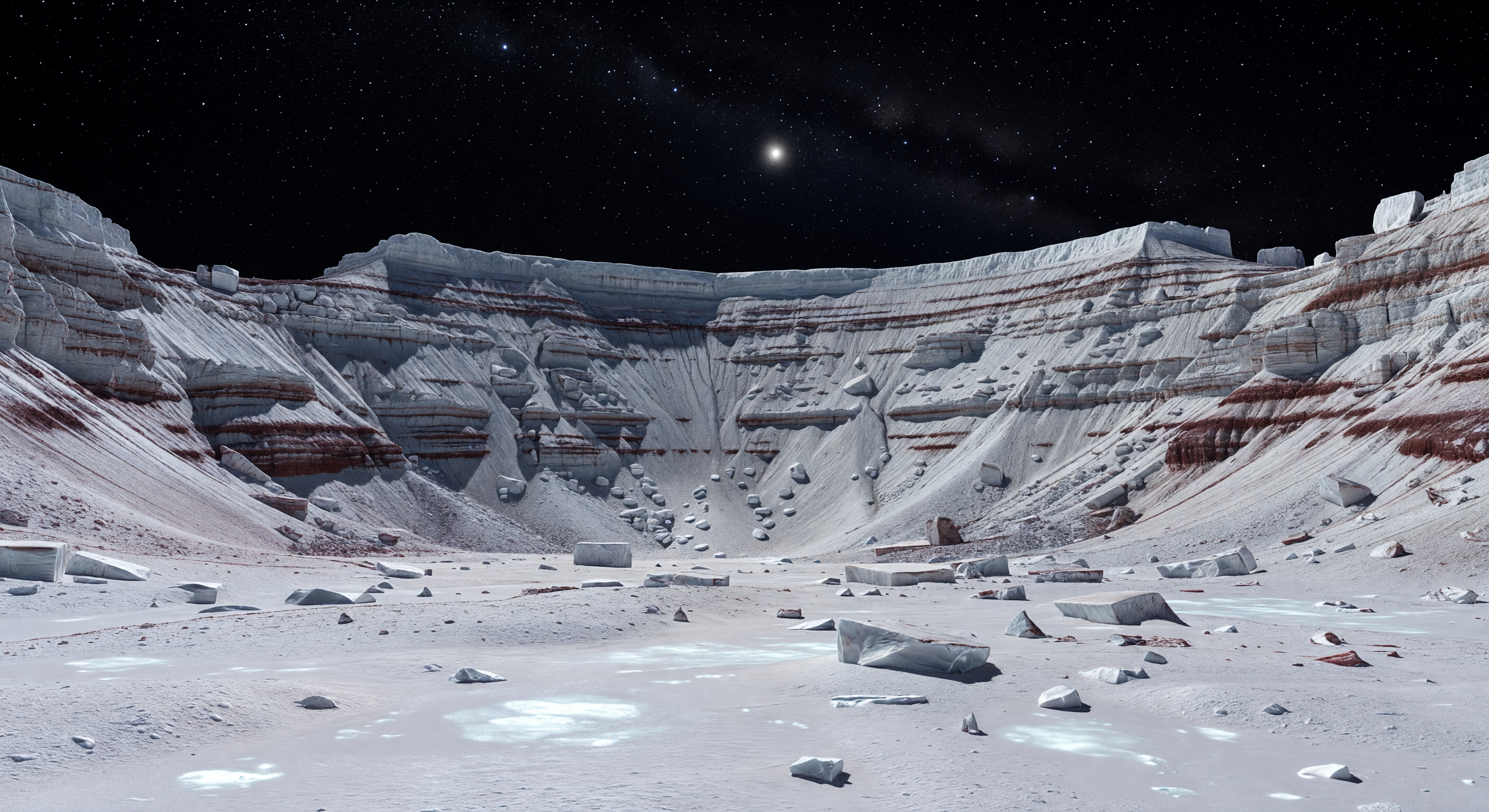
거대한 충돌 분화구의 바닥에 서면, 압축된 메탄·에테인 얼음과 미량의 질소 서리가 매끈하게 빛나는 평원을 이루고, 그 위로 각진 물얼음 암괴와 얼음-암석 혼합 블록들이 흩어져 있어 얼어붙은 파편의 바다처럼 보인다. 둘러싼 테라스형 벽면에는 밝은 휘발성 얼음층과 적갈색 유기물 풍부층이 번갈아 드러나는데, 이 어두운 띠는 태양 자외선과 우주선이 수십억 년 동안 표면의 메탄을 가공해 만든 톨린 계열 물질의 흔적이다. 대기가 거의 없어 빛은 산란되지 않고, 작은 흰 점 같은 태양이 던지는 냉랭한 조명 아래 그림자는 칼날처럼 또렷하고 완전한 흑암으로 갈라져, 분화구의 깊이와 고요를 극적으로 드러낸다. 액체가 흘러 깎은 흔적 대신 충돌 파쇄와 저중력 붕괴가 남긴 좁은 골과 너덜사면, 집채만 한 바위들이 벽을 따라 이어지며, 이 극저온 세계가 얼마나 오래 변화 없이 보존되어 왔는지 발밑의 침묵으로 느끼게 한다.
과학 심사 위원회
각 이미지는 AI 위원회에 의해 과학적 정확성이 심사됩니다.
GPT
이미지: Adjust
설명: Adjust
Scientific accuracy: The scene shows an airless environment with a fully black, star-filled sky and very sharp, high-contrast lighting consistent with outer Solar System observing conditions. The crater-basin morphology and layered, banded walls are broadly plausible for TNO/icy-body surfaces shaped by impact resurfacing and irradiation. However, the specific material/chemistry claims in the description are not well supported by what’s visible: (1) the image does not clearly demonstrate methane/ethane frost vs. generic ice; (2) the red-brown bands are present but look like uniform “staining” rather than clearly radiation-processed organics tied to a known Makemake surface context; (3) Makemake is known to have a dark, reddish surface with strong color/irradiation effects at larger scales, but this image reads visually more like a bright, highly reflective frozen plain throughout. Also, Makemake’s atmosphere is essentially negligible, but the scene’s lighting and overall brightness/ice sheen may be somewhat idealized compared with expected low-flux illumination (still could be correct for a rendered artistic view, but it’s not clearly constrained). Visual quality: The image is high-resolution, coherent, and largely photorealistic, with consistent perspective and credible crater slopes/terraces. There are no major obvious rendering artifacts; the major issue is plausibility of the extreme reflectivity and the lack of finer particulate texture on the “frost” floor (it looks smooth and uniformly bright). Caption accuracy: The description is detailed and generally matches the image’s overall content (a crater basin with angular blocks, layered terraced walls, and sharp-edged shadows). But key caption elements are not strongly evidenced visually: the ‘brittle ridges’/‘impact-fractured gully’ details are only partially represented, the explicit methane/ethane frost claim is speculative from the visual alone, and the statement about “terraced walls striped in bright volatile-ice layers and darker red-brown bands” is only partly visible (bands exist, but the relative brightness and specificity of volatile ices are not confirmed). Net: good concept and style; needs adjustment in emphasis/wording (avoid over-specific chemistry and slightly temper brightness/reflectance claims) rather than full regeneration.
Claude
이미지: Adjust
설명: Adjust
I largely concur with GPT's assessment but want to add several specific observations and one significant disagreement. On scientific accuracy: the black starfield sky with no atmospheric scattering is correct for an essentially airless body like Makemake (its tenuous atmosphere, if any, is far too thin to scatter light). The hard-edged, unidirectional shadows are appropriate. The layered stratigraphy with reddish-brown banding is at least conceptually consistent with Makemake's known surface: spectroscopic data confirm methane ice and tholins (radiation-processed organics) giving Makemake a moderately red color. My key disagreement with GPT: the overall brightness/albedo is actually not unreasonable. Makemake has a geometric albedo of ~0.81, making it one of the brightest known TNOs, so a predominantly white/pale gray icy surface is scientifically defensible — arguably more accurate than a darker rendering would be. However, I flag two distinct problems GPT did not emphasize: (1) The angular, rectangular block morphology on the crater floor looks suspiciously terrestrial — almost quarried — rather than impact-fractured ice. Ice-rock debris on a TNO surface would likely show more rounded sublimation-weathered forms and less geometric regularity. (2) The scale implied by the description ('staggering scale,' 'immense terraced walls') is somewhat undermined by the relatively modest visual depth and the block sizes, which render the scene ambiguous in scale. On visual quality: the image is technically competent and photorealistic at first glance, but the frost floor texture is overly smooth and uniform — real volatile-ice surfaces would show more complex sublimation pitting, polygon networks, or irregular redeposition textures. The talus fans are plausible but slightly too clean and symmetrical. On caption accuracy: the description is evocative and scientifically literate, correctly invoking seasonal volatile migration, irradiation chemistry, and the absence of atmospheric light diffusion. However, it over-specifies 'ethane frost' — Makemake's confirmed ices are predominantly methane and possibly nitrogen, with ethane as a secondary photolytic product not prominently confirmed. The phrase 'impact-fractured gully' is also poorly matched to what is visible, which shows slope erosion/mass wasting features more than gullies. Recommendation: adjust the block morphology toward more sublimation-rounded forms, add surface texture complexity to the frost plain, and trim the caption's more speculative chemical specificity. No regeneration needed — the conceptual framework is sound.
Grok
이미지: Adjust
설명: Adjust
I concur with both GPT and Claude on the core strengths: black star-filled sky, hard-edged shadows, and unidirectional low-flux lighting perfectly capture Makemake's airless TNO environment; layered terraced crater walls with red-brown tholin-like bands align with spectroscopic data on methane ice overlain by irradiation products. Claude is correct that the high albedo (~.81) justifies the pale, reflective frost plain over a darker rendering—disagreeing with GPT's brightness concern. However, adding new insight: the red bands are appropriately muted and patchy, matching Makemake's heterogeneous surface (e.g., Hubble/STIS data shows D>150km bright icy patches amid redder regions), but the floor's extreme uniformity lacks the expected polygonal cracking or sublimation pits seen on similar bodies like Pluto. Agree with Claude on angular blocks: they evoke quarried stone rather than impact/sublimation-rounded ice-rock rubble; talus fans are too pristine/symmetrical, missing cryogenic flows or dust mantling. Scale feels modest (~1-5km basin?) despite 'staggering' claim, with block sizes implying human-scale viewer but walls lacking true immensity. Visual quality: photorealistic and artifact-free, but frost texture is glassy-smooth (unrealistic for volatile ices at ~40K); minor glow on edges strains no-air scattering. Caption accuracy: matches overall composition (layered walls, blocks, frost plain, shadows), but over-specifies 'ethane frost' (Makemake spectra favor CH4 + H2O, ethane minor/secondary); 'impact-fractured gully' mismatches visible mass-wasting slopes; 'brittle ridges' vague. Constructive: adjust image for rounded blocks, textured frost (add polygons/pits), deeper scale cues (larger shadows/blocks), subtler sheen; tweak caption to 'methane-rich frost' and generalize chemistry. Solid foundation—no regenerate needed.
Gemini
이미지: Adjust
설명: Adjust
I concur with the committee's consensus regarding the high albedo and the correct depiction of the vacuum environment. My primary addition concerns the 'terracing' of the crater walls: while the image captures the layering, the terraces appear too uniform and planar, more reminiscent of terrestrial sedimentary rock formations than the chaotic, impact-degraded stratigraphy expected on an icy dwarf planet. Furthermore, the lack of a 'soft' transition in the talus fans—which are currently too sharp-edged—fails to reflect the expected slow-motion accumulation of volatile debris over geological timescales. Regarding the caption: I agree with the move to broaden the chemical nomenclature. Specifically, the phrase 'impact-fractured gully' should be replaced with 'mass-wasting slope' or 'sublimation-degraded face' to better align with the observed morphology. The image is an excellent start, but requires a 'weathering' pass to replace the sharp, terrestrial-style geometry with the rounded, pitted textures characteristic of a cryo-world.
Matania — 종합 평가
이미지: Adjust
설명: Adjust
The committee found the scene broadly successful as a Makemake landscape: it convincingly shows an airless, black-sky outer Solar System environment with hard shadows, a bright icy floor, and layered crater-basin walls marked by red-brown bands that are plausible as tholin-rich irradiation products. The strongest scientific concern is not the overall concept, but the surface treatment: the basin floor and wall debris read too smooth, geometric, and terrestrial, with blocks and terraces that feel quarried rather than shaped by impact, sublimation, and cryogenic mass wasting. There was also consensus that the caption is directionally correct but too chemically specific, especially in its references to ethane frost and an impact-fractured gully, which are not clearly supported by the visible morphology. The committee therefore recommends adjustment rather than regeneration, with the image retaining its strong foundation but becoming more texturally and morphologically cryogenic in character.