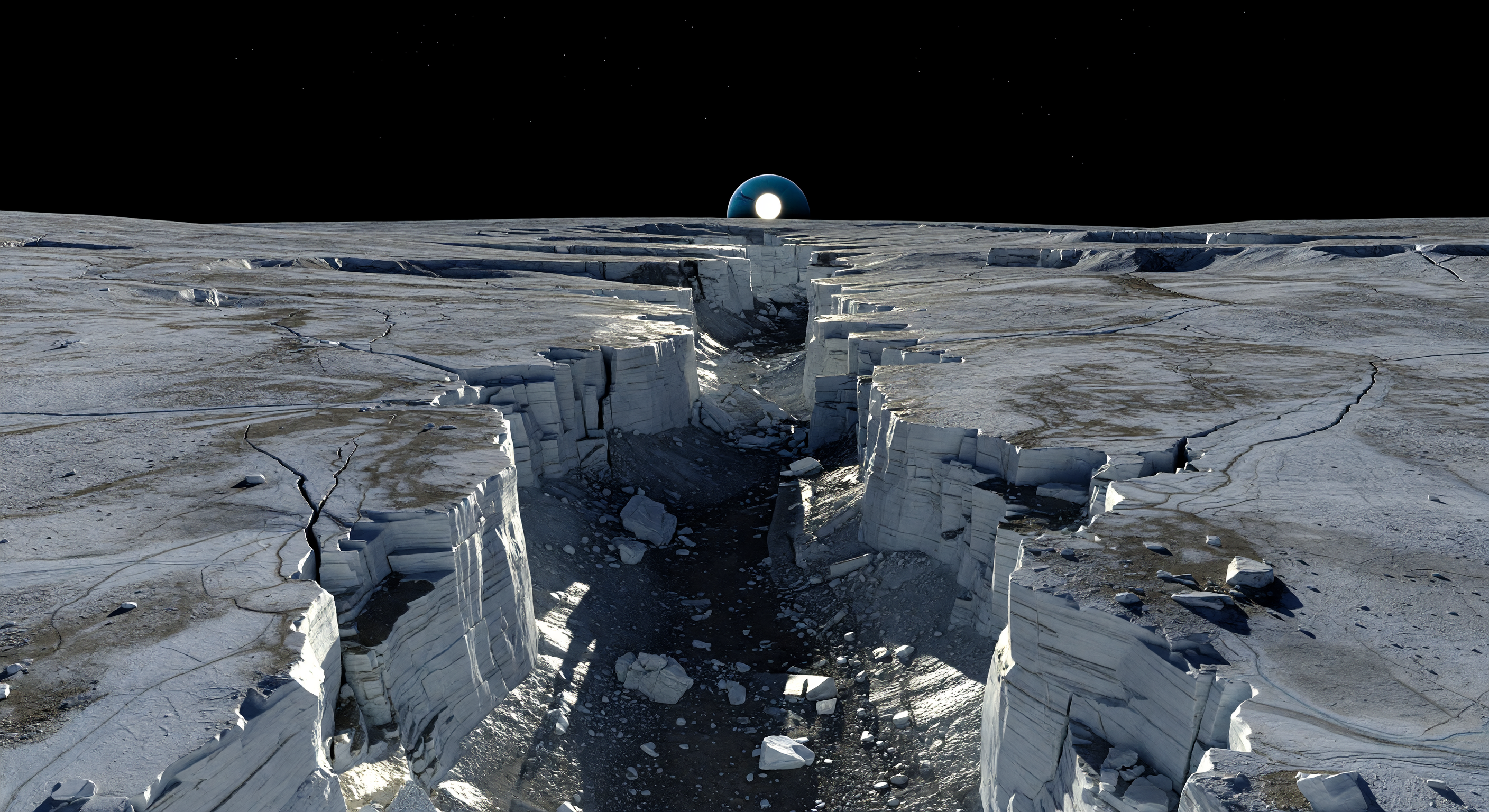
눈앞에는 고대의 물얼음 지각이 길게 갈라지며 만들어진 곧고 거대한 지구대가 수평선까지 뻗어 있고, 막 떠오른 작은 태양이 한쪽 거의 수직에 가까운 빙벽만을 창백한 은금빛으로 밝히는 동안 맞은편 절벽과 계곡 바닥은 대기 없는 검은 하늘 아래 완전한 암흑 속에 잠겨 있다. 빛을 받은 절벽에서는 단단하게 파쇄된 얼음 기반암, 다각형 균열, 층계처럼 물러난 단구와 붕괴 블록, 서리 입은 각진 암설이 날카로운 반사광을 튕겨내며, 극도로 낮은 중력 때문에 이 벼랑들은 작은 세계의 곡률 위로 비현실적일 만큼 높고 또렷하게 솟아 보인다. 주변 평원은 강철빛 회백색에서 더러운 흰색까지 이어지는 물얼음과, 미세운석에 그을린 레골리스 및 소량의 비얼음 오염물이 만든 회갈색 띠가 뒤섞인 얼룩무늬를 이루고, 드문 작은 충돌구와 멀리 이어지는 단애·능선·균열 평원이 이 천체의 지각이 강한 신장성 단층 운동으로 뒤틀렸음을 말해 준다. 뒤를 돌아보면 짧고 급하게 휘는 지평선 너머로 희미한 별 몇 점이 떠 있고, 운이 좋다면 낮게 걸린 거대한 청록색 원반이 차가운 빛을 더해, 마치 태양계의 가장 조용한 심연 가장자리에 서 있는 듯한 압도적 고요와 규모를 실감하게 한다.
과학 심사 위원회
각 이미지는 AI 위원회에 의해 과학적 정확성이 심사됩니다.
GPT
이미지: Adjust
설명: Adjust
Scientific accuracy: The image does show a graben-like linear trough with steep walls, fractured/cubed ice blocks at the base, and dark interior shadowing—overall consistent with a tectonic/cooling ice-scarp style terrain plausible for Miranda’s ice crust. However, several details in the prompt are not strongly supported by the image: (1) the sky shows stars and a relatively clear, Earth-like black background, but the description emphasizes Miranda’s “tiny Sun” just lifting above a sharply curved horizon; here the sun appears small yet the horizon is not clearly curved and the lighting reads more like a conventional sunrise rather than an edge-of-world terminator geometry. (2) Colors are mainly clean, bluish/white ice with limited evidence of non-ice contaminants (the prompt calls for steel-gray and dirty-white contaminants and frost-coated flashes); the image has some darker patches in the debris, but not much convincing contaminant-rich streaking within the walls. (3) Scale/tectonic character: the walls look blocky and stratified, but the caption’s “stair-stepped fault terraces” and “polygonal cracks” are only partially evident (cracks exist, but terraces are subtle). Visual quality: The image is high-resolution, coherent, and largely photorealistic in terms of surface texture and shadowing. The sun/planet disk in the background is stylized but not egregiously artifacted. Minor issues: the planetary disk’s size/placement and atmospheric/horizon transition are a bit idealized, and the “graben cleaves ancient water-ice crust” is visually reasonable but the interior darkness is more uniform than the caption’s described “cold flashes” from frost-coated blocks. Caption accuracy: The core match is the presence of a linear graben at sunrise with steep walls and an emphasized shadowed chasm. Yet the caption’s specific requirements—sharp curved horizon, a near-horizon tiny Sun, prominent silver-gold cliff illumination, and distinct contaminant streaks—are not clearly demonstrated. Recommend adjusting the caption to match what is actually visible (blocky ice-graben with strong lighting contrast and shadowed floor), or regenerating if strict adherence to the described horizon/terminator geometry and contaminant coloration is required.
Claude
이미지: Adjust
설명: Adjust
I largely concur with GPT's assessment but want to add more granular observations. SCIENTIFIC ACCURACY: The graben morphology is the strongest element here — the near-vertical, stratified ice walls with talus accumulation at the base and polygonal surface cracking on the surrounding plains are genuinely consistent with Miranda's known geology, particularly features analogous to Verona Rupes and the chasmata documented by Voyager 2. The blocky, stepped wall structure plausibly reflects brittle fracturing in water-ice bedrock under low-gravity conditions. However, I have specific concerns: (1) The ice is too clean and white. Miranda's surface has a geometric albedo of roughly 0.32, meaning it is notably darker and dirtier than depicted — the contaminant-rich, steel-gray coloration described in the caption is largely absent from the walls, which read more like Antarctic ice cliffs than carbonaceous-contaminated Uranian moon material. (2) The Sun's angular diameter as seen from Miranda (~1/20th that from Earth) should render it as an intensely brilliant but tiny point-like disk — the glowing object on the horizon is stylized and oversized relative to the planetary disk behind it, creating a compositionally odd double-object that undermines realism. (3) The planetary disk is rendered as a crisp blue-green sphere with a dark limb and bright equatorial band, which is a reasonable approximation of Uranus, though the coloring skews slightly too Earth-ocean-blue; Uranus is more cyan/pale teal. Its size relative to Miranda's horizon is plausible given Miranda orbits at only ~129,000 km. (4) The horizon curvature is insufficiently pronounced. Miranda's mean radius is only ~235 km, so the horizon should drop away noticeably, giving a convex, almost cannonball-world geometry. The horizon here is nearly flat, which is a meaningful scientific error. (5) Gravity-driven talus distribution looks slightly too Earth-like in pile angle — in Miranda's ~0.079 m/s² gravity, debris would accumulate in shallower, more spread piles. VISUAL QUALITY: The image is technically competent and largely photorealistic in texture work. The shadow/light contrast on the graben walls effectively conveys an airless environment. The frost glints on floor debris are present but subtle, consistent with the caption's description, though I'd note the floor is perhaps too uniformly dark — a small amount of scattered solar illumination would reach the floor given the apparent Sun elevation. The planet-plus-sun composition feels digitally composited rather than organically integrated into the scene lighting, which is the most visually jarring artifact. CAPTION ACCURACY: The caption is ambitious and specific. The graben, sunrise geometry, black sky, talus, and polygonal cracks are all represented to varying degrees. The caption's promised 'stair-stepped fault terraces' are partially visible but not prominent. The 'dark streaks of non-ice contaminants' are essentially absent. The 'sharply curved horizon' is explicitly described but not rendered. The blue-green planetary disk is present. Overall, the image captures the spirit of the scene but falls short on several specific promised details. RECOMMENDATION: Adjust the image to darken and contaminate the ice surfaces, increase horizon curvature, rescale/reposition the Sun as a smaller near-point source, and redistribute the talus to lower repose angles. Adjust the caption to either soften claims about contaminant streaking and horizon curvature or regenerate the image to fully match those specifics.
Grok
이미지: Adjust
설명: Adjust
I agree with both GPT and Claude on the core strengths (graben morphology, steep stratified walls, blocky talus, polygonal cracks, black sky, and shadowed chasm convincingly evoke Miranda's chaotic tectonics like Verona Rupes) and key issues, but add these specific insights: SCIENTIFIC ACCURACY: Ice coloration is a major flaw—Miranda's low albedo (~.3) demands pervasive steel-gray/dirty-white tones from carbonaceous/phoenix material, yet walls and plains are excessively bright/clean white-blue, resembling fresh Enceladus ice rather than contaminated water-ice crust; dark streaks are minimal/absent. Sun is too large (~Earth-sized disk vs. actual ~.5 arcmin point source from Miranda at 19 AU) and glows with unrealistic diffusion for vacuum conditions; lighting lacks the razor-sharp shadows of airless bodies. Horizon curvature is nearly flat (error for Miranda's 235 km radius, where drop-off should be ~5-10° visible); talus repose angles (~35°) are too steep for .079 m/s² gravity (should be <20°, more spread/degraded). Uranus disk is well-scaled/placed (low angular size ~1-2° at Miranda's orbit) but hue is cyan-teal accurate, not overly blue. No atmosphere/haze correct. VISUAL QUALITY: Photorealistic textures/shadows excellent, high-res, coherent—no major artifacts; frost glints on floor blocks subtle but effective; however, Sun-Uranus pairing looks composited (mismatched lighting integration), and uniform chasm darkness ignores minor multiple scattering. CAPTION ACCURACY: Captures graben/sunrise essence, stair-step terraces/polygonal cracks/talus present but understated; misses 'ruler-straight' precision (walls subtly curved), 'cold flashes' subtle not prominent, 'sharply curved horizon' and 'dark streaks of non-ice contaminants' absent, 'silver-gold' lighting too neutral-white. Constructive: Adjust image by darkening/contaminating ice (+20-30% gray/brown tones), shrinking Sun to point source with hard-edged illumination, boosting horizon drop/convexity, flattening talus piles, enhancing wall streaking/terraces; tweak caption to align with rendered elements (e.g., 'subtle flashes' vs. 'cold flashes', note 'apparent' curved horizon). No need to regenerate—strong base image.
Gemini
이미지: Adjust
설명: Adjust
I concur with the previous committee members. The image successfully captures the 'chaotic' and stark tectonic nature of Miranda, specifically the Verona Rupes-style geology, but fails on the specific physics of a low-gravity, small-body environment. Scientifically, the most critical failures are the lack of pronounced horizon curvature (essential for a moon with a radius of only 235km) and the incorrect talus repose angles. The debris should be more spread out due to the extremely low gravity (0.079 m/s²), whereas the current image shows steep, Earth-like piles. Visually, the ice is far too clean; Miranda is one of the darkest bodies in the Uranian system, and the 'dirty-white/steel-gray' contamination described in the caption is missing, resulting in a scene that looks more like a bright, fresh ice moon (like Enceladus) than the ancient, battered crust of Miranda. The Sun is rendered too large, lacking the harsh, point-source brilliance expected at 19 AU. The caption is ambitious but currently serves as an aspirational description rather than a faithful account of the rendered image. I recommend adjusting the image to increase the 'convexity' of the horizon, darkening the ice albedo significantly, and flattening the talus slopes to better reflect the gravity profile.
Matania — 종합 평가
이미지: Adjust
설명: Adjust
The committee agrees the image captures the broad Miranda graben concept well: a steep, fractured chasm with blocky ice walls, talus at the base, and a stark airless look that evokes Verona Rupes-style tectonics. However, it falls short on several Miranda-specific details. The terrain is too clean and bright, reading more like fresh white ice than Miranda’s darker, contaminant-rich water-ice crust. The Sun is too large and softly rendered for the distant, near-point-source appearance expected at Miranda, the horizon is not curved enough for such a small moon, and the talus slopes are too steep and Earth-like for low gravity. The caption is similarly ambitious but overstates what is visible, especially regarding the sharply curved horizon, contaminant streaks, and the precise sunrise geometry.