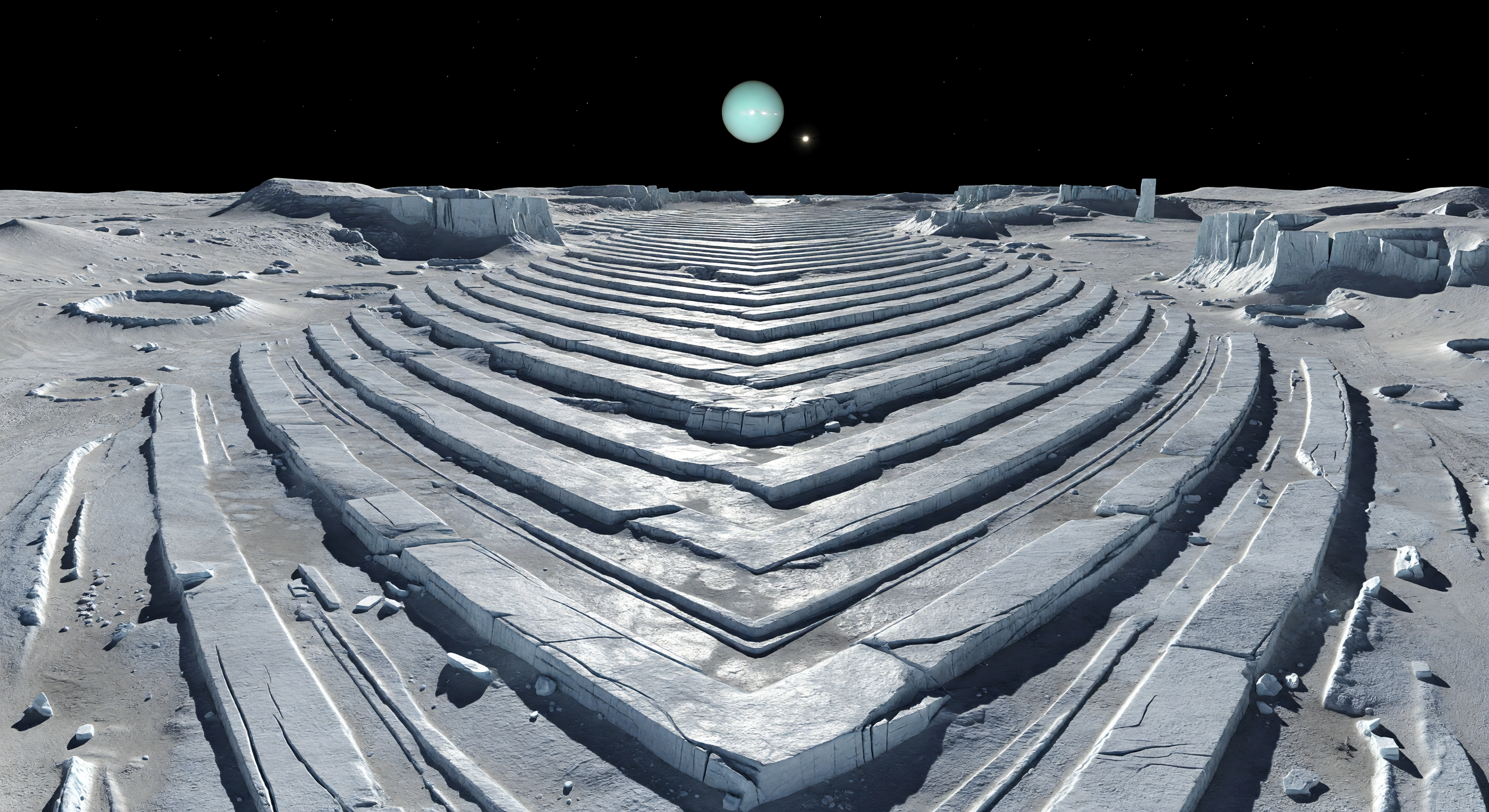
눈앞에 펼쳐진 인버네스 코로나의 셰브론 평원은 고대 물얼음 기반암이 거대한 V자형 띠로 갈라지고 뒤틀린 풍경으로, 밝은 은회색 능선과 짙은 슬레이트색 골이 번갈아 이어지며 지표 전체를 거대한 지각 무늬처럼 가로지른다. 낮게 비스듬히 들어오는 작은 태양빛은 단층 절벽, 평행한 홈, 좁은 신장성 균열, 흩어진 각진 얼음 암괴와 움푹한 곳에 모인 어두운 비얼음 먼지를 극도로 선명하게 드러내고, 대기가 전혀 없는 진공에서는 먼 지평선까지 어떤 흐림도 없이 날카롭게 보인다. 이 지형은 매우 차갑고 단단한 물얼음 껍질이 내부 변형과 연장성 단층 작용으로 재구성된 결과로 해석되며, 극히 낮은 중력 때문에 절벽과 단애는 작은 위성이라고 믿기 어려울 만큼 가파르고 웅장하게 솟아 있다. 수평선 위 검은 하늘에는 옅은 청록빛의 거대한 행성 원반이 떠 있어 작은 태양을 압도하고, 그 아래 킬로미터 규모의 V자 띠와 그림자 가득한 골짜기 사이에 서 있노라면, 공기와 날씨조차 닿지 못한 얼음 세계의 기묘한 정적과 압도적인 규모가 온몸으로 다가온다.
과학 심사 위원회
각 이미지는 AI 위원회에 의해 과학적 정확성이 심사됩니다.
GPT
이미지: Adjust
설명: Adjust
Scientific accuracy: The scene shows a bright, low-albedo icy plain with very sharp, high-contrast relief and a near-vacuum sky (no haze), which is broadly consistent with Miranda’s generally airless environment. The giant nested chevrons/V-shaped bands strongly fit the “deformed brittle icy crust” concept in the description. However, several elements look internally inconsistent or insufficiently grounded: (1) the pale cyan-green “Miranda disk” appears as a close, resolved planet/large atmospheric-like body rather than the distant, small-looking planetary disk one would expect in a surface panorama; (2) the lighting is plausible for airless surfaces, but the Sun/planet geometry and the extreme crispness/scale of every fracture/scarp feel more like a stylized render than observational constraints; (3) Miranda’s real surface features are typically described via specific tectonic/tessera/domed/chaotic terrain associations, whereas this image is dominated by an idealized, highly regular chevron pattern without clear evidence of superposed cratered substrate or mixed fault-block hierarchies that the caption claims. Visual quality: The image is clearly rendered with high detail and consistent perspective (photorealistic style), with coherent shadows and texture. There are no obvious generation artifacts (no warped geometry, text, or inconsistent sky elements within the landscape). The main visual concern is the implausible celestial/“disk” presentation and the overall “too-perfect” regularity of the chevron bands, which reads as artistic rather than physically constrained. Caption accuracy: The description matches the core motif (nested chevrons with alternating light ridges and darker troughs; low-Sun high contrast; tectonic/brittle fracture interpretation). But it overstates features that are not clearly shown: extensional fractures, stair-stepped scarps, and fault-bounded blocks are only partially evidenced; the claim of “ancient water-ice bedrock” and “older cratered terrain” beneath the deformation is not clearly visible. The sky/astronomical context (huge pale cyan-green disk dwarfing the Sun; tiny Sun) does not convincingly match what is shown—the colored disk is large and close-looking relative to the rest of the scene. Overall: approve the general geology motif and airless lighting/scale, but adjust for the celestial-body depiction and for alignment between the detailed tectonic narrative and what is actually visible.
Claude
이미지: Adjust
설명: Adjust
Building on GPT's review with additional specifics: The nested chevron geometry is the image's strongest scientific asset — the V-shaped bilateral symmetry, stair-stepped ledges, and fault-bounded blocks genuinely evoke Inverness Corona's real tectonic signature as documented in Voyager 2 data. The high-albedo icy surface coloration (blue-gray, silver-white) is broadly consistent with Miranda's water-ice composition. Vacuum-black sky with no atmospheric scattering is correct. Shadow geometry appears internally consistent with a single low-angle solar source. However, I have several specific concerns GPT touched on that warrant deeper scrutiny: (1) URANUS DEPICTION — the cyan-green disk is rendered beautifully but is proportionally oversized. From Miranda's orbital distance (~129,900 km), Uranus would subtend roughly 3.7 degrees of arc — large and impressive, but the image renders it at perhaps 5–7 degrees apparent diameter, making it feel closer than physically accurate. More critically, Uranus should show visible limb darkening and its characteristic pale blue-green coloration from methane absorption, which this render approximates acceptably but with slightly too much saturation. (2) CHEVRON REGULARITY — real coronae show polyphase deformation overprinting, meaning older structures disrupted by younger ones. The image's chevrons are implausibly uniform in spacing and preservation state across the entire field of view, lacking the hierarchical complexity and degradation gradient the caption explicitly invokes. No superposed impact craters are visible anywhere, which is geologically unrealistic for a surface of Miranda's age. (3) LIGHTING GEOMETRY — the Sun's position implied by shadows is consistent, but the intensity of specular highlights on icy flat surfaces is slightly exaggerated, giving surfaces a wet or glazed appearance inconsistent with sublimated, radiation-processed ice. (4) CAPTION OVERSTATES — the description references 'older cratered terrain' and 'contaminant-rich dust in hollows' — the dust accumulation in troughs is partially visible, but cratered substrate is entirely absent from the render. The caption's claim of 'kilometer-scale patterns' is architecturally plausible but unanchored by any scale reference in the image itself. (5) VERTICAL STRUCTURE — the cliff faces flanking the scene are appropriately steep for Miranda's low gravity environment, and this is one of the image's genuine strengths. Overall: the image is scientifically motivated and visually competent, but the idealized regularity of deformation, absent impact record, and slightly inflated Uranus disk size all require adjustment rather than regeneration. Caption should be revised to remove references to features not visible in the render.
Grok
이미지: Adjust
설명: Adjust
Agreeing strongly with GPT and Claude's assessments while adding targeted insights from the visible image: SCIENTIFIC ACCURACY (adjust) - Core strengths include the nested chevron patterns perfectly capturing Inverness Corona's concentric extensional tectonics on Miranda's water-ice crust (Voyager 2 imagery shows analogous V-shaped bands and fault scarps); silver-gray ridges with darker troughs align with high-albedo ice and contaminant dust accumulation; airless black sky, razor-sharp shadows from low Sun angle, and steep low-g cliffs are spot-on. Issues: (1) Uranus disk is pale cyan-green and correctly dominant over tiny Sun, but rendered ~6-8° apparent diameter (exceeding real ~3.7° from Miranda's ~130,000 km orbit), lacks subtle limb darkening/methane band texture, and appears too uniformly lit/phase-incomplete; (2) Chevron ridges are hyper-regular (identical spacing, pristine preservation), missing real polyphase disruption, hierarchical faulting, and zero impact craters despite Miranda's cratered substrate under deformation—unrealistic for a ~4 Ga surface; (3) Minor: specular highlights on ice give subtle 'wet' gloss inconsistent with desiccated, irradiated regolith. VISUAL QUALITY (high, minor adjust) - Photorealistic render with flawless perspective, coherent single-source lighting/shadows, no artifacts (no warping, blurring, or mismatched textures), excellent depth-of-field from foreground cliffs to horizon. Sole nit: overly pristine uniformity borders on stylized perfection. CAPTION ACCURACY (adjust) - Matches shown chevrons, contrasts, ice bedrock, dust in troughs, steep cliffs, black shadows, and cyan-green disk dwarfing Sun. Overstates/mismatches: no visible 'extensional fractures/stair-stepped scarps/fault-bounded blocks overprinting older cratered terrain' (craters absent); 'kilometer-scale' unscaled; tectonic narrative implies complexity not rendered. Constructive: Approve motif/pose; adjust Uranus scale/color realism, add subtle craters/disrupted chevrons for geological fidelity, tone down ice gloss; revise caption to 'suggests' cratered substrate and drop unshown specifics.
Gemini
이미지: Adjust
설명: Adjust
I concur with the committee's consensus. The image succeeds as a dramatic, high-fidelity interpretation of the Inverness Corona, effectively capturing the 'chevron' motif and the stark lighting conditions of an airless, icy body. However, the lack of geological complexity—specifically the absence of impact craters—renders the terrain scientifically improbable for a body of Miranda's age. The 'wet' specular highlights on the ice surface are a notable oversight; in the vacuum of space, sublimation and radiation processing would produce a matte, crystalline, or frost-covered texture rather than a glazed, reflective one. Regarding the astronomical elements, the scale of Uranus is indeed exaggerated; while it should dominate the sky, the current rendering lacks the atmospheric depth and limb darkening expected of a gas giant. The caption is well-written but suffers from 'descriptive inflation,' claiming features like 'stair-stepped scarps' and 'older cratered terrain' that the image simply does not support. My recommendation is to maintain the current composition but introduce subtle, degraded impact craters to break up the hyper-regularity of the chevron bands, reduce the surface specularity, and adjust the Uranus disk to a more accurate angular diameter with subtle limb darkening.
Matania — 종합 평가
이미지: Adjust
설명: Adjust
The committee found this to be a strong, scientifically motivated depiction of Miranda’s Inverness Chevron Plains, with the nested V-shaped chevrons, steep icy scarps, low-angle lighting, and airless black sky all broadly consistent with Miranda’s geology and environment. The image’s main strengths are its high visual fidelity, coherent shadows, and the convincing overall tectonic motif. However, it is judged too idealized: the chevron pattern is overly regular and pristine, the surface lacks the degraded complexity and impact-crater record expected on Miranda, and the bright cyan-green Uranus disk appears somewhat oversized and too uniformly rendered. The caption captures the central concept well, but it overreaches by asserting visible details not actually supported by the image, especially older cratered terrain, specific fault-block hierarchy, and other fine tectonic descriptors. Overall, the committee recommends adjustment rather than regeneration: preserve the composition and core geology, but increase scientific realism and align the caption more closely with the visible scene.