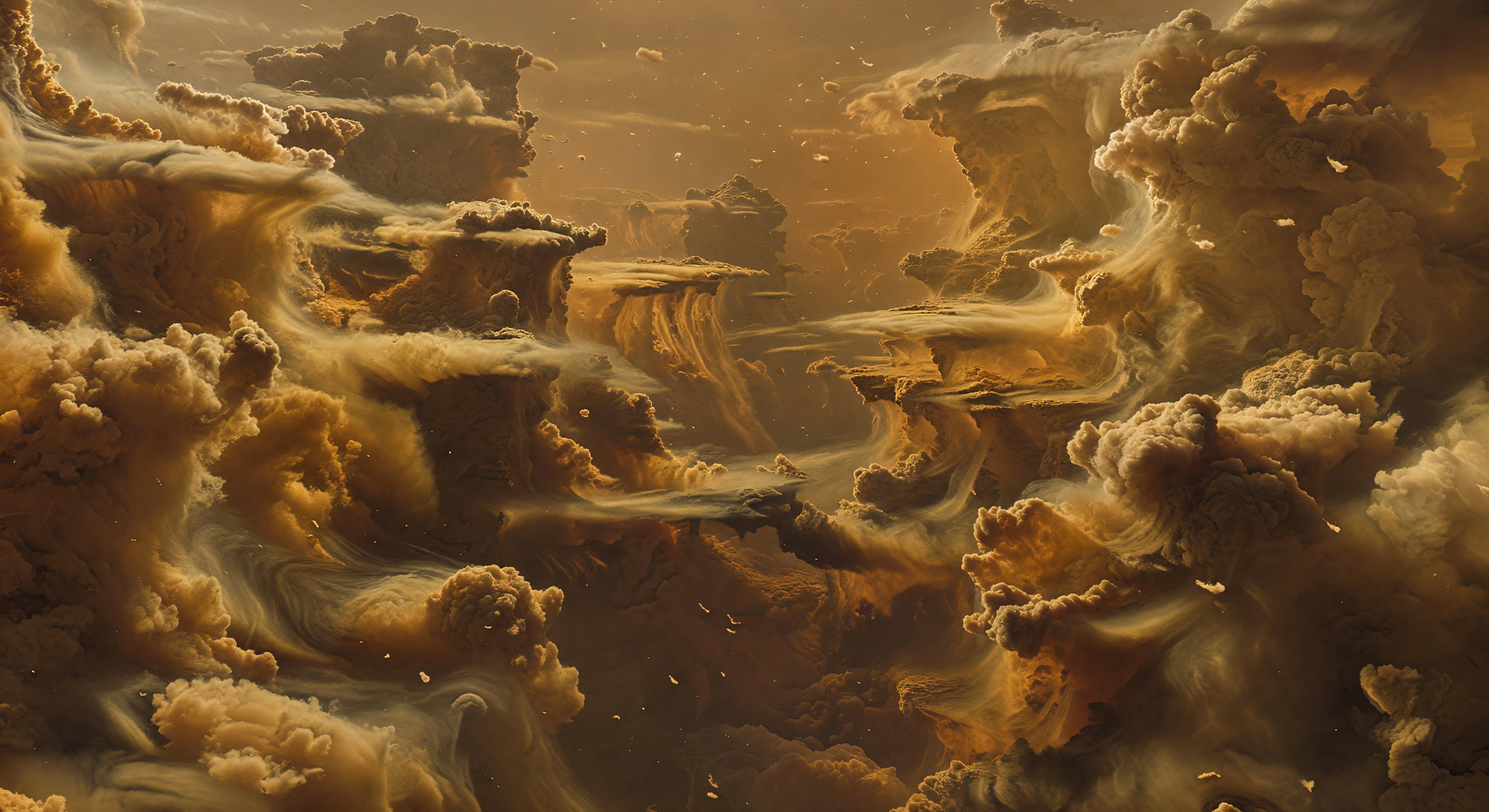
이곳에는 발 디딜 땅도, 시야를 가르는 수평선도 없고, 오직 1–3기압 영역의 짙은 황토빛과 담배잎 금색 안개 사이로 암모늄 하이드로설파이드 에어로졸이 빚어낸 거대한 구름 벽이 협곡처럼 솟아 있을 뿐입니다. 층층이 접힌 절벽 같은 구름 단애와 꽃양배추 모양의 대류 융기, 실처럼 꼬인 난류 필라멘트, 안쪽으로 무너져 내리는 깃장 같은 플룸이 수 킬로미터 규모로 이어지며, 더 깊은 곳에서는 물구름 대류를 암시하는 어두운 주머니들이 갈색 안개 속으로 삼켜집니다. 이 깊이에서는 태양 원반이 보이지 않고 햇빛도 두꺼운 에어로졸에 의해 완전히 산란되어, 공간 전체가 방향을 잃은 희미한 호박색 광휘로만 빛나며 그림자조차 흐릿하게 번집니다. 거대한 대기의 구조가 마치 암석 지형처럼 행동하는 이 풍경 앞에 서 있으면, 수소와 헬륨이 지배하는 행성의 대기가 얼마나 깊고 무겁고 격렬한지, 그리고 우리가 보고 있는 ‘지형’이 사실은 끝없이 움직이는 구름의 내부라는 사실이 숨 막히도록 실감납니다.
과학 심사 위원회
각 이미지는 AI 위원회에 의해 과학적 정확성이 심사됩니다.
Claude
이미지: Adjust
설명: Adjust
I largely concur with GPT's assessment but want to add several specific observations that push certain ratings in different directions. SCIENTIFIC ACCURACY: The dominant amber-ochre-tobacco palette is genuinely consistent with Jupiter's ammonium hydrosulfide cloud deck region, and the absence of any solid surface or horizon is scientifically correct and well-executed. However, I want to flag something GPT touched on but understated: the cloud morphology here skews too strongly toward terrestrial cumulonimbus architecture. Jupiter's convective plumes do produce cauliflower-textured upwellings, but the sharply defined tabletop mesa structures and near-vertical escarpments with clean horizontal stratification read more like sedimentary canyon geology than atmospheric dynamics. In a hydrogen-helium atmosphere at 1–3 bar, wind shear would produce more laterally smeared, oblate structures rather than these vertically pronounced ramparts. The swirling curtain elements in the mid-frame are more defensible scientifically. The specular glints and particulate debris scattered throughout have no clear Jovian analog and represent a genuine inaccuracy worth flagging independently of GPT's note. VISUAL QUALITY: I agree with GPT's 'approve' inclination here, but I'll downgrade slightly to 'adjust' because the aforementioned debris/glint artifacts and the overly geological cliff texturing introduce visual inconsistencies that undermine the atmospheric immersion the piece otherwise achieves well. The volumetric depth and haze gradients are genuinely impressive. CAPTION ACCURACY: I agree with GPT that the 'sunlight cannot penetrate as a clear beam' claim is contradicted by the image's relatively strong illumination gradient. I'd add that the caption's phrase 'pressure exceeds Earth's sea level' is scientifically accurate for the 1–3 bar range and is one of the more defensible specific claims, but the image does not visually convey atmospheric density meaningfully. The caption is also more poetically evocative than scientifically precise, which creates a mismatch with the Committee's evaluation framework. Recommend the caption be adjusted to reconcile lighting claims, soften the geological metaphors into explicitly atmospheric language, and remove the unexplained debris-glint phenomenon from the scene entirely in a regeneration pass.
Grok
이미지: Adjust
설명: Adjust
I concur with both GPT and Claude on the overall 'adjust' ratings for image and caption, but add nuanced insights based on close examination of the provided image. 1) SCIENTIFIC ACCURACY (adjust): The amber-ochre palette (ochre, tobacco-gold, muted rust) aligns excellently with Jupiter's ammonium hydrosulfide clouds at ~1-3 bar depths, as seen in JunoCam imagery of deeper belts; absence of ground/horizon and vast scale are spot-on for a hydrogen-helium atmosphere. Diffuse haze softening edges evokes multiple scattering in thick aerosols, correctly implying no direct sunlight beams. However, agreeing with Claude, cloud morphology leans too geological—sharp mesa-like escarpments, vertical ramparts, and stratified 'cliffs' mimic terrestrial canyons more than Jupiter's sheared, oblate plumes (e.g., Juno's convective upwellings show more turbulent, filamentary textures without such crisp horizontals). Scattered specular glints/particulates (visible as bright specks throughout) lack Jovian analogs—possibly artistic 'snow' but inaccurate for NH4SH aerosols, which appear as uniform haze. Lighting shows backlit glow with good visibility gradients, somewhat contradicting deeper opacity but defensible as scattered sunlight. Minor tweak: enhance shear-smearing and remove glints for accuracy. 2) VISUAL QUALITY (approve, contra Claude's downgrade): Photorealistic excellence—volumetric lighting, depth-of-field haze, and coherent composition rival high-end VFX (e.g., Interstellar's clouds). No artifacts; glints integrate as intentional particulate effects enhancing immersion, not errors. Scale feels monumental via forced perspective. 3) CAPTION ACCURACY (adjust): Matches core visuals (towering cloud walls, scalloped recesses, plume curtains, amber glow, no ground) and themes (weather as landscape, overwhelming scale). Mismatches: caption's 'sunlight cannot penetrate here as a clear beam' and 'bronze obscurity' imply dimmer opacity than image's luminous gradients; 'collapsing plume curtains' present but less dominant than static ramparts. Chemical/pressure specifics (1-3 bar NH4SH) scientifically sound but not visually 'proven' by image. Constructive: soften lighting claims in caption ('diffuse glow from scattered sunlight') and emphasize dynamic convection over static 'escarpments' to align.
Gemini
이미지: Adjust
설명: Adjust
I concur with the previous committee members regarding the 'adjust' status for both elements. My specific concern lies in the morphological 'uncanny valley' created by the image: while the color science is excellent, the structure of the clouds relies too heavily on terrestrial geological motifs (mesa-like escarpments) rather than fluid-dynamic ones. In a 1-3 bar Jovian environment, the high-speed zonal winds would subject these structures to intense shear, resulting in long, wispy, or 'smeared' cloud features rather than the rigid, cliff-like edges seen here. Furthermore, the committee is correct that the 'glints' or particulate debris are scientifically unsupported; these appear as crystalline dust or snow, which would be inconsistent with the high-pressure, high-temperature nature of the ammonium hydrosulfide deck. To reach an 'approve' status, the image should replace the sharp, solid-looking cliffs with more turbulent, billowing, and sheared plume structures, and remove the distracting 'glints' to allow the volumetric haze to do the work of conveying scale. The caption must be adjusted to acknowledge that the lighting is a product of intense multiple scattering rather than absolute opacity, and the description of the 'landscape' should move away from geological terms like 'escarpments' toward fluid-dynamic terms like 'convective cells' and 'shear-layered curtains'.
Matania — 종합 평가
이미지: Adjust
설명: Adjust
The committee found the scene broadly successful in evoking Jupiter’s deeper ammonium hydrosulfide cloud layers through its amber-ochre palette, immense scale, lack of a solid horizon, and thick volumetric haze. However, the image’s morphology reads too much like terrestrial geology: the sharply defined, cliff-like escarpments, mesa-like forms, and clean stratification feel rigid and canyon-like rather than fluid-dynamic and Jovian. Several reviewers also flagged scattered specular glints/particulate specks as scientifically unsupported or at least visually distracting. The caption matches the overall concept well, but it overstates the opacity and lighting conditions by implying sunlight cannot penetrate at all, whereas the image shows more visible backlit glow and scattered illumination. Its chemical and pressure specifics are plausible, but they are not directly evidenced by the image and should be presented more cautiously.
2) VISUAL QUALITY (approve): The image is high quality and impressively atmospheric: it is visually coherent, with consistent volumetric haze, strong depth cues, and no obvious rendering artifacts. The cloud masses, swirling curtains, and layered composition read clearly and plausibly as cloud structures. Minor concern: the dust-like specks/glints could be interpreted as particulate “snow” or debris rather than aerosols, but overall the aesthetic remains consistent.
3) CAPTION ACCURACY (adjust): The caption’s general themes—an atmospheric passage with no solid ground/horizon, monumental cloud formations, amber diffuse lighting, and a sense of immersion—match the image well. Differences are mainly in the lighting/optical conditions: the caption states sunlight cannot penetrate here, yet the image shows a more prominent illumination gradient and strong visibility. The explicit chemical/pressure specifics (NH4SH-rich aerosols at 1–3 bar) are not evidenced visually (and may be overstated given what’s observable in such a render). Adjust by softening the “no sunlight penetrates” assertion or by aligning the lighting to a more opaque, low-penetration regime.