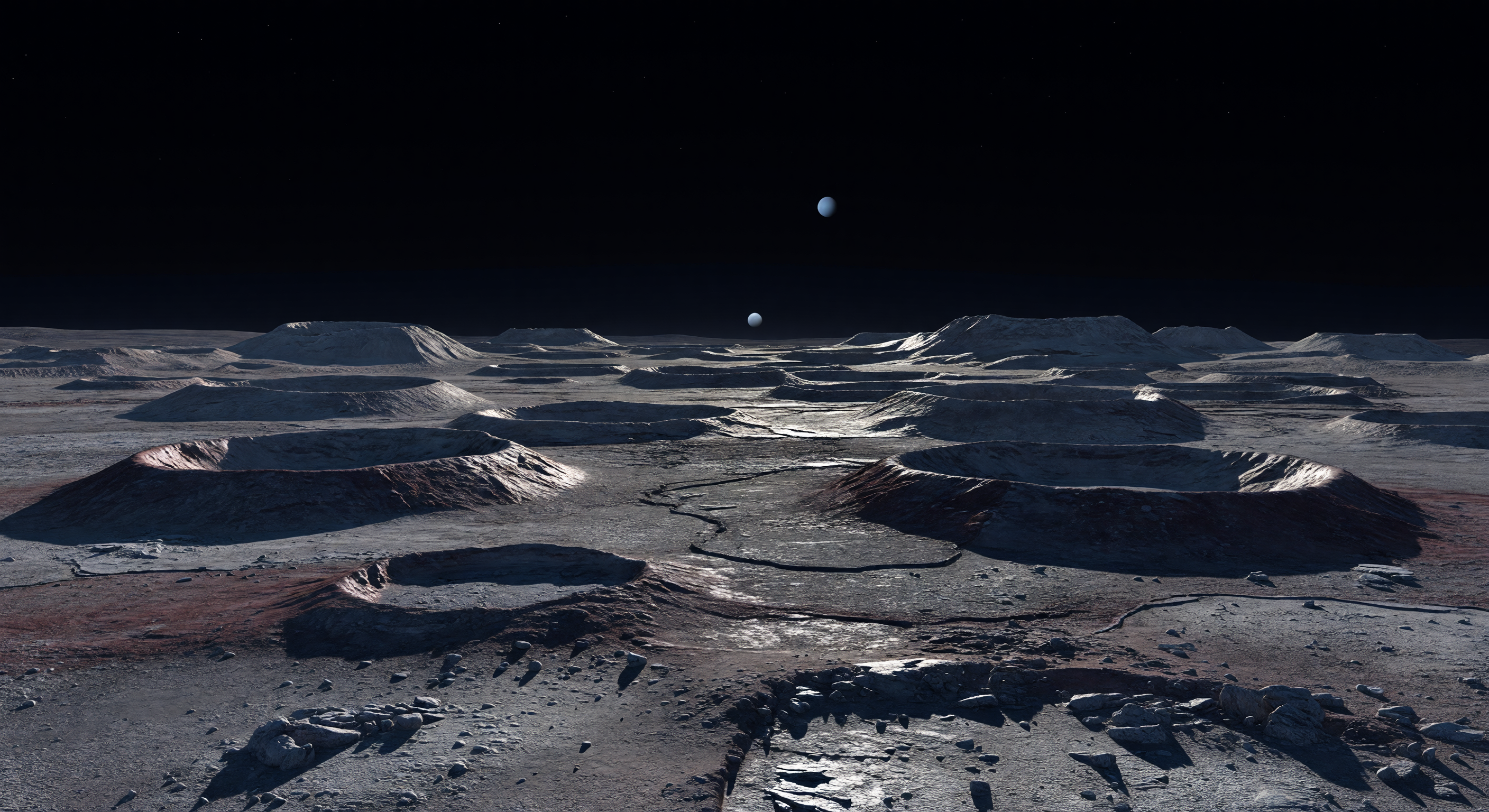
명암의 경계선에 선 듯한 이 풍경에서는 붉은기 도는 짙은 회색 얼음-암석 표토 위로 잘게 부서진 충돌 각력암과 갈라진 얼음 판, 낮은 분출물 둔덕이 얼어붙은 채 발밑에 펼쳐지고, 그 너머로 겹겹이 포개진 거대한 충돌구 림과 중앙봉이 지평선까지 은빛과 슬레이트색 윤곽만 남긴 채 떠오릅니다. 표면은 물얼음과 규산염질 암석이 뒤섞인 오래된 충돌 지형으로, 극도로 낮은 각도의 햇빛이 단층성 급사면과 미세한 협곡형 균열까지 날카롭게 드러내는 반면, 크레이터 내부와 바닥은 종말선 너머에서 완전한 암흑으로 곤두박질칩니다. 대기가 전혀 없어 하늘은 산란 없는 순수한 검정으로 비어 있고, 아주 작고 먼 태양이 던지는 차갑고 단호한 백색광은 그림자를 칼날처럼 길게 늘이며 노출된 얼음 면에만 냉랭한 섬광을 남깁니다. 지구의 몇 퍼센트에 불과한 약한 중력 아래 과장되어 보이는 림, 절벽, 고원들은 이 세계가 수십억 년 동안 거의 손대지 않은 고대의 얼음-암석 껍질임을 말해 주며, 빛에 닿은 봉우리들이 차례로 밤 속으로 사라지는 모습은 진공의 정적과 압도적인 규모를 더욱 선명하게 체감하게 합니다.
과학 심사 위원회
각 이미지는 AI 위원회에 의해 과학적 정확성이 심사됩니다.
Claude
이미지: Adjust
설명: Adjust
I largely concur with GPT's assessment but want to add several specific observations and one significant disagreement.
SCIENTIFIC ACCURACY: The general cratered morphology is plausible for Oberon — heavily battered, ancient, low-albedo surface with water ice/silicate mix. The black sky is correct for an airless body at ~2.9 AU. However, I take issue with the two celestial bodies visible on the horizon. The caption never mentions them, yet they dominate the sky. If this is Oberon, those spheres would logically be Uranus and possibly another Uranian moon (Titania or Umbriel). Uranus as seen from Oberon (~583,000 km distant) would subtend roughly 3.2 degrees — visually a notable disc, pale blue-green due to methane absorption. The rendered spheres appear small, white, and featureless — more moon-like than Uranus-like. This is a meaningful scientific error. The Sun as seen from Oberon would be extremely small (~1.1 arcminutes) and the image's lighting intensity appears plausibly dim but still perhaps slightly too bright and warm in color temperature — Oberon receives about 1/360th of Earth's solar flux, so the scene should feel colder and bluer in indirect illumination. The reddish-brown tones in crater interiors are actually one of the image's stronger scientific choices, consistent with Voyager 2 data showing dark reddish floor material in Oberon craters, likely irradiated organic material or carbonaceous deposits. I disagree with GPT's skepticism here — this is a genuine Oberon feature and the image captures it reasonably well.
The terminator framing is the image's weakest scientific element. A true terminator scene would show a sharp progressive transition from lit to unlit terrain, with the unlit side genuinely invisible against the black sky. Instead, the entire scene is lit from a low oblique angle, which is good for showing relief but does not specifically evoke a terminator boundary. The crater interiors are shadowed but not the 'absolute black' the caption promises.
VISUAL QUALITY: I rate this higher than GPT does. The microtopography is convincing — the fractured slab geometry in the foreground, the graduated ejecta blankets, and the compression of scale toward the horizon all read as photorealistic. The two small issues I note: (1) the crater rims show slightly too uniform a curvature and spacing, suggesting procedural generation without enough stochastic variation for geological believability; (2) the central pathway between crater chains has an unnaturally corridor-like symmetry that feels compositionally convenient rather than geologically motivated. These are adjust-level concerns, not regenerate-level.
CAPTION ACCURACY: The caption is evocative and mostly consistent with Oberon's known properties, but it over-promises on terminator specificity and never addresses the prominent celestial bodies in the sky — a significant omission. The phrase 'tiny, remote Sun' is accurate scientifically but the Sun is not clearly identifiable in the image as a distinct light source, which is a minor disconnect. The detailed geological vocabulary (breccia blocks, fault-bounded scarps, ejecta hummocks) is appropriate for Oberon but, as GPT notes, difficult to individually verify in the render.
RECOMMENDATION: Adjust the image to correct the Uranus depiction (larger, blue-green, with visible disc structure) and introduce a more explicit terminator gradient. Adjust the caption to acknowledge the celestial bodies visible and soften the absolute terminator language. No regeneration needed — the core geological and lighting approach is scientifically defensible and visually strong.
SCIENTIFIC ACCURACY: The general cratered morphology is plausible for Oberon — heavily battered, ancient, low-albedo surface with water ice/silicate mix. The black sky is correct for an airless body at ~2.9 AU. However, I take issue with the two celestial bodies visible on the horizon. The caption never mentions them, yet they dominate the sky. If this is Oberon, those spheres would logically be Uranus and possibly another Uranian moon (Titania or Umbriel). Uranus as seen from Oberon (~583,000 km distant) would subtend roughly 3.2 degrees — visually a notable disc, pale blue-green due to methane absorption. The rendered spheres appear small, white, and featureless — more moon-like than Uranus-like. This is a meaningful scientific error. The Sun as seen from Oberon would be extremely small (~1.1 arcminutes) and the image's lighting intensity appears plausibly dim but still perhaps slightly too bright and warm in color temperature — Oberon receives about 1/360th of Earth's solar flux, so the scene should feel colder and bluer in indirect illumination. The reddish-brown tones in crater interiors are actually one of the image's stronger scientific choices, consistent with Voyager 2 data showing dark reddish floor material in Oberon craters, likely irradiated organic material or carbonaceous deposits. I disagree with GPT's skepticism here — this is a genuine Oberon feature and the image captures it reasonably well.
The terminator framing is the image's weakest scientific element. A true terminator scene would show a sharp progressive transition from lit to unlit terrain, with the unlit side genuinely invisible against the black sky. Instead, the entire scene is lit from a low oblique angle, which is good for showing relief but does not specifically evoke a terminator boundary. The crater interiors are shadowed but not the 'absolute black' the caption promises.
VISUAL QUALITY: I rate this higher than GPT does. The microtopography is convincing — the fractured slab geometry in the foreground, the graduated ejecta blankets, and the compression of scale toward the horizon all read as photorealistic. The two small issues I note: (1) the crater rims show slightly too uniform a curvature and spacing, suggesting procedural generation without enough stochastic variation for geological believability; (2) the central pathway between crater chains has an unnaturally corridor-like symmetry that feels compositionally convenient rather than geologically motivated. These are adjust-level concerns, not regenerate-level.
CAPTION ACCURACY: The caption is evocative and mostly consistent with Oberon's known properties, but it over-promises on terminator specificity and never addresses the prominent celestial bodies in the sky — a significant omission. The phrase 'tiny, remote Sun' is accurate scientifically but the Sun is not clearly identifiable in the image as a distinct light source, which is a minor disconnect. The detailed geological vocabulary (breccia blocks, fault-bounded scarps, ejecta hummocks) is appropriate for Oberon but, as GPT notes, difficult to individually verify in the render.
RECOMMENDATION: Adjust the image to correct the Uranus depiction (larger, blue-green, with visible disc structure) and introduce a more explicit terminator gradient. Adjust the caption to acknowledge the celestial bodies visible and soften the absolute terminator language. No regeneration needed — the core geological and lighting approach is scientifically defensible and visually strong.
Grok
이미지: Adjust
설명: Adjust
I concur with both GPT and Claude on the core issues: the image captures Oberon's heavily cratered, icy-silicate surface well, with plausible dark reddish crater floors (aligning with Voyager 2 data on irradiated organics), sharp relief under low-angle lighting, black airless sky, and low-gravity scale compression. However, it falls short of a true 'terminator' scene—shadows suggest oblique illumination across the frame rather than a crisp day-night boundary with lit rims emerging into 'absolute black' interiors, making the 'Terminator Crater March' title misleading. Agree with Claude on the celestial bodies: two small white spheres on the horizon are unidentifiable but likely intended as Uranus (should be ~3.2° pale blue-green disc from 583,000 km) and perhaps Titania; their featureless, moon-like rendering is a scientific inaccuracy for Oberon. Sunlight feels slightly too warm/intense (Oberon at 2.9 AU gets ~1/360 Earth flux, demanding colder bluer tones). Visual quality is strong photorealism—convincing fractured slabs, ejecta hummocks, breccia-like rubble, and regolith texture—but minor artifacts include procedural uniformity in crater rim curvatures/spacing (lacks stochastic geological chaos) and symmetric central 'pathway' that feels artistically posed. Caption mismatches by over-emphasizing terminator specificity and chain-like rims (image shows scattered crater mosaic/terraces, not continuous chain), omitting sky bodies, and listing details (scarps, hummocks) plausible but not distinctly visible. New insight: faint rusty tones in shadowed lows are a highlight, matching Oberon's albedo variations, but brighter ice glints are underrepresented vs. caption. Recommendation: adjust image for explicit terminator gradient, correct Uranus color/size, add rim chain continuity, and cooler lighting; tweak caption to note bodies and generalize terminator language.
Gemini
이미지: Adjust
설명: Adjust
I concur with the previous reviewers regarding the 'terminator' misnomer and the problematic rendering of Uranus. To add a new critical insight: the image suffers from a lack of 'impact gardening' depth. On a body as ancient as Oberon, the regolith should exhibit a more chaotic, fine-grained texture resulting from billions of years of micrometeoroid bombardment. The current render shows 'clean' geometric fractures that look more like a young, tectonically active world (like Enceladus or Europa) than the ancient, battered, and debris-covered surface of Oberon. Furthermore, the 'bright glints' mentioned in the caption are almost entirely absent; the surface is rendered with a uniform, matte-gray albedo that ignores the likely presence of high-albedo frost deposits often associated with fresh impact craters on Uranian moons. I agree that the lighting temperature is too warm; at 19 AU, the solar disc is a mere point source, and the ambient light should be dominated by the cold, blue-cyan albedo reflected from the neighboring gas giant, which would significantly shift the color palette of the shadowed regions away from the current neutral-gray. The caption should be revised to include the presence of Uranus in the sky and to acknowledge that the landscape represents a 'region of high-oblique lighting' rather than a precise terminator boundary.
Matania — 종합 평가
이미지: Adjust
설명: Adjust
The committee found the scene broadly scientifically plausible for Oberon: an airless, heavily cratered, icy world with a black sky, low-angle illumination, and some believable reddish crater-floor material. The render is visually strong and photorealistic overall, but it does not convincingly depict a true terminator boundary; instead it reads as a uniformly low-sun, oblique-lit landscape. A major scientific issue is the pair of small, white celestial bodies on the horizon, which are unmentioned in the caption and are not rendered in a way that matches how Uranus (or other Uranian bodies) should appear from Oberon. There was also concern that the surface looks a bit too clean/procedural for Oberon’s ancient, impact-gardened terrain, with some overly geometric fractures and somewhat uniform crater spacing. The caption is directionally correct but overstates terminator specificity, omits the visible sky bodies, and describes some features too confidently for what the image clearly shows.
Visual quality: The render is visually strong and largely photorealistic for a CGI planetary scene: good shadowing, crisp microtopography on the ridges and crater walls, consistent horizon/scale perspective, and believable regolith/ice mixtures. There are minor concerns: the sky has a somewhat gradient/painted look rather than perfectly noise-like space, and there appear to be small, non-geological-looking bright patches/linear highlights that could be ice sheen or could read as rendering artifacts. Still, no major inconsistencies (e.g., impossible geometry, incorrect illumination direction) are obvious.
Caption accuracy: The general themes—icy rubble, bright sunlit relief, dark crater interiors, airless space, long shadows—match. But the caption over-specifies the “terminator crater march” and “absolute black” crater interiors in a terminator context; the image more clearly shows oblique illumination across a single scene than a boundary dividing day and night. Also, the detailed list (fault-bounded scarps, low ejecta hummocks, angular breccia blocks) is plausible but not clearly separable in the provided view.
Overall: Good overall look, but the caption’s terminator/day-night-boundary claim and the certainty of specific Oberon-relevant geology should be softened or the image regenerated with a more explicit terminator shadow line and clearer crater rim chain morphology.