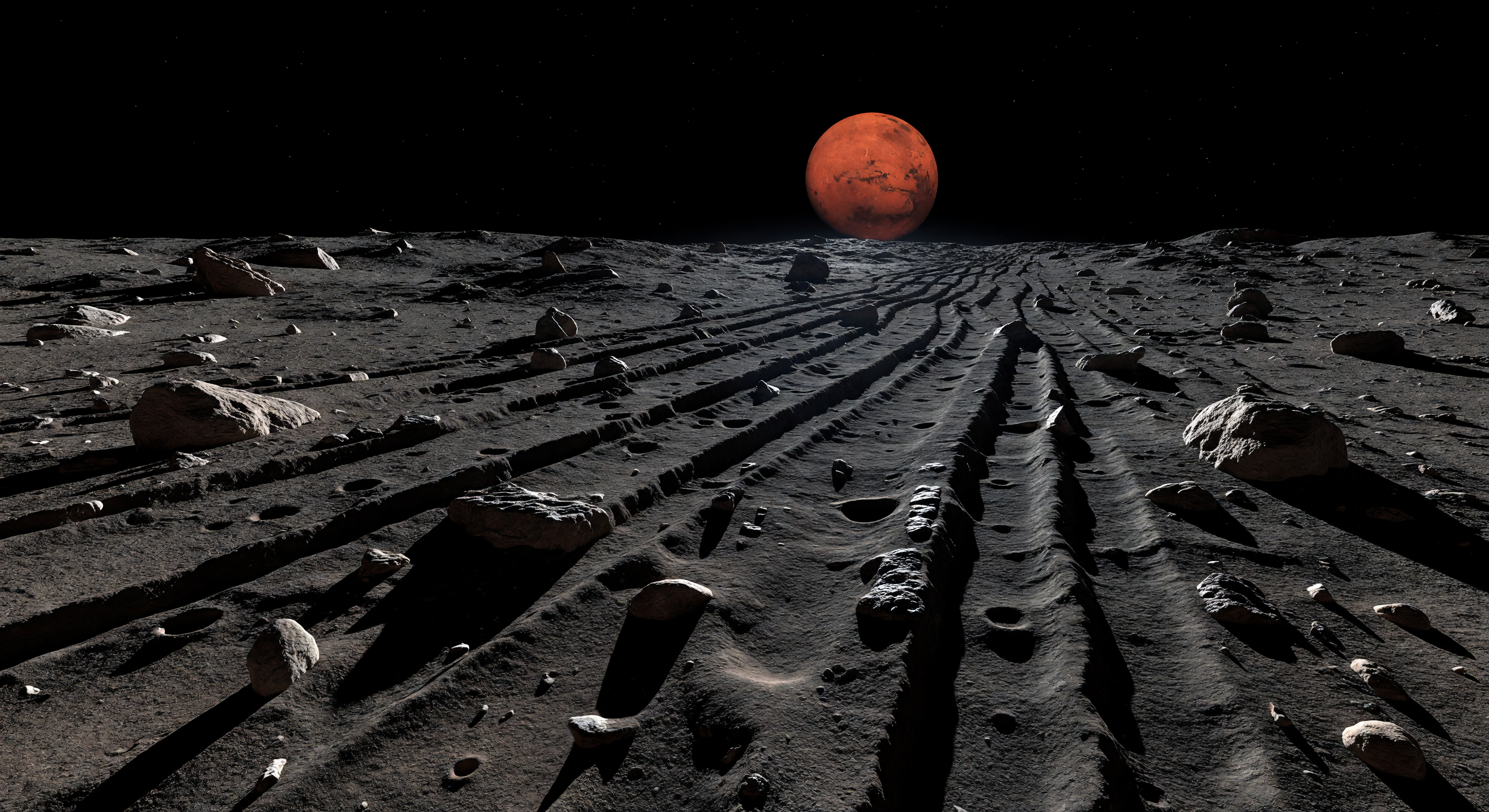
검은 진공의 하늘 아래, 지평선에 바짝 붙은 낮은 태양빛이 어두운 회색의 먼지투성이 표토를 거의 수평으로 쓸며 지나가자, 얕고 평행한 홈들과 그 사이의 가느다란 암석 능선이 수 킬로미터 너머까지 이어지는 거대한 복도처럼 모습을 드러냅니다. 발치에는 각진 각력암 조각, 구멍 많은 바위, 자갈 크기의 충돌 파편, 홈 바닥에 고인 미세한 분말이 놀라울 만큼 선명한 질감으로 놓여 있고, 대기가 전혀 없어 모든 그림자는 면도날처럼 날카롭게 길게 뻗어 홈 내부를 거의 완전한 암흑으로 떨어뜨립니다. 이 표면은 탄소질 소행성 물질을 닮은 저반사율의 오래된 암석과 두꺼운 레골리스로 덮여 있으며, 극도로 약한 중력 덕분에 섬세한 능선과 작은 2차 충돌구의 가장자리까지 쉽게 무너지지 않은 채 보존되어 있습니다. 가까운 곡률이 느껴지는 낮은 지평선 위로는 붉은 행성이 거대한 원반으로 떠 있어 그 미약한 반사광이 그림자 가장자리에 희미한 녹슨 빛을 더하고, 그 앞에 서 있으면 이 작고 상처 입은 세계가 얼마나 고요하고도 위태로운 천체인지 실감하게 됩니다.
과학 심사 위원회
각 이미지는 AI 위원회에 의해 과학적 정확성이 심사됩니다.
Claude
이미지: Adjust
설명: Adjust
I largely concur with GPT's assessment but want to add several more specific observations. SCIENTIFIC ACCURACY: The most glaring issue is the identity of the planet in the sky. The description states this is Phobos' surface with Mars looming overhead, but the rust-red disk shown is clearly Mars rendered as a simple, nearly featureless orange sphere — this is actually the most scientifically defensible element, since from Phobos Mars would subtend roughly 25° of arc (about 6,400 km diameter viewed from ~9,400 km), so the apparent size is plausible and even slightly conservative. However, Mars' surface detail is severely lacking; real imagery would show Valles Marineris, polar caps, and albedo features. The groove geometry is the primary geological problem. Phobos' famous grooves (likely stress fractures from the Stickney impact or tidal forces) are irregular, variable in width, and rarely form the kind of near-perfectly parallel, evenly-spaced corridor shown here. The pattern reads far more like vehicle tire tracks or a raked field, which GPT correctly flagged. The regolith color and texture are reasonably consistent with a carbonaceous, low-albedo body — dark gray with subtle brown tones. The airless lighting with infinitely sharp shadow terminations is correctly rendered. VISUAL QUALITY: The image is technically accomplished. Shadow casting is physically consistent with a single unfiltered light source. Rock diversity (angular breccia, rounded boulders, fine powder) is convincing. The main visual problem, beyond the groove regularity, is that the grooves converge too perfectly toward a vanishing point, giving a perspective-exaggerated, almost theatrical quality that undermines photorealism. A genuine groove field would show more lateral variation, branching, and interruption by craters. CAPTION ACCURACY: The description is well-crafted but overclaims. 'Narrow rock ribs' and 'fine dust pooled in groove bottoms' are mentioned but not clearly visible at this resolution. The description of 'countless' superposed craters is not well supported — only a modest number of small craters are visible. The phrase 'recede for kilometers' is plausible given scale but unverifiable in the render. The 'surprisingly close, curved horizon' is partially visible but not as dramatic as implied given the wide field of view. RECOMMENDATION: The image needs groove geometry revision to introduce lateral variability, branching, and crater interruptions consistent with known Phobos groove morphology. Mars' disk should include albedo features. The caption should moderate claims about dust pooling and crater density to match what is actually depicted.
Grok
이미지: Adjust
설명: Adjust
I concur with both GPT and Claude on the core issues, with some additional insights. SCIENTIFIC ACCURACY: approve with caveats—the dark regolith color (charcoal-gray/brownish, low albedo ~.07), sharp airless lighting, black sky, and curved near-horizon (Phobos radius ~11 km implies ~3 km visible distance at 2m height) are spot-on per Viking/HiRISE data. Mars disk size (~20-25° angular diameter from Phobos' orbit) is accurate, rust-red hue correct, but lacks albedo features (e.g., Syrtis Major, Hellas) and visible limb darkening/texture, making it too uniform (disagree slightly with Claude: featurelessness is a miss, not a strength). Primary flaw: grooves are excessively uniform, parallel, and track-like (spacing ~5-10m, straight for 100s m), unlike Phobos' real grooves (Grooves on Phobos are 100m-5km wide, irregular, radial to Stickney or tidal, interrupted by craters/breccia, per MRO imagery—not corridor-like rakes). Low-g ejecta blanket and micro-craters plausible but sparse here. VISUAL QUALITY: High photorealism overall—no artifacts, consistent shadows from grazing Sun (azimuth ~10° elevation), good regolith diversity (powder, breccias, boulders), dynamic range fits unfiltered sunlight. Detracts: groove convergence to vanishing point feels artificial/staged; shadows in grooves too uniformly dark without subtle multiple scattering. CAPTION ACCURACY: Matches composition (low Sun, shadows to horizon, Mars glow, grooves), but overstates 'parallel grooves and narrow rock ribs' (ribs vague), 'fine dust pooled in groove bottoms' (not distinctly visible), 'countless impacts/tiny superposed craters' (few shown), and 'recede for kilometers' (plausible but exaggerated by perspective). New insight: Add faint Mars-illuminated glow on shadowed regolith (albedo ~.07 reflects ~.001 lux) and disrupt grooves with Stickney-ray-like debris for fidelity. Overall: strong visuals/lighting justify 'adjust' over regenerate.
Gemini
이미지: Adjust
설명: Adjust
I concur with the committee's consensus. The image succeeds in capturing the high-contrast, airless lighting environment essential for a Phobos landscape, but suffers from significant geological inaccuracies. Specifically, the 'groove' morphology is too uniform and linear, failing to reflect the complex, irregular, and intersecting nature of Phobos’ actual surface features, which are typically associated with the Stickney impact or tidal stress. The depiction of Mars is too simplistic; as a body filling such a massive portion of the sky, it requires discernible albedo features (e.g., Valles Marineris or identifiable dark/light regions) to achieve true scientific credibility. Regarding the caption, it over-promises on micro-geological details like 'fine dust pooling' and 'countless' craters, which are not resolved in the current render. To move to 'approve,' the next iteration should introduce lateral branching in the grooves, break up the geometric regularity with random impact craters, and add realistic atmospheric albedo detail to the disk of Mars.
Matania — 종합 평가
이미지: Adjust
설명: Adjust
The committee found the scene broadly convincing in lighting and environmental context for Phobos: an airless black sky, razor-sharp shadows, dark low-albedo regolith, and a plausibly sized Mars disk all support the setting. However, the main scientific weakness is the groove field, which is rendered as overly uniform, parallel, corridor-like furrows that read more like artificial tracks or raked terrain than the irregular, disrupted, crater-crosscutting groove systems known on Phobos. Mars also appears too featureless and clean for a scientifically credible view from Phobos, lacking visible albedo structure. The caption matches the overall mood but overstates unresolved details such as dust pooling, crater abundance, and the exact geometry of the grooves. Overall, the image is strong visually but needs geological correction, and the caption should be tightened to match what is actually visible.
VISUAL QUALITY: The image is high-quality and convincingly rendered: realistic rocky regolith, coherent grazing shadows, and a sharp dynamic range that fits low light conditions. The Phobos disk is visually integrated and the surface shading is consistent. Main concern is geometric plausibility: the grooves/furrows are overly regular and uniform, and some shadows/contours imply near-kinematic “track” behavior rather than erosion/impact-texturing. Aside from that, there are no obvious rendering artifacts, UI elements, or compositing errors.
CAPTION ACCURACY: The caption matches the general gist (sunrise-like low-angle light, near-black sky, long shadows, dusty dark regolith, surface clutter, Phobos dominating one side). But the description is too specific about “parallel grooves and narrow rock ribs carved into dark, dusty regolith” and “fine dust pooled in groove bottoms” plus numerous superposed tiny craters; in the image, the grooves appear more like continuous, channel-like furrows with less clear evidence of abundant superposed micro-craters across the channels’ floors. The “absolute black” sky is accurate, and the “razor-long shadows” are well represented.
Overall: good atmosphere/lighting realism, but the geological motif (highly uniform parallel grooves) and the Phobos disk portrayal reduce scientific fidelity. Hence minor-to-moderate adjustment rather than full approval.