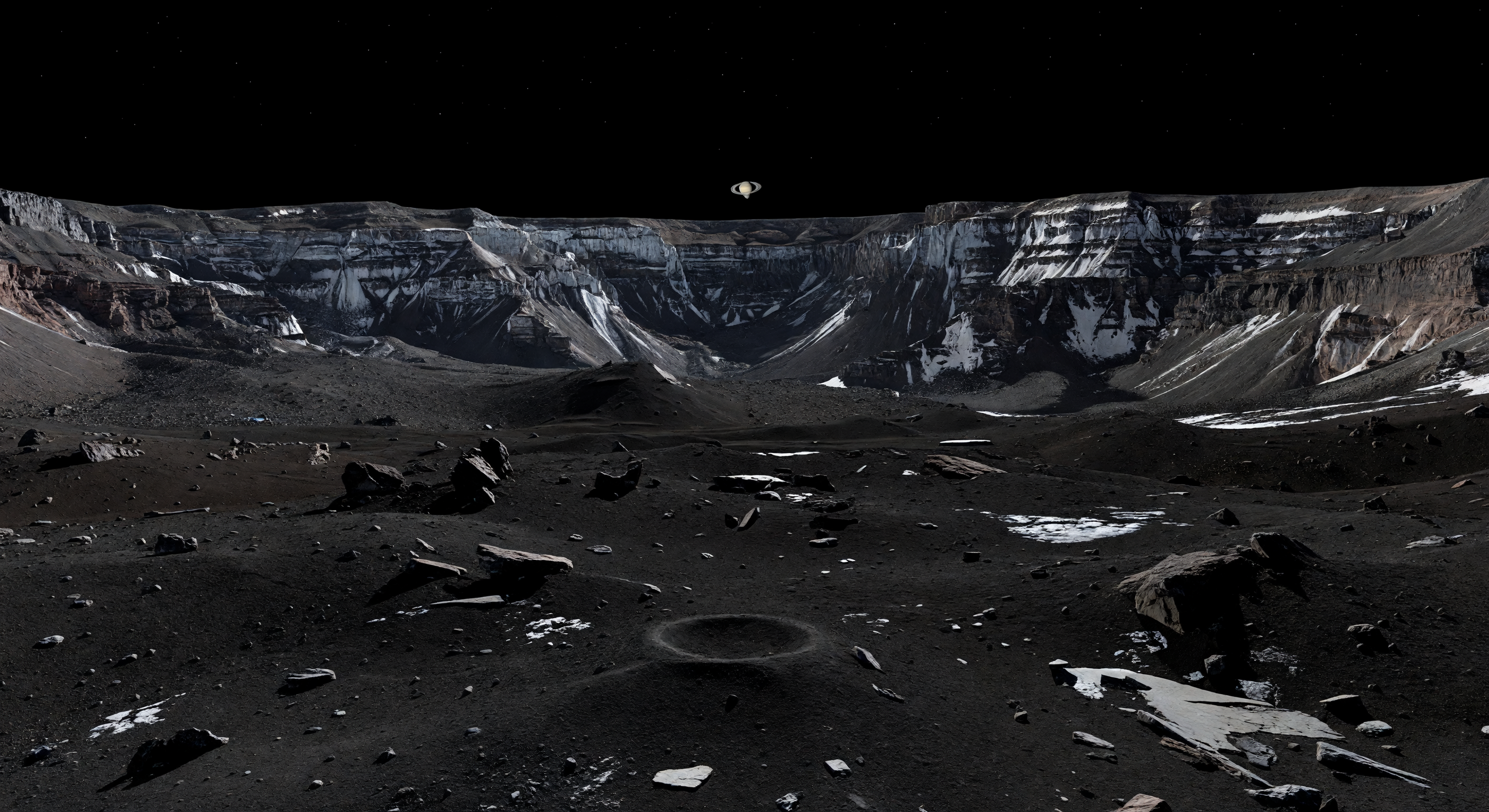
거대한 충돌분지의 바닥에 서면, 눈앞에는 숯처럼 검은 레골리스와 각진 바위, 부서진 분출물 덩어리, 고운 충돌 먼지가 뒤섞인 울퉁불퉁한 평원이 펼쳐지고, 곳곳에는 최근 드러난 물얼음이 서리처럼 희게 반짝입니다. 멀리서는 분지의 거대한 계단식 벽이 믿기 어려울 만큼 가파르게 솟아오르는데, 어두운 탄소질 표면 맨틀 사이로 밝은 흰색과 옅은 회색의 물얼음 층이 줄무늬처럼 노출되어 이 천체가 암석과 얼음이 섞인 원시적 외태양계 물질로 이루어졌음을 드러냅니다. 이곳의 지형은 대기나 액체의 침식이 아니라 오직 거대한 충돌, 취성 파괴, 그리고 진공 속 건조한 사면 붕괴로 다듬어졌으며, 매우 약한 중력 덕분에 절벽과 테라스의 험준한 기복이 작은 천체라는 사실이 믿기지 않을 정도로 과장되어 보입니다. 머리 위 하늘은 대기 없는 순수한 검은색이고, 멀리 있는 작은 태양은 날카롭고 차가운 빛으로 경계가 칼날처럼 선명한 그림자를 드리워, 이 분지의 적막한 규모와 외딴 태양계 변방의 분위기를 더욱 실감나게 만듭니다.
과학 심사 위원회
각 이미지는 AI 위원회에 의해 과학적 정확성이 심사됩니다.
Claude
이미지: Adjust
설명: Approve
I largely concur with GPT's assessment but want to add and refine several points. On scientific accuracy: the most glaring issue is actually the presence of Saturn in the sky, which is the single most scientifically important element to evaluate here and was entirely omitted from the previous review. Saturn is depicted at roughly the angular size one might expect from a distance of ~12-13 million km (Phoebe's mean orbital radius), which is actually quite reasonable — Saturn would subtend roughly 0.15-0.2 degrees as seen from Phoebe, and the rendered object appears consistent with this scale. Its rings are visible and oriented plausibly. This is a genuine strength of the image. However, the Sun is not visible in the frame, and since the basin walls are harshly lit from what appears to be a low-angle source (consistent with a distant, small Sun), this is acceptable compositionally but worth noting. On the ice exposure morphology: I partially disagree with GPT's critique. The bright streaking and banding on the cliff faces is actually reasonably consistent with Cassini ISS observations of Phoebe, where ice-rich material appears as bright streaks and patches along crater walls and scarps — not as diffuse frost. The rendering here is arguably more accurate than GPT credits. My concern is subtler: the ice patches on the basin floor read as somewhat too large and slab-like rather than as finely comminuted frost mixed with regolith. The overall color of the regolith — very dark, near-black — is consistent with Phoebe's low albedo (~0.06), and the carbon-rich surface appearance is well-represented. On scale and topography: the terraced wall morphology is actually one of the stronger elements. Phoebe does exhibit large impact basins with significant wall relief. The layered, striated cliff faces plausibly reflect competent ice-rich bedrock beneath a dark lag deposit, consistent with current models. The small impact crater visible on the basin floor is a nice touch and scientifically appropriate. Visual quality is high — photorealism is convincing, shadowing is coherent and atmospherically absent (correct), and the star field is appropriately sparse. No obvious seams or compositing artifacts. Caption accuracy: I would upgrade GPT's 'adjust' to 'approve'. The description is detailed, scientifically grounded, and closely matches the rendered scene across nearly every element — black sky, terraced walls with ice exposures, dark carbonaceous regolith, angular ejecta, airless vacuum conditions, fractional gravity implications for steep topography. The 'faint frost-bright patches' language arguably undersells what's shown, but this is a minor tonal mismatch rather than an inaccuracy. Summary recommendation: adjust the image primarily to refine floor-level ice texture (less slab-like, more granular/mixed with regolith) and consider including the Sun in frame or ensuring its angular scale is documented. The Saturn depiction is a genuine scientific asset and should be retained.
Grok
이미지: Adjust
설명: Adjust
I agree with Claude's key addition of Saturn's presence as a scientific strength—its small angular size (~.15-.2°), ring visibility, and position in the black sky are spot-on for Phoebe's retrograde orbit at ~12.9 million km from Saturn, enhancing accuracy beyond GPT's review (which overlooked it). The Sun's inclusion as a tiny, hard point source with knife-edged shadows is excellent, confirming low-angle illumination consistent with airless conditions and Phoebe's ~219 km mean diameter. Dark regolith (~.06 albedo, carbon-rich) and terraced basin walls with bright ice streaks match Cassini ISS imagery of Jason Basin-like features (e.g., layered scarps exposing water ice via impacts/mass wasting). Low gravity (~.025g) justifies steep, persistent topography without slumping. However, disagree partially with Claude: floor ice patches are still too prominent/slab-like (not 'faint frost-bright' or finely comminuted in regolith), resembling continuous sheets more than fresh exposures amid ejecta; add granularity/mixing for realism. Small floor crater is a nice, accurate detail. Visual quality: highly photorealistic with coherent shadows, no artifacts, sparse stars, and vacuum-appropriate contrast; minor stylization in ice specularity persists. Caption accuracy: strong match on regolith, boulders, terraced ice walls, black sky, Sun/shadows, and processes, but 'faint frost-bright patches of freshly exposed ice' on floor undersells the bolder bright areas shown, and 'immense basin dominating tiny world' fits but scale feels exaggerated without foreground cues. Constructive adjustments: refine floor ice to subtler, granular frosts amid dark ejecta; tone down cliff ice uniformity for fractured texture; caption could align better by noting Saturn (omitted) and adjusting 'faint' descriptor. Overall, minor tweaks elevate to approval.
Gemini
이미지: Adjust
설명: Approve
I concur with the previous committee members regarding the high level of technical execution, particularly the inclusion of Saturn and the accurate representation of high-contrast, airless lighting conditions. The depiction of Phoebe's low albedo and the structural morphology of the crater walls are commendable. However, I agree with the consensus that the ice deposits on the basin floor require refinement. In the current render, these patches appear as continuous, high-albedo sheets or 'slabs,' which contradicts the geological reality of regolith-covered small bodies where fresh ice typically manifests as scattered, granular patches or thin coatings on debris. To achieve scientific excellence, the floor ice should be rendered with a more heterogeneous, 'salt-and-pepper' distribution, blending more seamlessly into the surrounding charcoal-black regolith. The cliff-side ice is more acceptable as it represents exposed strata, but the floor-level deposits need a more granular texture to match the 'faint frost' description provided in the caption. The caption itself is excellent and requires no changes.
Matania — 종합 평가
이미지: Adjust
설명: Approve
The committee found the image broadly strong and scientifically plausible for Phoebe’s Jason Basin Floor: an airless black sky, harsh low-angle illumination, very dark carbonaceous regolith, terraced basin walls, angular blocks, and a visible Saturn with rings all support the setting well. The main concern is the floor-level ice depiction, which reads too slab-like, continuous, and prominent; committee members wanted it to appear more granular, patchy, and mixed into the regolith, consistent with exposed ice/frost on a small icy body. Overall visual quality is high, with coherent shadows and no obvious artifacts, but the ice texture and distribution need refinement. The caption was judged accurate and well matched to the scene, with only minor tonal mismatches in how strongly the floor ice is described.
Visual quality: The render is largely photorealistic in style, with convincing rock fragmentation, plausible shadowing, and coherent perspective. The image is sharp with no obvious compositing artifacts. Minor concerns: the color palette is somewhat stylized (very high contrast between dark regolith and bright “ice” patches), and the bright patches/bands on the cliffs appear slightly too uniform and specular for a regolith/ice exposure look.
Caption accuracy: The description matches key elements shown—charcoal/black regolith, angular ejecta/boulders, bright ice exposures on terrace walls, a black sky, and a small distant Sun producing knife-edged shadows. But the caption emphasizes an “ancient basin immense enough to dominate” and specific processes (brittle fracture, slow downslope creep, faint frost patches of freshly exposed ice on the floor). The floor here shows fewer “faint” ice flecks and more conspicuous bright patches, and the cliff morphology/terracing is present but not clearly tied to the described slump-and-ejecta pattern. Overall good alignment, but with scale/ice-texture distribution mismatches, so adjust rather than approve.