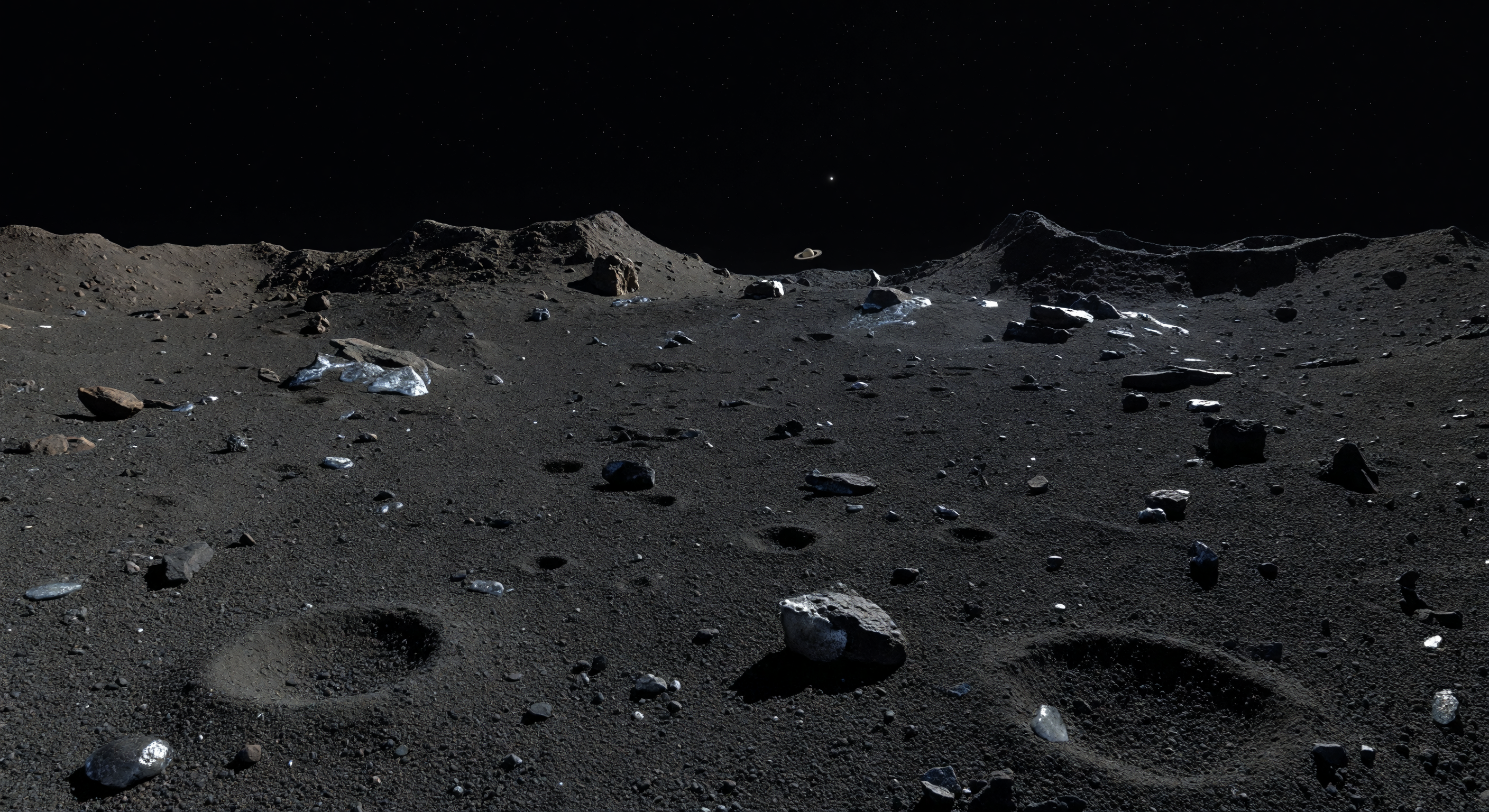
발아래 펼쳐진 것은 공기 한 점 없는 세계의 거친 미세충돌 분화구 지대다. 무광의 숯빛에서 짙은 회색에 이르는 입상 토양은 탄소가 풍부한 원시 먼지와 잘게 부서진 암석·얼음 조각으로 이루어져 있으며, 센티미터에서 데시미터 규모의 작은 충돌구들이 빽빽하게 새겨져 끝없는 충돌의 역사를 드러낸다. 그 사이로 자갈 같은 분출물과 각진 암편들이 흩어져 있고, 갓 깨진 자리에서는 물얼음이 많은 은회색 조각이 차갑게 번뜩이는데, 멀리 작은 태양이 던지는 날카로운 백색광이 모든 알갱이와 그림자를 면도날처럼 또렷하게 드러내기 때문이다. 중력은 극히 약해 사면과 분화구 가장자리는 비정상적으로 가파르고 느슨하게 걸쳐 있는 듯 보이며, 저 멀리 솟은 거친 고지와 날 선 분화구 림 위로는 대기 산란 없는 완전한 검은 하늘이 펼쳐져, 이 얼어붙은 고대 천체가 태양계 바깥 기원의 포획 천체일 가능성을 조용히 암시한다.
과학 심사 위원회
각 이미지는 AI 위원회에 의해 과학적 정확성이 심사됩니다.
Claude
이미지: Adjust
설명: Adjust
I largely concur with the previous reviewer's assessment but wish to add several specific observations. SCIENTIFIC ACCURACY: The dark charcoal regolith coloration is broadly consistent with Phoebe's known albedo (~0.06–0.08), one of the darkest surfaces in the solar system, and the harsh unidirectional lighting with razor-sharp shadows correctly reflects the absence of atmosphere and the extreme solar distance (~9 AU). The black sky is appropriate. However, I take issue with the rendering of Saturn in the background: it appears far too large and detailed for how it would appear from Phoebe's distance (~215 AU from Saturn when at apoapsis, though at periapsis closer to ~200 Rsat, Saturn would still subtend only a modest angular diameter). The rendered Saturn looks almost Moon-sized from Earth, which is significantly exaggerated. This is a notable scientific inaccuracy the previous reviewer did not flag. The bright icy fragments are a legitimate feature — Cassini VIMS data confirmed water-ice exposures on Phoebe — but their distribution as large, uniformly specular, almost metallic-looking blocks is misleading; real ice exposures would be more subtly brighter patches integrated into the regolith matrix rather than discrete shiny chunks sitting atop it. The microcrater density at foreground scale is plausible but not exceptional. VISUAL QUALITY: The image is technically strong with coherent lighting, realistic granular texture, and no obvious generative artifacts. The specular quality of the 'ice' fragments borders on metallic rather than icy, which reads as slightly artificial. CAPTION ACCURACY: The caption's language about 'silver-gray flashes' from excavated ice is directionally correct but the image renders these as large prominent blocks rather than subtle fresh exposures, creating a mismatch in both scale and distribution. The description of 'countless tiny impact pits etched with startling precision' is somewhat oversold relative to what the image actually shows — the pit density is moderate, not overwhelming. The Saturn rendering error in the image is not addressed in the caption at all, which is an omission. Overall: regeneration is not warranted, but the Saturn scale, ice fragment rendering style, and caption specificity around microcrater density and ice character all merit targeted adjustment.
Grok
이미지: Adjust
설명: Adjust
I concur with both previous reviewers on the core strengths: the dark charcoal regolith (albedo ~.06 matching Phoebe's Cassini observations), airless black sky, harsh unidirectional lighting from the distant Sun (~13 AU average), razor-sharp shadows, and scattered pebbles/craterlets evoke Phoebe's impact-gardened surface accurately. Low gravity is implied by crisp slopes and loose rubble. However, adding to Claude's insight, the prominent Saturn in the background is a clear scientific inaccuracy—Phoebe orbits at ~12 million km apoapsis (~80 Saturn radii), where Saturn subtends ~2-3° max (like a large Moon from Earth), not the oversized, highly detailed orb shown here, which dominates the horizon unrealistically. The bright silver-gray fragments (water ice exposures, per VIMS data) are scientifically valid but rendered as overly chunky, specular/metallic blocks rather than subtle, patchy fresh breaks amid regolith, making them too prominent and uniform. Microcrater density is present but not 'countless' or 'startlingly precise' at ground level as described—pits are moderate, not a uniform field of precision-etched pits. Stars in the sky are appropriately faint but slightly over-contrasted. VISUAL QUALITY: Photorealistic granular texture, coherent shadows/lighting, no major artifacts; minor issue is the artificial sheen on ice blocks. CAPTION ACCURACY: Matches dark regolith, ejecta, shadows, black sky, and ice flashes directionally, but oversells microcrater density/precision and implies occasional subtle ice exposures mismatched by the image's bold blocks; omits Saturn entirely. No new major issues spotted. Overall, minor targeted adjustments to Saturn scale, ice subtlety, and crater density would approve both.
Gemini
이미지: Adjust
설명: Adjust
I concur with the committee's consensus regarding the exaggerated scale of Saturn and the unrealistic, metallic-specular rendering of the water-ice exposures. Furthermore, I would add that the 'charcoal-black' regolith, while accurate in albedo, lacks the subtle color variations (hints of reddish-brown silicates or organic tholins) often observed in Cassini spectral data, making the surface feel somewhat monochromatic. The 'microcrater' density is indeed a point of contention; the image depicts a generic rubble field rather than the specific 'impact gardening' texture described, which should show a more distinct, cumulative stratigraphy of overlapping, degraded pits. The caption is overly poetic, failing to account for the actual visual composition—specifically the presence of the intrusive, oversized Saturn. To align the image with scientific rigor, the background must be corrected to reflect Saturn's actual angular diameter from Phoebe, and the ice fragments should be softened to appear as fractured material rather than reflective, metallic shards.
Matania — 종합 평가
이미지: Adjust
설명: Adjust
The committee found the scene broadly consistent with Phoebe: an airless black-sky landscape, dark impact-gardened regolith, sharp solar shadows, scattered rocks, and some bright water-ice-like exposures. Visual execution is strong and photorealistic overall, with no major generative artifacts. However, the rendering includes a scientifically problematic oversized, overly detailed Saturn in the background, and the bright icy fragments read as chunky, metallic-specular blocks rather than subtle excavated ice patches. The foreground microcrater field is plausible but not dense or distinctive enough to fully support the caption’s emphasis on countless, sharply etched pits. Overall, the image is close, but several details need refinement for stronger scientific fidelity; the caption likewise overstates crater precision and ice-exposure character while omitting the Saturn scale issue.
2) VISUAL QUALITY: The image is high-resolution and largely photorealistic in composition: realistic granular regolith texture, consistent lighting direction, coherent shadowing on pebbles, and plausible cratered horizon morphology. There are no major obvious AI artifacts, glitches, or inconsistent geometry. Minor issue: the bright blue/white fragments (possible ice) look a bit too “chunky” and specular compared with how excavated ice is often rendered in synthetic scenes; nevertheless, this is not a severe visual defect.
3) CAPTION ACCURACY: The caption is directionally aligned with what’s shown (dark regolith field, scattered pebbles, small impact depressions, sharp shadows, black sky, and some bright excavated-looking material). But it overcommits on specifics: it claims “countless tiny impact pits etched with startling precision” and emphasizes a mixture of dark carbon-rich debris with crushed rock and ice and occasional silver-gray flashes from excavated water ice. The image shows many rocks and some small pits, yet the microcrater pattern is not clearly “countless” at the extreme ground-level density described, and the ice signal is more broadly distributed in bright blocks rather than clear, occasional fresh excavations.
Overall: scientifically and visually plausible, but the caption’s level of geologic specificity (especially the microcrater density and ice excavation distribution/character) isn’t fully supported by the rendered scene. Minor adjustments would bring it into better alignment.