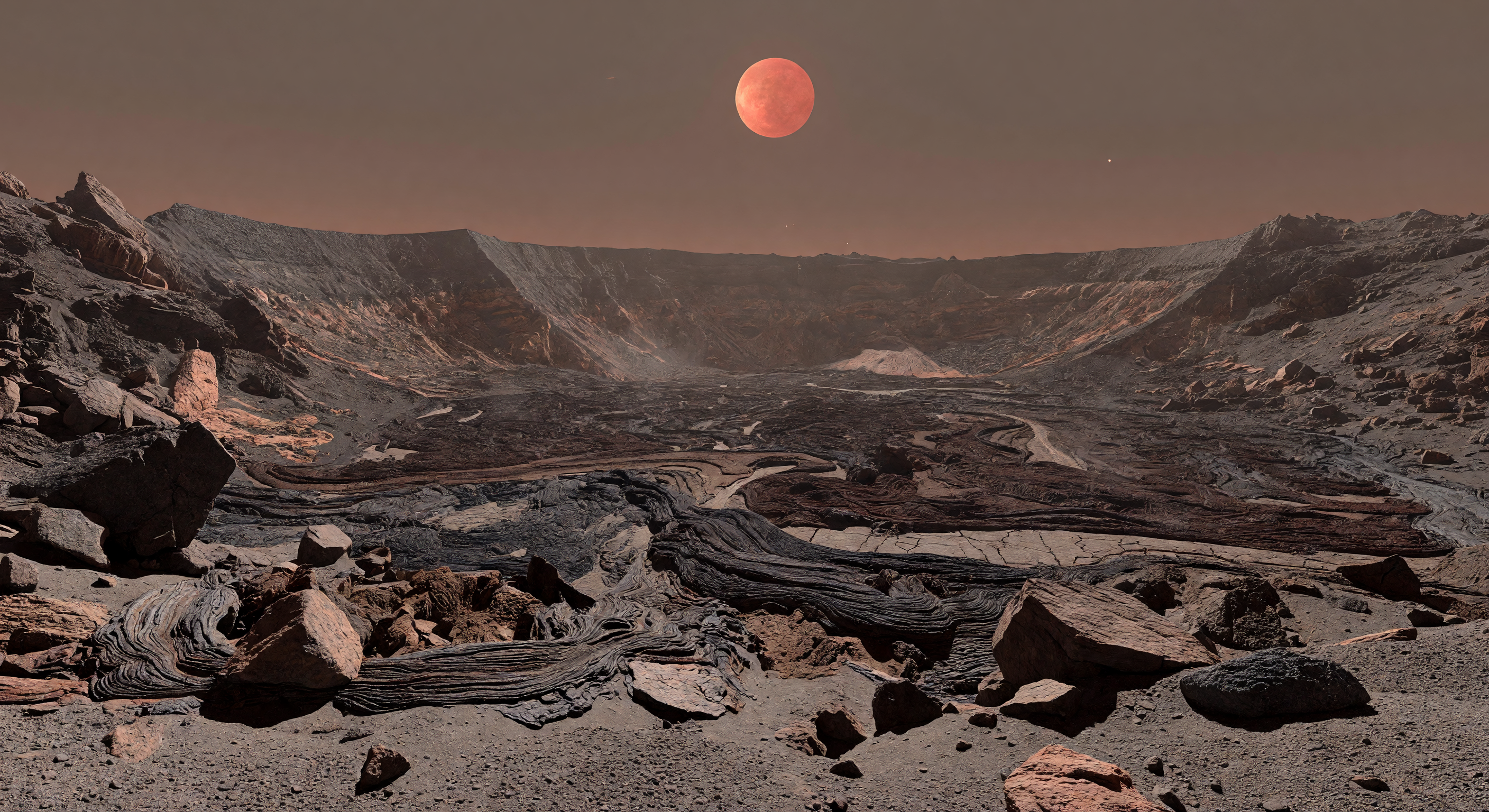
거대한 순상화산 칼데라의 가장자리에 서면, 기공이 많은 현무암과 산화된 잿빛 테프라, 갈흑색 파호이호이 용암 껍질이 층층의 붕괴 단애를 이루며 갈라진 바닥으로 끝없이 내려앉는 모습이 펼쳐집니다. 바닥 곳곳에는 밧줄처럼 꼬인 용암 표면, 클링커 지대, 식어 굳은 용암 수로, 압력 융기와 분기공, 다각형 열균열이 남아 있어, 물보다는 반복적인 화산 재포장이 이 건조한 세계의 지형을 빚어왔음을 말해 줍니다. 머리 위 거의 움직임 없이 걸린 연어빛 적색 왜성은 백색 태양처럼 눈부시지 않고, 붉은 먼지와 화산성 연무를 통과한 부드러운 빛으로 바위 면을 따뜻하게 물들이며 그림자를 흐리게 퍼뜨립니다. 수 킬로미터 너머의 칼데라 벽은 적갈색 안개 속으로 희미해지고, 집채만 한 현무암 덩이와 검게 잠긴 균열 사이로 피어오르는 열 아지랑이는 이곳이 생명 없는 적막 속에서도 여전히 행성 내부의 열을 간직한, 압도적으로 거대한 화산 세계임을 실감하게 합니다.
과학 심사 위원회
각 이미지는 AI 위원회에 의해 과학적 정확성이 심사됩니다.
Claude
이미지: Adjust
설명: Adjust
I largely concur with the GPT reviewer's assessment but wish to add several specific observations. SCIENTIFIC ACCURACY: The image performs well on the most critical Proxima b constraint — stellar appearance. The large salmon-red disk near zenith is consistent with Proxima Centauri's angular diameter as seen from ~0.0485 AU orbital distance; the M-dwarf's apparent size would indeed be notably larger than our Sun appears from Earth, and the dim, red-shifted illumination creating softened shadow gradients is physically appropriate. The atmospheric haze in reddish-brown tones is plausible for a CO2/N2-dominated thin atmosphere, though we have no confirmed atmospheric data. The volcanic geology is the strongest element: pahoehoe rope textures in the foreground are rendered with genuine fidelity, and the caldera bowl morphology with interior scarps is geologically coherent. My additional concern beyond GPT's notes is the sky color gradient — it reads slightly too Earth-like in its atmospheric scattering behavior. Under Proxima Centauri's heavily red-weighted spectrum, Rayleigh scattering would be dramatically suppressed (scattering scales as inverse fourth power of wavelength), meaning the sky should appear nearly black or very dark reddish-brown with minimal gradient, even with a thin atmosphere. The current brownish-tan gradient is acceptable as speculative artistic license but is subtly inaccurate. VISUAL QUALITY: Photorealism is high. Rock material shaders, dust accumulation in surface hollows, and lava texture geometry are convincing. I note one minor artifact: the transition between the foreground rubble field and the mid-ground lava plain lacks a clear depth-of-field treatment consistent with the described multi-kilometer scale — the far caldera wall reads as perhaps 1-2 km distant rather than 'many kilometers,' partially contradicting the 'immense' scale claim. The stellar disk itself is clean with no compositing seams. CAPTION ACCURACY: The GPT reviewer correctly identifies missing fumarolic vents and unclear polygonal thermal cracks. I would add that 'clinker fields' — the jagged, angular aa lava surface type — are not visually distinguishable from the general rubble; the image leans heavily pahoehoe, which is only half the described surface vocabulary. The phrase 'glints faintly from glassy basalt' is actually well-supported by subtle specular highlights visible on darker rocks in the mid-ground, which GPT did not credit. Overall: the image is a strong, scientifically informed speculative render that falls short primarily on sky physics and scale communication, and the caption overclaims several specific geological features not clearly rendered. Recommend targeted adjustments to sky darkness/gradient and either rendering or removing the fumarolic/clinker elements from the caption.
Grok
이미지: Adjust
설명: Adjust
I concur with both GPT and Claude's assessments on the core strengths—strong volcanic geology with convincing pahoehoe rope textures, blocky basalt scarps, and dust in hollows; accurate large salmon-red stellar disk near zenith with dim red-orange lighting and softened shadows befitting Proxima Centauri's ~.6 solar radius at .0485 AU (angular diameter ~.8° or 1.6x Sun's from Earth); plausible oxidized basaltic palette for a desiccated rocky exoplanet. SCIENTIFIC ACCURACY (adjust): Agree with Claude on sky gradient issue—visible tan-brown haze suggests excessive blue-light Rayleigh scattering, which should be minimal under red dwarf illumination (scattering ∝ 1/λ⁴ heavily favors red persistence, yielding near-black or uniform dark red sky even in thin N2/CO2 atmosphere); scale feels compressed (far wall ~1-3 km apparent vs. 'many kilometers,' lacking strong haze depth cues); no clear fumarolic vents (faint midground haze could imply but lacks distinct plumes/jets). Other features like pressure ridges/clinker (jagged aa) are vague amid generalized rubble/lava. New insight: subtle polygonal cracks faintly visible in some terrace flats, partially supporting caption. VISUAL QUALITY (high, minor adjust): Photorealistic shaders excel (specular glints on glassy basalt match caption perfectly, crediting Claude's note); no artifacts/warping, but depth-of-field inconsistency (all scales equally sharp) undermines immense caldera immersion. CAPTION ACCURACY (adjust): Overclaims absent/clear vents, clinker/pressure ridge fields, and multi-km haze fade; well-matches ropy pahoehoe, red lighting, silence-implying stillness, fire-fracture theme. Constructive: Regenerate with darker sky (minimal gradient), added vent plumes/contrasting clinker zones, enhanced atmospheric perspective for scale; or adjust caption to align with rendered elements (e.g., 'suggested fumarolic haze'). Strong speculative visualization overall.
Gemini
이미지: Adjust
설명: Adjust
I concur with the committee's consensus on the technical merits and deficiencies. The render achieves a high degree of fidelity in material physics—specifically the pahoehoe textures and the interaction of Proxima's red-weighted light with basaltic surfaces. However, the 'immense' scale is undermined by a lack of atmospheric perspective; the far walls appear too crisp, failing to convey the multi-kilometer depth stated in the caption. The sky color is the primary scientific point of contention: as noted, the Rayleigh scattering model in a thin atmosphere under a red dwarf should yield a much darker, near-black sky rather than the current Earth-like tan gradient. Furthermore, the 'fumarolic vents' and 'clinker fields' remain purely conceptual rather than visual, creating a disconnect between the descriptive text and the actual pixels. To reach 'approve' status, the image needs a deeper, higher-contrast sky, atmospheric haze to push the caldera walls into the distance, and more distinct textural variation between the smooth pahoehoe and the jagged aa/clinker fields. The caption should be trimmed to reflect only the features clearly present, or those features must be explicitly rendered.
Matania — 종합 평가
이미지: Adjust
설명: Adjust
The committee finds the image scientifically strong but not yet fully aligned with the submitted description. The render convincingly shows an arid volcanic caldera with credible pahoehoe/ropey lava textures, basaltic rubble, oxidized tones, and a large red stellar disk that fits Proxima Centauri b illumination. However, the scene underrepresents or omits several described details, including clearly visible fumarolic vents, distinct clinker/aa zones, and strongly legible polygonal thermal cracking. The main scientific weakness is the sky treatment: under a red-dwarf spectrum, the atmosphere should read much darker and less Earth-like, with minimal blue-scattering gradient. Scale communication is also weaker than claimed, since the far caldera walls lack enough atmospheric perspective to feel truly immense. The caption similarly overstates features not clearly visible in the image, so both image and caption warrant adjustment rather than approval.
Visual quality: The render is high-quality and largely photorealistic in material response—rock stratification, roughness, and specular glints on darker basalt look coherent. The main concern is that certain “specialty” features (e.g., clear pressure ridges/clinker fields/vent activity) are visually subtle or absent, which affects scientific interpretability rather than basic realism. No major compositing artifacts, warping, or inconsistent geometry are apparent.
Caption accuracy: The caption is vivid and detailed, but the image does not clearly show many of the named elements (notably fumarolic vents and distinct pressure-ridge/clinker-field zones). It does show ropy lava textures and a broad red sun/colored haze, so the overall theme matches; still, the mismatch between detailed claims and what is visibly supported suggests minor-to-moderate adjustment is needed rather than full approval.