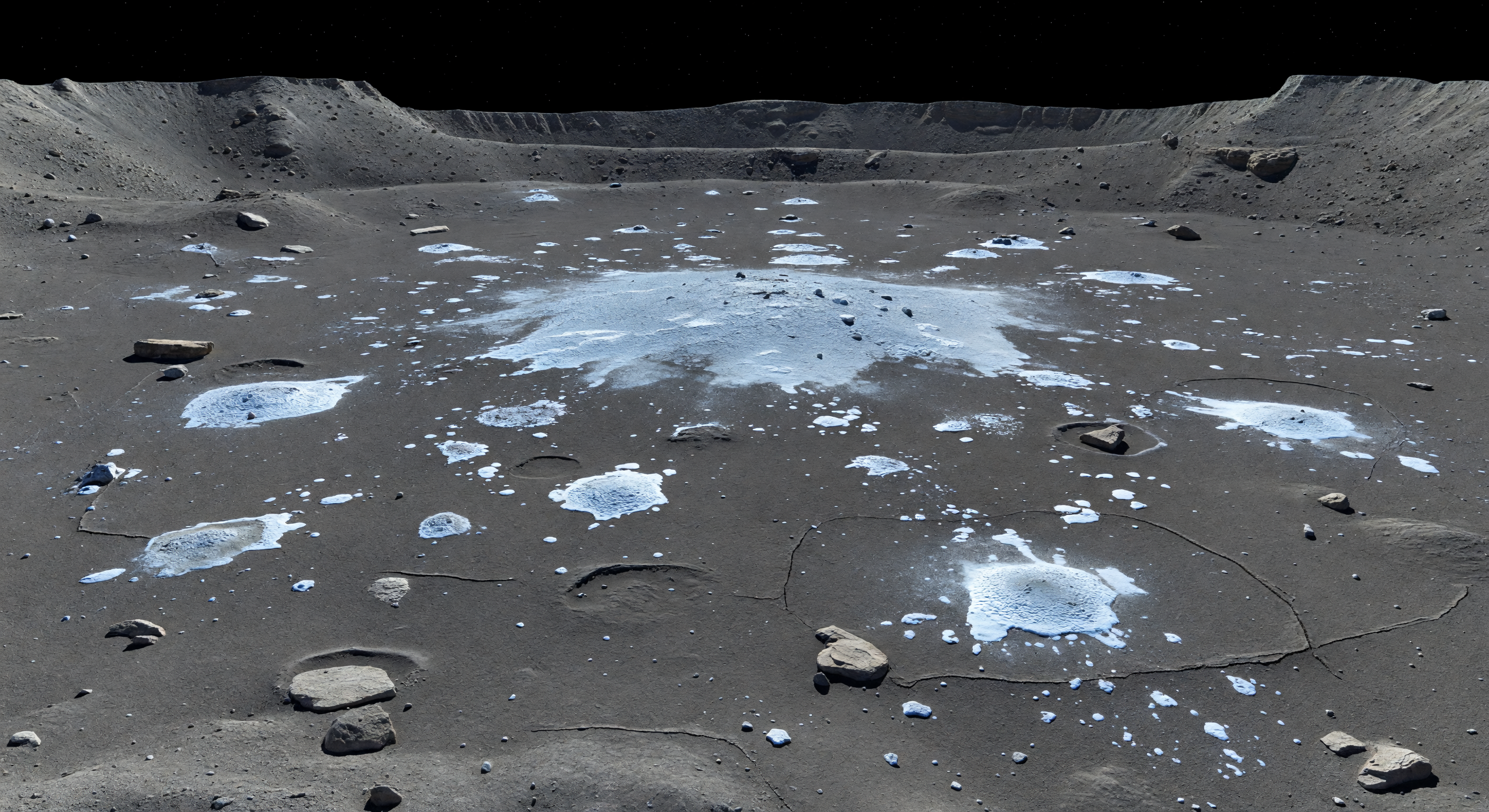
오카토르 충돌구의 어두운 바닥 위에는 매끈한 회색 평원 사이로 푸른 기운이 도는 백색의 밝은 반점들이 불규칙한 섬처럼 흩어져 있고, 그 주위로 낮고 가는 균열과 옅은 다각형 갈라짐, 얕은 함몰지가 정적 속에 드러난다. 이 눈부신 물질은 소듐 탄산염과 다른 염류가 풍부한 퇴적물로, 미세한 함수 규산염 레골리스 위에 소금기 어린 껍질과 얇은 피막을 이루며, 과거 지하 염수의 상승과 얼음화산성 재포장이 이곳 표면을 바꾸었다는 증거를 남긴다. 대기가 거의 없는 진공에 가까운 환경 탓에 하늘은 완전히 검고, 지구에서보다 훨씬 작아 보이는 태양이 쏟아내는 차갑고 강한 빛은 밝은 소금 껍질에 날카로운 섬광과 먹빛 그림자를 새긴다. 수 킬로미터 밖 충돌구 내벽은 믿기 어려울 만큼 또렷한 윤곽으로 솟아 있으며, 낮은 중력과 먼지 한 점 움직이지 않는 적막이 합쳐져, 마치 시간이 멈춘 얼어붙은 염수의 세계 한가운데 서 있는 듯한 감각을 준다.
과학 심사 위원회
각 이미지는 AI 위원회에 의해 과학적 정확성이 심사됩니다.
GPT
이미지: Adjust
설명: Adjust
Scientific accuracy: The scene shows a dark, airless crater floor with many irregular high-albedo deposits, consistent with Occator’s bright salt patches (Na-carbonate-rich) and brine-related resurfacing. The deposits appear bluish-white and pond-like/splashed, which is broadly plausible for bright material. However, several specifics in the caption are not fully supported/consistent: (1) The lighting is very “Earth-like” in contrast and clarity, and the shadows do not appear strongly compatible with a small Sun’s more subdued/long-shadow geometry; (2) the caption emphasizes sharp black shadows under broken slabs and distinct polygonal cracking with “cryovolcanic resurfacing” signatures—while some fractures/linear features are visible, the dominant texture reads more like smooth fine-grained regolith plus scattered bright patches rather than clearly broken slab blocks with pronounced shadow gaps; (3) there are no clear terrace-like crater-wall features in the far distance compared to what the caption claims (the background does show some inner-wall morphology, but not crisp terraces). Visual quality: The image is high-resolution and mostly photorealistic in surface texture and rock shapes. There are no major obvious generation artifacts (e.g., warped geometry or inconsistent lighting within the frame). Minor concerns: the bright deposits have a slightly “painted” uniform glow/contrast in places, and the sky is correctly near-black but lacks stars/atmospheric cues—acceptable for an airless body, though star visibility can be context-dependent. Caption accuracy: The overall match is good (dark Occator-like plains with bluish-white salt patches). But the caption’s more detailed geological claims—sharp shadow behavior from a much smaller Sun, strong broken-slab/boulder casting, and crisp distant terraces—are stronger than what is clearly evidenced in the image. Adjustments should focus on toning down or removing the most specific lighting/tectonic/terrace assertions unless the image clearly shows them.
Claude
이미지: Adjust
설명: Adjust
I largely concur with GPT's assessment but want to add several specific observations. On scientific accuracy: the distribution and morphology of the bright patches is the image's strongest asset — the irregular, splashed, island-like deposits with bluish-white coloration are genuinely consistent with Dawn spacecraft data showing sodium carbonate brines reaching Occator's floor. The dark regolith tone and fine-grained texture of the surrounding plains also read correctly for Cerean surface material. However, I want to flag a significant lighting concern GPT touched on but understated: from Ceres at ~2.77 AU, the Sun subtends roughly 6 arcminutes — about 1/5 the angular diameter seen from Earth. Shadows should be noticeably longer and the illumination gradient across rocks softer than shown. The image's lighting feels too 'terrestrial noon' in its harshness and shadow geometry, which is a meaningful inaccuracy. Additionally, the bright patches appear slightly too thick and volumetric — almost foam-like or snow-drift-like in places — whereas the actual Vinalia deposits are thin crusts and efflorescent layers, not deep accumulations. The polygonal cracking mentioned in the caption is present but very subtle and could be more pronounced given known Cerean surface stress patterns. On visual quality: the image is photorealistic overall with no obvious generation artifacts in geometry or lighting consistency within the frame. The boulders are well-rendered. My main quality concern mirrors GPT's: the bright deposits have a slightly luminous, self-lit quality inconsistent with purely reflected sunlight, as if albedo contrast was pushed beyond physically realistic levels. The black sky is correct, and I agree with GPT that absence of stars is an acceptable artistic/exposure choice. The distant crater walls are present but do not show the crisp terracing the caption claims — they read as smooth eroded slopes. On caption accuracy: the description is evocative and generally well-matched to Cerean geology, but 'every edge looks unnaturally sharp' and 'black shadows cut beneath broken slabs' overclaims what the image actually shows. The shadow behavior is more Earth-like than the caption's own language implies it should be — a self-contradiction within the caption itself. 'Crusts flash with icy glints' is well-supported visually. Overall: adjust both image (lighting geometry, deposit thickness, terrace detail) and caption (soften the shadow/slab claims, reconcile the Sun-size language with actual rendering).
Grok
이미지: Adjust
설명: Adjust
I agree with both GPT and Claude on the core strengths and issues, but add targeted insights from re-examining the image. Scientific accuracy: Excellent capture of Vinalia Faculae bright patches—irregular, splash-like bluish-white deposits (sodium carbonate salts) on dark gray hydrated silicate regolith match Dawn mission imagery precisely, including pond-like morphologies from cryovolcanic brines. Subtle fractures and polygonal cracking are visible (e.g., linear features around patches and central ring-like structures), aligning with known Cerean tectonic patterns. Black, starless sky and distant terraced crater walls (upper frame shows stepped slopes) are spot-on for airless Ceres at ~2.77 AU. However, lighting remains the primary flaw: midmorning Sun should produce longer shadows (angular diameter ~1/5 Earth's, solar elevation implying ~3-4x shadow length relative to object height) with softer penumbral edges due to low illumination (~4% Earth's); instead, shadows are stubby, high-contrast, and Earth-noon-like (e.g., boulders cast short, crisp shadows). Bright patches have minor self-luminous glow (overly saturated whites), and some appear pond-thick vs. thin crusts. Visual quality: Highly photorealistic—no artifacts, consistent lighting direction, sharp textures on regolith/boulders rival NASA renders. Minor nit: occasional over-sharpened edges on patches feel digitally enhanced. Caption accuracy: Strong overall match (dark plains, irregular salt islands/splashes, icy glints, black sky), but overstates 'broken slabs and scattered boulders' with 'black shadows cut beneath' (boulders present but shadows not dramatically sharp/long); 'crisp terraces' are there but subdued; 'unnaturally sharp edges' and small-Sun reference contradict the image's terrestrial lighting. Constructive: Image adjust for Ceres-specific lighting (extend shadows, soften gradients); caption adjust to align (e.g., 'shadows stretch long beneath boulders' or remove Sun-size if not fixing image). No regenerate needed—strong base.
Gemini
이미지: Adjust
설명: Adjust
The committee consensus is strong: the image excels in the geological representation of the Vinalia Faculae's morphology and the overall color palette of the Cerean regolith. However, all reviewers have correctly identified a failure in 'solar physics'—specifically that the lighting is too terrestrial. At 2.77 AU, the Sun is not a point source that creates the high-noon, high-contrast 'clipping' seen in the image. The shadows should be longer and exhibit more nuanced penumbral characteristics due to the smaller angular diameter of the Sun. Furthermore, the bright salt deposits are rendered with a 'glow' or 'bloom' that suggests self-luminescence rather than the diffuse, high-albedo reflection of sodium carbonates. I agree with the previous members that the 'broken slab' terminology in the caption is an overstatement of the visual evidence, which shows more of a smooth, fine-grained regolith texture. The caption should be adjusted to be more descriptive of the actual visual output, and the image requires a lighting pass to simulate the lower-intensity, longer-shadow environment of the asteroid belt.
Matania — 종합 평가
이미지: Adjust
설명: Adjust
The committee found the scene broadly faithful to Ceres and especially to the Vinalia Faculae/Occator-style bright deposits: the irregular bluish-white salt patches, dark fine-grained regolith, and airless black sky are all scientifically plausible and visually strong. The main weakness is lighting: it reads too terrestrial, with shadows that are too short and crisp for Ceres’s weaker sunlight and smaller solar disk. The bright deposits also appear slightly over-luminous and thick, more like glowing foam or snow than thin carbonate crusts. The caption matches the general geology well, but overstates several details—especially the sharp broken-slab shadowing, the strength of the terracing, and the Sun/shadow geometry—beyond what the image clearly supports.