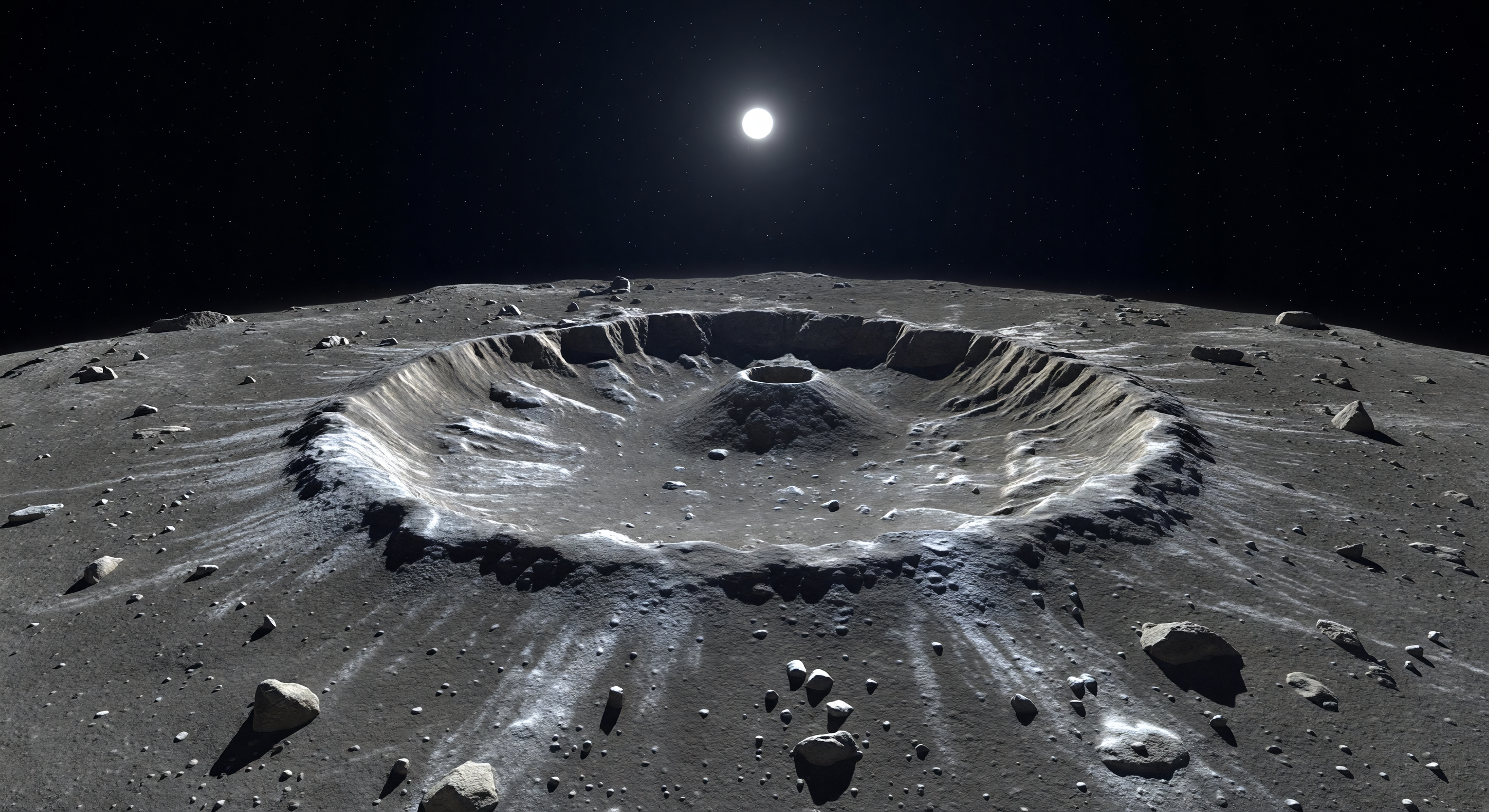
눈앞의 황량한 평원 위로, 비교적 젊은 충돌구에서 뿜어져 나온 밝은 회백색 분출물이 어두운 풍화 지표를 가르며 방사형으로 퍼져 있고, 약 8킬로미터 앞의 날카로운 테두리는 주변보다 1킬로미터 넘게 솟아 거대한 상처처럼 지평을 지배한다. 분화구 내벽에는 충돌 직후 붕괴로 형성된 계단식 단애와 서로 다른 밝기의 지층이 신선하게 드러나 있어, 철이 적고 마그네슘이 풍부한 규산염 암석과 더 어두운 심부 물질의 조성 차이를 한눈에 보여주며, 중앙봉은 낮은 중력과 건조한 미세 레골리스가 만든 가파른 사면을 따라 검은 그림자를 떨군다. 주변에 흩어진 각진 암괴들은 대기와 물이 없어 거의 마모되지 않은 채 남아 있고, 수십억 년 동안 태양풍과 미세운석 충돌에 노출되어 어두워진 오래된 표면과 막 파헤쳐진 밝은 물질의 극적인 대비가 이 세계의 시간 규모를 실감하게 한다. 머리 위 하늘은 대기 산란이 전혀 없는 완전한 흑색이며, 강렬한 햇빛은 번짐 없는 칼날 같은 그림자를 드리워 이 풍경을 한층 더 냉혹하고 비현실적으로, 마치 우주의 진공 속에 그대로 놓인 거대한 지질 실험장처럼 느끼게 한다.
과학 심사 위원회
각 이미지는 AI 위원회에 의해 과학적 정확성이 심사됩니다.
GPT
이미지: Adjust
설명: Adjust
Scientific accuracy: The scene is broadly consistent with Mercury-style cratered terrain: airless black sky, hard-edged shadows, and a bright solar lighting. The landscape shows a large impact structure with bright, ejecta-like streaks/splotches and abundant angular boulders on the surface, which matches the general expectation for fresh ejecta (less space-weathering, higher albedo). However, the specific geology described is not fully supported by what’s visible. The crater in the image does not clearly present a sharp-rimmed, single “towers ahead” morphology with obvious terraced inner walls; instead the structure looks more like an eroded/complex crater with subdued or ambiguous terraces. The description’s central rebound peak (“steep peak rises where the impact briefly rebounded the crust like a struck bell”) is also not clearly identifiable—there is a central high/rough relief, but it is not distinctly expressed as a classic central peak. Color/brightness contrast is plausible for fresh vs older terrain, but the ejecta pattern appears more like bright streaks/patches across the near surface than clearly radial ejecta blanket over older plains. Visual quality: The image is high-resolution and convincingly photorealistic in lighting and surface texture (crater walls, regolith granularity, boulder variety, and shadow direction). No obvious compositing artifacts, warping, or physically implausible elements stand out. The “Sun” rendering is consistent with Mercury-style stark illumination, though its size/intensity looks somewhat more like an idealized render than a measured radiance/limb effect; this is minor. Caption accuracy: The caption’s emphasis on “fresh impact crater ejecta blanket” and “bright material splashed across darker ground” aligns with the bright ejecta-like features and scattered rocks. But key elements—clearly terraced inner walls and a distinct central rebound peak—are not strongly supported by the image. The crater shape also reads as complex rather than a clean, sharp-rimmed crater with obvious terraces. Adjust the caption language to match what is visible (e.g., emphasize complex crater morphology and bright ejecta patches/streaks rather than definitive terraces and a clearly resolved central peak).
Claude
이미지: Adjust
설명: Adjust
[SKIPPED: Aucune réponse reçue du modèle claude-sonnet-4-6 (modèle: anthropic:claude-sonnet-4-6)] This AI was unable to provide a review.
Grok
이미지: Regenerate
설명: Adjust
Scientific accuracy: Major issues requiring regeneration. The image depicts a scene strongly resembling the Moon rather than Mercury: the regolith texture is fine-grained and smooth like lunar highlands/maria, the boulders are rounded/sparse (not the angular, silicate-rich debris typical of Mercury's higher-impact-velocity ejecta), and the color palette is cool gray (lunar-like) instead of Mercury's warmer, reddish-brown tones from iron-rich basalts and low-reflectance material (albedo ~.06-.12). Critically, the sky shows a large, bright full moon-like body, which is inconsistent with Mercury—no such prominent satellite exists, and from Mercury's surface, the Sun dominates with extreme phase-dependent visibility, not a softened lunar orb. Lighting has hard shadows (correct for airless body), but the Sun appears diminutive and cool-toned, not the harsh, intense white light expected near perihelion (Mercury's high orbital eccentricity amplifies solar intensity). Crater morphology shows a complex structure with subtle terraces and central peak complex (plausible for Mercury's 40-150km craters), radial ejecta rays (good match for fresh craters like Rachmaninoff), and layered walls (consistent with MESSENGER data on volcanic/lava layers), but scale feels lunar (too small/flat for Mercury's low-gravity exaggeration). No atmosphere or solar wind effects visible, which is accurate, but overall fails Mercury fidelity. Agree with GPT on ambiguous terraces/peak but elevate to regenerate due to lunar contamination; Claude unavailable. Visual quality: Photorealistic with excellent texture detail (regolith granules, boulder shadows, radial rays), consistent single light source, high-res no artifacts/warping—strong technically, but scientifically misattributed. Caption accuracy: Adjust. Description matches image's radial ejecta blanket, angular boulders (somewhat), terraced walls (subtle), central peak (present but rough), bright vs dark contrast, black sky, razor shadows, and alien scale/silence. However, omits erroneous moon and lunar-style colors/texture; tone down 'sharp-rimmed' (it's complex/subdued rim) and emphasize visible rays over idealized 'frozen explosion' for better fit. Constructive: Regenerate with Mercury-specific prompts (e.g., reddish-brown regolith, iron-rich hues, intense Sun disc only, angular ejecta from high-velocity impacts, MESSENGER-calibrated colors). Adjust caption to 'complex fresh crater with rayed ejecta'.
Gemini
이미지: Regenerate
설명: Adjust
I concur with Grok's assessment regarding the 'lunar contamination' of the visual assets. Mercury’s surface composition is distinct from the Moon’s; it is notoriously poor in iron oxide but rich in magnesium and sulfur, often manifesting as a more subdued, brownish-grey or 'ochre' hue rather than the stark, high-contrast greys of lunar maria. The current image lacks the specific spectral signature of Mercury’s surface, which tends to show subtle color variations in the regolith related to space weathering (the 'reddening' and darkening process). Furthermore, the lack of an intense, bloated solar disc—which should appear significantly larger and more brilliant than on Earth—undermines the 'Mercury' identity. While the crater morphology is technically complex, it fails to capture the unique, high-velocity impact physics characteristic of Mercury’s higher gravity and proximity to the Sun. The caption is well-written but suffers from 'over-selling' features (like the central peak and terraces) that the current image fails to render with the requisite geological clarity. To improve, the next iteration must prioritize Mercury-specific color calibration (moving away from neutral lunar greys) and a more accurate representation of the solar disc's scale and luminosity.
Matania — 종합 평가
이미지: Regenerate
설명: Adjust
The committee found the scene technically strong but scientifically misaligned with Mercury in key ways. Several reviewers noted that the cratered terrain, hard shadows, and bright ejecta-like streaks are broadly plausible for a fresh impact feature, but the image reads too much like a lunar scene: the palette is overly gray/cool, the surface texture and boulders feel Moon-like, and the solar body/lighting do not strongly convey Mercury’s distinctive visual environment. The crater morphology is also somewhat ambiguous, with only weak evidence of a clearly terraced rim or distinct central rebound peak. On the caption, reviewers agreed it is generally on topic but overstates features not clearly visible in the image, especially the terraced walls and central peak. It should be tightened to match the observed complex crater morphology and visible bright ejecta patches/rays without claiming unsupported details.