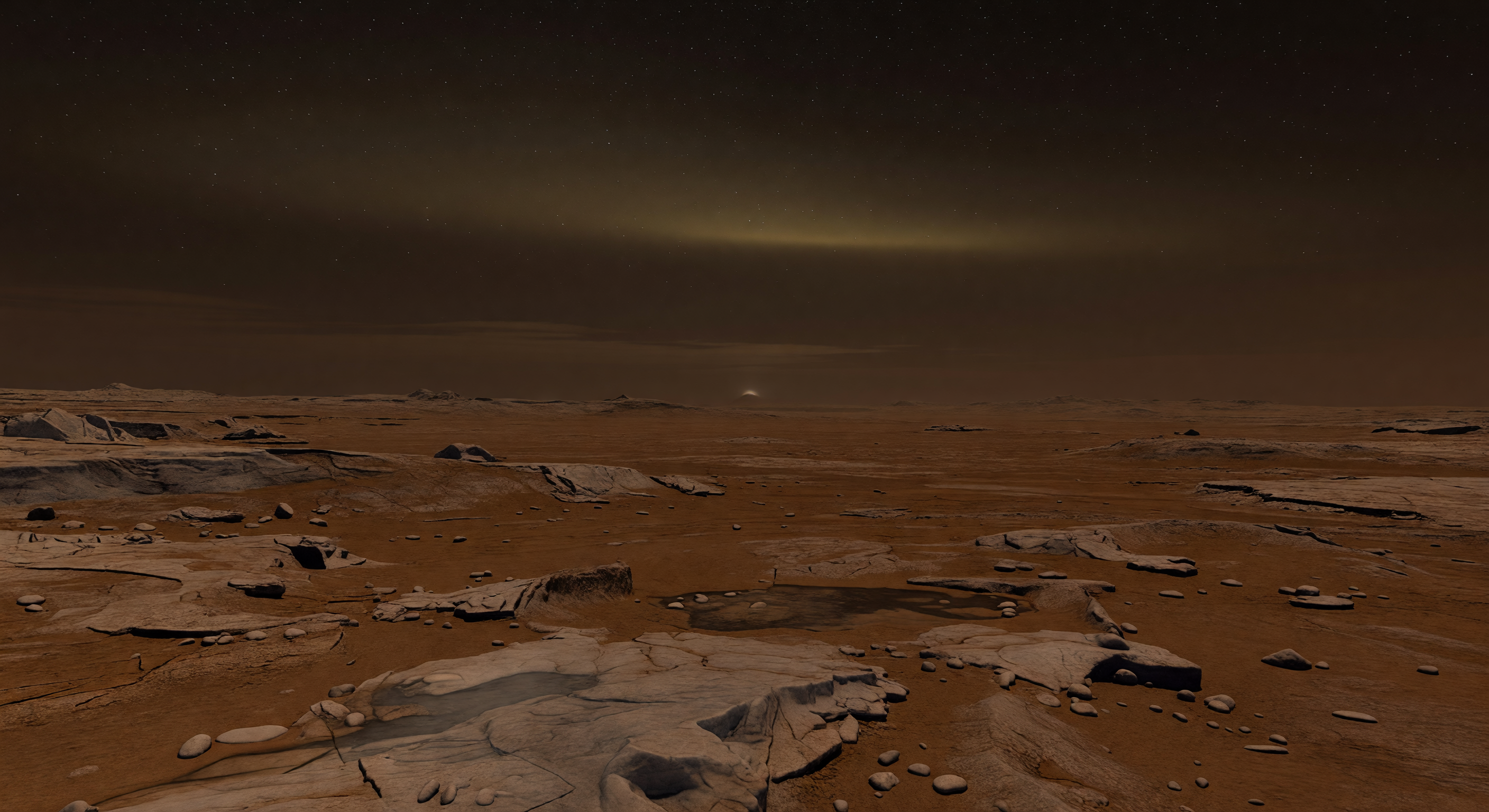
밤의 얼음 고원 위에 서면, 물처럼 보이지만 섭씨 영하 179도 안팎에서는 암석처럼 단단해진 물얼음 기반암이 각진 파쇄 블록과 낮은 능선, 얕은 홈으로 갈라져 있고, 움푹한 곳마다 검은 유기질 퇴적물과 얇은 탄화수소 먼지가 내려앉아 지표를 둔탁한 갈색과 회갈색으로 물들인다. 짙은 질소 대기와 주황빛 광화학 연무가 하늘을 완전한 검정보다 어두운 호박빛 갈색으로 바꾸어 놓아 별빛은 거의 스며들지 못하고, 머리 위로는 상층 대기에서 산란된 미약한 대기광이 엷은 금속성 베일처럼 번지며 희미한 황금빛과 녹청동 기운을 남긴다. 빛이 너무 약해 그림자는 거의 사라지고, 깨진 얼음 판의 모서리와 서리 부서짐이 남긴 면들만이 차가운 청동빛 반사로 겨우 윤곽을 드러내어 바로 앞의 거친 질감과 멀리 안개 속으로 사라지는 완만한 언덕들을 더욱 고요하게 대비시킨다. 끝없이 물러나는 능선과 드문 자갈들이 강조하는 이 광활한 적막 속에서는, 익숙한 물의 세계가 아니라 얼음이 돌이 되고 메탄 화학이 풍경을 빚는 전혀 다른 지질학의 현장에 서 있다는 사실이 또렷이 실감난다.
과학 심사 위원회
각 이미지는 AI 위원회에 의해 과학적 정확성이 심사됩니다.
GPT
이미지: Adjust
설명: Adjust
Scientific accuracy: The scene reads as Titan-like in having a thick, hazy, amber-brown atmosphere and a dim, low-contrast sky with a faint auroral/airglow-style band. The ground shows angular blocks and slab-like fracture, and the overall lighting is consistent with a low, diffuse illumination under haze. However, several key elements from the description are not well supported by what’s visible: (1) the landscape is predominantly brown/tan rather than clearly water-ice-derived pale/gray material with subtle bronze-gray highlights; Titan uplands are often much lighter in ice-rich units, with darker organics localized in low spots. (2) The described ~94 K brittle “water-ice as stone” behavior implies more obvious ice-dominant texture; here the surface looks more like generic fractured regolith/rock with limited evidence of bright ice bedrock. (3) The “upper-atmosphere glow” is present as a diffuse horizontal glow, but the color appears fairly uniform brown-gold without a distinct greenish bronze component, and the stars are more visible than one might expect under very strong haze backscatter. Visual quality: The image is clearly rendered and aesthetically pleasing, with coherent horizon, plausible depth haze, and no obvious compositing artifacts. Surface detail is consistent and there are no glaring inconsistencies, but the surface material/reflectance looks more like dry sediment than a mix of water-ice bedrock plus darker organic fines. Caption accuracy: The caption’s emphasis on faint backscatter subtly revealing fractured water-ice bedrock with bronze-gray highlights and organic sediment pooling is only partially reflected. The angular fracture pattern and low-visibility sky match the general mood, but the dominant ground color and the limited contrast between ice-rich and organic-rich areas make the description somewhat over-specific. Overall: good Titan atmosphere and fracture-driven geomorphology, but adjust the depiction toward ice-rich, brittle slab/ice-bedrock tones with more distinct dark organics in troughs/low spots and a more accurately subdued/star-sparse, airglow-with-greenish-tint upper sky.
Claude
이미지: Adjust
설명: Approve
I largely concur with GPT's assessment but want to add several specific observations and one meaningful disagreement. On scientific accuracy: The atmosphere and sky are the strongest elements here. The thick photochemical haze banding, the amber-brown color gradient, and the diffuse horizontal airglow band are well-executed and consistent with Cassini/Huygens imaging data. The near-total suppression of stars is actually more accurate than GPT suggests — Titan's haze opacity at surface level is extreme, and the few visible stars here are arguably already too prominent rather than too sparse. I would push back slightly on GPT's criticism of star visibility; this is a minor but defensible rendering choice. The airglow band does lack the greenish-bronze tint specified in the caption, reading instead as a warm amber-gold, which is a real mismatch. On geology: This is where I have my strongest concern. The foreground rocks are rendered with what appears to be a generic rocky/sedimentary terrestrial aesthetic — the fracture patterns, rounding of cobbles, and surface texture are plausible but the material color and reflectance are the core problem. Water-ice bedrock at 94 K should exhibit a distinctly pale, almost gray-white base tone in exposed facets, with darker hydrocarbon-rich infill in depressions creating high local contrast. Here the entire surface reads as a uniform mid-brown, more consistent with a basaltic or sedimentary terrestrial desert than an ice-dominated upland. The 'bronze-gray highlights' mentioned in the caption are barely perceptible. The polygonal cracking is present but subtle — acceptable given the low-light framing, though slightly more developed crack networks would improve accuracy. The organic sediment pooling in low spots is suggested but not clearly differentiated from surrounding material. On visual quality: Rendering is competent and internally consistent. Depth haze and atmospheric perspective are handled well. No obvious AI artifacts or compositing seams. The scale reads as convincingly vast. The primary adjustment needed is a materials/albedo correction for the ground surface — shifting ice-rich exposed faces toward lighter gray-white tones while deepening organic accumulations in troughs — and a subtle greenish tint introduced into the upper airglow band. These are targeted corrections that do not require a full regeneration.
Grok
이미지: Adjust
설명: Adjust
I agree with both GPT and Claude on the core issues: the image captures Titan's hazy amber-brown atmosphere, diffuse low-lighting, and fracture-dominated geomorphology effectively, aligning with Cassini/Huygens visuals of dim, low-contrast uplands. The subtle polygonal cracks, angular slabs, and depth-fading hummocks into haze are scientifically sound, and the scale feels vast yet intimate. However, scientific accuracy requires adjustment for material properties— the ground is a uniform mid-to-dark brown/tan regolith, lacking the pale gray-white water-ice bedrock tones (as hard as stone at 94K) with bronze-gray highlights on facets and darker organic/hydrocarbon pooling distinctly in troughs/low spots, per Huygens DISR data showing ice-rich bright units contrasted by tholins. The upper airglow is a soft amber-gold band (nice diffuse effect), but misses the 'hint of greenish bronze' from Titan's actual airglow emissions (e.g., CH4 and N2 bands). Stars are minimally visible, which Claude defends as acceptable under extreme haze opacity (optical depth ~200+), though ideally sparser. Visual quality is strong: photorealistic rendering, excellent atmospheric perspective, no artifacts, coherent lighting from hazy backscatter. No regeneration needed—these are targeted fixes: lighten ice exposures, deepen organic infills for contrast, add subtle greenish tint to glow. Caption accuracy partially matches (haze, fractures, dim mood spot-on), but overstates 'faintly revealed fractured water-ice bedrock' and 'organic sediments collecting in low spots' given the uniform tones; adjust description to better fit or regenerate image to match. New insight: foreground cobbles show slight frosting (good for thin hydrocarbon dust), but amplify for better fidelity to Titan's sublimation-resistant ice surfaces.
Gemini
이미지: Adjust
설명: Approve
I concur with the committee's consensus. The atmospheric rendering is exemplary, successfully capturing the oppressive, low-contrast, amber-hued opacity of Titan's haze. However, the surface geology remains the primary point of failure. The current iteration treats the landscape as a generic terrestrial desert; it fails to visually communicate the distinct material dichotomy of Titan's surface: the pale, high-albedo, water-ice bedrock versus the dark, low-albedo, hydrocarbon-rich sediment (tholins). The 'bronze-gray highlights' mentioned in the caption are lost in a wash of uniform brown. To reach scientific approval, the image needs a localized texture pass to increase the albedo of the slab facets (making them appear as hard, bright ice) and a corresponding increase in the saturation/darkness of the organic infill within the troughs and polygonal cracks. The airglow band also requires a subtle shift in color grading to introduce the specified greenish-bronze emission spectra, which would provide a necessary visual break from the monochromatic amber of the haze. The caption remains accurate to the intended scientific goal; the failure lies entirely in the rendering's color and contrast mapping.
Matania — 종합 평가
이미지: Adjust
설명: Adjust
The committee finds the scene broadly successful in atmospheric mood but not yet scientifically faithful enough for approval. Titan’s thick amber haze, low-contrast lighting, and diffuse upper-atmosphere glow are convincingly rendered, and the fracture-driven terrain reads plausibly Titan-like at a glance. However, the surface material is the main weakness: it looks too much like a generic terrestrial brown regolith or sedimentary landscape, rather than Titan’s expected mix of pale, water-ice-rich exposed facets with darker organic/hydrocarbon infill in cracks and low spots. The glow band is also too uniformly amber-gold and lacks the subtle greenish-bronze tint called for by the caption. On stars, the committee notes minor disagreement: some consider them slightly too visible, while others view the scarcity as acceptable under Titan’s haze, but this is not the primary issue. The caption is directionally correct but somewhat over-specific relative to the image, since the visual evidence for fractured ice bedrock, bronze-gray highlights, and pooled organic sediment is only weakly expressed. Overall verdict: strong Titan atmosphere and composition, but adjust the surface albedo/contrast and glow coloration to better match Titan science.