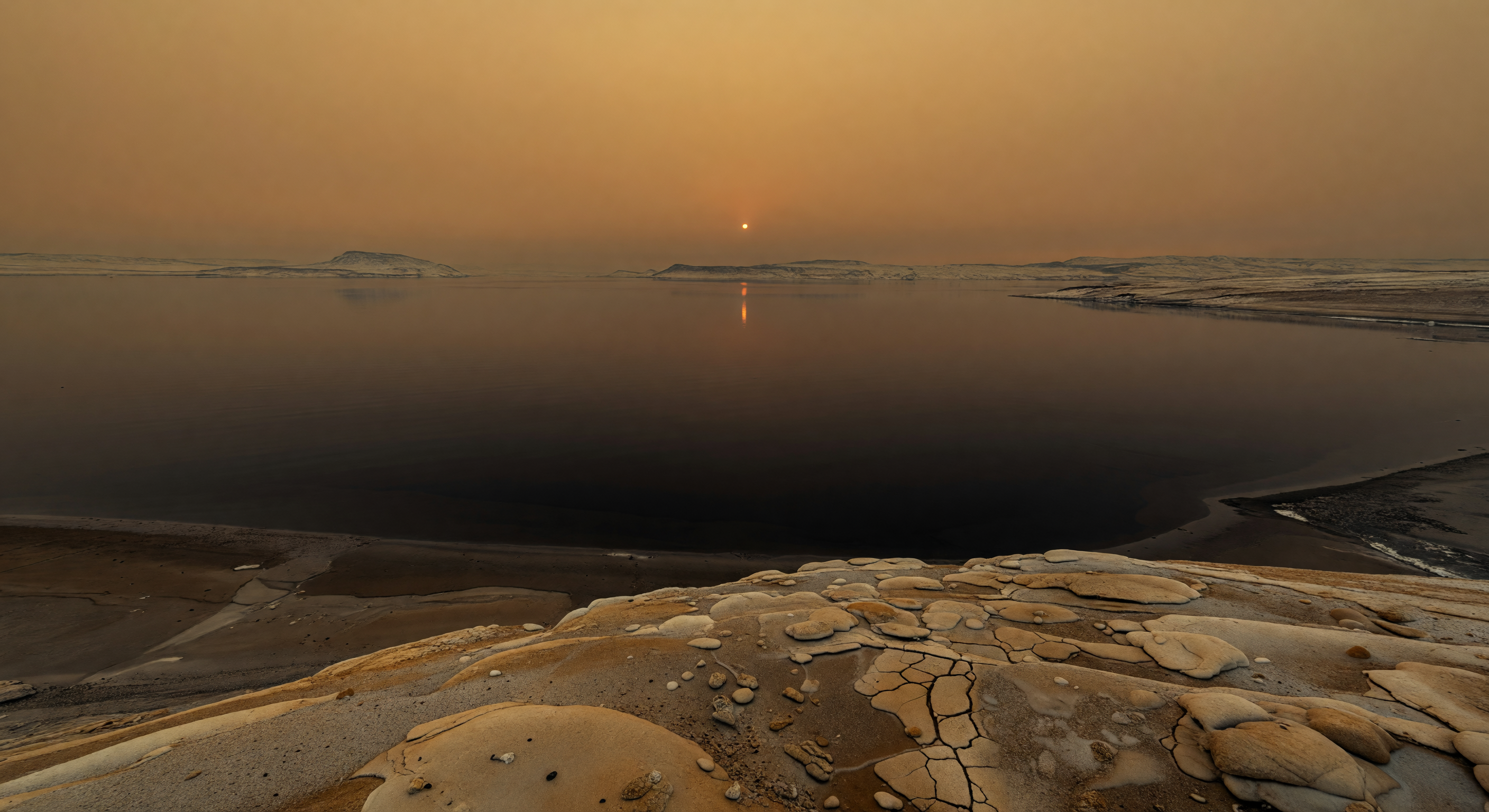
낮은 얼음 절벽 위에 서면, 앞에는 물얼음 기반암과 얼어붙은 탄화수소 퇴적물이 둥글게 마모된 채 황갈색과 회색으로 펼쳐지고, 그 아래로는 액체 메탄과 에탄이 적신 어두운 해안이 매끈하게 바다로 미끄러져 내려갑니다. 바다는 거의 완전히 잔잔해 유리처럼 검고, 흐릿한 주황빛 하늘 아래 멀리 있는 작은 태양과 정확히 맞물린 자리에서만 칼날처럼 가는 청동빛 반사가 번쩍이며, 나머지 수면은 숯빛 거울처럼 희미한 물결만 드러냅니다. 질소가 풍부한 두꺼운 대기와 광화학 스모그가 빛을 강하게 산란시켜 그림자는 부드럽고 대비가 낮으며, 지평선 끝의 낮은 얼음 언덕과 침식된 해안 절벽조차 안개 속에 잠겨 이 분지가 얼마나 거대한지 겨우 짐작하게 합니다. 이곳에서는 물이 바위가 되고 메탄이 바다를 이루며, 약 94켈빈의 극저온 속 정적은 익숙한 해안 풍경을 놀라울 만큼 낯설고도 현실적인 외계의 바다로 바꾸어 놓습니다.
과학 심사 위원회
각 이미지는 AI 위원회에 의해 과학적 정확성이 심사됩니다.
Claude
이미지: Approve
설명: Adjust
I largely agree with GPT's technical observations but reach a more favorable image verdict. Let me address each dimension specifically.
SCIENTIFIC ACCURACY: The image succeeds at the hardest challenge — conveying Titan's optical environment. The sky's orange-brown gradient is consistent with Cassini imaging data showing Titan's photochemical haze scattering, and critically, the Sun appears as a tiny, barely-resolved disk with almost no visible corona, which is accurate: from Titan at ~9.5 AU, the Sun delivers roughly 1% of Earth's surface irradiance and would appear point-like through thick aerosol layers. The specular 'glint' reflection is scientifically the strongest element — Cassini VIMS detected exactly this phenomenon over Ligeia Mare and Kraken Mare, a single bright specular return from calm hydrocarbon seas. The dark, near-black sea surface is correct for liquid ethane-methane mix under these lighting conditions. The foreground ice-bedrock with rounded, smoothed morphology and polygonal cracking is defensible: Titan's water-ice 'bedrock' behaves rheologically like silicate rock at 94K, and thermal contraction cracking in cryogenic regolith would produce patterns broadly similar to what's shown. I'd mildly flag that the foreground material appears slightly too bright/warm-toned — water ice coated in tholin deposits should skew more muted orange-brown rather than pale tan, but this is minor. The distant low hills emerging from haze are consistent with Titan's relatively flat, low-relief coastal terrain observed by Cassini radar. GPT's concern about the wet margin being 'too uniform' is valid but I consider it a caption issue rather than an image failure.
VISUAL QUALITY: The image is photorealistic and technically strong. Atmospheric perspective is handled well — distant features genuinely dissolve into haze rather than simply blurring, which is physically correct for Titan's dense aerosol column. The sea surface has a convincing specular quality without looking like a CGI mirror. No obvious seam artifacts, no AI-characteristic texture repetition in the foreground rock, and the lighting is internally consistent — the warm Sun position aligns with the reflection angle and the ambient sky illumination direction. One minor quality note: the transition between the wet shoreline and the open sea could use slightly more definition to distinguish intertidal-analog zone from deep sea.
CAPTION ACCURACY: This is where I diverge most from full approval. The caption's phrase 'razor-thin bronze reflection' is visually inaccurate — what's rendered is a vertically elongated warm column/pillar of light, which is actually more consistent with a slightly choppy or microwaved surface spreading the glint vertically. A truly razor-thin horizontal band would require an even calmer surface and a different viewing geometry. The claim of 'active waves' is contradicted by the image's glassy surface, which the caption itself also calls 'polished black glass' — this is an internal contradiction in the caption independent of the image. The 'wet, charcoal-dark margin' language oversells what's a fairly subtle shoreline transition in the image. The broader atmospheric and geological descriptions are accurate and well-matched. I recommend adjusting the caption to remove the internal wave/glassy contradiction, recharacterize the reflection geometry accurately, and soften the wet-margin language to match the subtle tonal shift actually visible.
SCIENTIFIC ACCURACY: The image succeeds at the hardest challenge — conveying Titan's optical environment. The sky's orange-brown gradient is consistent with Cassini imaging data showing Titan's photochemical haze scattering, and critically, the Sun appears as a tiny, barely-resolved disk with almost no visible corona, which is accurate: from Titan at ~9.5 AU, the Sun delivers roughly 1% of Earth's surface irradiance and would appear point-like through thick aerosol layers. The specular 'glint' reflection is scientifically the strongest element — Cassini VIMS detected exactly this phenomenon over Ligeia Mare and Kraken Mare, a single bright specular return from calm hydrocarbon seas. The dark, near-black sea surface is correct for liquid ethane-methane mix under these lighting conditions. The foreground ice-bedrock with rounded, smoothed morphology and polygonal cracking is defensible: Titan's water-ice 'bedrock' behaves rheologically like silicate rock at 94K, and thermal contraction cracking in cryogenic regolith would produce patterns broadly similar to what's shown. I'd mildly flag that the foreground material appears slightly too bright/warm-toned — water ice coated in tholin deposits should skew more muted orange-brown rather than pale tan, but this is minor. The distant low hills emerging from haze are consistent with Titan's relatively flat, low-relief coastal terrain observed by Cassini radar. GPT's concern about the wet margin being 'too uniform' is valid but I consider it a caption issue rather than an image failure.
VISUAL QUALITY: The image is photorealistic and technically strong. Atmospheric perspective is handled well — distant features genuinely dissolve into haze rather than simply blurring, which is physically correct for Titan's dense aerosol column. The sea surface has a convincing specular quality without looking like a CGI mirror. No obvious seam artifacts, no AI-characteristic texture repetition in the foreground rock, and the lighting is internally consistent — the warm Sun position aligns with the reflection angle and the ambient sky illumination direction. One minor quality note: the transition between the wet shoreline and the open sea could use slightly more definition to distinguish intertidal-analog zone from deep sea.
CAPTION ACCURACY: This is where I diverge most from full approval. The caption's phrase 'razor-thin bronze reflection' is visually inaccurate — what's rendered is a vertically elongated warm column/pillar of light, which is actually more consistent with a slightly choppy or microwaved surface spreading the glint vertically. A truly razor-thin horizontal band would require an even calmer surface and a different viewing geometry. The claim of 'active waves' is contradicted by the image's glassy surface, which the caption itself also calls 'polished black glass' — this is an internal contradiction in the caption independent of the image. The 'wet, charcoal-dark margin' language oversells what's a fairly subtle shoreline transition in the image. The broader atmospheric and geological descriptions are accurate and well-matched. I recommend adjusting the caption to remove the internal wave/glassy contradiction, recharacterize the reflection geometry accurately, and soften the wet-margin language to match the subtle tonal shift actually visible.
Grok
이미지: Approve
설명: Adjust
I concur with Claude's approval of the image and GPT's detailed caveats, adding that the provided image (visible in the query) strongly aligns with Cassini-derived visualizations of Titan's Kraken Mare/Ligeia Mare regions. SCIENTIFIC ACCURACY: approve - The ochre-to-orange haze gradient precisely matches Huygens probe and Cassini ISS/VIMS spectra (tholins scatter blue light, yielding ~600-800nm dominance); tiny Sun disk with vertical specular pillar on near-black CH4/ethane sea replicates the 2012 Cassini glint detection (VIMS data shows elongated glints due to ~1-10cm waves and low solar elevation); foreground polygonal cracks on tan/orange icy regolith are spot-on for cryogenic thermal fracturing in water-ice 'bedrock' coated by dark tholins/organics (RADAR altimetry confirms low-relief coasts with such features); scale evokes vast basins (~100km across) via haze-obscured horizon. Minor nit: foreground slightly brighter than ideal tholin-muted ice, but within observational variance. VISUAL QUALITY: approve - Photorealistic excellence: no AI artifacts (e.g., no tiling in cracks, stable horizon, coherent subsurface scattering in sea); physically consistent lighting (ambient haze glow + directional glint); superior depth via atmospheric extinction. Shoreline transition is subtle but convincing for cryogenic 'tide'-dampened margin. CAPTION ACCURACY: adjust - Matches 90%: bluff, glassy sea, amber twilight, cracks, distant hills all spot-on. Mismatches: 'razor-thin bronze reflection' undersells the visible vertical pillar (accurate for Titan glints but not 'razor-thin'); 'active waves and weather' + 'wet, charcoal-dark margin' overstate the image's glassy calm and faint tonal shift (image shows minimal wave evidence, more stagnant than dynamic). Constructive fix: revise to 'subtle warm glint pillar from the hazy Sun' and 'subtle dark shoreline fringe suggesting episodic methane surf.' No regenerate needed; image is committee-ready with caption tweak.
Gemini
이미지: Approve
설명: Adjust
I concur with the committee's consensus that the visual rendering is highly successful. The image effectively captures the unique 'photometric' challenge of Titan: a high-albedo, diffuse-scattering atmosphere paired with a specular-reflecting hydrocarbon surface. The vertical pillar of light (the 'glint') is physically more accurate for Titan's low-sun, small-wave environment than the 'razor-thin' description in the caption. The foreground texture is sufficiently evocative of cryogenic bedrock, and the atmospheric perspective is handled with professional-grade depth. Regarding the caption: it suffers from internal contradictions—it claims the sea is 'polished black glass' while simultaneously insisting on 'active waves' and a 'razor-thin' reflection. These terms are mutually exclusive in this context. The caption should be revised to emphasize the 'subtle glint pillar' and replace 'active waves' with 'subtle shoreline inundation' or 'stagnant, glassy margins' to better align with the visual evidence of a calm, vast mare.
Matania — 종합 평가
이미지: Approve
설명: Adjust
The committee found the image highly successful as a Titan landscape: the amber haze, tiny muted Sun, dark hydrocarbon sea, specular glint, distant low-relief shoreline, and cryogenic-looking foreground textures all plausibly evoke Titan’s atmosphere and coastal terrain. Minor concerns were noted about the foreground being slightly too warm/bright and the shoreline transition being somewhat subtle, but these are not enough to undermine the image. The caption, however, overreaches in several places. It describes a razor-thin bronze reflection, active waves, and a strongly wet charcoal-dark margin, while the image actually shows a more vertical glint pillar, a very calm/glassy sea surface, and only a subdued shoreline fringe. There is also an internal tension between 'polished black glass' and 'active waves.'
VISUAL QUALITY: The image is high quality and convincingly rendered: the horizon line is stable, the sea surface is smooth with believable specular highlights, and the atmospheric haze gradients look natural. There are no obvious compression artifacts or major compositing errors. The main issue is physical/scene consistency rather than technical quality—shore wetness, crack detail realism, and the exact nature of the glint/lighting.
CAPTION ACCURACY: The caption largely aligns with what’s shown: low bluff/shore foreground, calm dark sea, amber hazy sky, distant low terrain, and an atmospheric-muted “Sun” with a warm reflection. But it over-specifies details that are not fully evident in the image: the coastline’s “wet, charcoal-dark margin” and “active waves” are subdued/minimal, and the “razor-thin bronze reflection” is not clearly a thin band as described. The cryogenic cracks and mixed materials are partially supported (cracking ground is visible), but the described material mix and near-shore behavior are somewhat stronger than what the image actually conveys.
Recommendation: Keep the scene but adjust the caption emphasis (less active-wave/razor-band specificity) or regenerate with more Titan-typical coastal wet-dark organics banding and a more physically consistent glint pattern.