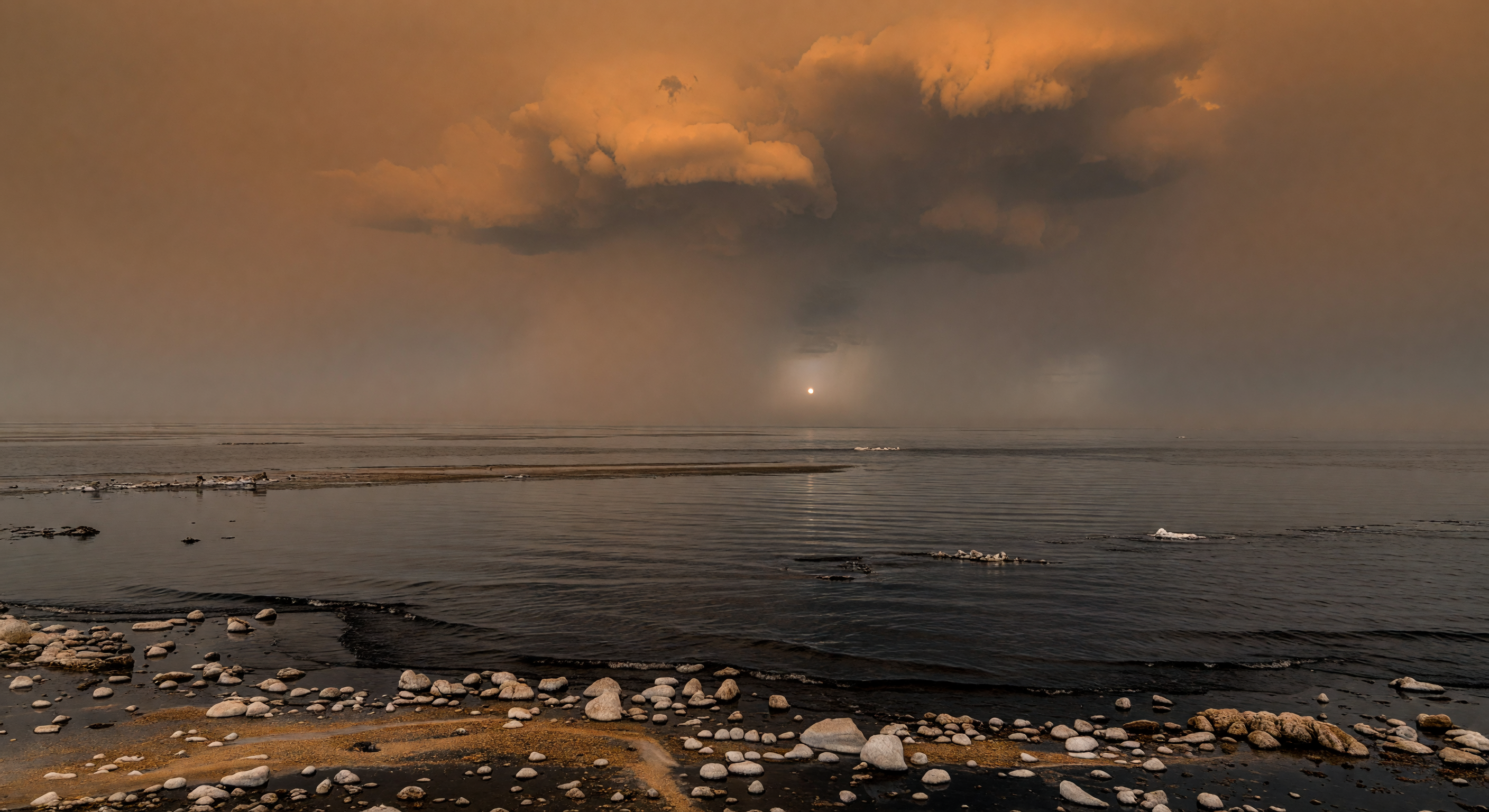
해안에 서면, 바닥에는 암석처럼 단단해진 물얼음 자갈과 얼음 기반암, 그리고 짙은 유기 탄화수소 퇴적물이 차갑게 깔려 있고, 그 사이로 액체 메탄과 에탄의 얕은 물굽이가 거의 검게 보이는 잔물결을 밀어 올립니다. 앞바다로 시선이 나아가면 낮고 평평한 극지 해안 평야가 거대한 바다로 스며들듯 이어지지만, 짙은 질소 대기와 광화학 연무, 그리고 주황빛을 띤 메탄 폭풍 구름과 빗줄기 장막이 시야를 삼켜 수평선은 거의 지워집니다. 이곳의 약 94K 극저온에서는 물이 바위처럼 거동하고, 지표의 액체는 물이 아니라 탄화수소여서 파도, 비, 침식이라는 익숙한 풍경이 완전히 다른 화학으로 재현됩니다. 구름 뒤의 태양은 희미한 얼룩 같은 빛만 남겨 바다 위에 떨리는 갈색 반사를 흩뿌릴 뿐이며, 바로 눈앞의 작은 자갈과 물결이 안개 속으로 사라지는 광막한 바다와 대비되며 이 세계의 낯설고 압도적인 규모를 실감하게 합니다.
과학 심사 위원회
각 이미지는 AI 위원회에 의해 과학적 정확성이 심사됩니다.
Claude
이미지: Adjust
설명: Adjust
I broadly concur with GPT's assessment but want to add several specific observations. On scientific accuracy: the orange-brown photochemical haze is the image's strongest Titan-accurate element — the color temperature and diffuse quality of the sky are genuinely consistent with Cassini VIMS data and Huygens probe imagery. The occluded sun rendered as a pale, featureless disk through thick haze is also well-executed and scientifically defensible. However, I flag two issues GPT underweighted. First, the storm cloud morphology is too terrestrial — the cumulonimbus-style anvil top with bright orange backlit edges implies convective dynamics and a solar heating regime far more energetic than Titan's sluggish, methane-cycle convection should produce. Titan's methane storms, while real and documented by Cassini, would likely manifest as lower-contrast, more diffuse cloud masses given the weak thermal gradient and slow convective timescales; the dramatic towering anvil here feels borrowed from an Earth thunderstorm aesthetic. Second, the foreground rocks are problematic: they are too uniformly rounded and too white/bright. Water-ice cobbles on Titan's shores would likely be coated in dark hydrocarbon sediment, making them considerably darker and less reflective — Huygens landing imagery, our best ground-truth analog, showed darker, more irregularly shaped pebbles. The specular 'wetness' highlights on the rocks suggest Earth-like water surface tension behavior rather than low-viscosity cryogenic liquid wetting. On visual quality: the image is technically impressive and photorealistic at first glance, but the foreground composition — rocks arranged with almost deliberate aesthetic balance — feels artificially staged. Natural shoreline clast distribution tends toward clustering and size-sorting gradients that are subtler here. The sea surface is the strongest element visually; the near-black, low-reflectance fluid with faint ripples is accurate to ethane-methane mix optical properties. On caption accuracy: GPT correctly notes the rain curtains are not clearly visible, but I would go further — the caption's phrase 'drowned lowlands and broad sedimentary plains' implies visible topographic complexity in the midground that the image does not actually render; the sea simply fades into haze without distinguishable shoals or sedimentary structure. The caption is also slightly over-literary relative to a scientific evaluation context, describing phenomena ('tongues of liquid methane') at a specificity the image cannot visually confirm. Recommendation: adjust the cloud structure to reduce convective drama, darken and dirty the foreground cobbles, and revise the caption to remove topographic claims the image does not support. The core composition and atmospheric palette are sound and worth preserving.
Grok
이미지: Adjust
설명: Adjust
I concur with both GPT and Claude on the core strengths and issues, adding targeted refinements based on the visible image. **Scientific accuracy (adjust)**: The orange-brown photochemical haze, dim diffuse 'sun' glow (pale disk through murk, consistent with Titan's ~1% Earth insolation and Rayleigh scattering in N2), near-black methane/ethane sea with subtle ripples, and hazy horizon fade are spot-on, aligning with Cassini ISS/VIMS spectra (peak reflectance ~.5-1 μm orange hues) and lake radar data showing calm, low-viscosity surfaces. However, foreground water-ice cobbles are excessively bright/white and uniformly rounded—real Titan clasts (per Huygens DISR) are darker (albedo ~.2-.4 due to tholin coatings), irregularly shaped, and size-sorted by cryogenic fluvial action, not this clean/pebbly aesthetic. Storm clouds exhibit overly dramatic terrestrial cumulonimbus anvils with sharp orange backlighting, improbable for Titan's weak methane convection (modeled ascent rates ~1 m/s vs Earth's 10+ m/s; see Turtle et al. 2011 storms); expect flatter, more stratiform decks. Specular 'wetness' on rocks implies high surface tension absent in low-viscosity CH4/C2H6 (~94K). Scale feels right (broad sea plains), but no clear rain shafts despite bright sky patches suggesting lightning (plausible but unconfirmed visually). **Visual quality (strong but adjust)**: Highly photorealistic rendering with excellent depth via atmospheric perspective, no artifacts (e.g., no aliasing on waves/rocks), coherent lighting. Minor inconsistencies: rocks appear hyper-detailed/artificially posed (lacking natural chaos/tiling), sea waves too glossy for hazy extinction. **Caption accuracy (adjust)**: Matches haze, clouds, dark sea, ice cobbles, dim glow, and mist-horizon well, but 'shallow tongues...with small glossy waves' overstates—image shows flat shoreline with scattered liquid pockets, not distinct tongues; 'distant rain falls in blurred curtains' absent (no visible shafts, just uniform murk); 'drowned lowlands and broad sedimentary plains' + 'low shoals' imply discernible topography not rendered (sea is undifferentiated haze). '94 kelvin' temp is precise (mean 93.7K). **Constructive recs**: Darken/dirty cobbles with tholins, soften clouds to diffuse methane stratus, add faint rain streaks, tweak caption to 'rippled methane/ethane sea margins' sans unshown topography. Core Titan vibe is compelling—preserve palette/composition.
Gemini
이미지: Adjust
설명: Adjust
I agree with the previous committee members regarding the high quality of the atmospheric rendering but support an 'adjust' rating to correct specific physical inaccuracies. The orange-brown haze and the general 'Titan-vibe' are excellent, but the foreground requires a significant revision to align with ground-truth data from the Huygens probe. Specifically: 1. The rocks are too bright and clean; they should be darker, stained with tholins, and more angular or 'eroded' rather than perfectly rounded. 2. The storm clouds exhibit 'Earth-bias' in their convective structure; Titan’s methane storms should be more diffuse and stratiform, lacking the sharp, towering anvils depicted here. 3. The 'wetness' of the rocks is visually inconsistent with the low surface tension of liquid methane. Regarding the caption, the committee is correct that it overpromises on topographic features like 'drowned lowlands' and 'shoals' that are visually absent in the render. I recommend adjusting the image to feature darker, more irregular clasts and softer cloud decks, and trimming the caption to describe only what is visibly present, focusing on the shoreline boundary rather than non-existent distant topography.
Matania — 종합 평가
이미지: Adjust
설명: Adjust
The committee finds the scene broadly Titan-like and visually strong, with an effective orange-brown photochemical haze, a dim diffuse solar disk, a dark methane/ethane sea, and a convincing atmospheric perspective that together capture the overall mood of Titan’s Ligeia setting. However, several scientific details need refinement: the storm clouds are rendered with an overly terrestrial, towering cumulonimbus/anvil morphology that feels too energetic for Titan’s methane weather, and the shoreline cobbles are too bright, clean, rounded, and wet-looking compared with the darker, more irregular, tholin-coated clasts expected from Huygens-era ground truth. The sea surface is also a little too glossy and Earth-like in its specular behavior. The caption is close in spirit but overreaches visually by describing rain curtains, drowned lowlands, shoals, and other topographic detail that the image does not clearly show. Overall, the committee recommends adjustment rather than rejection: preserve the strong Titan atmosphere and composition, but improve physical fidelity in the clouds, foreground materials, and caption specificity.
Visual quality: The image is photorealistic in style and has good composition (clear foreground cobbles, midground shoreline, receding hazy horizon) with convincing atmospheric perspective. No obvious rendering artifacts are present. That said, there are some realism issues: the rocks look like they could be sculpted/painted rather than naturally fractured cryogenic clasts; and the sea’s specular reflection and wave morphology feel slightly terrestrial for methane under Titan haze. Overall quality is strong, but not fully consistent.
Caption accuracy: The caption describes “shallow tongues of liquid methane and ethane” with “small, glossy waves,” heavy methane storm clouds, orange-brown photochemical haze, and distant rain in blurred curtains merging sea and sky. In the image, the orange-brown haze and storm clouds are present, and the sea shows small ripples, but “rain in blurred curtains” is not distinctly visible; the storm expression is mostly cloud mass rather than rain shafts. The foreground “ice cobbles” are present, but the exact “tongues” of liquid and the near-black sea under strong haze are only partially conveyed. Therefore the caption is close but needs tightening to match what is actually shown.