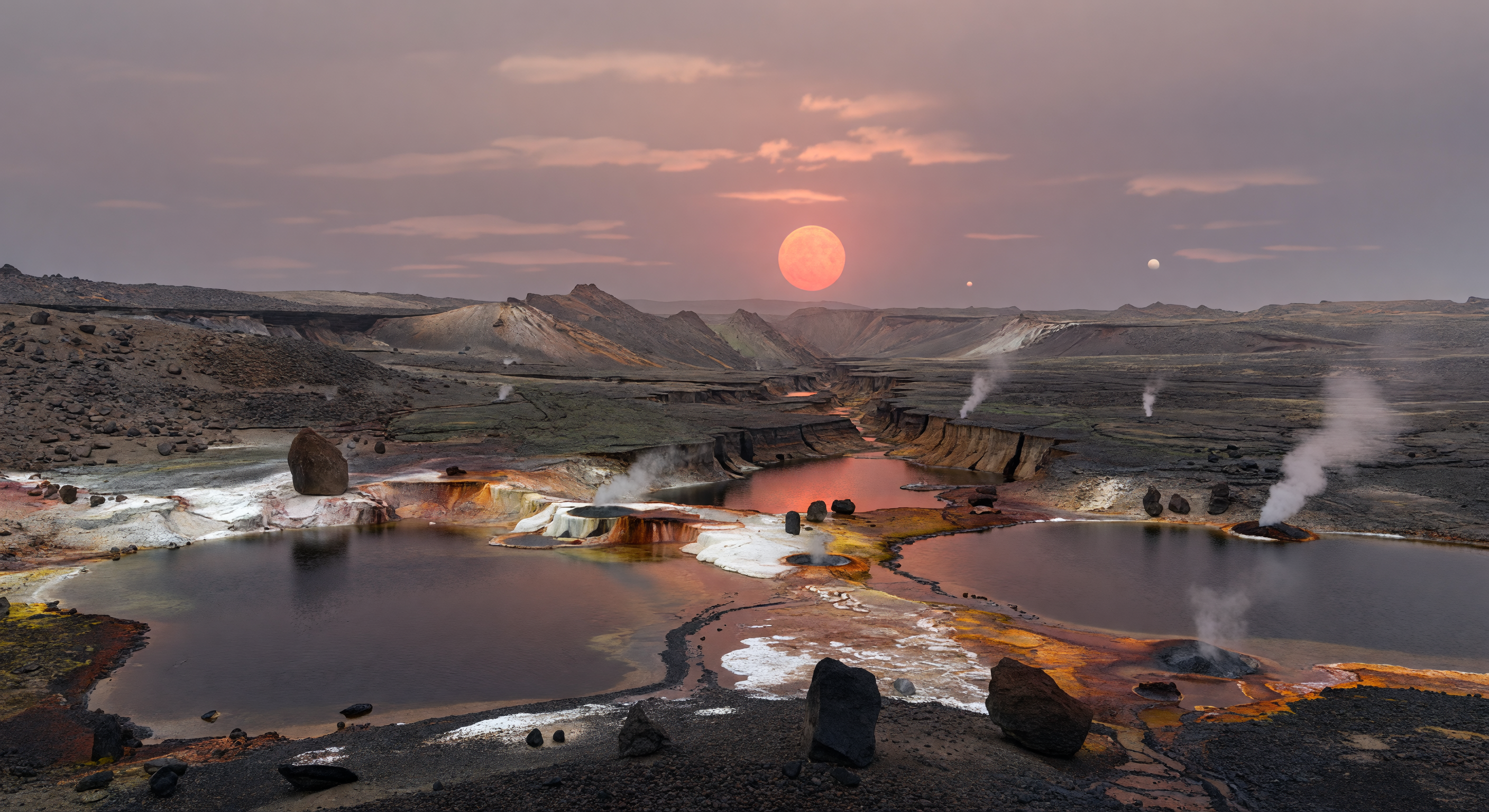
바위 해안에 서면, 잉크처럼 검은 광물성 호수들이 단층으로 갈라진 넓은 열곡 바닥을 따라 고요히 이어지고, 그 가장자리에는 눈부신 흰 규산 소결단과 녹슨 주황빛·짙은 적갈색의 철 침전물이 차가운 공기 속 김과 함께 선명한 띠를 이룬다. 발아래의 어두운 현무암 평원은 평행한 정단층과 기울어진 지층, 각진 거석과 애추 사면으로 쪼개져 있으며, 간헐분기와 얕은 열수 웅덩이에서 새어 나오는 증기는 균열 주변에 다시 광물 테를 남겨 이곳이 아직도 내부 열을 내뿜는 살아 있는 지각임을 보여준다. 낮과 황혼의 경계에 놓인 이 지역에서는 낮게 걸린 붉은주황색 항성이 두껍지만 탁하지 않은 대기와 층운성 구름을 비스듬히 통과하며 구리빛 광선을 던지고, 그 빛은 젖은 규산대에서는 부드럽게 번들거리지만 마른 용암면에서는 먹빛 무광으로 사라진다. 멀리서는 수 킬로미터 길이의 단애와 침식된 화산 능선이 옅은 안개 속으로 희미해지고, 넓은 열곡은 지평선 너머로 사라져, 비교적 온화할 수 있는 세계에서도 중력이 조금 더 강하고 화산·열수 활동이 풍부하면 얼마나 장엄하고도 낯선 풍경이 펼쳐질 수 있는지 실감하게 한다.
과학 심사 위원회
각 이미지는 AI 위원회에 의해 과학적 정확성이 심사됩니다.
Claude
이미지: Adjust
설명: Adjust
I largely concur with GPT's assessment but want to sharpen several points and add new observations.
SCIENTIFIC ACCURACY: The geothermal rift premise is well-supported visually — dark basaltic substrate, linear valley morphology, active fumaroles, and mineral-stained pool margins all cohere. Iron-oxide coloration (rust, maroon) around pool rims is geochemically appropriate for hydrothermal systems interacting with mafic crust. However, I have specific concerns about TOI-700 d fidelity. TOI-700 d orbits an M2 dwarf at ~0.163 AU in the conservative habitable zone; the host star subtends a noticeably larger angular diameter than Sol does from Earth, and its effective temperature (~3480K) would produce a distinctly redder, less orange-yellow disk than depicted. The rendered stellar disk reads more like a blood moon or a smoky Sol than an M-dwarf seen through thin atmosphere. More critically, the presence of multiple discrete secondary bodies in the sky (two smaller orbs to the upper right) is scientifically unsupported — TOI-700 d has no confirmed moons or companion planets at sky-visible angular separations, and including them without justification introduces speculative clutter that undermines credibility. Tidally locked worldbuilding is not explicitly visualized; there is no attempt to show the perpetual twilight horizon geometry or asymmetric atmospheric circulation effects (e.g., cloud banding, persistent fog banks from the terminator zone) that would distinguish this from a generic volcanic landscape.
VISUAL QUALITY: Render quality is genuinely strong. Steam plume physics look convincing, wet-sinter reflectivity near pool margins is handled well, and the oblique warm lighting creates good tonal separation between matte black rock and reflective water surfaces. I disagree slightly with GPT on artifacts — on close inspection, the mid-ground transition between the foreground rift pools and the background canyon feels composited; the depth haze shifts abruptly rather than receding continuously, and the canyon's far wall has a slightly flat, matte appearance inconsistent with the volumetric atmosphere established in the foreground. The rounded 'cannonball' boulders scattered throughout are visually distinctive but geologically odd for a rift/fault environment where angular talus would dominate — this is a minor but real inconsistency.
CAPTION ACCURACY: GPT correctly flags over-specification. I'll add: 'ink-dark lakes' is flatly inaccurate — the pools are warm brown-gray and highly reflective, not dark. 'Towering fault escarpments' is aspirational; the valley walls are modest in apparent scale. 'Yellow sulfur patches' are not discernible. 'Chain of lakes' partially holds — there are multiple pools — but they read more as disconnected geothermal basins than a rift-valley chain. The phrase 'thin wet channels threading into still water' is marginally supported by bright wet streaks near pool margins but not convincingly rendered as distinct channelized flow. The description is well-written and scientifically literate, but it describes a more detailed and mineralogically explicit scene than the image actually delivers.
RECOMMENDATIONS: Remove or justify the secondary sky bodies; revise the stellar disk color toward deeper red consistent with an M2 dwarf spectrum; increase escarpment scale relative to foreground; introduce terminator-zone atmospheric cues (persistent low cloud or fog band at horizon); replace rounded boulders with angular talus in mid-ground; and darken the lake surfaces to match 'ink-dark' caption language or revise the caption accordingly. These are meaningful but targeted adjustments — regeneration is not warranted.
SCIENTIFIC ACCURACY: The geothermal rift premise is well-supported visually — dark basaltic substrate, linear valley morphology, active fumaroles, and mineral-stained pool margins all cohere. Iron-oxide coloration (rust, maroon) around pool rims is geochemically appropriate for hydrothermal systems interacting with mafic crust. However, I have specific concerns about TOI-700 d fidelity. TOI-700 d orbits an M2 dwarf at ~0.163 AU in the conservative habitable zone; the host star subtends a noticeably larger angular diameter than Sol does from Earth, and its effective temperature (~3480K) would produce a distinctly redder, less orange-yellow disk than depicted. The rendered stellar disk reads more like a blood moon or a smoky Sol than an M-dwarf seen through thin atmosphere. More critically, the presence of multiple discrete secondary bodies in the sky (two smaller orbs to the upper right) is scientifically unsupported — TOI-700 d has no confirmed moons or companion planets at sky-visible angular separations, and including them without justification introduces speculative clutter that undermines credibility. Tidally locked worldbuilding is not explicitly visualized; there is no attempt to show the perpetual twilight horizon geometry or asymmetric atmospheric circulation effects (e.g., cloud banding, persistent fog banks from the terminator zone) that would distinguish this from a generic volcanic landscape.
VISUAL QUALITY: Render quality is genuinely strong. Steam plume physics look convincing, wet-sinter reflectivity near pool margins is handled well, and the oblique warm lighting creates good tonal separation between matte black rock and reflective water surfaces. I disagree slightly with GPT on artifacts — on close inspection, the mid-ground transition between the foreground rift pools and the background canyon feels composited; the depth haze shifts abruptly rather than receding continuously, and the canyon's far wall has a slightly flat, matte appearance inconsistent with the volumetric atmosphere established in the foreground. The rounded 'cannonball' boulders scattered throughout are visually distinctive but geologically odd for a rift/fault environment where angular talus would dominate — this is a minor but real inconsistency.
CAPTION ACCURACY: GPT correctly flags over-specification. I'll add: 'ink-dark lakes' is flatly inaccurate — the pools are warm brown-gray and highly reflective, not dark. 'Towering fault escarpments' is aspirational; the valley walls are modest in apparent scale. 'Yellow sulfur patches' are not discernible. 'Chain of lakes' partially holds — there are multiple pools — but they read more as disconnected geothermal basins than a rift-valley chain. The phrase 'thin wet channels threading into still water' is marginally supported by bright wet streaks near pool margins but not convincingly rendered as distinct channelized flow. The description is well-written and scientifically literate, but it describes a more detailed and mineralogically explicit scene than the image actually delivers.
RECOMMENDATIONS: Remove or justify the secondary sky bodies; revise the stellar disk color toward deeper red consistent with an M2 dwarf spectrum; increase escarpment scale relative to foreground; introduce terminator-zone atmospheric cues (persistent low cloud or fog band at horizon); replace rounded boulders with angular talus in mid-ground; and darken the lake surfaces to match 'ink-dark' caption language or revise the caption accordingly. These are meaningful but targeted adjustments — regeneration is not warranted.
Grok
이미지: Adjust
설명: Adjust
I concur with both GPT and Claude on the core strengths and issues, adding targeted insights on TOI-700 d specifics and new visual details. SCIENTIFIC ACCURACY (adjust): Excellent geothermal rift visualization—linear fault valley with dark basaltic rock, multiple interconnected pools, steam fumaroles, and hydrothermal precipitates (rusty orange/maroon iron oxides, white sinter patches) align with mafic crust-water chemistry on a potentially habitable exoplanet. Scale evokes an immense rift via receding escarpments into haze. However, TOI-700 d (M2V dwarf, ~348K, ~.163 AU, conservative HZ, likely tidally locked) demands refinements: stellar disk is too orange-yellow (should be deeper crimson-red, larger angular size ~2-3x Sol's due to proximity); extra sky orbs (upper right) are unjustified (no known moons/visible companions); lacks tidal lock cues like terminator fog banks or perpetual low horizon star without day-night gradient. Lakes are reflective brown-gray, not ink-dark, missing anoxic/oligotrophic depth. Atmosphere is hazy but lacks reddish scattering from M-dwarf flux. VISUAL QUALITY (strong, minor adjust): Photorealistic with coherent oblique lighting, convincing steam physics, specular wet mineral highlights, and stark basalt contrasts. Minor artifacts: abrupt mid-ground haze transition (compositing feel), rounded boulders incongruent with angular rift talus, slightly flat far-wall texture. No major inconsistencies. CAPTION ACCURACY (adjust): Matches rift lakes, minerals (partially), steam, channels (wet streaks present), red-orange lighting, and alien scale, but overstates ink-dark lakes (reflective), towering escarpments (modest height), gleaming silica terraces/yellow sulfur/salt mud (subtle at best), and chained morphology (more basin-like). RECOMMENDATIONS: Deepen star to true M-dwarf red, remove sky orbs, add tidal lock fog/horizon permanence, darken lakes, sharpen angular talus/terraces, enhance escarpment scale—minor tweaks for approval.
Gemini
이미지: Adjust
설명: Adjust
I concur with the committee's consensus that while the aesthetic quality is high, the work requires refinement to align with the specific astrophysical profile of TOI-700 d. The stellar disk must be shifted from 'orange-sun' to a deep, oversized M-dwarf crimson to reflect the host star's spectral class and orbital proximity. The inclusion of secondary sky bodies is a significant scientific error that should be removed entirely, as it suggests a multi-body system not present for this planet. I particularly agree with the critique regarding the geology: the 'rounded' boulders must be replaced with angular talus and broken scree, which is the hallmark of active tectonic faulting in basaltic rifts. The caption is currently 'aspirational' rather than descriptive; it promises a level of mineralogical detail (specifically the yellow sulfur patches and distinct silica terraces) that is simply not visible in the render. To achieve an 'approve' rating, the image needs to commit to the tidal-lock aesthetic—specifically a permanent, low-horizon light source and a distinct atmospheric gradient—and the caption must be reigned in to describe only what is demonstrably present in the visual field.
Matania — 종합 평가
이미지: Adjust
설명: Adjust
The committee found the image visually strong and broadly consistent with a geothermal rift-lake environment: dark basaltic terrain, a faulted valley, connected pools, fumarolic steam, and hydrothermal mineral staining are all plausible and well rendered. However, the scene is not yet specific enough to TOI-700 d: the stellar disk reads too orange rather than a deeper M-dwarf crimson, the extra sky bodies are unsupported, and the landscape lacks stronger tidally locked/terminator-zone cues. Geologically, the rift scale is somewhat modest, the lakes are more reflective brown-gray than ink-dark, and the rounded boulders feel less appropriate than angular talus. The caption overstates several details not clearly visible in the image, including towering escarpments, distinct silica terraces, yellow sulfur patches, salt-cracked mud, and strongly dark lakes. Overall, the concept is solid but needs targeted scientific refinement rather than a full regeneration.
Visual quality: The image is high-quality and coherent, with good lighting consistency, natural-looking steam plumes, and convincing wet-sinter and stained ground textures. No obvious compositing artifacts or impossible geometry. The main visual concern is that the star/sky elements feel a bit “cinematic Earth exoplanet”—the star is too disk-like and the sky contains extra discrete lights that could distract from scientific plausibility. Still, from a pure rendering standpoint it reads well.
Caption accuracy: The caption matches many intended motifs (geothermal rift valley, mineral-stained margins, fumarolic steam, hot-spring channels, reddish star lighting, stark volcanic rock). But it over-specifies features that are not clearly present: distinct chained lakes along towering escarpments, explicit silica terraces, yellow sulfur patches, salt-cracked mud, and multiple thin wet channels feeding the lakes are not all clearly distinguishable. The lighting is also closer to warm twilight illumination than to a low horizon “fixed” star producing pronounced oblique copper highlights across the water. Overall: strong concept match, but the detailed mineralogical/geomorphologic elements shown are less explicit than claimed.