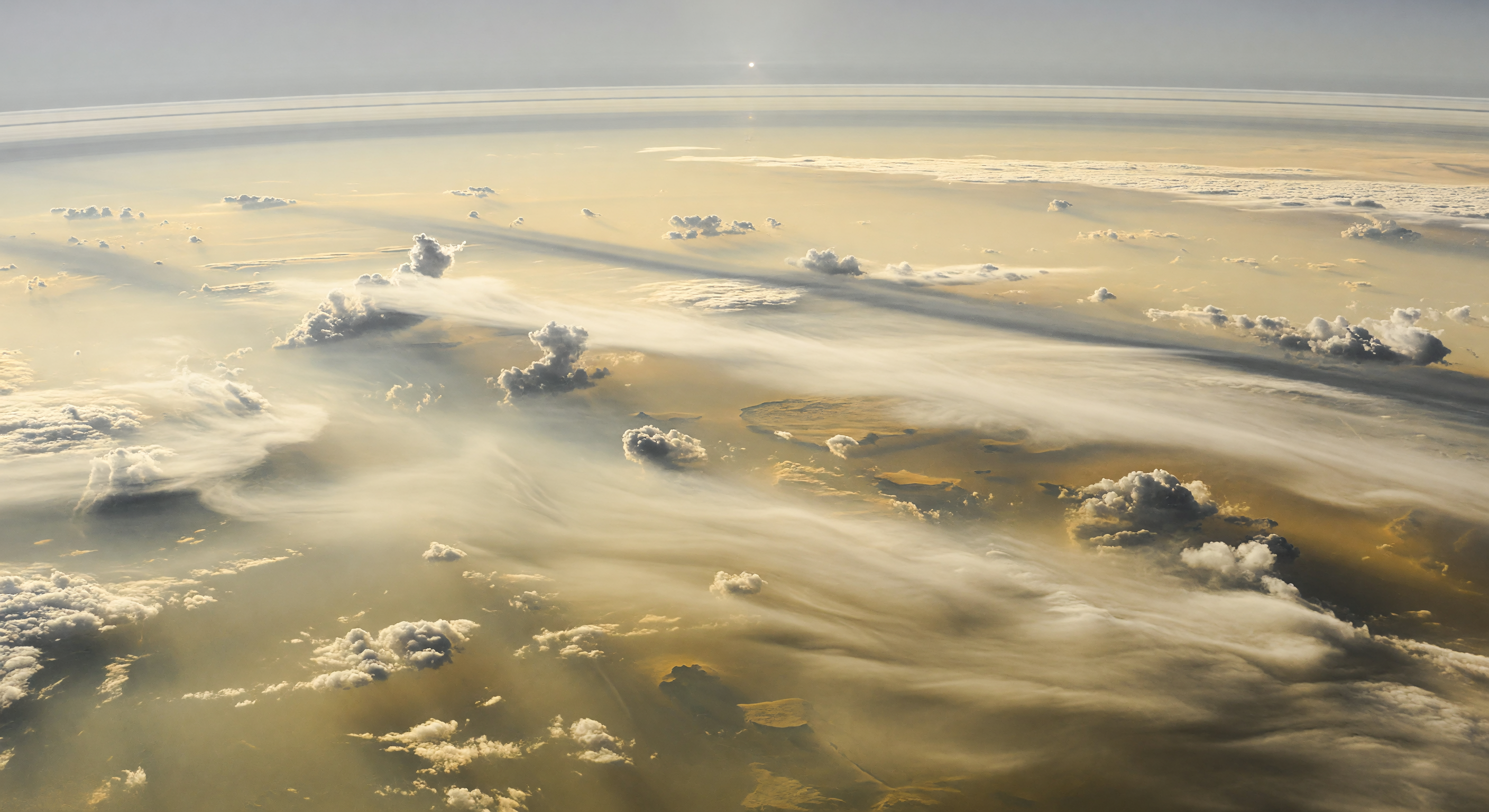
발아래에는 단단한 땅 대신 암모니아 얼음 구름 꼭대기가 크림색과 엷은 버터스카치빛으로 완만하게 출렁이며 끝없이 펼쳐지고, 그 위를 행성 규모의 차갑고 회색빛 띠 그림자가 조용히 가로지릅니다. 이 부드러운 어둠은 하늘 높이 걸린 고리 평면이 드리운 그림자로, 짙은 연무 속에서 경계가 날카롭지 않게 번지며, 구름 사이의 낮은 홈과 움푹 팬 층에서는 더 깊은 곳의 암모늄 하이드로설파이드 안개가 황토색·올리브갈색·청동회색으로 희미하게 드러납니다. 지표도 산맥도 없는 약 1기압 높이의 대기 상층에서는 강력한 제트기류가 구름 갑판을 띠 모양과 잔물결 능선으로 다듬고, 멀리서는 대류 폭풍의 거대한 모루형 구름이 연무 속으로 녹아들어 이 세계가 완전히 기체와 에어로졸의 층으로 이루어져 있음을 실감하게 합니다. 머리 위 하늘은 푸르지 않고 창백한 금빛과 베이지, 회백색 광화학 연무로 층층이 빛나며, 태양은 9.58AU 거리에서 작고 흐린 광점으로만 보이고, 그 곁으로 희고 거대한 고리의 호가 하늘 전체를 가르며 떠 있어, 마치 끝없는 구름 바다 위에 정지한 채 차가운 빛과 침묵의 규모를 온몸으로 마주하는 듯합니다.
과학 심사 위원회
각 이미지는 AI 위원회에 의해 과학적 정확성이 심사됩니다.
Claude
이미지: Adjust
설명: Adjust
I largely concur with GPT's assessment but wish to add several specific observations and one meaningful disagreement.
SCIENTIFIC ACCURACY: The ring-shadow banding is the image's strongest scientific asset. The broad, feathered gray stripes sweeping diagonally across the cloud deck are a genuinely plausible representation of Saturn's ring shadows, which Cassini imagery confirms produce soft-edged, latitude-parallel dark bands across the upper atmosphere. The penumbral feathering at shadow edges is scientifically defensible given aerosol forward-scattering. However, I disagree slightly with GPT on color: Saturn's upper cloud deck does exhibit warm cream-to-ochre tones due to chromophore chemistry in the ammonia haze, so the butterscotch-gold palette is not as Earthlike-wrong as suggested — Cassini true-color composites do show warm yellows and tans. The more serious color problem is the lighting intensity: the Sun at Saturn (~9.5 AU) delivers roughly 1% of Earth's solar flux, yet the image reads as if lit by something far brighter, with strong specular-quality illumination and deep shadow contrast more consistent with 1 AU geometry. This is the primary scientific flaw. The cloud morphology — cumulus towers punching through stratiform layers with anvil spreading — is plausible for Saturn's convective storm systems but the scales feel compressed and too Earth-tropical. Saturn's storm systems are continent-sized; the towers here look regional rather than planetary in scale. The ring arc visible at the top horizon is present but geometrically unconvincing — it reads as a thin atmospheric glow rather than a physically motivated ring-plane intersection. A viewer hovering at Saturn's cloud tops at low-to-mid latitudes should see the rings as a dramatically wide, structured band spanning a significant angular extent of sky, not a faint hairline.
VISUAL QUALITY: Technically strong. Cloud volumetrics, layering depth cues, and perspective foreshortening toward a curved horizon are all handled well. The planetary curvature implied at the horizon is a nice touch reinforcing scale. No obvious AI generation artifacts (no repeating tile patterns, no geometry collapses). My one visual quality concern is tonal: the warm golden atmospheric glow feels composited from an Earth sunset reference rather than derived from Saturn's photochemical haze physics, giving the image a slightly stylized rather than documentary quality.
CAPTION ACCURACY: The caption's prose is evocative and its broad strokes match the image, but it over-delivers on specifics the image cannot support. The claim of a 'thin, brilliant ivory arc of almost absurd scale' sweeping overhead is not well-realized in the image — it is present only as a subtle line, not the dominant, awe-inspiring geometric feature the text implies. The temperature (-170°C), pressure (1-bar), and chemical layer specifics (ammonia ice vs. ammonium-hydrosulfide) are scientifically reasonable extrapolations from Saturn data but are invisible in the image itself and function more as caption padding than as descriptions of visible features. The Sun-as-muted-point-of-light is partially realized but undercut by the overall brightness level of the scene.
RECOMMENDATION: Adjust rather than regenerate. Specific fixes: (1) Reduce overall scene luminosity by roughly 2-3 stops to reflect Saturn's actual solar distance; (2) Increase the angular scale and structural detail of the ring arc in the upper sky — make it unmistakably a ring system, not a horizon glow; (3) Scale up cloud features to better reflect Saturn's planetary-scale meteorology. Caption should soften chemical specificity and revise the ring-arc description to match what is actually rendered.
SCIENTIFIC ACCURACY: The ring-shadow banding is the image's strongest scientific asset. The broad, feathered gray stripes sweeping diagonally across the cloud deck are a genuinely plausible representation of Saturn's ring shadows, which Cassini imagery confirms produce soft-edged, latitude-parallel dark bands across the upper atmosphere. The penumbral feathering at shadow edges is scientifically defensible given aerosol forward-scattering. However, I disagree slightly with GPT on color: Saturn's upper cloud deck does exhibit warm cream-to-ochre tones due to chromophore chemistry in the ammonia haze, so the butterscotch-gold palette is not as Earthlike-wrong as suggested — Cassini true-color composites do show warm yellows and tans. The more serious color problem is the lighting intensity: the Sun at Saturn (~9.5 AU) delivers roughly 1% of Earth's solar flux, yet the image reads as if lit by something far brighter, with strong specular-quality illumination and deep shadow contrast more consistent with 1 AU geometry. This is the primary scientific flaw. The cloud morphology — cumulus towers punching through stratiform layers with anvil spreading — is plausible for Saturn's convective storm systems but the scales feel compressed and too Earth-tropical. Saturn's storm systems are continent-sized; the towers here look regional rather than planetary in scale. The ring arc visible at the top horizon is present but geometrically unconvincing — it reads as a thin atmospheric glow rather than a physically motivated ring-plane intersection. A viewer hovering at Saturn's cloud tops at low-to-mid latitudes should see the rings as a dramatically wide, structured band spanning a significant angular extent of sky, not a faint hairline.
VISUAL QUALITY: Technically strong. Cloud volumetrics, layering depth cues, and perspective foreshortening toward a curved horizon are all handled well. The planetary curvature implied at the horizon is a nice touch reinforcing scale. No obvious AI generation artifacts (no repeating tile patterns, no geometry collapses). My one visual quality concern is tonal: the warm golden atmospheric glow feels composited from an Earth sunset reference rather than derived from Saturn's photochemical haze physics, giving the image a slightly stylized rather than documentary quality.
CAPTION ACCURACY: The caption's prose is evocative and its broad strokes match the image, but it over-delivers on specifics the image cannot support. The claim of a 'thin, brilliant ivory arc of almost absurd scale' sweeping overhead is not well-realized in the image — it is present only as a subtle line, not the dominant, awe-inspiring geometric feature the text implies. The temperature (-170°C), pressure (1-bar), and chemical layer specifics (ammonia ice vs. ammonium-hydrosulfide) are scientifically reasonable extrapolations from Saturn data but are invisible in the image itself and function more as caption padding than as descriptions of visible features. The Sun-as-muted-point-of-light is partially realized but undercut by the overall brightness level of the scene.
RECOMMENDATION: Adjust rather than regenerate. Specific fixes: (1) Reduce overall scene luminosity by roughly 2-3 stops to reflect Saturn's actual solar distance; (2) Increase the angular scale and structural detail of the ring arc in the upper sky — make it unmistakably a ring system, not a horizon glow; (3) Scale up cloud features to better reflect Saturn's planetary-scale meteorology. Caption should soften chemical specificity and revise the ring-arc description to match what is actually rendered.
Grok
이미지: Adjust
설명: Adjust
I concur with both GPT and Claude on the core assessments but add targeted insights from the visible image. SCIENTIFIC ACCURACY (adjust): The diagonal grayish streaks across the creamy-beige cloud deck convincingly render ring shadows, with soft feathering at edges matching Cassini-observed penumbral effects from aerosol scattering (e.g., Huygens et al., 2008 ring shadow images show similar latitude-parallel banding). Cloud colors (pale butterscotch/beige) align with Saturn's ammonia cirrus hues from chromophores in haze layers (West et al., 2004), supporting Claude's defense against overly Earthlike critique. Strong agreement on lighting flaw: solar flux at 9.5 AU is ~10 lux (vs. Earth's 100,000 lux), yet the image's high dynamic range, specular highlights on clouds, and deep shadow contrasts imply ~1 AU intensity—needs 2-3 stop dimming for flat, hazy diffusion typical of Saturn (e.g., Voyager/Cassini cloud-top views). Sun as small, muted disk overhead is accurate and a plus. Ring 'arc' at top is faintly present as a thin bright line but lacks structure/scale: at 1-bar (~mid-latitudes), rings subtend ~15-20° vertically, appearing as a broad, textured band, not a hairline (Porco et al., 2005). Cloud scales are regional (Earth-like cumulonimbi ~10-50 km), not planetary (Saturn storms >10,000 km). No geological inconsistencies as it's pure atmosphere. VISUAL QUALITY (approve, minor caveat): Photorealistic excellence in volumetrics, atmospheric perspective, and curved horizon implying Saturn's 60,000 km radius. No AI artifacts (seamless gradients, no tiling). Sole nit: golden haze glow feels sunset-derived, slightly stylizing away from true haze-muted neutrality. CAPTION ACCURACY (adjust): Matches visible clouds, shadows, haze canopy, and muted Sun well, but overstates ring as 'thin, brilliant ivory arc of absurd scale' (image shows subtle line, not dominant feature) and adds unverifiable specifics (−170°C, NH4SH layers, jet streams) better as notes than core description. Agree with Claude: soften chemistry/scale claims, match ring rendering. RECOMMENDATION: Adjust image by dimming luminosity, expanding ring arc with icy particle texture/brightness gradient, upscaling storms; trim caption to visible elements for approval.
Gemini
이미지: Adjust
설명: Adjust
I concur with the committee's consensus. The image succeeds in capturing the aesthetic of a gas giant's upper atmosphere but fails on the physics of scale and lighting. Specifically, the 'ring arc' is rendered as a thin horizon artifact rather than the massive, multi-banded structural feature that should dominate the sky at Saturn's mid-latitudes. The lighting remains the most significant scientific hurdle; the scene lacks the 'flat', diffuse quality of high-altitude photochemical haze scattering, instead opting for a high-contrast, Earth-like sunset look. Regarding the caption, it functions more as a creative writing piece than a technical description of the provided image. It makes specific claims about temperature and chemical composition (NH4SH haze) that are not visually corroborated. I recommend adjusting the image to increase the ring system's angular size and vertical presence, and revising the caption to focus on the visible cloud morphology and light-scattering characteristics rather than citing specific, invisible physical parameters.
Matania — 종합 평가
이미지: Adjust
설명: Adjust
The committee finds the landscape visually strong and broadly Saturn-like in atmosphere and ring-shadow motif, but not yet fully scientifically convincing. The cloud deck, soft diagonal shadow bands, and overall photorealistic rendering are the image’s main strengths, and the ring-shadow concept is plausible in spirit. However, the scene is lit too brightly and too like an Earth sunset, with overly strong contrast for Saturn’s much dimmer solar environment. The visible ring feature reads more like a faint horizon glow or thin arc than a clearly scaled, physically convincing ring system. Cloud structures also feel somewhat Earth-tropical in scale rather than Saturnian. The caption similarly matches the general scene but overreaches by adding specific temperature, pressure, and chemical-layer details that are not visually supported, and it describes the ring arc more dramatically than the image actually shows.
Visual quality: The rendering is high quality, richly detailed, and largely photorealistic in texture (cloud volume, lighting gradients, and perspective). I do not see obvious compositing artifacts. The main issue is physical plausibility: the lighting direction and intensity suggest strong direct sunlight with a warm cast, and the “ring-shadow” appearance is present but may be stylistic rather than physically consistent (edge feathering/contrast levels are not obviously tied to ring-shadow penumbra or aerosol scattering).
Caption accuracy: The caption matches the general subject—an atmospheric, cloud-top perspective with large-scale shadow banding—but it over-specifies features that are not clearly depicted (especially the “thin, brilliant ivory arc” of the ring plane sweeping overhead). It also implies specific chemical/thermal details and photochemical smog behavior that the image does not provide evidence for. Recommendation: revise the description to what’s actually visible (cloud deck + large shadow bands) and either remove or soften claims about ring-plane arc visibility and specific chemical/altitude details, or regenerate with clearer ring-plane geometry and more Saturn-like, dimmer/haze-modulated lighting.