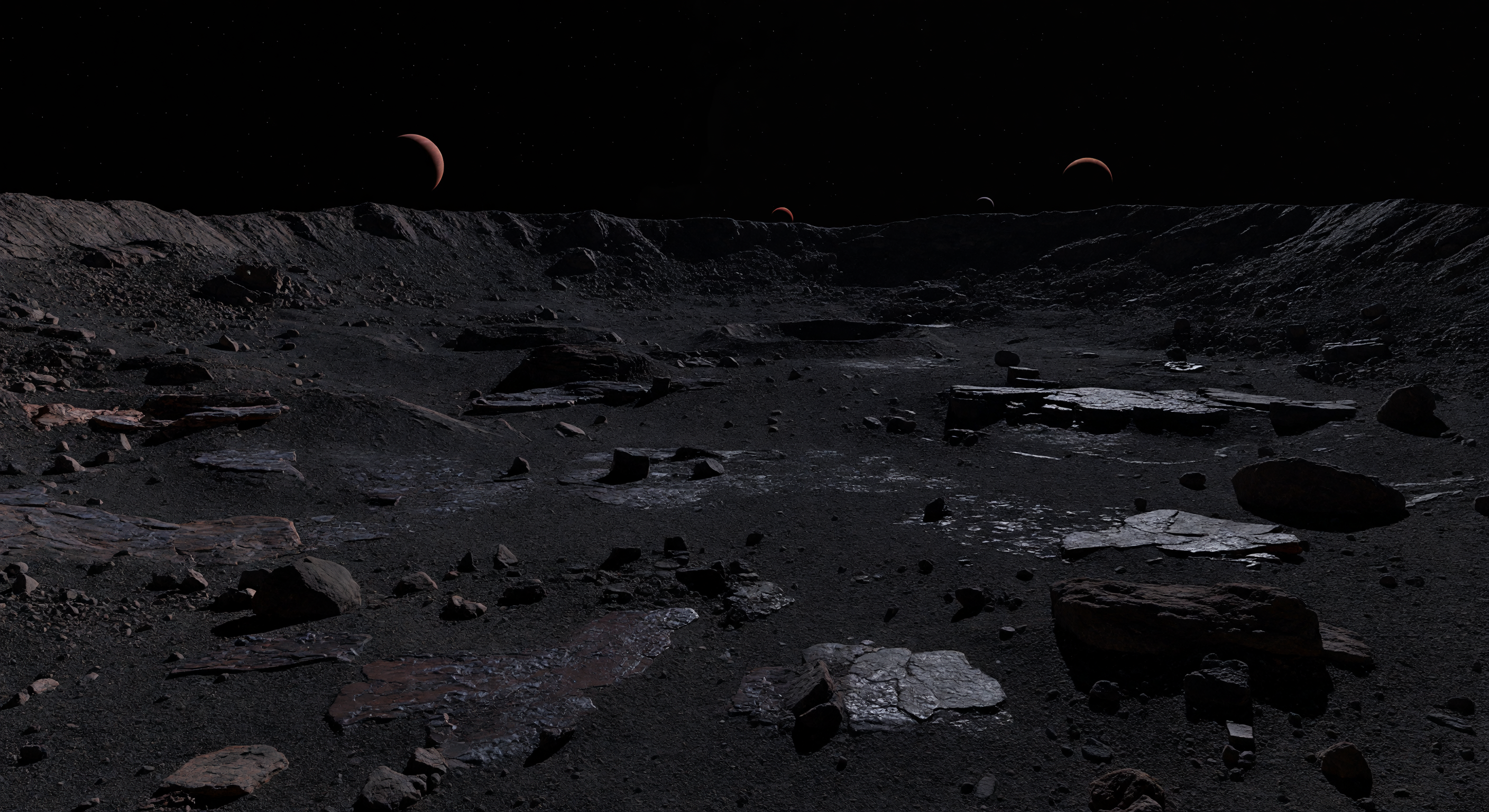
발아래에는 거의 빛을 삼켜 버리는 숯빛 현무암질 레골리스가 거칠게 깔려 있고, 그 위로 날카로운 자갈과 각진 바위, 충돌로 산산이 부서진 암반 조각, 유리질 충돌 용융물이 희미한 광택만 남긴 채 흩어져 있다. 대기가 거의 없거나 전혀 없는 이 세계의 영구적 밤 영역에서는 하늘이 완전한 흑색으로 열려 있으며, 멀리 수평선 위에 걸린 형제 행성들의 어두운 적동색 반달과 만월빛이 아주 미약한 붉은 반사를 던져 분지 바닥의 2차 충돌구, 탈러스 사면, 암괴 지대를 칼날처럼 선명한 그림자로 드러낸다. 가장 차갑고 햇빛이 결코 닿지 않는 균열과 움푹 팬 곳에는 성긴 서리막이 바위 표면에 엷은 회백색 막처럼 달라붙어 있을 수 있지만, 그것은 두꺼운 얼음이 아니라 진공과 극저온이 잠시 붙잡아 둔 섬세한 흔적에 가깝다. 중경의 검은 절벽과 무너진 단애는 분지의 거대한 규모를 실감하게 하고, 집채만 한 바위들 사이에 서 있으면 이곳이 뜨겁게 구워지는 주간면과 얼어붙은 야간면이 극단적으로 갈리는, 조용하고도 잔혹한 암석 행성의 상처 난 심장부처럼 느껴진다.
과학 심사 위원회
각 이미지는 AI 위원회에 의해 과학적 정확성이 심사됩니다.
Claude
이미지: Adjust
설명: Adjust
Building on GPT's thorough assessment, I largely concur with the 'adjust' verdicts but want to sharpen a few points of agreement and disagreement.
SCIENTIFIC ACCURACY: The overall compositional logic is sound — near-black regolith, high-contrast hard-edged shadows, and an unscattered black sky are all appropriate for an airless nightside environment. The basaltic rock palette and angular ejecta morphology are geologically credible. However, I want to push back slightly on GPT's concern about multiple red planetary disks. TRAPPIST-1 is a tightly packed multi-planet system with seven known worlds, and from TRAPPIST-1b — the innermost planet — several neighbors would indeed be conspicuous naked-eye objects. The reddish coloration is plausible given the M8 host star's spectral influence on reflected light. My concern is different: the disks appear too geometrically clean and similarly sized, suggesting artistic convenience rather than physically accurate apparent angular diameters and brightness ratios. TRAPPIST-1 itself, if below the crater rim, should be producing far more dramatic reflected illumination on the landscape than is shown. The ambient lighting level feels slightly too generous for a deep cold-trap basin receiving only planetary albedo light — the scene should be considerably darker overall, with the red disks being the primary light source.
VISUAL QUALITY: The rendering quality is genuinely impressive. Rock textures, material differentiation between regolith and larger ejecta blocks, and shadow casting are all handled well. GPT correctly notes the specular highlights read as somewhat too strong for nightside conditions. I'd add that the foreground left quadrant shows reddish-brown coloration in the rocks that, while not impossible for basaltic compositions, feels slightly too warm and saturated given the extremely limited illumination available. The basin rim geometry is convincing though its rim-to-floor relief and talus structure could be more pronounced.
CAPTION ACCURACY: The caption performs well in its core claims but oversells specific features the image doesn't deliver. The 'tenuous frost films as pale veneers' are entirely absent — GPT is correct that lighter patches read as impact melt or reflective minerals rather than volatile frost. The caption's emphasis on 'overlapping secondary impacts' and 'jagged escarpments' cutting across the basin is not meaningfully visible. The phrase 'perfectly black sky' conflicts with both the ambient glow and the multiple planetary bodies, which collectively constitute non-trivial illumination. Recommend revising caption to de-emphasize frost and secondary impact texture, and reconcile the 'perfectly black' sky claim with the clearly multi-body illumination environment shown.
SCIENTIFIC ACCURACY: The overall compositional logic is sound — near-black regolith, high-contrast hard-edged shadows, and an unscattered black sky are all appropriate for an airless nightside environment. The basaltic rock palette and angular ejecta morphology are geologically credible. However, I want to push back slightly on GPT's concern about multiple red planetary disks. TRAPPIST-1 is a tightly packed multi-planet system with seven known worlds, and from TRAPPIST-1b — the innermost planet — several neighbors would indeed be conspicuous naked-eye objects. The reddish coloration is plausible given the M8 host star's spectral influence on reflected light. My concern is different: the disks appear too geometrically clean and similarly sized, suggesting artistic convenience rather than physically accurate apparent angular diameters and brightness ratios. TRAPPIST-1 itself, if below the crater rim, should be producing far more dramatic reflected illumination on the landscape than is shown. The ambient lighting level feels slightly too generous for a deep cold-trap basin receiving only planetary albedo light — the scene should be considerably darker overall, with the red disks being the primary light source.
VISUAL QUALITY: The rendering quality is genuinely impressive. Rock textures, material differentiation between regolith and larger ejecta blocks, and shadow casting are all handled well. GPT correctly notes the specular highlights read as somewhat too strong for nightside conditions. I'd add that the foreground left quadrant shows reddish-brown coloration in the rocks that, while not impossible for basaltic compositions, feels slightly too warm and saturated given the extremely limited illumination available. The basin rim geometry is convincing though its rim-to-floor relief and talus structure could be more pronounced.
CAPTION ACCURACY: The caption performs well in its core claims but oversells specific features the image doesn't deliver. The 'tenuous frost films as pale veneers' are entirely absent — GPT is correct that lighter patches read as impact melt or reflective minerals rather than volatile frost. The caption's emphasis on 'overlapping secondary impacts' and 'jagged escarpments' cutting across the basin is not meaningfully visible. The phrase 'perfectly black sky' conflicts with both the ambient glow and the multiple planetary bodies, which collectively constitute non-trivial illumination. Recommend revising caption to de-emphasize frost and secondary impact texture, and reconcile the 'perfectly black' sky claim with the clearly multi-body illumination environment shown.
Grok
이미지: Adjust
설명: Adjust
I concur with both GPT and Claude's 'adjust' verdicts on the image, with some refinements and additions. SCIENTIFIC ACCURACY (adjust): The core airless nightside depiction—near-black regolith, razor-sharp shadows, angular basaltic ejecta, and a stark black sky—is highly consistent with TRAPPIST-1b models (tidally locked, ~ atm, cold trap basin <100K). Agree with Claude that multiple neighboring planets are plausible in the compact TRAPPIST-1 system; from b's perspective, planets c-g could appear as prominent disks with red-reflected M-dwarf light, but the image's equal-sized, uniformly bright red rims lack realistic phase/brightness gradients (e.g., TRAPPIST-1c should dominate if near conjunction; host star illumination is absent/underplayed, as Claude notes—should be the key faint red glow source if peeking over rim). No frost veneers visible; pale patches read as impact melt. Scale feels vast but lacks clear low rims/escarpments. VISUAL QUALITY (adjust): Photorealistic excellence in rock textures (fractured basalt, regolith graininess), coherent hard shadows, and no AI artifacts—superior to typical generations. Minor issues: specular highlights on 'glassy melt' too pronounced/intense for planetary-albedo-only light (~10^-4 lux); foreground rocks show implausibly warm reddish tones amid dominant cool ember-red wash; could deepen overall darkness for cold-trap authenticity. CAPTION ACCURACY (adjust): Matches ~70% (dark regolith, debris, red reflections, sharp shadows, black sky), but mismatches on 'tenuous frost films' (absent; pale areas are melt/rock), 'overlapping secondary impacts/jagged escarpments' (implied by blocks/slopes but not distinctly shown), and 'perfectly black sky' (contradicted by prominent planets/stars/glow). Constructive: Regenerate image with dimmer TRAPPIST-1 host glow over rim, varied planet sizes/contrasts, subtle pale frost on shaded hollows, pronounced talus/rims; adjust caption to 'subtle pale impact melt and possible frost traces,' tone down structural specifics, acknowledge faint celestial glow.
Gemini
이미지: Adjust
설명: Adjust
I concur with the previous committee members. The image is technically sophisticated but suffers from 'artistic inflation' regarding the celestial bodies and lighting. My specific addition to the consensus: The 'glassy impact melt' is currently rendered with a high-gloss, wet-look reflection that is physically inconsistent with the extremely low-light, cryogenic environment of a nightside cold trap. In such a regime, any reflection should be diffuse or extremely muted. Furthermore, the committee is correct that the 'frost' is missing; the pale patches are clearly mineralogical. To achieve an 'approve' rating, the next iteration must prioritize a lower dynamic range: the scene should be dominated by deep, crushing blacks with only subtle, pinpoint highlights on the sharpest rock edges, rather than a broad, ambient-style wash. The sky needs to reflect the reality of the TRAPPIST-1 system's orbital mechanics—if multiple planets are visible, they must vary significantly in size and phase based on their respective orbits. The caption should be revised to remove the claim of a 'perfectly black sky' and replace it with a more nuanced description of the faint, complex celestial illumination.
Matania — 종합 평가
이미지: Adjust
설명: Adjust
The committee agrees the scene is broadly credible for TRAPPIST-1b’s nightside cold-trap environment: airless near-black regolith, hard-edged shadows, basaltic ejecta, and an unscattered sky are all scientifically appropriate. The rendering quality is strong, with coherent geometry and convincing rock textures. However, the image overstates the celestial display and lighting: the multiple red planetary disks are too uniform in size/brightness and feel more stylized than physically constrained, while the ambient glow and specular highlights are somewhat too pronounced for such a low-light, cryogenic setting. The caption is directionally correct about the dark basin and harsh illumination, but it overreaches on features not clearly visible—especially frost veneers, overlapping secondary impacts, and perfectly black sky. Overall, the image and caption are close, but both need refinement for tighter physical realism and closer correspondence to the actual visual evidence.
Visual quality: The rendering is high quality and grounded—materials look rock-like (dark basaltic fragments, lighter impact-melt/patches), scale feels crater-like, and lighting/shadowing is coherent. There are no obvious geometry glitches or AI artifacts. However, the “glassy/impact-melt” specular highlights are a bit uniform and strong for near-black regolith in extreme darkness; some areas also read as reflective in a way that may not match plausible nightside illumination. The distant red disks could be visually improved to better match physically expected brightness/size contrast.
Caption accuracy: The caption’s core elements (permanently dark basin, airless harsh lighting, angular debris, faint reddish reflections from above) are mostly supported by what’s shown. Nonetheless, the image does not clearly show “a few tenuous frost films” as pale veneers—any pale regions appear more like brighter rock/impact melt than frost. The “impact basin” structure is present, but the caption’s emphasis on crater rims/escarpments/secondary impact textures is only partially evident in the current framing. Overall, it’s close but would benefit from tighter alignment: reduce emphasis on multiple clearly resolved red disks (or justify them), and clarify frost vs. melt/reflection in the foreground.