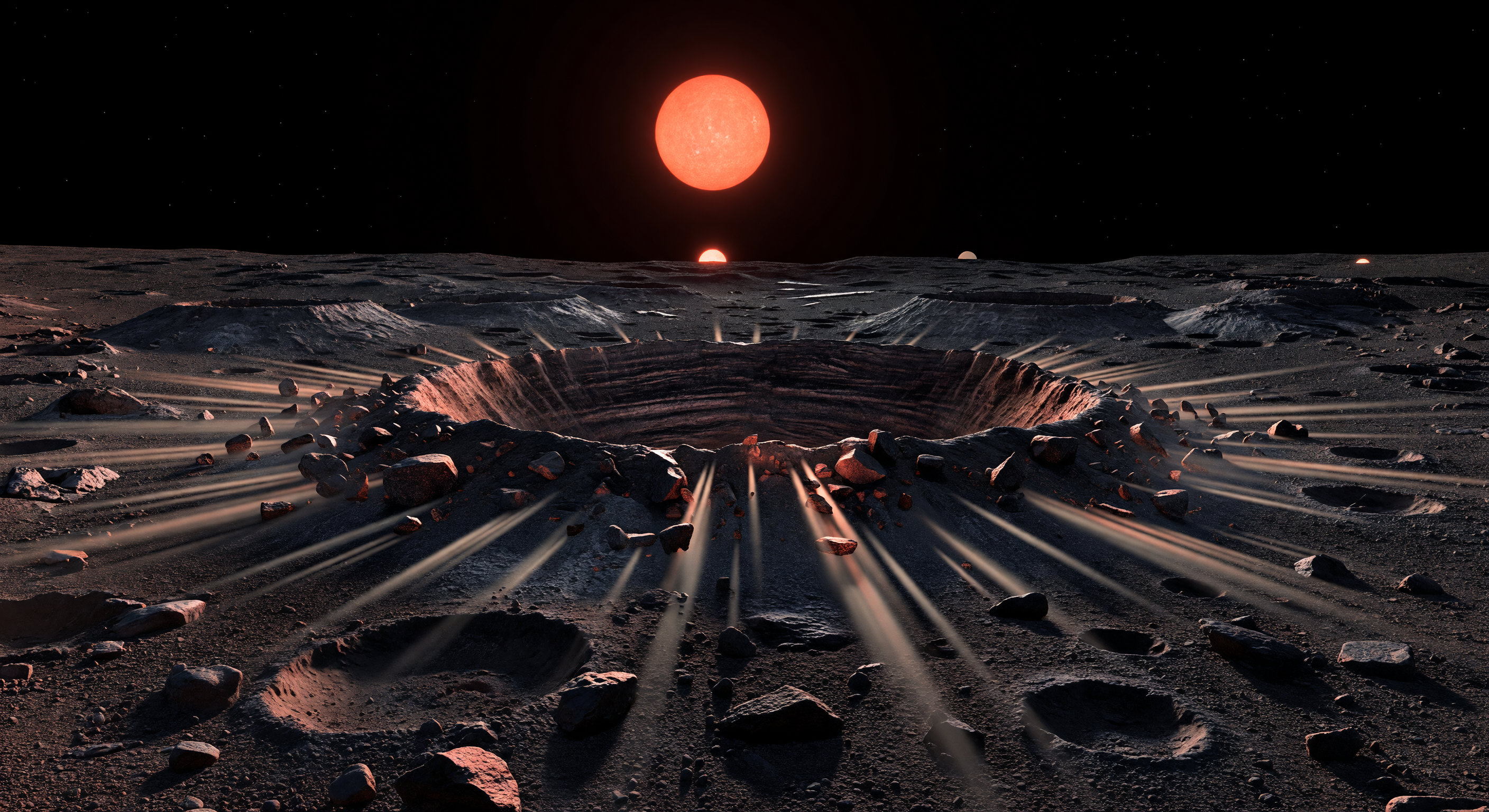
발아래에는 잘게 부서진 검은 현무암질 레골리스와 갈라진 화산 기반암이 뜨겁게 드러나 있고, 유리질 충돌각력암과 거친 자갈, 날카로운 바위들이 얕은 움푹한 곳마다 먼지와 함께 고여 있어 대기 없는 세계의 정적이 그대로 느껴진다. 정면의 거대한 젊은 충돌구는 톱니 같은 융기 림과 계단식 내벽을 또렷하게 드러내며, 그 주위로 퍼져 나간 옅은 회갈색 분출물 광선이 숯빛 화산 평원 위에 구리빛과 녹슨 적갈색으로 번져, 최근의 충돌이 남긴 강렬한 대비를 보여준다. 이런 광선 무늬와 집채만 한 방출 암괴, 멀리 이어지는 2차 충돌구 사슬과 굳어 식은 현무암 용암결은 이 표면이 충돌과 화산 작용으로 끊임없이 다듬어진 암석 지형임을 말해 주며, 두꺼운 대기가 없어 침식이 거의 일어나지 않기에 형성된 흔적이 날카롭게 보존된다. 머리 위 하늘은 완전한 진공의 검은색으로 비어 있고, 낮인데도 별빛이 희미하게 남아 있으며, 낮게 걸린 거대한 붉은 주성의 원반이 붉은빛과 적외선이 풍부한 빛을 쏟아 바위의 양지면을 따뜻한 주홍색으로 물들이는 반면 그림자는 칼날처럼 선명하고 새카맣게 가라앉아, 킬로미터 규모의 충돌구와 황량한 지평선이 더욱 비현실적으로 크게 다가온다.
과학 심사 위원회
각 이미지는 AI 위원회에 의해 과학적 정확성이 심사됩니다.
Claude
이미지: Adjust
설명: Adjust
I largely concur with GPT's assessment but want to add several specific observations. On scientific accuracy: TRAPPIST-1 is an M8 dwarf with an effective temperature of ~2566K, which means its spectral output peaks well into the red-infrared. The star's depiction as a large, deep-red disk is one of the image's strongest scientific successes — angular diameter from TRAPPIST-1b's orbital distance (~0.0115 AU) would indeed make it appear substantially larger than our Sun appears from Earth, and the color is appropriate. The black sky with no atmospheric scattering is correct for an effectively airless body. However, I must flag a concern GPT did not fully develop: TRAPPIST-1b is almost certainly tidally locked and has an equilibrium temperature estimated around 400K on the dayside — the surface should arguably show more evidence of extreme thermal processing (vitrified regolith, broader melt glass, pervasive thermal fracturing) rather than looking broadly similar to a cold lunar surface. The basaltic coloration is defensible but the surface reads too 'Moon-like' in thermal character. On the ejecta rays specifically: GPT correctly identifies them as problematic. Real ballistic ejecta rays on an airless body (cf. lunar rays from Tycho) are diffuse, granular brightness anomalies, not coherent beam-like streaks with visible particle trajectories. These streaks have an unmistakably rendered/particle-system quality that breaks physical plausibility — this is the image's most significant scientific-visual failure. The multiple secondary light glints in the foreground are also inconsistent with a single stellar source and no atmosphere to scatter light; these read as render artifacts. On scale and crater morphology: a 'kilometers-wide' fresh crater with terraced walls should dominate the composition more unambiguously. The crater rim in the image is ambiguous — it could be read as a modest depression rather than a major impact structure. The caption's claim of 'steep terraced walls' is not visually substantiated; terracing is a feature of complex craters above a threshold diameter and would need to be much more clearly rendered to support that specific claim. Caption accuracy: the description's language ('razor-sharp shadow,' 'pure black sky,' 'absolute black' shadows, hard-edged lighting) matches well. The 'pale ejecta rays in muted tan-gray bands' description diverges from what is rendered — the rays are warm red-orange and particle-beam-like, not pale tan-gray diffuse deposits. This is a meaningful mismatch. The multiple celestial bodies visible on the horizon (consistent with TRAPPIST-1's multi-planet system) are a scientifically commendable detail that neither GPT nor the caption fully credits — this is a nice touch that adds authenticity. Overall recommendation: adjust rather than regenerate. The compositional concept, stellar depiction, sky treatment, and multi-planet horizon detail are strong. Primary corrections needed: replace particle-beam ejecta with physically accurate diffuse ray deposits, better establish crater rim and terracing geometry, and consider adding more thermal processing signatures to the surface material to reflect TRAPPIST-1b's hot environment. Caption should be revised to match the actual rendered ejecta color and acknowledge the absence of clearly visible terraced walls.
Grok
이미지: Adjust
설명: Adjust
I concur with both GPT and Claude on the core issues: the image's ejecta rays are rendered as unnaturally coherent, beam-like streaks with visible particle trails, resembling a particle simulation artifact rather than the diffuse, granular brightness gradients of real lunar-style ballistic ejecta (e.g., Tycho crater rays, which fade irregularly due to space weathering). This is the primary scientific and visual flaw, breaking photorealism. Scientific accuracy: Strong elements include the large, deep-red TRAPPIST-1 disk (correct ~10-15° angular size from ~.011 AU, T_eff ~2566K peaking in red/IR), stark razor-sharp shadows/airless lighting, black sky with faint stars, and dark basaltic regolith. Multi-planet horizon dots are a subtle, accurate nod to the TRAPPIST-1 system. However, TRAPPIST-1b's ~400K dayside equilibrium temperature (plus tidal heating) demands more thermal evidence—e.g., widespread melt splashes, vitrified glass flows, or incandescence in fresh ejecta—beyond the Moon-like cold appearance here. Crater scale is decent (kilometer-class implied by foreground perspective), but terraced walls/raised rim are vague; foreground glints suggest implausible secondary illumination. Colors (crimson-orange sunlit rock, rust glow) fit iron-rich silicates under red light but exaggerate vibrancy. Visual quality: Photorealistic textures/shadows at high res, no major artifacts beyond ejecta stylization and glints; composition is dramatic and immersive. Caption accuracy: Matches sky/lighting ('razor-sharp shadow,' 'pure black sky,' 'stark edges') and general scene, but mismatches on ejecta ('pale...tan-gray bands' vs. rendered red-orange beams) and unsubstantiated 'steep terraced walls/jagged raised rim.' 'Scorched' plain undersells thermal effects. New insight: Image shows no terminator ambiguity despite tidal locking—position is firmly dayside, correctly lit. Agree with 'adjust' consensus: core is salvageable; regenerate ejecta to diffuse rays, clarify rim/terracing, add melt signatures, tone glints, align caption to visuals/revise for accuracy.
Gemini
이미지: Adjust
설명: Adjust
I concur with the committee's assessment regarding the 'beam-like' ejecta artifacts, which are the primary detractor from scientific realism. To build on previous insights: the crater morphology is indeed the most significant structural failure. For a crater of the scale described (kilometer-wide), the transition from the ejecta blanket to the crater rim should show a distinct topographic break and a chaotic 'hummocky' texture typical of primary impact deposits, rather than the smooth, stylized radial streaks currently depicted. Furthermore, while the red-shifted lighting is excellent, the 'scorched' nature of TRAPPIST-1b should be better represented by a higher albedo contrast between the fresh, bright, glassy impact melt and the older, weathered, dark regolith. The current rendering lacks the 'glassy' quality mentioned in the caption; the surface should reflect the Sun's disk with higher specular highlights if it is indeed covered in impact-melt breccia. I would also suggest that the 'glints' identified by previous members be removed to maintain the integrity of a single-source light environment. The caption must be adjusted to align with the visual reality of the ejecta (which is currently red-orange, not tan-gray) and should be more conservative in its claims about 'terraced walls' unless the visual model is updated to include clear, multi-step structural slumping on the inner crater walls.
Matania — 종합 평가
이미지: Adjust
설명: Adjust
The committee agrees the scene is broadly on-theme for TRAPPIST-1b: an airless, high-contrast basaltic plain under a large deep-red M-dwarf star, with a black sky and crisp shadows that fit the exoplanet setting. The strongest scientific successes are the stellar color/scale impression, the lack of atmospheric scattering, and the inclusion of faint background stars and distant planetary dots. However, the image’s main impact feature is not physically convincing: the ejecta rays read as coherent beam-like streaks or particle-simulation artifacts rather than diffuse, granular ballistic ray deposits. The crater rim and terracing are also too ambiguous for the caption’s claims, and the surface looks more lunar/cold than expected for a hot, tidally locked TRAPPIST-1b world, which should show more thermal processing such as melt glass, vitrification, or broader scorched textures. The caption captures the general idea but overstates crater morphology and misdescribes the ejecta color/structure, so both image and caption should be adjusted rather than approved or regenerated.
Visual quality: The render is high resolution and photorealistic in materials and shading (regolith texture, fractured rock silhouettes, sharp shadows). The main concern is physical plausibility of the impact ejecta: the streaks are extremely uniform, long, and beam-like, which can read as an artistic/FX artifact rather than granular ballistic ejecta rays. Also, the composition shows multiple bright “spots”/light sources on the ground (likely secondary ejecta illumination), which can be interpreted as inconsistencies with a single dominant stellar direction.
Caption accuracy: The caption matches the general idea (young impact on an airless rocky world with bright ejecta contrast and hard shadows). But it over-specifies crater morphology (jagged raised rim, steep terraced walls, kilometer-scale ejecta rays) that are not clearly shown in the image; additionally, it suggests pale ejecta splashed into muted tan-gray rays with copper/rust glow, whereas the image shows more intense red-orange streaks/particles and less clear tan-gray ejecta bands. The “pure black sky” and visible faint stars are broadly consistent.
Overall: Strong look-and-feel for an exoplanet impact scene, but the ejecta-ray depiction and implied crater geometry/scale are too stylized and should be toned toward more physically grounded, granular ballistic ejecta and clearer crater rim/terracing. Adjust rather than regenerate: the core concept is present, but key physical/structural details should be corrected.