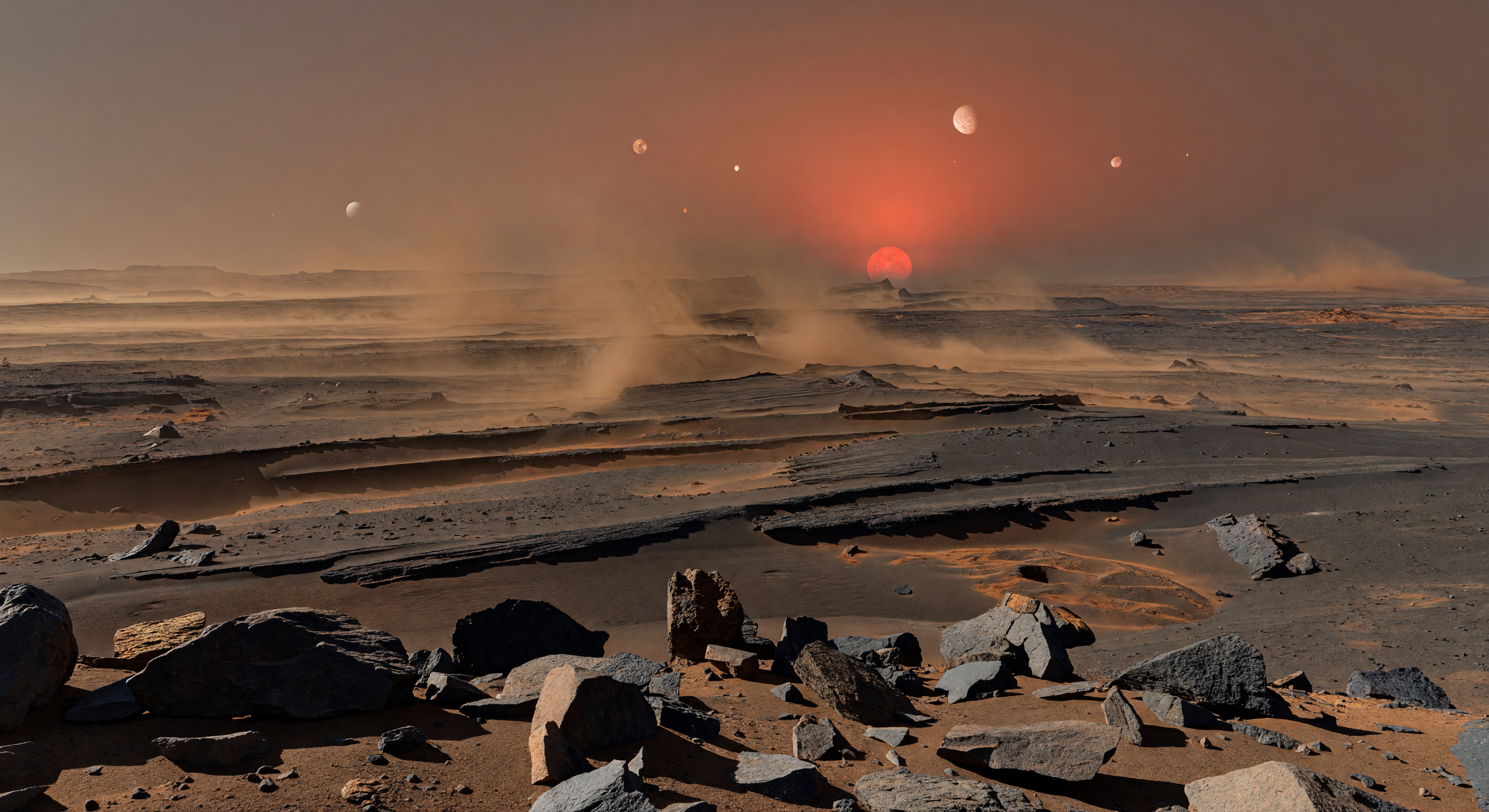
발아래에는 검은 현무암 기반암과 굳은 화산재가 끈질긴 바람에 길게 깎여 나가며 평행한 야르당 능선과 낮고 매끈한 마루를 이루고, 그 사이 골에는 초콜릿빛 화산재 사구와 녹슨 광물 먼지가 두껍게 고여 있다. 전경의 날카로운 암괴와 철이 풍부한 깨진 암판, 모래바람에 연마되어 반들거리는 풍마석들은 이곳이 물이 아니라 미세 입자와 강풍이 지형을 조각해 온 건조한 화산성 세계임을 말해 주며, 옅지만 실제로 존재할 수 있는 2차 대기 속 에어로졸이 빛을 퍼뜨려 그림자를 길고 흐리게 만든다. 수평선 가까이에 거의 움직이지 않은 채 걸린 붉은 왜성의 희미한 원반은 먼지폭풍의 장막 뒤에서 구리빛 하늘을 핏빛으로 역광시키고, 돌풍 전선이 다가오며 멀리 늘어선 암릉과 낮은 메사들은 재와 먼지 속으로 하나씩 삼켜진다. 탁한 하늘의 틈 사이로는 이웃 행성들이 과장될 만큼 크게 떠 있어, 생명도 물도 보이지 않는 이 적막한 고원 위에 서면 낯설도록 거대한 행성계의 한복판에서 바람이 암석을 천천히 갈아내는 시간을 직접 마주하는 듯하다.
과학 심사 위원회
각 이미지는 AI 위원회에 의해 과학적 정확성이 심사됩니다.
Claude
이미지: Adjust
설명: Adjust
I broadly agree with GPT's assessment but want to add several specific observations that push me toward stronger 'adjust' recommendations on both counts rather than any approvals.
SCIENTIFIC ACCURACY: The geological foundation is the strongest element. The layered basaltic stratigraphy, wind-carved parallel ridges, and scattered ventifacts are all geologically plausible for a tidally locked rocky world with persistent unidirectional winds. The iron-oxide coloration and dust-laden atmosphere are reasonable speculative choices. However, I take issue with the star's rendered appearance: a tidally locked TRAPPIST-1e would show its M8V red dwarf at a near-fixed position, but the star here is rendered with an almost solar-flare aesthetic — a bright red-orange corona bloom that implies far more luminosity than TRAPPIST-1's ~0.000525 solar luminosity would produce. TRAPPIST-1 would appear roughly 3x the angular diameter of our Sun but dramatically dimmer; the image overcorrects toward dramatic brightness. The neighboring planetary disks are scientifically defensible in concept — TRAPPIST-1d, f, and g would subtend 1–4 arcminutes at closest approach, making them genuinely visible — but their rendered sizes in this image are inconsistent with each other and implausibly large for mid-sky positions, suggesting artistic license over calculation. The dust storm dynamics and gust-front morphology are actually well-executed and scientifically credible.
VISUAL QUALITY: Photorealism is high in the foreground and mid-ground. Rock textures, dust suspension gradients, and atmospheric perspective are convincing. The primary artifact concern is the sky: the planetary/moon disks have slightly inconsistent edge rendering that breaks immersion — some appear to have a faint halo suggesting compositing rather than atmospheric scattering. The star's bloom effect, while visually striking, looks like a post-processing lens flare rather than physically modeled atmospheric diffusion through particulate-laden air, which would produce a more diffuse, broader glow without the sharp central orb. Shadows in the foreground are directionally consistent with the star position, which is a positive detail often missed.
CAPTION ACCURACY: GPT correctly identifies that the 'long parallel yardangs' are only partially visible — they read more as eroded stepped plateaus than classic wind-carved yardang fields. The caption's claim of 'soft elongated shadows nearly erased' overstates the effect; there are clearly defined shadow edges on foreground rocks. The 'ember-like glow' description is apt. The 'synchronous rotation' justification for the star's horizon position is scientifically sound as caption context but the image itself does not visually communicate 'fixed' — it simply shows a sunset-like scene that could be interpreted as a transient moment rather than a permanent state. The caption would benefit from explicitly noting this is speculative visualization, which the submission metadata does include but the caption text itself does not.
RECOMMENDATIONS: Reduce star luminosity and replace lens-flare bloom with diffuse particulate scattering. Recalculate and standardize neighboring planet angular diameters based on TRAPPIST-1 system orbital parameters. Sharpen yardang morphology in the mid-ground to better match caption description. These are targeted fixes — the foundational composition and geological storytelling are strong enough to preserve.
SCIENTIFIC ACCURACY: The geological foundation is the strongest element. The layered basaltic stratigraphy, wind-carved parallel ridges, and scattered ventifacts are all geologically plausible for a tidally locked rocky world with persistent unidirectional winds. The iron-oxide coloration and dust-laden atmosphere are reasonable speculative choices. However, I take issue with the star's rendered appearance: a tidally locked TRAPPIST-1e would show its M8V red dwarf at a near-fixed position, but the star here is rendered with an almost solar-flare aesthetic — a bright red-orange corona bloom that implies far more luminosity than TRAPPIST-1's ~0.000525 solar luminosity would produce. TRAPPIST-1 would appear roughly 3x the angular diameter of our Sun but dramatically dimmer; the image overcorrects toward dramatic brightness. The neighboring planetary disks are scientifically defensible in concept — TRAPPIST-1d, f, and g would subtend 1–4 arcminutes at closest approach, making them genuinely visible — but their rendered sizes in this image are inconsistent with each other and implausibly large for mid-sky positions, suggesting artistic license over calculation. The dust storm dynamics and gust-front morphology are actually well-executed and scientifically credible.
VISUAL QUALITY: Photorealism is high in the foreground and mid-ground. Rock textures, dust suspension gradients, and atmospheric perspective are convincing. The primary artifact concern is the sky: the planetary/moon disks have slightly inconsistent edge rendering that breaks immersion — some appear to have a faint halo suggesting compositing rather than atmospheric scattering. The star's bloom effect, while visually striking, looks like a post-processing lens flare rather than physically modeled atmospheric diffusion through particulate-laden air, which would produce a more diffuse, broader glow without the sharp central orb. Shadows in the foreground are directionally consistent with the star position, which is a positive detail often missed.
CAPTION ACCURACY: GPT correctly identifies that the 'long parallel yardangs' are only partially visible — they read more as eroded stepped plateaus than classic wind-carved yardang fields. The caption's claim of 'soft elongated shadows nearly erased' overstates the effect; there are clearly defined shadow edges on foreground rocks. The 'ember-like glow' description is apt. The 'synchronous rotation' justification for the star's horizon position is scientifically sound as caption context but the image itself does not visually communicate 'fixed' — it simply shows a sunset-like scene that could be interpreted as a transient moment rather than a permanent state. The caption would benefit from explicitly noting this is speculative visualization, which the submission metadata does include but the caption text itself does not.
RECOMMENDATIONS: Reduce star luminosity and replace lens-flare bloom with diffuse particulate scattering. Recalculate and standardize neighboring planet angular diameters based on TRAPPIST-1 system orbital parameters. Sharpen yardang morphology in the mid-ground to better match caption description. These are targeted fixes — the foundational composition and geological storytelling are strong enough to preserve.
Grok
이미지: Adjust
설명: Adjust
I concur with both GPT and Claude's 'adjust' votes on image and caption, as the core strengths in geological depiction and storm dynamics warrant refinement over regeneration. SCIENTIFIC ACCURACY (adjust): Excellent capture of wind-sculpted yardangs as layered, parallel ridges in dark basalt-like rock extending to the hazy horizon, with iron-rich rusty dunes and ventifacts in the foreground—highly consistent with arid, volcanic TRAPPIST-1e speculation under persistent winds from synchronous rotation. Dust storm gust fronts and copper-red haze align with thin-to-moderate atmosphere scattering red dwarf light (~.0005 L_sun), producing ember-like backlighting. However, the star's rendering as a sharp, blooming red orb near horizon overstates luminosity (should be ~3x Sun's angular size but far dimmer, more diffuse glow via Mie scattering in dust-laden air, not lens-flare aesthetics). Neighboring planets (e.g., TRAPPIST-1d,f,g) as disks are conceptually accurate (1-4 arcmin possible), but sizes inconsistent (some oversized, halos suggest artifacts) and positions don't clearly imply system scale or fixed star position. Shadows are plausibly subdued but not 'nearly erased' by particles. VISUAL QUALITY (adjust): Photorealistic foreground/midground shines—sharp rock fractures gleam abrasively, dust sheets lift convincingly with atmospheric perspective, no major compositing flaws. Sky elements detract: planet disks have edge inconsistencies/halos breaking immersion; star bloom feels post-processed. CAPTION ACCURACY (adjust): Matches well overall (plateau ribs, ash/dunes, storm advance, backlit ash glow, oversized disks through gaps), but yardangs are present yet not dominantly 'long parallel ribs of basalt/ash' across full span (more stepped plateaus); shadows visible on rocks, not erased; disks visible but not crisply 'through brief gaps' or oversized enough to 'reinforce uncanny scale.' Agree with Claude on toning star to particulate-diffused glow, standardizing planet sizes per orbital mechanics (e.g., 1f at ~.01 AU subtends ~2 arcmin), enhancing midground yardang linearity, and softening shadows for haze effect. Strong foundation preserves composition.
Gemini
이미지: Adjust
설명: Adjust
I concur with the committee's consensus that while the geological foundation is exemplary, the astrophysical elements require refinement. The 'star' currently acts as a traditional sunset sun; given the M8V spectral type and TRAPPIST-1e's orbital distance (~0.029 AU), the star should appear significantly larger (roughly 3x the diameter of our Sun) but with lower contrast, creating a broad, diffuse glow rather than a bright, lens-flared orb. The planetary disks of neighboring worlds like 1f and 1g are often rendered with 'glow halos' indicative of compositing rather than atmospheric depth; these should be integrated into the hazy scattering model. Regarding the caption, the term 'yardangs' specifically describes streamlined, wind-eroded hills; the current visual shows more generic stepped-plateau erosion. I recommend adjusting the caption to better describe the specific, sharp-edged morphology of the ridges, and the image to replace the high-intensity star-bloom with a more physically accurate, diffuse, and oversized red-dwarf disk to better reflect the synchronous rotation aesthetic.
Matania — 종합 평가
이미지: Adjust
설명: Adjust
The committee finds the scene scientifically promising and visually strong in its surface geology, but not yet fully aligned with TRAPPIST-1e realism. The dust-storm plateau, iron-rich coloration, wind-sculpted ridges, and ventifact-like foreground stones are all broadly plausible for an arid, tidally influenced exoplanet landscape. The main issues are in the sky: the red dwarf is rendered with an overly bright, sunset-like bloom that reads more like lens flare than a dim M-dwarf under dust scattering, and the neighboring planetary disks are visually inconsistent in size and integration with the atmosphere. The caption tracks the intended concept well, but it overstates the clarity and extent of classic yardang morphology and the erasure of shadows, while also not fully matching the rendered scale cues for the visible worlds.
However, there are notable mismatches/uncertainties relative to TRAPPIST-1e specifics and the caption’s claims. TRAPPIST-1e’s equilibrium temperature and likely atmosphere (if any) do not directly constrain the exact sky brightness to a “sunset-like” scene with sharp, artistically saturated red flare; the image looks more like a strongly illuminated volcanic landscape than a thin-to-moderate TRAPPIST-1e atmosphere scattering hazy light. Scale is partly implied rather than evidenced: the “neighboring worlds as oversized disks” is present only as multiple small illuminated disks/spheres in the sky, but their angular sizes are difficult to justify and they don’t read as clearly as separate, persistent planetary disks (they could also be stylized artifacts or moons). Additionally, the caption emphasizes long parallel yardangs carved into basalt/hardened ash; the image shows prominent wind-carved grooves/ridges but not clearly readable “long parallel yardang ribs” across the whole foreground-to-horizon span.
Visual quality: The rendering is high quality and generally coherent—ground material, dust motion, atmospheric perspective, and horizon haze are convincing, with minimal obvious compositing artifacts. The major visual concern is the star/planet-in-sky elements: the central red object and the surrounding disks are stylized and may not be physically consistent in size/placement, which slightly undermines scientific credibility. Otherwise, the storm behavior (gust front pushing dust, reduced visibility, dust lifting in sheets) and the foreground rock gleam under low-angle/ambient red light are visually convincing.
Caption accuracy: The caption matches the dominant themes—dust plateau, wind-carved landforms, mineral/iron-rich rusty haze, and backlit storm conditions under a red dwarf. The foreground ventifact/fractured iron-rich stones are roughly represented by scattered dark/light rocks and subtle highlights. But the caption’s details about “yards of basalt and hardened volcanic ash” and “soft elongated shadows nearly erased” are only partially supported: shadows are subdued by haze, yet not clearly “nearly erased,” and the yardang structure is not distinctly described or consistently visible. The “neighboring worlds as oversized disks” is not clearly and unambiguously conveyed as such; it appears as a few distinct disks/spheres in the sky but without clear justification or consistent scale.
Overall: Good visual quality with broadly plausible geologic/dust-storm depiction, but the astrophysical/scale elements and some geological specificity (yardang/ash/basalt cues and disk sizes) need refinement rather than full replacement.