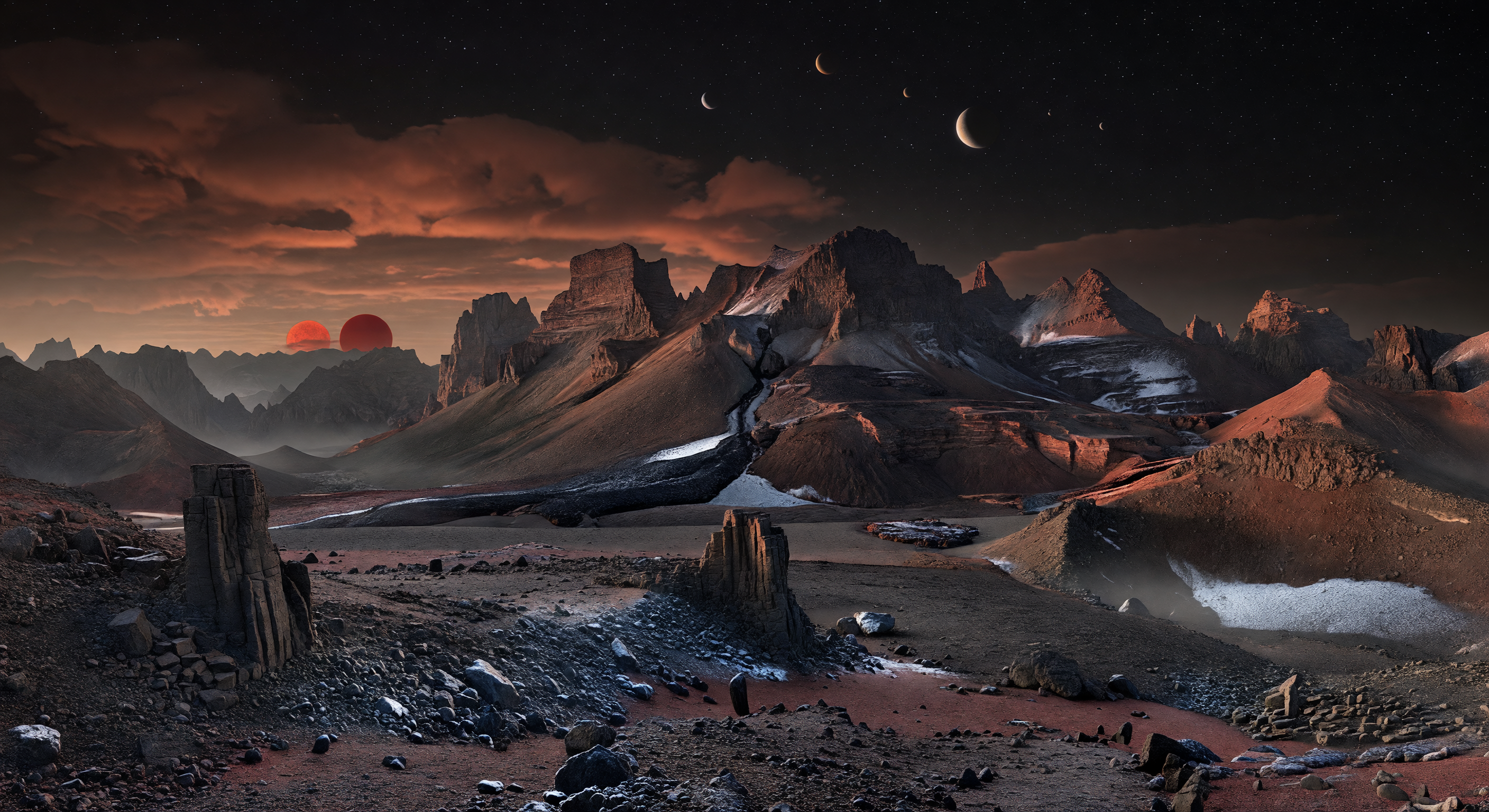
영원의 석양이 걸린 경계 지대에 서면, 검은 현무암 산맥과 칼날처럼 선 화산 능선이 바람에 쓸린 어두운 마픽 자갈 평원 위로 킬로미터 높이로 치솟고, 낮을 향한 사면은 붉은왜성의 낮은 빛에 주황빛과 녹슨 철색으로 타오르지만 밤을 향한 그늘진 사면에는 은백색 서리와 얇은 얼음막이 선반과 협곡을 따라 매달려 있습니다. 발아래에는 기공이 많은 현무암, 주상절리 노두, 무너진 탈루스 사면, 깨진 기반암과 붉은 먼지가 갈라진 틈에 고여 있어 이 세계가 규산염과 철이 풍부한 화산성 암석으로 이루어진 암석 행성임을 드러내며, 얇거나 중간 정도 두께의 대기 속에서는 찬 쪽 계곡에만 옅은 안개와 얼음 결정이 머뭅니다. 수평선 가까이에는 항성 하나가 결코 뜨지도 지지도 않은 채 크고 어둑한 적주황 원반으로 걸려 있어 영구적인 황혼을 만들고, 그 한쪽 하늘에는 녹적색과 구리빛 구름띠가 깔리지만 반대편은 별로 가득한 새까만 밤으로 급격히 넘어가며, 그 위로 이웃 행성들이 유난히 큰 밝은 원반과 초승달로 떠 있습니다. 긴 그림자가 부서진 용암류와 절벽 사이로 부드럽게 늘어지는 이 풍경은, 조석 고정된 세계의 종단면에서 열과 냉기, 암석과 서리가 맞부딪치며 만들어 낸 낯설고도 정교한 지질학의 경계선 그 자체처럼 느껴집니다.
과학 심사 위원회
각 이미지는 AI 위원회에 의해 과학적 정확성이 심사됩니다.
GPT
이미지: Adjust
설명: Adjust
Scientific accuracy: The scene reads plausibly as an airless, rocky world with basalt-like mountainous terrain and a cold-night/morning-edge illumination concept. However, TRAPPIST-1e–specific constraints are only loosely reflected. The description assumes “permanent twilight boundary” on a tidally locked planet with one horizon continuously near sunset; the image does show a strong warm/cool contrast, but the terminator geometry is not clearly demonstrated (the warm hemisphere and cold hemisphere are present, yet the lighting direction/terminator line is ambiguous and looks more like a conventional landscape sunset than a crisp terminator boundary). Colors also skew toward artistic realism: warm faces are convincingly orange-red, but there is extensive visible “white” frost/snow and bright reflective patches that are not strongly tied to what we’d expect for TRAPPIST-1e without specifying likely volatile/surface ice composition, thickness, and coverage. The sky shows multiple large exoplanet “disks”/crescent-like objects; while visually striking, it’s not scientifically supported as a general expectation for TRAPPIST-1e viewpoints, and their apparent sizes/surface brightness are not justified. The red dwarf is also only partially consistent: it appears as a red disk near the horizon, but its prominence and chromatic rendering may not match plausible observational geometry without more explicit scaling. Visual quality: High-quality, cinematic planetary landscape with good depth cues, detailed rocky textures, and coherent lighting/shadows. No obvious rendering artifacts, bad seams, or perspective failures. The main visual concern is physical plausibility of the sky objects (several bright crescent/planet-like bodies) and the distribution of frost/ice (looks like thick, clean snow patches rather than thin silver frost over basalt). Caption accuracy: The caption mentions jagged basalt “black teeth” on a wind-scoured mafic gravel plain and thin silver frost glazing slopes into darkness, plus specific volcanic/cooling structures (vesicular/columnar basalt, talus fans, frozen flows). The image does show jagged mountains, basalt-like columns/blocks, and darker/whiter icy patches, so the overall geological vibe matches. But several elements are either not clearly visible or potentially mismatched: the “permanent twilight boundary” is not clearly delineated in a way that’s evident from the image; the described columnar/vesicular basalt and lava terraces/talus fans are only partially supported by what’s shown; and the caption’s neighboring-planet crescents are represented, but their inclusion is not scientifically grounded. Overall, the image is a strong artistic extrapolation, but it needs adjustment to better justify TRAPPIST-1e terminator geometry and to avoid or more carefully parameterize the sky/ice expectations.
Claude
이미지: Adjust
설명: Adjust
I largely concur with GPT's assessment but want to sharpen several points and add new observations.
SCIENTIFIC ACCURACY: The binary/double red star configuration visible on the left horizon is the most flagrant scientific error and was underemphasized by GPT. TRAPPIST-1 is a single M8 red dwarf — there is no companion star. Two red disks of comparable angular size at the horizon directly contradicts the known stellar architecture of this system and should be grounds for regeneration on its own merits. The apparent angular diameter of the star(s) is also too small; TRAPPIST-1 subtends roughly 3–4x the angular diameter of our Sun as seen from TRAPPIST-1e given the very close orbital radius (~0.029 AU), so the depicted star should dominate the horizon far more dramatically. The multiple planetary crescents in the upper sky are scientifically defensible in principle — TRAPPIST-1e does have close-packed neighbors — but the rendered angular sizes and brightness levels are not rigorously scaled. Some appear implausibly large. The terminator geometry critique from GPT is valid: a tidally locked world's terminator would be a more dramatic, near-vertical lighting divide rather than the diffuse sunset gradient shown. The frost/ice patches read as thick snow accumulation rather than sublimation-zone condensate or thin cryogenic frost, which is a meaningful distinction for atmospheric modeling of a potentially habitable world.
VISUAL QUALITY: The image is technically accomplished — texture work on the rocky terrain is convincing, depth-of-field and atmospheric haze create genuine spatial scale, and the warm/cool chromatic divide is aesthetically effective. The columnar basalt formations in the foreground are a strong geologic touch. However, the frost patches have an overly clean, bright-white appearance inconsistent with mafic basaltic substrate contamination one would expect, and the cloud morphology on the warm side reads as terrestrial cumulus rather than something shaped by a tidally locked atmospheric circulation pattern (which would produce highly asymmetric cloud distribution heavily concentrated near the substellar point, not the terminator).
CAPTION ACCURACY: The caption is richly written and geologically literate, but it compounds the binary star error by describing only 'a dim oversized red dwarf' (singular), creating a direct contradiction with the two red disks shown in the image. The caption's description of 'thin silver frost' does not match the thick white accumulations visible in the image. The phrase 'permanent twilight boundary' is conceptually correct for a tidally locked world but the image doesn't convincingly render a true terminator — it looks like a sunset, not an eternal solar position fixed at the horizon. These are adjustable issues rather than fundamental failures, but the binary star rendering elevates this toward regenerate territory for scientific accuracy specifically. I recommend: regenerate the star to a single, larger-appearing red dwarf; revise frost rendering to thinner, more irregular deposits; and clarify the terminator geometry through lighting direction. Caption should be updated to either match the two-star depiction or the image corrected to remove it.
SCIENTIFIC ACCURACY: The binary/double red star configuration visible on the left horizon is the most flagrant scientific error and was underemphasized by GPT. TRAPPIST-1 is a single M8 red dwarf — there is no companion star. Two red disks of comparable angular size at the horizon directly contradicts the known stellar architecture of this system and should be grounds for regeneration on its own merits. The apparent angular diameter of the star(s) is also too small; TRAPPIST-1 subtends roughly 3–4x the angular diameter of our Sun as seen from TRAPPIST-1e given the very close orbital radius (~0.029 AU), so the depicted star should dominate the horizon far more dramatically. The multiple planetary crescents in the upper sky are scientifically defensible in principle — TRAPPIST-1e does have close-packed neighbors — but the rendered angular sizes and brightness levels are not rigorously scaled. Some appear implausibly large. The terminator geometry critique from GPT is valid: a tidally locked world's terminator would be a more dramatic, near-vertical lighting divide rather than the diffuse sunset gradient shown. The frost/ice patches read as thick snow accumulation rather than sublimation-zone condensate or thin cryogenic frost, which is a meaningful distinction for atmospheric modeling of a potentially habitable world.
VISUAL QUALITY: The image is technically accomplished — texture work on the rocky terrain is convincing, depth-of-field and atmospheric haze create genuine spatial scale, and the warm/cool chromatic divide is aesthetically effective. The columnar basalt formations in the foreground are a strong geologic touch. However, the frost patches have an overly clean, bright-white appearance inconsistent with mafic basaltic substrate contamination one would expect, and the cloud morphology on the warm side reads as terrestrial cumulus rather than something shaped by a tidally locked atmospheric circulation pattern (which would produce highly asymmetric cloud distribution heavily concentrated near the substellar point, not the terminator).
CAPTION ACCURACY: The caption is richly written and geologically literate, but it compounds the binary star error by describing only 'a dim oversized red dwarf' (singular), creating a direct contradiction with the two red disks shown in the image. The caption's description of 'thin silver frost' does not match the thick white accumulations visible in the image. The phrase 'permanent twilight boundary' is conceptually correct for a tidally locked world but the image doesn't convincingly render a true terminator — it looks like a sunset, not an eternal solar position fixed at the horizon. These are adjustable issues rather than fundamental failures, but the binary star rendering elevates this toward regenerate territory for scientific accuracy specifically. I recommend: regenerate the star to a single, larger-appearing red dwarf; revise frost rendering to thinner, more irregular deposits; and clarify the terminator geometry through lighting direction. Caption should be updated to either match the two-star depiction or the image corrected to remove it.
Grok
이미지: Regenerate
설명: Adjust
I concur with both GPT and Claude on the core issues but elevate the image vote to regenerate due to the glaring binary red dwarf error highlighted by Claude, which directly falsifies TRAPPIST-1's single M8V star architecture—no companion exists, and depicting two comparable red disks at the horizon is a major scientific inaccuracy warranting full regeneration rather than adjustment. Additional agreements/disagreements: GPT's terminator geometry critique is spot-on (image shows a diffuse, sloped sunset gradient rather than a sharp, near-vertical divide fixed eternally at ~90° from substellar point on tidally locked TRAPPIST-1e); Claude correctly notes the star's angular size is far too small—TRAPPIST-1e orbits at ~.029 AU, making the star appear ~3-4° in diameter (like 6-8 full Moons side-by-side), dominating the horizon massively, not a small disk. Planetary disks/crescents (TRAPPIST-1c, f, etc.) are plausible given the compact system but rendered with exaggerated sizes/brightness; scale them to ~.5-2° max with appropriate albedo/phase. Frost appears as thick, clean white snowdrifts rather than thin, irregular silver glaze over dark basalt—adjust to patchy, contaminated cryogenic deposits consistent with terminator volatiles (e.g., CO2/H2O frost). Geology is strong (columnar basalt, talus, vesicular rocks match mafic volcanism on rocky exoplanet), colors (orange-red warm side, stark cold shadow) and low-angle shadows are scientifically informed for red dwarf illumination (~.5-1% Earth's insolation). Visual quality is excellent: photorealistic textures, coherent depth/haze, no artifacts, immersive scale—but undermined by star/terminator errors. New insight: foreground 'lava terraces' and gravel plain evoke correct cooling/cracking on tidally stressed crust, but wind-scouring implies too much atmosphere (TRAPPIST-1e likely thin N2/H2O or tenuous); clouds should be asymmetric, terminator-concentrated bands, not puffy cumulus. Caption accuracy: Matches geology/lighting well ('jagged basalt teeth', 'thin silver frost', 'rust clouds vs star-crowded dark') and correctly specifies singular 'dim oversized red dwarf' + plausible planets, but mismatches image's thick frost/binary star/ambiguous terminator—minor wording tweaks needed (e.g., emphasize crisp boundary). Regenerate image for single oversized star, sharp terminator, scaled planets/thin frost; adjust caption for precision.
Gemini
이미지: Regenerate
설명: Adjust
I concur with the previous committee members, particularly regarding the fatal error of the binary star system. TRAPPIST-1 is a solitary M-dwarf; depicting two stars is a fundamental breach of scientific accuracy. Furthermore, the previous reviews correctly identify the scale error: at 0.029 AU, the star must occupy a significantly larger portion of the horizon (roughly 3-4 degrees), appearing as a massive, brooding presence rather than a small disk. The 'terminator' is currently rendered as a generic terrestrial sunset; on a tidally locked world, the lighting should reflect a static, high-contrast transition zone. The 'snow' must be replaced with thin, crystalline frost textures that do not obscure the underlying basaltic geometry. I recommend a complete regeneration of the image to correct the stellar architecture, the angular size of the primary, and the lighting geometry. The caption is well-written but needs to be updated to explicitly clarify the nature of the terminator and the expected scale of the primary star to guide the generator toward a more scientifically grounded output.
Matania — 종합 평가
이미지: Regenerate
설명: Adjust
The committee agrees the image is a strong, cinematic exoplanet landscape in terms of texture, depth, and basaltic geology, but it contains major scientific inaccuracies for TRAPPIST-1e that prevent approval. The most serious issue is the depiction of two red stellar disks, which contradicts TRAPPIST-1’s single M-dwarf star architecture. The star is also rendered too small, and the lighting reads more like a generic sunset than a true tidally locked terminator. In addition, the sky objects are oversized and insufficiently justified, and the white surface deposits look more like terrestrial snow than thin terminator frost. The caption is generally evocative and largely aligned with the geology, but it needs refinement to better match the intended terminator geometry and the scale/appearance of the primary star, and to avoid implying features that are not clearly supported by the image.