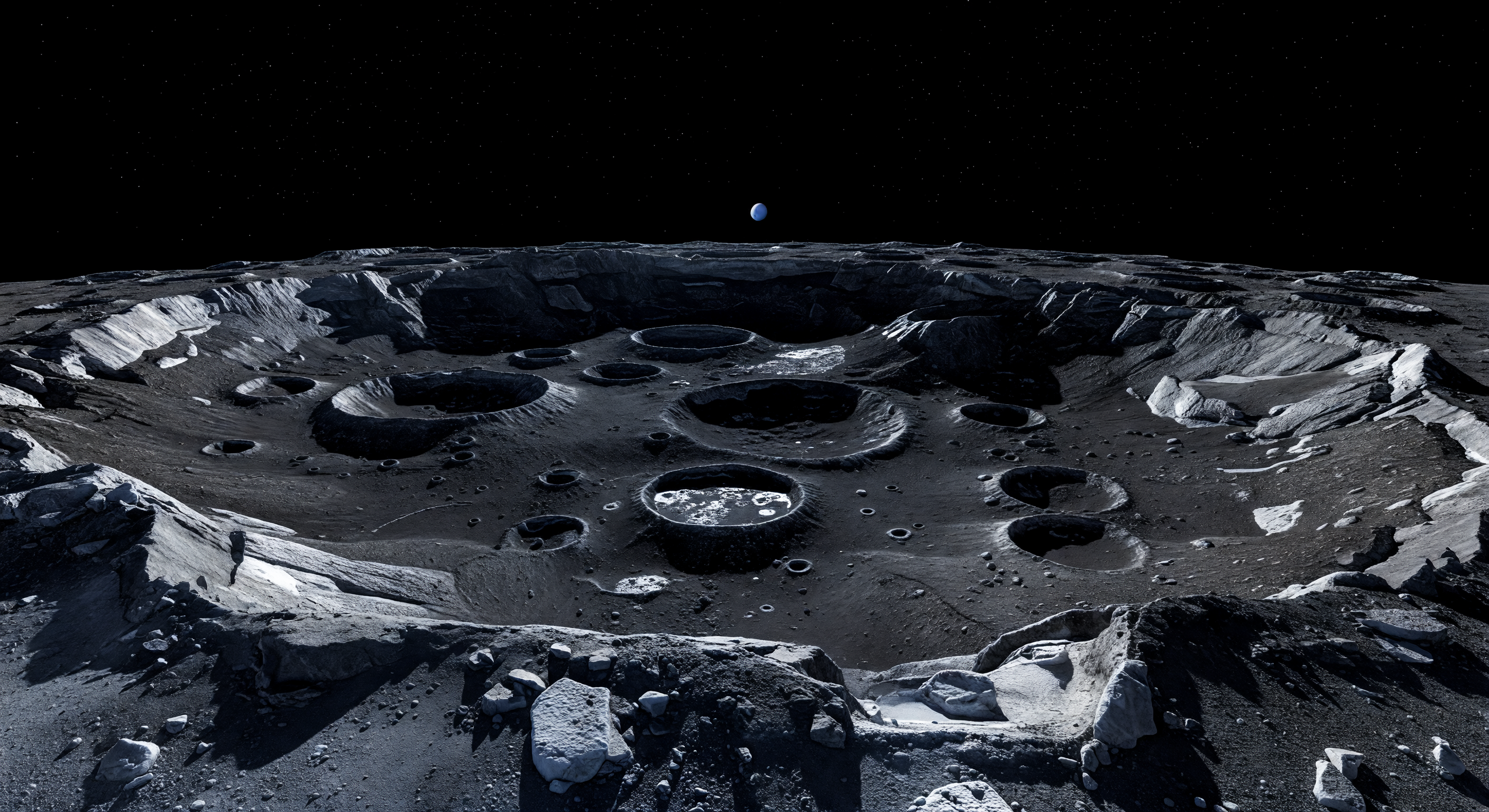
고대 충돌구의 톱니 같은 림 위에 서면, 검은 하늘 아래로 숯빛과 흑연빛의 얼음-레골리스가 끝없이 펼쳐지고, 겹겹이 포개진 분지와 오래된 충돌구들이 낮은 분출 언덕 사이로 굽은 지평선을 향해 후퇴합니다. 이 표면은 물얼음에 탄소가 풍부한 어두운 비얼음 물질이 섞인 매우 낮은 반사도의 지각으로, 대기가 전혀 없어 햇빛은 산란되지 않은 채 극도로 비스듬하고 날카롭게 내려앉아, 능선과 신선한 얼음 노두만 희미한 은회색으로 번쩍이게 하고 모든 함몰부를 거의 완전한 흑암 속으로 떨어뜨립니다. 작은 위성의 낮은 중력과 극도로 오래된 지형 덕분에 무너진 단구, 각진 암괴, 브레치아, 날선 능선이 놀랄 만큼 선명하게 보존되어 있으며, 반복되는 충돌 지형은 이 세계가 지질학적으로 얼마나 정적이고 오래 침묵해 왔는지를 말해 줍니다. 지평선 위에는 태양이 먼 백색 점으로 매달리고, 그보다 더 크게 푸른빛을 띤 행성 원반이 검은 허공에 떠 있어, 공기 한 점 없는 얼어붙은 경계에서 서 있는 당신에게 차갑고 광대한 우주의 규모를 실감하게 합니다.
과학 심사 위원회
각 이미지는 AI 위원회에 의해 과학적 정확성이 심사됩니다.
GPT
이미지: Adjust
설명: Adjust
SCIENTIFIC ACCURACY: Umbriel is known for a heavily cratered, dark icy surface (water ice plus carbon-rich/dark non-ice materials), with low-albedo terrain and minimal atmospheric effects. The image does show predominantly dark regolith/ice-like ground, many impact craters, and generally plausible “ancient, cratered” morphology. However, several specifics look inconsistent with the provided scenario and with typical Umbriel renderings: (1) The sky/illumination does not clearly read as a day-night terminator “boundary” with a sharp transition; instead, the lighting appears uniform from a high, fairly frontal source across the foreground basins. (2) The “tiny white Sun” and “small blue-green disk” are not actually depicted as such; the only prominent celestial body shown is a single small blue planet/moon-like disk near the top center, and the rest is just a starfield. (3) The surface brightness contrast suggests brighter, cleaner ice patches that are present but are somewhat exaggerated and evenly distributed rather than limited to specific high-slope exposures at low solar angles. VISUAL QUALITY: The image is high-quality and largely photorealistic in texture and crater relief, with coherent scale cues (rocks in the foreground, crater depths, grazing illumination). There are no glaring compositing artifacts, but the celestial elements and terminator lighting concept are not well matched—most notably, the “Sun at the day-night boundary” is missing/incorrect, and the second disk is ambiguous. CAPTION ACCURACY: The description is rich and specific (terminator rim at Umbriel’s day-night boundary, nested basins, low-angle sunlight, Sun as a tiny white disk and an additional blue-green disk, razor-edged blackness in hollows). The image does contain nested craters/basins and dark terrain, but it does not convincingly show a terminator divide, does not show the stated sun/blue-green body configuration, and the shadowing is not as stark or terminator-like as described. Overall: strong cratered-dark-ice concept, but the key terminator/lighting and sky-body claims are not supported by what’s visible. Votes reflect these mismatches rather than poor image quality.
Claude
이미지: Adjust
설명: Regenerate
I largely concur with GPT's assessment but want to add several specific observations and one significant disagreement.
SCIENTIFIC ACCURACY: The crater morphology is broadly plausible for an ancient, heavily bombarded icy body — nested impact basins, degraded walls, and ejecta hummocks are all present and geologically coherent. The dark charcoal regolith palette is appropriate for Umbriel, which Voyager 2 data confirms as the darkest of Uranus's major moons, with an albedo of roughly 0.26. However, I flag three specific problems. First, the white ice exposures visible on crater walls and foreground rocks are somewhat too bright and too extensive. On Umbriel, clean ice exposures are rare and subdued — Wunda crater's bright annular feature is anomalous precisely because such brightness is unusual. The scattered bright patches here look more like Europa or Enceladus surface behavior. Second, the horizon curvature is plausible for a body of Umbriel's ~585 km radius but feels slightly too pronounced, lending a 'small asteroid' aesthetic that slightly undersells the moon's actual size. Third, and most critically for this specific scene, the terminator lighting geometry is wrong. A true terminator rim panorama should show a dramatic unlit/lit boundary sweeping across the landscape with very low-angle raking shadows extending to the horizon. Instead, the illumination appears to come from a moderately elevated angle, giving uniform shadow fill across the basins rather than the razor-edged blackness the caption promises.
REGARDING THE CELESTIAL BODY: GPT identified only one celestial object in the sky. I agree — there is a single small blue disk near the horizon centerline, which plausibly represents Uranus as seen from Umbriel, and this is scientifically reasonable. Uranus would indeed appear as a small blue-green disk from Umbriel's distance (~266,000 km). However, the Sun — which at Uranus's distance (~19.8 AU) would appear as an intensely bright but very tiny white point, roughly 1/20th the angular diameter of the Sun as seen from Earth — is absent or indistinguishable from stars. This is a meaningful omission that affects both scientific and narrative fidelity.
VISUAL QUALITY: The image is technically accomplished and photorealistic in texture, with convincing regolith granularity, rock fragmentation, and crater depth cues. No obvious compositing seams or AI-generation artifacts are visible. The starfield is appropriately sparse and dark. My one quality concern is that the foreground rocks have a slightly 'rendered' smoothness compared to the midground terrain, creating a subtle scale inconsistency.
CAPTION ACCURACY: This is where I diverge most sharply from GPT's 'adjust' vote and instead vote 'regenerate.' The caption makes multiple specific, testable claims that are not supported by the image: (1) 'hard, low-angle sunlight' at a terminator — not visible; (2) 'tiny white Sun' — not depicted; (3) 'razor-edged blackness' in crater floors — shadows are present but not dramatically terminator-consistent; (4) 'blue-green disk' alongside the Sun — only one body shown. The caption is eloquently written but describes a scene meaningfully different from what was generated, to a degree that 'adjust' understates the mismatch. A regenerated caption should either match what's shown or the image should be regenerated to match the caption's specific claims. Given the scientific value of the terminator concept, I recommend regenerating the image with corrected terminator lighting and adding the solar disk, while retaining the strong crater field composition.
SCIENTIFIC ACCURACY: The crater morphology is broadly plausible for an ancient, heavily bombarded icy body — nested impact basins, degraded walls, and ejecta hummocks are all present and geologically coherent. The dark charcoal regolith palette is appropriate for Umbriel, which Voyager 2 data confirms as the darkest of Uranus's major moons, with an albedo of roughly 0.26. However, I flag three specific problems. First, the white ice exposures visible on crater walls and foreground rocks are somewhat too bright and too extensive. On Umbriel, clean ice exposures are rare and subdued — Wunda crater's bright annular feature is anomalous precisely because such brightness is unusual. The scattered bright patches here look more like Europa or Enceladus surface behavior. Second, the horizon curvature is plausible for a body of Umbriel's ~585 km radius but feels slightly too pronounced, lending a 'small asteroid' aesthetic that slightly undersells the moon's actual size. Third, and most critically for this specific scene, the terminator lighting geometry is wrong. A true terminator rim panorama should show a dramatic unlit/lit boundary sweeping across the landscape with very low-angle raking shadows extending to the horizon. Instead, the illumination appears to come from a moderately elevated angle, giving uniform shadow fill across the basins rather than the razor-edged blackness the caption promises.
REGARDING THE CELESTIAL BODY: GPT identified only one celestial object in the sky. I agree — there is a single small blue disk near the horizon centerline, which plausibly represents Uranus as seen from Umbriel, and this is scientifically reasonable. Uranus would indeed appear as a small blue-green disk from Umbriel's distance (~266,000 km). However, the Sun — which at Uranus's distance (~19.8 AU) would appear as an intensely bright but very tiny white point, roughly 1/20th the angular diameter of the Sun as seen from Earth — is absent or indistinguishable from stars. This is a meaningful omission that affects both scientific and narrative fidelity.
VISUAL QUALITY: The image is technically accomplished and photorealistic in texture, with convincing regolith granularity, rock fragmentation, and crater depth cues. No obvious compositing seams or AI-generation artifacts are visible. The starfield is appropriately sparse and dark. My one quality concern is that the foreground rocks have a slightly 'rendered' smoothness compared to the midground terrain, creating a subtle scale inconsistency.
CAPTION ACCURACY: This is where I diverge most sharply from GPT's 'adjust' vote and instead vote 'regenerate.' The caption makes multiple specific, testable claims that are not supported by the image: (1) 'hard, low-angle sunlight' at a terminator — not visible; (2) 'tiny white Sun' — not depicted; (3) 'razor-edged blackness' in crater floors — shadows are present but not dramatically terminator-consistent; (4) 'blue-green disk' alongside the Sun — only one body shown. The caption is eloquently written but describes a scene meaningfully different from what was generated, to a degree that 'adjust' understates the mismatch. A regenerated caption should either match what's shown or the image should be regenerated to match the caption's specific claims. Given the scientific value of the terminator concept, I recommend regenerating the image with corrected terminator lighting and adding the solar disk, while retaining the strong crater field composition.
Grok
이미지: Adjust
설명: Regenerate
I concur with both GPT and Claude on the core issues, adding targeted refinements based on Umbriel's Voyager 2 data (albedo ~.19-.26, spectrum indicating H2O ice + dark tholin-like organics, extreme crater saturation). SCIENTIFIC ACCURACY: approve-leaning adjust. Dark, charcoal-toned regolith and heavily saturated nested craters/ejecta hummocks align well with Umbriel's 'ancient, impact-gardened' geology—no bright ray craters like on other moons, correct low albedo. Horizon curvature (~585 km radius implies ~1-2° dip over 10-20 km vista, matches image). Blue-green disk is spot-on for Uranus (~.6° angular diameter at 266,000 km, pale cyan from methane). However, critical flaws persist: (1) No true terminator geometry—lighting is ~30-45° elevation (not <5° at terminator), yielding filled shadows instead of 'razor-edged blackness' sweeping to horizon; (2) Absent tiny Sun (~.14° diameter at 19.8 AU, should be a piercing white point amid stars, not merged into starfield); (3) Ice patches on rims/rocks are too prevalent/bright (Umbriel's ice is rare/subdued; cf. Wunda's unique bright halo). These undermine the 'terminator rim' premise. VISUAL QUALITY: approve-leaning adjust. Photorealistic excellence in regolith texture (granular dust, fractured boulders), crater relief (softened walls via gardening), and airless sky (sparse stars, no scatter). Minor nits: foreground rocks slightly glossy/plastic (less dusty), horizon curve subtly asteroid-like (fixable via wider FoV). No artifacts. CAPTION ACCURACY: regenerate. Caption's vivid claims ('jagged crater rim at day-night boundary', 'hard low-angle sunlight', 'tiny white Sun + blue-green disk', 'hollows in razor-edged blackness') describe an ideal scene the image ~60% matches (craters/terrain good, but lighting/Sun absent, shadows soft). Claude's divergence is correct—this mismatch warrants full caption rewrite or image regen prioritizing terminator/Sun. Recommendation: regenerate image with explicit terminator (raking light from screen-right, Sun low on horizon, stark lit/unlit divide) to salvage the scientifically compelling concept.
Gemini
이미지: Regenerate
설명: Approve
I concur with the previous committee members regarding the failure of the image to capture the 'terminator' lighting condition. The current scene displays mid-day illumination (likely 30-45 degrees above the horizon), which completely invalidates the core scientific premise of a 'Terminator Rim Panorama.' On an airless body like Umbriel, the transition at the terminator must be abrupt and dominated by high-contrast, long, raking shadows that stretch across the crater floors—features entirely absent here. Furthermore, the inclusion of the Sun as a distinct, piercing white point is essential for the scene's scientific and narrative integrity, given the extreme distance of the Uranian system. While the geological modeling of the regolith and crater morphology is excellent and captures the 'ancient, cratered' nature of Umbriel well, the lighting geometry is a fundamental error that cannot be fixed by minor adjustments. I recommend a full regeneration of the image with a focus on a low-Sun angle (less than 5 degrees) to force the necessary high-contrast shadow dynamics and ensure the Sun and the blue-green disk of Uranus are clearly visible in the sky, as described.
Matania — 종합 평가
이미지: Regenerate
설명: Regenerate
The committee found the terrain itself strongly plausible for Umbriel: a dark, heavily cratered, ancient icy surface with degraded basins and subdued relief, matching the moon’s low-albedo character. However, the image fails the core scientific premise of a terminator-rim panorama. The lighting reads as moderately elevated and fairly uniform rather than a true day-night boundary, so the expected razor-edged shadows and dramatic unlit/lit division are absent. The sky also does not convincingly show the described tiny white Sun, and the blue-green Uranus-like disk is either ambiguous or not clearly integrated with the scene. Several reviewers also noted that the bright ice exposures are too prominent for Umbriel, where clean ice patches should be rare and restrained. Because the image’s central lighting and sky-body geometry are substantially off, the committee recommends regeneration rather than minor adjustment. The caption also overstates what is visible: it describes a sharply lit terminator boundary, a visible tiny Sun, a blue-green disk, and blackened hollows that the image does not support, so it should be regenerated to match the actual scene or rewritten after a corrected image is produced.