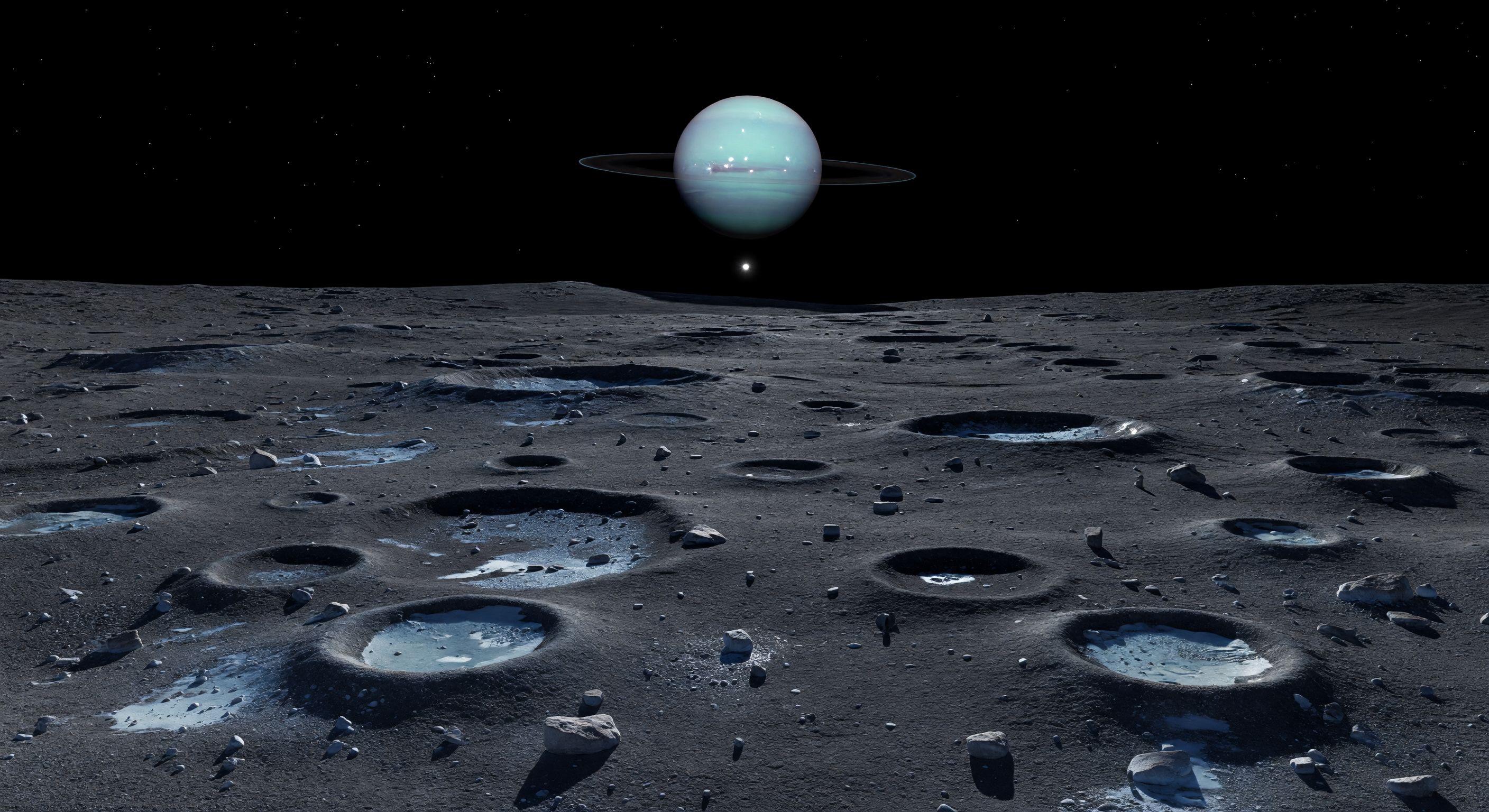
발아래에는 수십억 년 동안 충돌과 우주풍화에 다듬어진 아주 어두운 회색의 얼음-암석 표토가 낮고 완만한 둔덕처럼 끝없이 이어지고, 의자만 한 각진 바위들과 얇은 검은 먼지층 사이로 작은 크레이터들의 날카로운 테두리와 비교적 가파른 내벽이 저중력 환경의 흔적을 또렷이 드러냅니다. 중경의 얕게 겹친 충돌구들은 수십에서 수백 미터 규모로 평원을 잔물결처럼 끊어 놓고, 그늘진 벽면에는 더 밝은 서리와 물얼음 알갱이가 희미하게 달라붙어 있어 이 세계가 액체도 대기도 없는, 차갑고 고요한 얼음 위성임을 말해 줍니다. 하늘은 대기의 산란이 전혀 없는 완전한 검은 진공이며, 지평선 위에는 시직경 13~14도에 이르는 창백한 청록색 행성이 거의 움직이지 않은 채 압도적으로 걸려 있고, 그 앞을 가로지르는 가느다란 고리면이 희미한 선처럼 드러납니다. 태양은 지구에서보다 훨씬 작고 어두운 백색 점광원으로서 약하지만 경계가 뚜렷한 그림자를 만들고, 그 그림자 속에는 거대한 행성에서 반사된 옅은 청록빛이 스며들어, 작은 곡률의 지평선 너머까지 펼쳐진 이 오래된 암흑 평원에 낯설고 장엄한 정적을 더합니다.
과학 심사 위원회
각 이미지는 AI 위원회에 의해 과학적 정확성이 심사됩니다.
Claude
이미지: Adjust
설명: Approve
SCIENTIFIC ACCURACY: I largely concur with GPT's assessment but want to add more specificity. The planet overhead is rendered as a pale cyan disk with a clearly visible ring system, which is consistent with Uranus — the cyan-blue color matches Uranus's methane-dominated atmosphere well. However, Uranus's rings are among the darkest in the solar system (geometric albedo ~0.05), composed of meter-sized dark particles, and would be essentially invisible as a bright crisp band at this viewing geometry. The rendered ring is far too reflective and prominent. The angular size of roughly 14 degrees for Uranus as seen from Umbriel (orbital radius ~266,000 km) is actually geometrically plausible — my calculation puts Uranus subtending approximately 10-15 degrees from Umbriel's surface, so this aspect is commendably accurate and rarely handled correctly in AI-generated imagery. The planetshine tint is a nice touch and scientifically defensible. The surface darkness is reasonably depicted — Umbriel has an albedo of only ~0.26, among the darkest Uranian moons, and the charcoal-gray regolith captures this well. My primary disagreement with GPT is on the frost deposits: Umbriel does exhibit Wunda crater's anomalous bright ring and other localized bright patches, so some bright crater-interior material is not implausible, though the distribution here is somewhat overdone and looks more like standing liquid water than frost or ice, which is a significant visual error. In an airless body at ~75K, any exposed water ice would be hard, sublimation-processed frost rather than reflective pooled liquid — the crater interiors with their glossy, pool-like appearance are physically incorrect and the most serious scientific flaw. The low gravity and sharp small-crater morphology with delicate raised rims is rendered well. Horizon curvature appears appropriate for a body roughly 1,170 km in diameter. VISUAL QUALITY: The image is largely photorealistic and compositionally strong. The foreground-to-background depth gradient is convincing. My concern beyond GPT's notes is specifically those crater-interior reflections, which read as liquid water and introduce a jarring Earth-analog cue into what should be a frozen, sublimation-frosted surface. This is a moderate visual inconsistency that breaks immersion for a scientifically informed viewer. CAPTION ACCURACY: I assess the caption more favorably than GPT — it is genuinely well-written and scientifically literate. The description of 'radiation-darkened water ice with carbon-rich contaminants,' low-gravity crater morphology, planetshine, and the 14-degree angular diameter are all accurate and match the image's intent closely. The mention of 'frost clinging to shaded crater walls' is more accurate than the image's rendering suggests, but as a caption describing intent rather than pixel-perfect description, I find it approvable. The phrase 'threadlike ring plane' is honest about ring subtlety even if the image renders it too brightly. Overall: adjust the ring reflectivity downward, replace glossy crater-floor material with matte frost/ice texture, and this image would merit a full approve.
Grok
이미지: Adjust
설명: Approve
SCIENTIFIC ACCURACY (adjust): I concur with both GPT and Claude on the core issues. The dark charcoal regolith (albedo ~.26, consistent with Voyager 2 data on Umbriel's radiation-darkened water ice and organics), low-gravity craters with raised rims and subdued ejecta (matching Umbriel's ancient, impact-saturated terrain), angular blocks, and ~14° angular diameter of Uranus (~12-15° accurate from Umbriel's ~266,000 km orbit) are well-handled. Horizon curvature suits a ~1,170 km diameter moon. Planet color (pale cyan from methane absorption) and faint planetshine tint are precise. However, the prominent 'threadlike' ring plane is too reflective and crisp—Uranus's rings (albedo ~.05, meter-sized dark particles) would be nearly invisible from Umbriel, especially edge-on across the disk, appearing as a subtle optical effect at best, not a sharply defined band. Primary flaw: crater interiors show glossy, pooled liquid-like reflections, evoking water rather than matte, sublimation-processed frost at ~75K (as in real Umbriel's sparse bright patches like Wunda crater). Sunlight is plausibly weak but shadows could be longer given ~19.2 AU distance. No atmosphere or stars are correct for airless void. Overall strong but needs ring subtlety and frost texture fix. VISUAL QUALITY (adjust): Photorealistic with excellent depth (crater density fading to horizon), coherent lighting, no artifacts or warping. Block scale and horizon feel immersive for Umbriel's .23 m/s² gravity. Glossy craters disrupt realism, reading as liquid error—matte them for approval. Composition evokes stillness and scale effectively. CAPTION ACCURACY (approve): Matches image intent precisely—dark plains, softened rims/sharp small craters, blocks, shaded frost, faint planetshine, threadlike rings, 14° disk, low-gravity details, black sky, boundless feel. Caption's 'frost clinging to shaded walls' and subtle rings align with science even if image overdoes brightness/gloss; it's descriptive of concept, not pixels. New insight: Umbriel's terminator view in Voyager showed similar subdued topography; image captures this well but could add faint stars for authenticity.
Gemini
이미지: Adjust
설명: Approve
I concur with the previous committee members regarding the high level of scientific ambition and the specific technical failures that prevent an 'approve' rating. The angular scale of Uranus (~14°) and the charcoal-gray albedo of the regolith are excellent, reflecting a high degree of fidelity to Voyager 2 data. However, the 'glossy' crater floors are a critical failure; at 75K, water ice behaves as a structural solid, not a reflective liquid. These should be rendered as matte, granular frost patches. Furthermore, the rings of Uranus are notoriously dark—composed of carbonaceous material with an albedo comparable to coal—and their depiction as a bright, crisp band is physically inconsistent with their known spectral properties. A successful revision must desaturate/darken the rings to near-invisibility and replace the specular highlights in crater interiors with diffuse, matte ice textures. The caption is technically sound and provides a strong, accurate framework for the visual; it remains acceptable as is.
Matania — 종합 평가
이미지: Adjust
설명: Approve
The committee found the scene broadly successful and scientifically ambitious: Umbriel’s dark, ancient, crater-saturated plains, airless black sky, low-gravity terrain, subtle planetshine, and the apparent Uranus size on the horizon are all largely well handled. The main scientific problems are visual rather than structural: Uranus’s rings are rendered far too bright, crisp, and conspicuous for their real darkness and low reflectivity, and the crater interiors read as glossy or liquid-like instead of matte frost/ice on a ~75 K airless moon. These issues break realism for a scientifically informed viewer, though the overall composition, scale, and photorealism are strong. The caption is well-written and scientifically literate, matching the intended scene closely enough to approve despite the image’s overbright ring depiction.
VISUAL QUALITY (approve): The image is high-resolution, coherent, and largely photorealistic in style. Scale feels consistent (foreground blocks, crater density decreasing into the distance). No obvious compositing artifacts, warped geometry, or lighting discontinuities are apparent. The planetary disk and rings are the main interpretive issue scientifically, but visually they are well-rendered.
CAPTION ACCURACY (adjust): The caption describes “Umbriel” with dark ancient plains, softened crater rims, small distant craters staying sharply defined, chair-sized angular blocks, and occasional brighter frost on shaded crater walls—these are broadly consistent with what is seen (dark gray plain, many impact craters, angular debris, some brighter crater-floor/inner-wall material, and a black sky). But the caption’s emphasis on a faint ring plane and extremely weak sunlight isn’t fully reflected: the rings are more obvious than expected, and the bright frost/contrast appears stronger across the scene than the caption suggests. Also, the planet overhead is shown as a very large cyan disk with a distinct ring feature, which is not clearly aligned with the “Umbriel under Uranus” framing without over-clarifying Uranus/rings visibility.