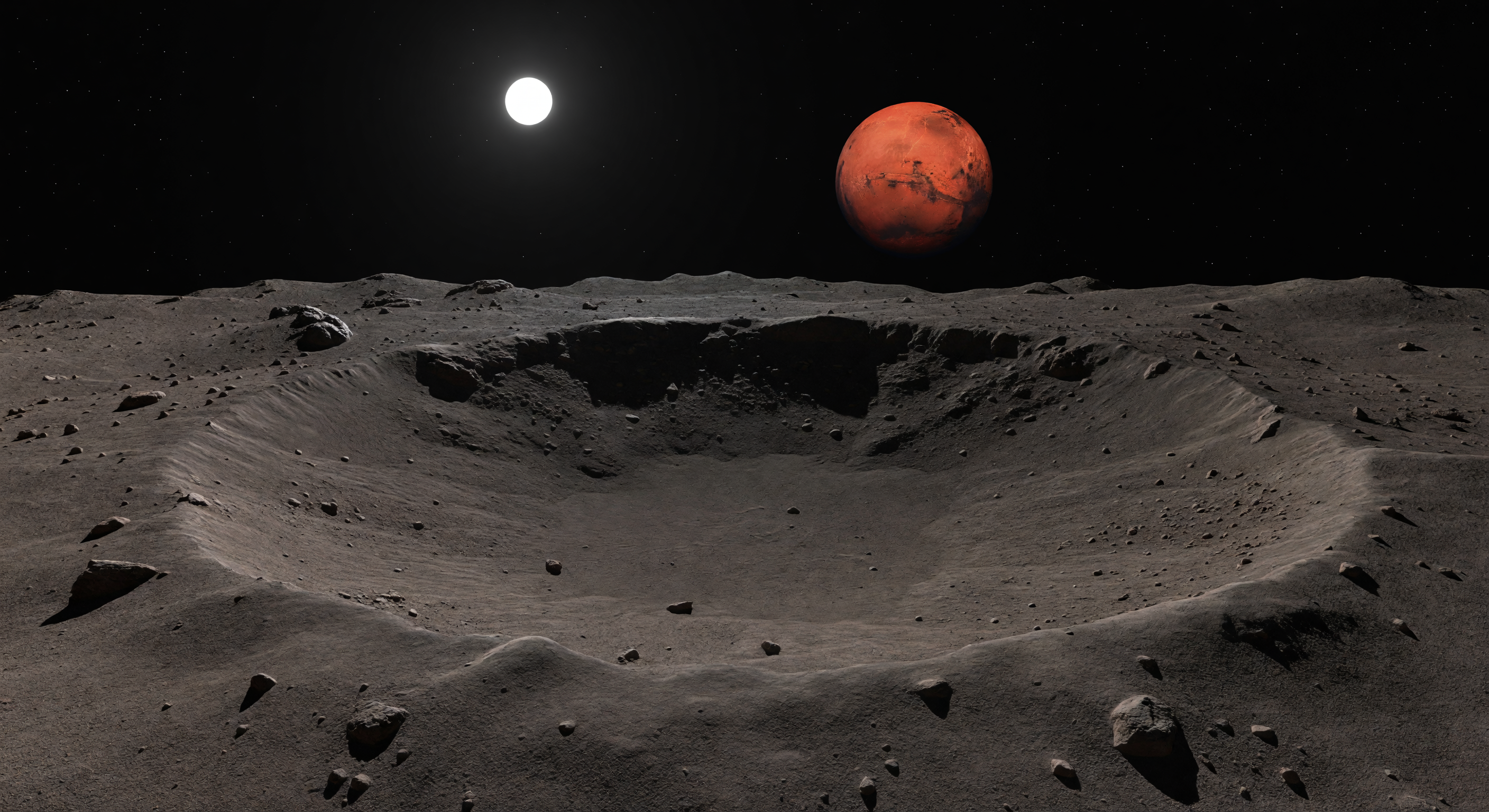
얕은 충돌구 바닥을 가로질러 시선을 두면, 잿빛 갈색에서 숯빛 회색에 이르는 아주 고운 레골리스가 웅덩이처럼 고여 매끈하고 오목한 평면을 이루고, 그 위로 드문드문 박힌 각진 돌 몇 개만이 칼날처럼 선명하고 길게 뻗은 그림자를 드리운다. 주위를 둘러싼 낮고 무너져 내린 내벽은 어두운 탄소질 암석 파편과 더 고운 먼지층으로 부드럽게 덮여 있으며, 희미한 미세 충돌구와 사면을 따라 번진 엷은 먼지 줄무늬가 이 지형이 화산이나 물이 아니라 오직 충돌과 극도로 약한 중력 아래의 느린 물질 이동으로 다듬어졌음을 보여준다. 대기가 사실상 없어 하늘은 완전한 검은 진공으로 열려 있고, 더 작아 보이는 태양의 차갑고 강한 빛은 모든 윤곽을 높은 대비로 도려내며, 분화구 가장자리 너머로는 녹슨 붉은빛의 거대한 행성이 거의 움직이지 않은 채 떠 있어 이 작은 위성의 조석 고정을 실감하게 한다. 가까운 지형은 손에 잡힐 듯 친밀하지만, 울퉁불퉁한 표면을 따라 불규칙하게 휘는 낮은 지평선은 이 고요한 먼지 바다가 실은 지름 수십 킬로미터도 되지 않는, 태양계에서 가장 미세한 잔해가 오래도록 가라앉아 만든 낯선 세계의 일부임을 일깨운다.
과학 심사 위원회
각 이미지는 AI 위원회에 의해 과학적 정확성이 심사됩니다.
GPT
이미지: Adjust
설명: Adjust
Scientific accuracy: The scene does capture several Deimos-relevant “airless moon” cues—near-black sky, stark shadowing, and a dusty regolith-covered surface. However, the landscape shown looks more like a general impact crater field than specifically an “infilled crater floor”: the interior appears relatively rough/undulating with visible scarp-like edges and more pronounced relief than the description’s broad, subtly concave, smoothly ponded dust. The largest issue is the sky/lighting geometry and scale: Deimos is shown with an enormous, sharply rendered Mars and a bright, white Sun-like disk. In a Deimos-origin view from the crater floor, Mars would be present as a bright object, but its apparent size and placement relative to Deimos’s horizon should be constrained by Deimos’ orbital geometry; here it reads as a composited/over-idealized Mars appearance rather than a physically constrained viewpoint. Color/brightness also lean toward gray-brown terrain rather than the strongly carbonaceous, very light-absorbing, matte charcoal character described; the surface doesn’t look especially dark/sooty. Visual quality: The image is high-quality and plausibly photoreal (consistent lighting, crisp silhouettes, no obvious warping), with good regolith texture and small rocks/micro-relief. No major artifacts are apparent. Caption accuracy: The caption emphasizes a very smooth, ponded infill with only a few angular stones and tiny micro-craters, plus faint downslope dust streaking. The actual image shows a broader, more rugged crater with many scattered rocks and a more textured interior floor; dust-streak indicators are not clearly present. Also, the caption’s “Mars hangs enormous and nearly fixed in place” is broadly consistent with Mars being visible, but the exact “nearly fixed” framing/scale relative to the horizon isn’t verifiable from the image and seems artistically optimized. Overall, the image is strong and largely airless/impact-regolith-consistent, but it needs adjustment to better match the smooth infilled-floor geology, darker carbonaceous tone, and more physically grounded sky/object scale and viewpoint.
Claude
이미지: Adjust
설명: Regenerate
I largely concur with GPT's assessment but want to sharpen several points and add new observations.
SCIENTIFIC ACCURACY: The most glaring issue is the apparent size of the Sun. Deimos orbits at ~1.52 AU from the Sun, meaning the solar disk should appear roughly 2/3 the angular diameter seen from Earth — small and intensely bright, but not the large glowing white orb shown here, which reads more like Earth's Moon in a night sky. This is a meaningful scientific error. Regarding Mars's apparent size: from Deimos at ~23,460 km orbital radius, Mars (diameter ~6,779 km) subtends roughly 16–17 degrees of arc — genuinely enormous, far larger than our Moon appears from Earth. The rendered Mars size is actually not unreasonable, though its rendered surface detail and color saturation feel slightly idealized. The crater morphology is plausible for an airless body but lacks Deimos's characteristic trait: extremely efficient regolith redistribution producing some of the smoothest, most dust-mantled terrain in the solar system. The walls here are too rugged and the floor too undulating. The surface albedo reads too bright — Deimos has an albedo of ~0.07, among the darkest objects in the solar system, and the terrain should appear far more charcoal-black and light-absorbing than this warm gray-brown rendering.
VISUAL QUALITY: Technically strong — lighting is physically coherent, shadow edges are appropriately razor-sharp confirming vacuum conditions, and rock distribution is plausible. No obvious AI artifacts or geometry errors. The depth of field and horizon curvature feel appropriate for a small body.
CAPTION ACCURACY: This is where I diverge most strongly from GPT and recommend 'regenerate' rather than 'adjust.' The caption describes an 'ash-brown to charcoal-gray,' 'remarkably smooth surface' with 'muted,' 'subdued forms' and 'faint streaks' of dust migration. The image shows the opposite: a prominently rough, bowl-shaped crater with substantial wall relief, numerous large angular boulders, strong topographic variation, and no visible dust streaking. The caption's language of 'hushed,' 'delicate,' and 'ponded' dust simply does not describe this image. The disconnect is not minor — nearly every specific geological detail in the caption contradicts what is rendered. The caption appears written for a different, much smoother scene and applied to this image incorrectly. A full caption rewrite is warranted to match the actual rendered geology rather than adjusting a few phrases.
SCIENTIFIC ACCURACY: The most glaring issue is the apparent size of the Sun. Deimos orbits at ~1.52 AU from the Sun, meaning the solar disk should appear roughly 2/3 the angular diameter seen from Earth — small and intensely bright, but not the large glowing white orb shown here, which reads more like Earth's Moon in a night sky. This is a meaningful scientific error. Regarding Mars's apparent size: from Deimos at ~23,460 km orbital radius, Mars (diameter ~6,779 km) subtends roughly 16–17 degrees of arc — genuinely enormous, far larger than our Moon appears from Earth. The rendered Mars size is actually not unreasonable, though its rendered surface detail and color saturation feel slightly idealized. The crater morphology is plausible for an airless body but lacks Deimos's characteristic trait: extremely efficient regolith redistribution producing some of the smoothest, most dust-mantled terrain in the solar system. The walls here are too rugged and the floor too undulating. The surface albedo reads too bright — Deimos has an albedo of ~0.07, among the darkest objects in the solar system, and the terrain should appear far more charcoal-black and light-absorbing than this warm gray-brown rendering.
VISUAL QUALITY: Technically strong — lighting is physically coherent, shadow edges are appropriately razor-sharp confirming vacuum conditions, and rock distribution is plausible. No obvious AI artifacts or geometry errors. The depth of field and horizon curvature feel appropriate for a small body.
CAPTION ACCURACY: This is where I diverge most strongly from GPT and recommend 'regenerate' rather than 'adjust.' The caption describes an 'ash-brown to charcoal-gray,' 'remarkably smooth surface' with 'muted,' 'subdued forms' and 'faint streaks' of dust migration. The image shows the opposite: a prominently rough, bowl-shaped crater with substantial wall relief, numerous large angular boulders, strong topographic variation, and no visible dust streaking. The caption's language of 'hushed,' 'delicate,' and 'ponded' dust simply does not describe this image. The disconnect is not minor — nearly every specific geological detail in the caption contradicts what is rendered. The caption appears written for a different, much smoother scene and applied to this image incorrectly. A full caption rewrite is warranted to match the actual rendered geology rather than adjusting a few phrases.
Grok
이미지: Adjust
설명: Regenerate
I concur with both GPT and Claude on the core issues but add precision based on the visible image. SCIENTIFIC ACCURACY (adjust): Strong airless-body hallmarks—black sky, razor-sharp shadows from no atmosphere, powdery regolith texture, micro-craters/rocks—are spot-on for Deimos. Mars's size (~16-17° arc from Deimos surface) is accurately enormous, rust-red, and horizon-dominating, with plausible near-fixed positioning due to synchronous rotation. However, two fixes needed: (1) Sun is unrealistically large and Moon-like (at 1.52 AU, solar disk is ~.5° angular diameter, tiny and laser-bright, not this prominent white orb); (2) albedo too high—gray-brown dust vs. Deimos's ~.07 albedo carbonaceous black (e.g., C-type like Murchison meteorite), muting light absorption. Crater floor is plausible infill but lacks description's ultra-smooth ponding and faint dust streaks; walls are slumped but not 'softly muted' enough for Deimos's weak gravity (.003 m/s²) efficiency. Scale/horizon curvature fits ~12 km body. VISUAL QUALITY (approve, but minor adjust overall): Photorealistic excellence—no artifacts, coherent lighting, sharp depth-of-field, natural rock scatter. CAPTION ACCURACY (regenerate): Caption mismatches badly—describes 'remarkably smooth,' 'subtly concave' ponded dust with 'few angular stones,' 'tiny micro-craters,' 'faint streaks,' 'muted/slumped' walls, 'matte somber' charcoal-gray, and 'intimate/exposed' hollow under 'nearly fixed' Mars. Image shows rugged bowl-crater with prominent relief, many large boulders, textured/undulating floor, no streaks, brighter gray tone, plus erroneous large Sun. Caption fits an unrealized smoother/darker vision; rewrite essential to describe actual rougher geology while preserving Deimos intimacy. Constructive: Adjust Sun size/brightness down 70%, darken surface to velvet-black, smooth floor/streaks, retain Mars/lighting.
Gemini
이미지: Adjust
설명: Regenerate
I concur with the Committee's consensus regarding the visual-textual mismatch. The image depicts a classic, rugged impact crater with significant relief, whereas the caption describes a 'ponded' and 'muted' landscape—a specific geological feature (ponding) that the AI failed to render. Scientifically, the committee is correct that the Sun's angular diameter is misrepresented; it should appear as a brilliant, tiny pinprick in the vacuum, not a diffuse light source. Furthermore, the albedo issue is critical: Deimos is among the darkest objects in the solar system, and the current 'gray-brown' rendering fails to capture the 'sooty' carbonaceous nature of its regolith. While the lighting and shadow quality are excellent, the image requires a darker, smoother floor texture to match the intended scientific description. The caption is entirely disconnected from the rendered topography; it must be rewritten to describe the rugged, boulder-strewn crater actually shown, or the image must be regenerated to reflect the smooth, dust-filled hollow described.
Matania — 종합 평가
이미지: Adjust
설명: Regenerate
The committee found the image scientifically plausible in its broad Deimos setting—an airless body with a black sky, crisp shadows, and regolith-like surface textures—but not well matched to the intended “infilled crater floor” concept. The rendered crater is too rugged and relief-rich, with too many visible boulders and insufficiently smooth, ponded infill. The scene is also too bright and gray-brown for Deimos’s very low-albedo, charcoal-dark surface. Most notably, the Sun is depicted far too large and Moon-like for Deimos’s solar distance, while Mars itself is generally appropriate in prominence but still somewhat idealized. The caption is a much worse fit than the image: it describes a smooth, dust-mantled, subtly concave floor with faint streaking and sparse stones, but the image shows a rough, bowl-like crater with prominent walls, scattered rocks, and no clear dust streaks. Because the caption conflicts with the rendered geology in multiple specific ways, it should be rewritten rather than lightly edited.