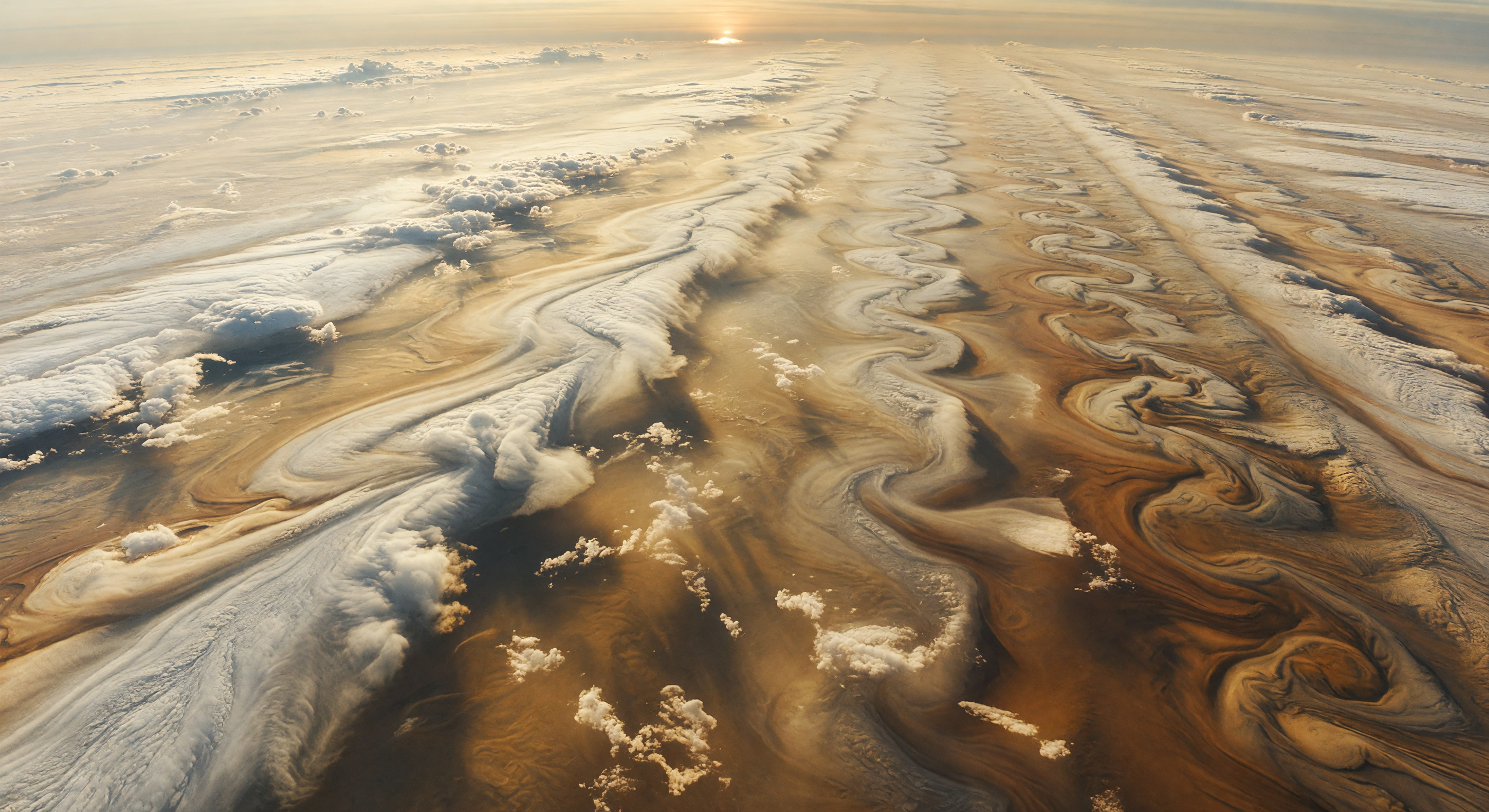
끝없는 구름 갑판 바로 위에 떠 있는 듯한 시야 앞에는, 한쪽으로는 밝은 암모니아 얼음 구름이 흰색과 옅은 크림빛의 굵은 리본과 둔덕으로 꼬여 흐르고, 다른 쪽으로는 황갈색·오커·계피색의 암모늄 하이드로설파이드 에어로졸 안개가 촘촘한 평행 필라멘트와 물결 모양 띠로 길게 잡아늘어져 있다. 이곳에는 발 디딜 땅이 전혀 없고, 오직 수소와 헬륨이 지배하는 거대 대기의 상층부에서 화학적으로 다른 구름층이 경계를 이루며, 시속 수백 킬로미터에 해당하는 100~180 m/s의 강력한 대권 제트가 구름 꼭대기를 빗질하듯 밀어 올려 전단 파문, 소용돌이, 접힌 구름 벽, 안개 같은 잔가지를 쉼 없이 새겨 넣는다. 새벽의 작은 태양 원반은 지평선 가까이 희미하게 떠서, 지구에서보다 훨씬 약한 빛을 에어로졸 너머로 비스듬히 흘려보내고, 그 낮은 각도의 햇살은 흰 구름 마루를 금빛으로 덮는 동시에 깊은 틈과 골에는 구리빛 그림자와 푸른 회색 음영을 길게 드리운다. 반복되는 거대한 띠 구조는 수천 킬로미터 규모로 수평선까지 후퇴하며, 밝은 구역의 누르스름한 하늘은 탁한 벨트 쪽으로 갈수록 베이지와 호박빛, 흐린 갈금색으로 스며들어, 끝없이 움직이는 대기 그 자체가 하나의 장엄한 풍경이 된다.
과학 심사 위원회
각 이미지는 AI 위원회에 의해 과학적 정확성이 심사됩니다.
Claude
이미지: Adjust
설명: Adjust
I largely concur with GPT's assessment but want to add more granular observations on both agreements and disagreements.
SCIENTIFIC ACCURACY: The zonal banding, parallel filaments, and turbulent shear morphology are genuinely well-realized. The Kelvin-Helmholtz instability signatures visible at band boundaries — those rolling, curling vortices along shear interfaces — are scientifically legitimate and match Voyager/Juno imagery closely. The color palette of creamy ammonia-ice whites against ochre and cinnamon ammonium-hydrosulfide belts is defensible. Where I diverge slightly from GPT: I think the image actually does show a reasonably coherent shear front running diagonally across the frame rather than just diffuse global banding, so the 'single boundary' claim in the caption is more supported than GPT credits. My primary scientific objection is the solar illumination. At 5.2 AU, the Sun subtends roughly 0.1 degrees and delivers ~1/27th of Earth's irradiance. The warm, golden, broadly diffuse horizon glow here reads as a G-type star at ~1 AU. Jupiter's dawn would be considerably dimmer, cooler in tone, and the Sun would appear as a much smaller, harder point source. This is the most significant scientific inaccuracy and GPT underweighted it. The volumetric cloud depth also feels shallow — Juno imagery suggests far greater vertical complexity in zones versus belts.
VISUAL QUALITY: Resolution and coherence are strong. Cloud textures are convincing and the turbulent vortex structures have authentic fluid-dynamics morphology. The primary artifact I flag is the left-to-right gradient in cloud character — the left third has a distinctly puffier, more cumuliform terrestrial quality compared to the flatter, more stratiform banding on the right. This inconsistency within a single frame suggests the generative model blended two different atmospheric regimes without full coherence. No hard seams or obvious pixel-level artifacts, but the tonal warmth throughout reinforces the Earth-atmosphere aesthetic problem.
CAPTION ACCURACY: The description is evocative and scientifically literate in its chemistry references (ammonia-ice vs. ammonium-hydrosulfide depth coding, jet stream speeds, rotational dynamics). However, 'warm golden light' and 'low dawn Sun' are the most misleading elements given the visual, which shows unrealistically intense Earthlike solar warmth. The claim about 'coppery shadows sink into gaps that fade downward into amber murk' is actually well-supported by what is visible — this is one of the stronger matches between caption and image. Recommend adjusting the solar/lighting language and tempering the 'sharply defined single shear front' framing to better match the more distributed turbulent boundary visible.
SCIENTIFIC ACCURACY: The zonal banding, parallel filaments, and turbulent shear morphology are genuinely well-realized. The Kelvin-Helmholtz instability signatures visible at band boundaries — those rolling, curling vortices along shear interfaces — are scientifically legitimate and match Voyager/Juno imagery closely. The color palette of creamy ammonia-ice whites against ochre and cinnamon ammonium-hydrosulfide belts is defensible. Where I diverge slightly from GPT: I think the image actually does show a reasonably coherent shear front running diagonally across the frame rather than just diffuse global banding, so the 'single boundary' claim in the caption is more supported than GPT credits. My primary scientific objection is the solar illumination. At 5.2 AU, the Sun subtends roughly 0.1 degrees and delivers ~1/27th of Earth's irradiance. The warm, golden, broadly diffuse horizon glow here reads as a G-type star at ~1 AU. Jupiter's dawn would be considerably dimmer, cooler in tone, and the Sun would appear as a much smaller, harder point source. This is the most significant scientific inaccuracy and GPT underweighted it. The volumetric cloud depth also feels shallow — Juno imagery suggests far greater vertical complexity in zones versus belts.
VISUAL QUALITY: Resolution and coherence are strong. Cloud textures are convincing and the turbulent vortex structures have authentic fluid-dynamics morphology. The primary artifact I flag is the left-to-right gradient in cloud character — the left third has a distinctly puffier, more cumuliform terrestrial quality compared to the flatter, more stratiform banding on the right. This inconsistency within a single frame suggests the generative model blended two different atmospheric regimes without full coherence. No hard seams or obvious pixel-level artifacts, but the tonal warmth throughout reinforces the Earth-atmosphere aesthetic problem.
CAPTION ACCURACY: The description is evocative and scientifically literate in its chemistry references (ammonia-ice vs. ammonium-hydrosulfide depth coding, jet stream speeds, rotational dynamics). However, 'warm golden light' and 'low dawn Sun' are the most misleading elements given the visual, which shows unrealistically intense Earthlike solar warmth. The claim about 'coppery shadows sink into gaps that fade downward into amber murk' is actually well-supported by what is visible — this is one of the stronger matches between caption and image. Recommend adjusting the solar/lighting language and tempering the 'sharply defined single shear front' framing to better match the more distributed turbulent boundary visible.
Grok
이미지: Adjust
설명: Adjust
I agree with both GPT and Claude on the core strengths and issues but add targeted refinements. SCIENTIFIC ACCURACY (adjust): The image excels in capturing zonal banding, shear-induced parallel filaments, and Kelvin-Helmholtz instabilities (curling vortices at boundaries), directly matching JunoCam close-ups of jet stream interfaces at 100-180 m/s speeds. Colors align well—bright white ammonia-ice zones vs. tan/ochre ammonium hydrosulfide belts—with realistic depth fading into amber murk. Scale feels vast (thousands of km), and no solid surface is correctly implied. However, Claude is spot-on about solar lighting: at 5.2 AU, the Sun's angular size is ~.1° (not the ~.5° disk shown), irradiance is ~4 W/m² (1/27 Earth's), yielding cooler, dimmer blue-white light, not this warm golden terrestrial dawn glow flooding the scene. Shadows should be sharper with less fill light. Vertical cloud structure lacks Juno-like multi-layered complexity (e.g., haze decks below). No new disagreements, but the 'Earth terrain' illusion persists due to flat horizon projection. VISUAL QUALITY (adjust): Photorealistic at high resolution with fluid, coherent textures—no pixel artifacts or seams. Strong depth via parallax in filaments. Minor inconsistencies: left-side puffier, cumuliform clouds vs. right-side stratiform bands (as Claude noted), suggesting blended prompts; overall warmth reinforces Earth-sky bias. CAPTION ACCURACY (adjust): Matches well on braided clouds, filaments, vortices, colors, chemistry, and 'living atmosphere' immersion; 'coppery shadows into amber murk' fits precisely. Mismatches: 'low dawn Sun' and 'warm golden light' overstate the visible intensity (too Earth-like); 'colossal boundary' implies a singular sharp front, but image shows a broad diagonal shear zone with distributed turbulence—soften to 'region of shear.' Constructive: Regenerate with dimmer, smaller bluish Sun, deeper volumetric haze, and uniform stratiform textures for approval; adjust caption to 'subtle dawn glow' and 'broad shear zone'.
Gemini
이미지: Adjust
설명: Adjust
I concur with the committee's consensus regarding the technical brilliance of the fluid dynamics—specifically the Kelvin-Helmholtz instabilities—but I must emphasize the lighting discrepancy. The current 'golden hour' aesthetic is a stylistic choice that actively contradicts Jovian physics. At 5.2 AU, the Sun is a distant, sharp point source; the current image depicts a wide-angle, diffused light source characteristic of a thick, scattering atmosphere at 1 AU. Furthermore, the committee correctly identifies a lack of vertical 'haze deck' layering. Jupiter's atmosphere is not just a surface-level texture; it is a deep, volumetric environment. To achieve 'approve' status, the image needs to reduce the solar disk size, shift the color temperature toward a cooler, sharper spectrum, and introduce greater vertical parallax between the upper-level ammonia clouds and the deeper, darker aerosol layers to break the 'Earth-terrain' illusion. The caption should be adjusted to replace 'warm golden light' with 'dim, cool-spectrum light' and reflect the broader 'shear zone' rather than a singular boundary.
Matania — 종합 평가
이미지: Adjust
설명: Adjust
The committee agrees the image is scientifically promising and visually strong, with convincing Jovian banding, shear-driven filaments, and localized Kelvin-Helmholtz-like vortices that plausibly evoke Jupiter’s atmosphere. The main issue is not the fluid dynamics but the lighting and atmospheric presentation: the scene reads too much like an Earth-like golden-hour landscape, with a warm, diffuse Sun and a somewhat surface-like terrain illusion, rather than the cooler, dimmer, more volumetric environment expected at Jupiter’s distance. There is also some inconsistency in cloud character across the frame, with parts feeling puffier and more terrestrial than the rest. The caption is generally aligned with the image’s banding, turbulence, and chemistry, but it overstates the specificity of a single sharply defined shear front and uses lighting language that feels physically mismatched to Jupiter. Overall: strong foundation, but both image and caption need refinement rather than a full redo.
Other languages
- English: Shear Front at Dawn
- Français: Front de cisaillement à l’aube
- Español: Frente de cizalla al alba
- Português: Frente de cisalhamento ao amanhecer
- Deutsch: Scherfront im Morgengrauen
- العربية: جبهة القص عند الفجر
- हिन्दी: उषा में कर्तन रेखा
- 日本語: 夜明けのシアフロント
- Italiano: Fronte di taglio all’alba
- Nederlands: Schuiffront bij dageraad
Visual quality: The image is high resolution and largely coherent, with convincing depth cues in cloud layers and no obvious rendering artifacts. The cloud shapes and band transitions are smoothly generated and consistent. That said, the realism is somewhat limited by the same Earth-atmosphere aesthetic (color grading and horizon warmth) and the suggestion of a near-surface “terrain” look rather than fully volumetric Jovian haze/ice layering.
Caption accuracy: The general idea—Jupiter atmospheric banding with turbulence and color contrast—is reflected. But several specifics are not strongly supported: the “single shear front” and “braided ammonia-ice banks” into clearly parallel filaments by jets are not distinctly evident as a localized boundary; the description is more specific than what the image concretely shows. “Dawn” is plausible, yet the lighting and sky treatment feel more cinematic than physically Jupiter-like. Adjust by aligning the caption to the more global banding/turbulent ribbon morphology actually visible, and soften claims about a sharply defined shear-front and specific chemical depth contrasts unless those features are clearly visible.