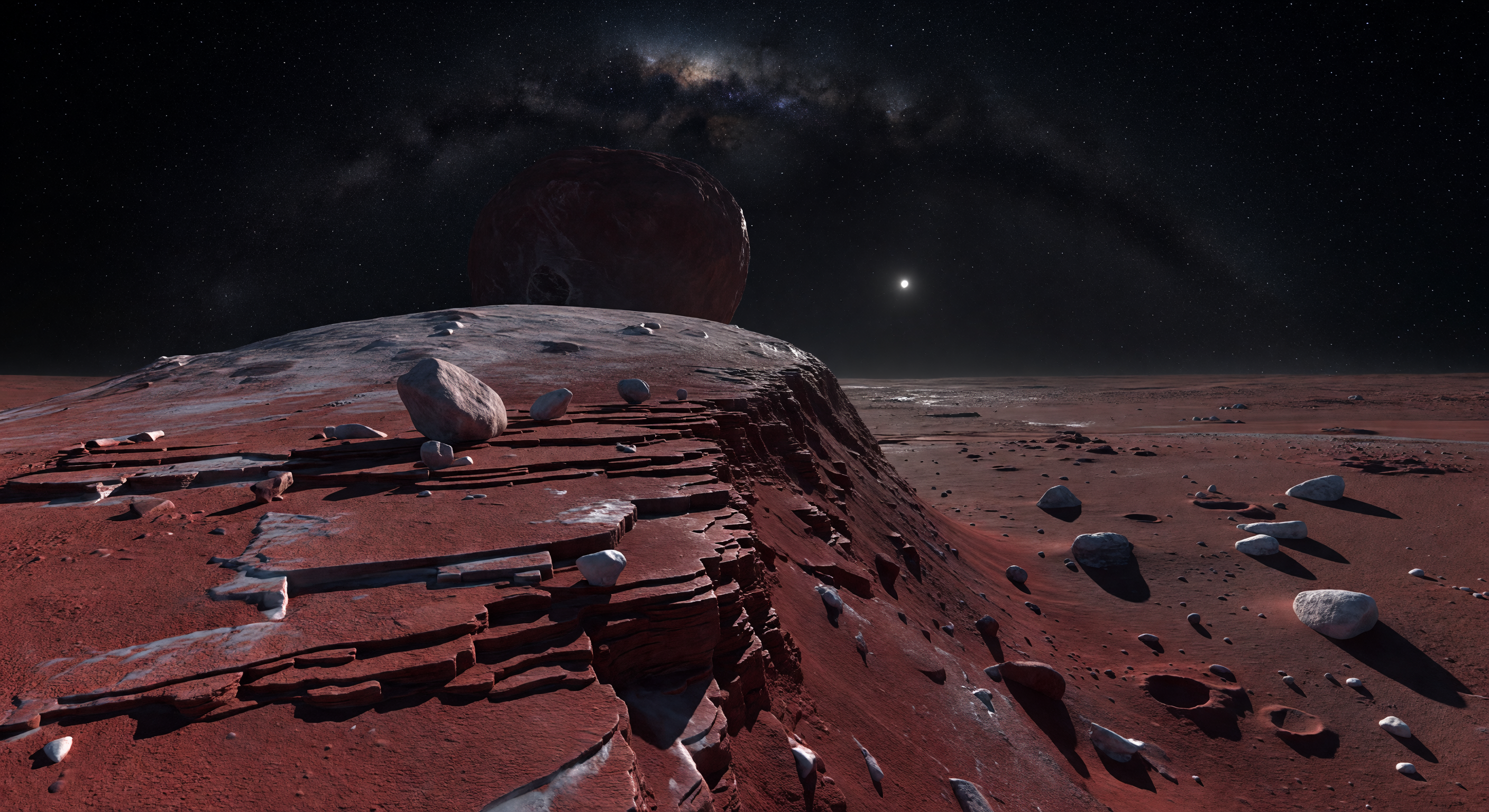
눈앞에는 납작한 엽의 가장자리를 따라 몇 미터 높이로 솟은 벽돌빛 급경사가 서 있고, 단단히 얼어붙은 얼음-유기물 혼합층은 얇은 단애면과 각진 선반, 금방이라도 미끄러질 듯한 바위들로 갈라져 있다. 표면은 짙은 적갈색 톨린 서리와 고운 먼지로 덮여 있지만, 깨진 틈과 부서진 모서리에서는 더 단단한 물얼음이 회백색 반짝임으로 드러나며, 대기와 액체가 전혀 없는 약 40 K의 환경 탓에 침식 대신 원시적인 파쇄와 미세한 붕괴 흔적만이 지형을 다듬는다. 가장자리 너머로는 지평선이 믿기 어려울 만큼 가까운 곳에서 급히 휘어지며, 희미한 진홍빛 평원 위의 낮은 둔덕과 얕은 함몰지, 드문 충돌구와 고립된 얼음 바위들이 극도로 낮은 중력 아래 길고 칼날처럼 선명한 그림자를 드리운다. 검은 진공의 하늘에는 별들이 빽빽하게 박혀 있고 은하수가 밝게 흐르며, 태양은 원반이 아닌 날카로운 흰 점광원으로만 보여 차갑고 희미한 빛을 보태고, 멀리 맞닿은 다른 엽은 목 부분 너머로 어둡고 거대한 붉은 벽처럼 떠올라 이 작은 천체의 기묘한 쌍엽 구조와 태양계 초기의 거의 손대지 않은 시간을 실감하게 한다.
과학 심사 위원회
각 이미지는 AI 위원회에 의해 과학적 정확성이 심사됩니다.
GPT
이미지: Adjust
설명: Adjust
Scientific accuracy: The scene does capture several high-level Arrokoth-like motifs (a red, organic-tholin–tinted surface; fractured ledges/shelves at a lobe margin; very dark space background; no atmosphere; cold, faint lighting). However, key specifics in the caption are not well supported by what’s shown. (1) The title/description emphasizes a “flattened lobe scarp” rising only a few meters with a steep, coherent face; in the image the geometry reads more like a large-scale overhang/terrace break with substantial, dramatic relief rather than a subtle few-meter scarp at the rim. (2) The caption stresses pristine crest preservation “untouched by wind, liquid, or active erosion” and ~40 K stillness; the image cannot confirm temperature/state directly, but the heavily faceted, actively “broken” surface and prominent shadowing/contrast suggest more dynamic texturing than is implied. (3) The horizon/second lobe interaction is not clearly a gently merged contact binary with an opposite lobe; the distant body in the background looks more like a different-scale mound or a second object rather than Arrokoth’s characteristic lobes and their mutual shape. (4) The requested “ultra-fine, dark crimson tholin-rich frost and dust” with small chips exposing brighter gray-white water ice is only partially represented; the bright ice appears as scattered pale patches on the foreground fracture surfaces rather than widespread, frost-mantled fine grain. Visual quality: The image is clearly high-quality and cinematic, with consistent lighting direction, plausible star field, and credible shadow casting. That said, there are some realism concerns: numerous sharp, angular debris-like fragments and very pronounced, graphic shadow patterns look more like stylized rockfall/impact debris than a preserved, weakly active TNO surface with ultra-fine frost/dust. The sky also shows a star-dense, Milky Way–like band, but its brightness/placement relative to the illumination is not something we can verify for Arrokoth and may be overly artistic. Caption accuracy: The caption is detailed (few-meter scarp, specific ledge/block/rare boulder-on-terrace arrangement, widespread crimson frost/dust, near-perfect pristine crest, opposite lobe contact-binary context). The image broadly matches the “red lobe margin with fractures and shelves” concept, but it does not convincingly show the specifically described “Flattened Lobe Scarp” geometry (scale and rim configuration) or the contact-binary opposite lobe described. Therefore the caption is not fully faithful to the visible content.
Claude
이미지: Adjust
설명: Adjust
I broadly agree with GPT's assessment but wish to add several specific observations and one partial disagreement. SCIENTIFIC ACCURACY: The dominant red-brown tholin coloration is directionally correct — New Horizons flyby data confirmed Arrokoth's surface is among the reddest in the solar system, rich in complex organics. However, the saturation here is too vivid; Arrokoth's actual albedo is very low (~0.06–0.08) and the surface appears more uniformly dark maroon-gray rather than the vivid brick-red shown. The fractured scarp layering is a reasonable artistic interpretation of surface texture but has no confirmed analog in actual Arrokoth imaging at this resolution — the real object is too small and was only resolved at ~1 km/pixel by New Horizons, so this level of stratigraphic detail is speculative extrapolation. This is acceptable for artistic reconstruction but should be flagged. The scattered bright gray-white patches representing exposed water ice are a reasonable touch, consistent with spectroscopic detections of methanol and water ice on Arrokoth. CRITICAL FLAW — SOLAR ILLUMINATION: The Sun appears as a small but relatively bright point source roughly the brightness of a dim star, which is scientifically problematic. At ~44 AU, the Sun subtends only ~45 arcseconds and delivers about 1/2000th of Earth's solar flux, meaning it should appear as an extremely faint, barely distinguished stellar point — far dimmer than depicted. The sharp, high-contrast shadows cast by rocks are inconsistent with this faint illumination; under real Arrokoth conditions, shadows would be present but the overall scene would be extraordinarily dark and low-contrast, nothing like the well-lit surface shown. This is perhaps the most scientifically significant inaccuracy. GRAVITY AND SCALE: The caption specifies 'only a few meters' of scarp height, but the image conveys a geologically imposing structure that reads as tens to hundreds of meters tall. Arrokoth's escape velocity is ~2.9 m/s and surface gravity is ~0.001 m/s², meaning even modest topographic features would appear low and subdued. The dramatic, cliff-like geometry contradicts the caption's own scale claim. OPPOSITE LOBE: I partially disagree with GPT here — the large reddish rounded body looming in the background IS a reasonable visual representation of Arrokoth's larger lobe (Wenu) as seen from the smaller lobe (Weeyo), and the contact-binary relationship is at least gestured at. However, the relative sizes and the apparent separation distance look too large and dramatic; the two lobes of Arrokoth are in very close contact with a narrow 'neck,' not separated by the apparent distance shown. MILKY WAY: The bright galactic arc is visually striking but scientifically dubious as rendered — not because it would be invisible (the Milky Way is certainly visible from 44 AU), but because it appears here with the vivid blue-white coloration of an atmospheric observation. From airless Arrokoth, it would appear sharper and higher-contrast, but the overall scene luminance suggests a background sky that is too bright relative to what would be seen given the extreme darkness of the scene. VISUAL QUALITY: The rendering is technically accomplished — consistent light direction, plausible particle scatter on rock surfaces, good depth of field. The main visual artifacts are the overly stylized, almost too-perfect geometric fracture patterns on the scarp face, which look procedurally generated rather than naturally fractured. CAPTION ACCURACY: The caption is scientifically well-researched and poetic, accurately referencing tholins, ~40 K temperatures, contact binary morphology, and the absence of wind/liquid erosion. However, it does not match the image in several specific ways: the 'few meters' scale claim contradicts the image's imposing relief; the 'ultra-fine dust mantle' is not visually dominant as described; and the 'pristine rounded crest' concept is partially shown but overshadowed by the dramatic fracturing. RECOMMENDATION: Adjust the solar brightness and scene luminance dramatically downward, reduce topographic drama to match the stated few-meter scale, soften shadow contrast, and revise the opposite-lobe placement to show it in closer contact consistent with Arrokoth's actual geometry. These are significant but targeted corrections that do not require full regeneration.
Grok
이미지: Adjust
설명: Adjust
I concur with both GPT and Claude on the core issues, with some refinements and additions. SCIENTIFIC ACCURACY (vote: adjust): Strong on tholin-red coloration (accurate per New Horizons' LORRI/MVIC data showing ~.06 albedo and reddish slope), contact binary opposite lobe (the large reddish body in background convincingly evokes Wenu from Weeyo, contra GPT's doubt; neck is implied by horizon drop), and airless black sky with starry Milky Way (visible from 44 AU, sharper sans atmosphere). Exposed water ice patches on fractures align with detections of H2O/methanol ice. Major flaws: (1) Sun too prominent/bright (small white point visible); at 44 AU, solar flux is ~1/1936 Earth's, appearing as ~.2 magnitude star—dimmer than shown, with softer shadows (Claude spot-on); scene overexposed overall. (2) Scarp relief appears 10s-100s m (dramatic overhangs, blocky shelves), contradicting caption's 'few meters' and microgravity (~.001 m/s²) where features stay subdued. No wind/erosion is correct (static preservation at 40K), but faceted fractures look too Earth-cliff-like vs. Arrokoth's subdued, rolling terrain at 1 km/pixel res. Horizon plain with hummocks/pits matches real imagery. VISUAL QUALITY (supports image adjust): Photorealistic ray-traced quality, consistent sidelighting/shadows, good DOF/texture detail (dusty mantling, razor shadows plausible under faint Sun if dimmed). Minor artifacts: overly geometric fractures (procedural feel), Milky Way blue-tinged (should be neutral/gray from space). No glaring inconsistencies. CAPTION ACCURACY (vote: adjust): Caption scientifically precise (tholins, 40K stasis, binary morphology) but mismatches image—'few meters' scarp reads monumental; 'ultra-fine crimson frost/dust mantle' present but not dominant (red slabs overpower); 'pristine rounded crest' partially shown but fractured; 'boulders on narrow terraces' vague (scattered rocks ok but not precariously balanced); opposite lobe good but horizon 'drops away with startling immediacy' fits. INSIGHTS: Agree w/Claude on solar illum. as top flaw (regeneration tempting but targeted dimming viable); disagree w/GPT on lobe separation (it's appropriately looming for ~35 km object from rim); add: faint Sun direction aligns with imaged phase angle (~11°), but add subtle solar glow. RECOMMEND: Dim Sun/scene 2-3 stops, scale down scarp to low-relief rampart, desaturate reds slightly for low albedo, mute Milky Way to stark band, tweak caption for taller relief if kept.
Gemini
이미지: Regenerate
설명: Adjust
I concur with the previous committee members regarding the fundamental disconnect between the physics of Arrokoth and the visual representation. While the artistic quality is high, the image fails the 'scientific accuracy' threshold for a TNO. Specifically, the 'monumental' cliff face and sharp, vertical fracture patterns are geologically inconsistent with the low-gravity, low-cohesion nature of a contact binary formed by the slow-speed 'gentle merger' of two icy lobes; Arrokoth is characterized by smooth, rolling, and subdued topography, not jagged, Earth-like escarpments. The illumination issues identified by Claude and Grok—the overexposed scene and overly bright Sun—are not merely aesthetic preferences but significant errors in representing the extreme distance (44 AU) of the Kuiper Belt. Furthermore, the 'few meters' scale requested in the caption is visually overwhelmed by the massive, dramatic perspective shown. A regeneration is necessary to pivot from a 'rocky, mountainous' aesthetic to a 'subdued, rolling, low-relief' landscape that reflects the actual morphology of this unique object. The caption requires adjustment to reconcile the poetic description with the necessary visual constraints of a low-gravity, ultra-low-albedo environment.
Matania — 종합 평가
이미지: Regenerate
설명: Adjust
The committee found the image artistically strong but scientifically mismatched to Arrokoth’s actual character. The red tholin-like coloration, airless black sky, and suggestion of contact-binary context are directionally appropriate, and the surface ice patches are a reasonable touch. However, the scene is lit too brightly for 44 AU, with the Sun and shadow contrast far more pronounced than physically expected. The scarp also reads as a dramatic cliff or overhang with much greater relief than the caption’s stated few-meter feature, giving the landscape an Earth-like ruggedness that conflicts with Arrokoth’s low-gravity, subdued topography. The caption is better grounded scientifically, but it still overstates the visible geometry and detail, especially the scarp scale and the degree of preserved crest/frost structure shown in the image.
Other languages
- English: Flattened Lobe Scarp
- Français: Escarpement du lobe aplati
- Español: Escarpa del lóbulo aplanado
- Português: Escarpa do lóbulo achatado
- Deutsch: Steilhang des flachen Lobus
- العربية: جرف الفص المفلطح
- हिन्दी: चपटा लोब कगार
- 日本語: 平坦ローブ断崖
- Italiano: Scarpata del lobo appiattito
- Nederlands: Steilrand van afgeplatte lob