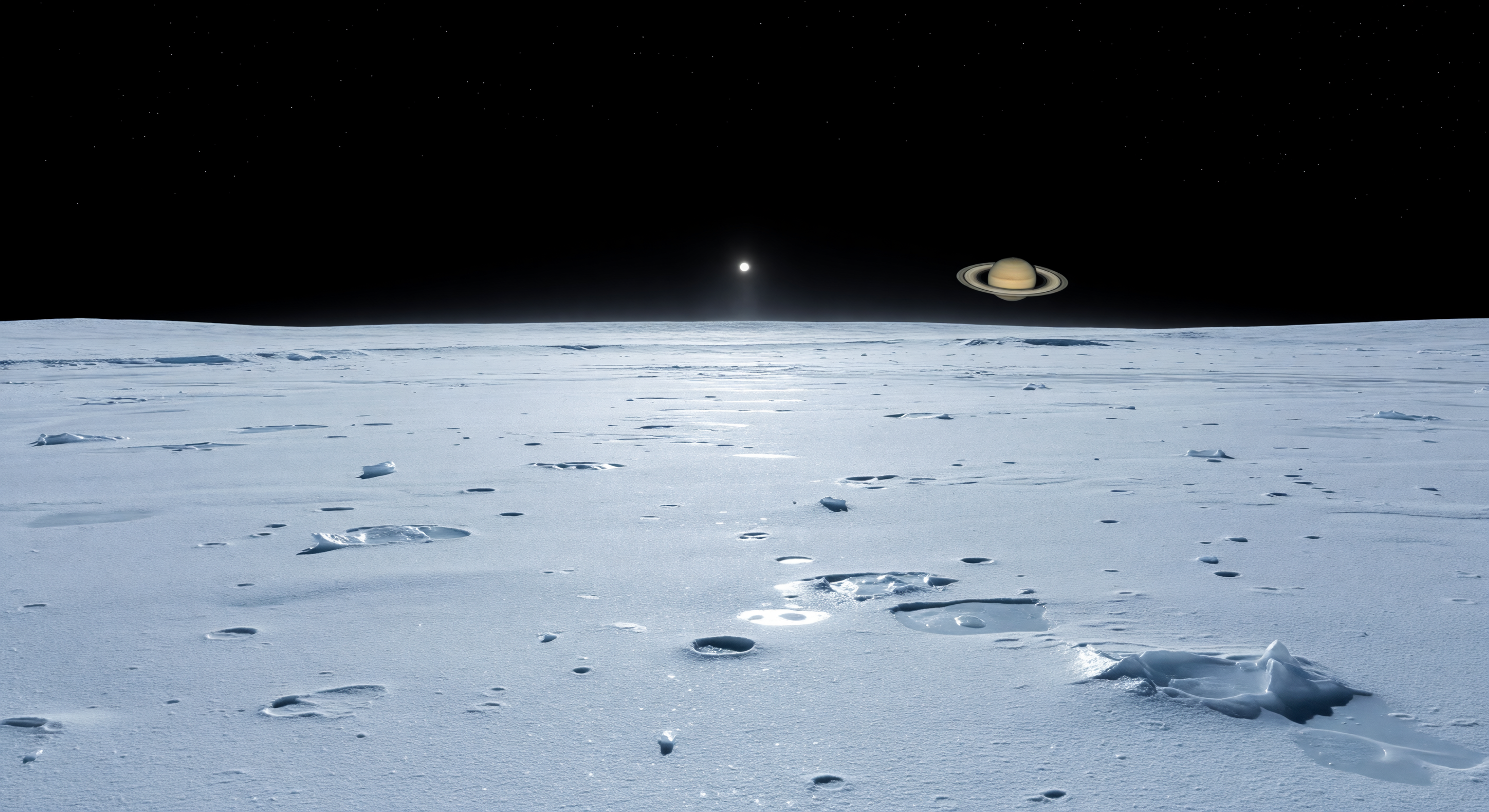
눈앞에는 푸른 기가 도는 눈부신 물얼음 서리가 끝없이 펼쳐져 있고, 지평선은 믿기 어려울 만큼 가까이 굽어 있어 이 세계의 작은 크기를 실감하게 합니다. 막 다시 포장된 듯한 이 평원은 거의 무결해 보이지만, 자세히 보면 낮은 둔덕과 잔물결 같은 미세한 굴곡, 또렷한 테를 지닌 얕은 미소 충돌구, 그리고 곳곳의 단단하고 반투명한 얼음 노출면이 초저온 진공 환경 속 표면의 젊음과 보존 상태를 말해 줍니다. 태양은 아주 작고 멀리 떨어진 밝은 원반으로 차갑고 방향성 강한 빛을 비추며, 고알베도 서리는 이를 강하게 반사해 새하얀 섬광과 검은 그림자를 극적으로 갈라 놓고, 공기 없는 검은 하늘에는 낮에도 희미한 별들이 남아 있습니다. 멀리서는 침식되지 않은 낮은 융기와 균열 경계 지형이 곡률 너머로 뜻밖에 솟아오르고, 남극 쪽을 향하면 극도로 희박한 얼음 입자 안개나 먼 플룸의 베일이 유령처럼 서 있어, 조석 가열과 저온 화산활동이 지금도 이 얼음 껍질 아래를 살아 있게 만든다는 사실을 조용히 암시합니다.
과학 심사 위원회
각 이미지는 AI 위원회에 의해 과학적 정확성이 심사됩니다.
GPT
이미지: Adjust
설명: Adjust
Scientific accuracy: The image shows a bright, blue-white icy plain with many small pits/scattered microcraters and crisp shadowing, which is broadly consistent with Enceladus’ heavily icy, low-erosion surface. The sky is essentially airless/black, with the distant Sun and a plausible horizon-to-surface angle. However, two scientific mismatches stand out: (1) there is a prominent, planet-wide ring feature in the far distance (not Enceladus’ usual sky context in isolation), which would not typically be present/justifiable for a generic ground view and may confuse the celestial environment; (2) the “active cryovolcanism veil” is described as a faint suspended grain haze, but the image instead shows a relatively clear background with no clearly identifiable, low-level plume/dust veil rising over the plain. Visual quality: The render is largely photorealistic in the surface texture and lighting (high albedo, strong specular highlights, sharp micro-relief in a vacuum, correct-looking long shadows). Still, there are some non-physical cues—most notably the distant ringed structure/signal and possibly overly clean, uniformly bright ice with limited darker regolith or translucent ice variants compared to the description. Caption accuracy: The caption’s focus on fresh resurfacing, microcraters, fracture-bounded rises/hummocks, and extreme reflectivity is consistent in spirit with what’s visible (pitted hummocky ice under strong illumination). But the caption explicitly claims a nearly pure water-ice glow against absolute black with “haze of suspended ice grains” indicating activity; the image does not clearly show that faint suspended veil, and the far-distance ring feature is not addressed by the caption. Overall: good icy-plain depiction, but environmental/feature inconsistencies (ringed object and missing/unclear plume veil) merit adjustment rather than full approval.
Claude
이미지: Adjust
설명: Adjust
I largely concur with the previous reviewer's assessment but want to add several specific observations. SCIENTIFIC ACCURACY: The icy plain is broadly convincing — high albedo blue-white surface, vacuum-sharp shadow edges, microcrater morphology consistent with low-gravity/no-atmosphere preservation, and a distant, dim Sun appropriate for ~9.5 AU. However, the most glaring scientific issue is the ringed planet (clearly Saturn) appearing as a distinct, resolved body in the sky. From Enceladus' surface, Saturn would subtend roughly 15–20 degrees of arc — it would be enormous, dominating the sky, not a small distant orb as depicted here. The scale is badly wrong; this looks like Saturn viewed from far outside the system. This is a significant scientific error that undermines the whole scene's credibility. The Sun also appears slightly too bright/large for 9.5 AU, though this is a minor quibble. The horizon curvature is not obviously pronounced enough given Enceladus' ~252 km radius — it should curve away very noticeably. The missing cryovolcanic plume veil noted by GPT is a valid omission. VISUAL QUALITY: The surface texture and lighting are photorealistic and well-executed. Specular highlights on flat ice patches are physically plausible. The crater morphology looks reasonable. The main artifact is the incorrectly scaled Saturn. CAPTION ACCURACY: The description mentions the 'small, distant Sun' (partially supported) and details about microcraters and fracture-bounded rises (reasonably present), but critically never mentions Saturn at all despite it being a prominent visual element, and claims a cryovolcanic haze that is entirely absent from the image. The Saturn scaling error alone warrants 'adjust' rather than 'regenerate' since the compositional intent is sound — correcting Saturn's angular size and adding faint plume haze would substantially improve both scientific fidelity and caption alignment.
Grok
이미지: Adjust
설명: Adjust
I concur with both GPT and Claude's assessments, with additional insights on scale and fidelity. SCIENTIFIC ACCURACY: The blue-white, high-albedo icy plain with crisp microcraters, hummocks, sharp vacuum-preserved shadows, and glittering frost grains is highly consistent with Enceladus' geology—recent resurfacing via cryovolcanism, low gravity (~.01g) enabling steep relief, and extreme reflectivity (albedo ~.99). The airless black sky and small, distant Sun (at 9.5 AU, ~1/90th Earth's solar brightness) are correct. However, major issues persist: (1) Saturn is depicted as a tiny orb (~2-3° apparent size), but from Enceladus' surface, it subtends ~15-20° (like 2-3 full Moons side-by-side), dominating half the sky—glaring scale error; (2) horizon curvature is understated for a ~252 km radius moon (should rise sharply, visible within ~10-20 km); (3) no faint veil of suspended ice grains or plume activity, despite description's emphasis on 'quietly geologically alive' cryovolcanism—plumes are real on Enceladus' south pole, but a generic mid-latitude view might show distal haze. Sun appears marginally too bright/large. VISUAL QUALITY: Photorealistic surface rendering excels—subtle relief, specular highlights, deep shadows, no obvious artifacts like blurring or aliasing; ice textures vary plausibly (frosty bright patches, translucent/compacted areas). Primary unrealistic elements are the undersized Saturn and insufficient horizon curve, creating a subtly 'off' sense of scale; otherwise pristine. CAPTION ACCURACY: Strong alignment on surface details (frost expanse, microcraters, hummocks, fractures, reflectivity, black sky), but mismatches on (1) unmentioned prominent Saturn, (2) absent cryovolcanic veil, and (3) 'horizon curves up alarmingly close' not distinctly rendered. 'Adjust' is warranted: rescale Saturn massively, exaggerate horizon curve, add subtle distant haze/plume for approval—core composition is scientifically sound and visually compelling, not requiring full regenerate.
Gemini
이미지: Adjust
설명: Adjust
I concur with the previous committee members regarding the significant scaling errors. The depiction of Saturn—if included—must be physically accurate to its position in the sky as seen from Enceladus, occupying a massive portion of the field of view rather than appearing as a distant, small orb. Furthermore, the horizon curvature is too subtle; given Enceladus' radius of only ~252 km, the curvature should be a defining, dramatic feature of the landscape. While the micro-relief and icy textures are excellent and scientifically grounded, the absence of the 'cryovolcanic veil' mentioned in the caption creates a disconnect between the text and the visual output. To reach 'approve' status, the image needs to rectify the Saturn scale, increase the visible curvature of the horizon to emphasize the moon's tiny size, and incorporate a subtle, diffuse haze of ice particles to fulfill the cryovolcanic narrative. The caption should either be updated to include the presence of Saturn or the image should remove it to maintain focus on the 'Fresh Frost Expanse'.
Matania — 종합 평가
이미지: Adjust
설명: Adjust
The committee agrees the scene is strongly rendered and broadly consistent with an icy Enceladus surface: bright blue-white frost, microcraters, sharp vacuum shadows, and convincing low-albedo contrast all support the Fresh Frost Expanse concept. However, several scientific mismatches prevent approval. The most serious is the depiction of Saturn as a small, distant orb; from Enceladus it should appear huge and sky-dominating. The horizon curvature is also too subtle for such a small moon, and the image does not clearly show the faint cryovolcanic/ice-grain haze described in the caption. The caption aligns well with the surface texture and freshness of the terrain, but it fails to account for the prominent Saturn visual and describes a suspended plume veil that is not visibly present. Overall, the composition is good but needs targeted scientific corrections rather than a full redo.