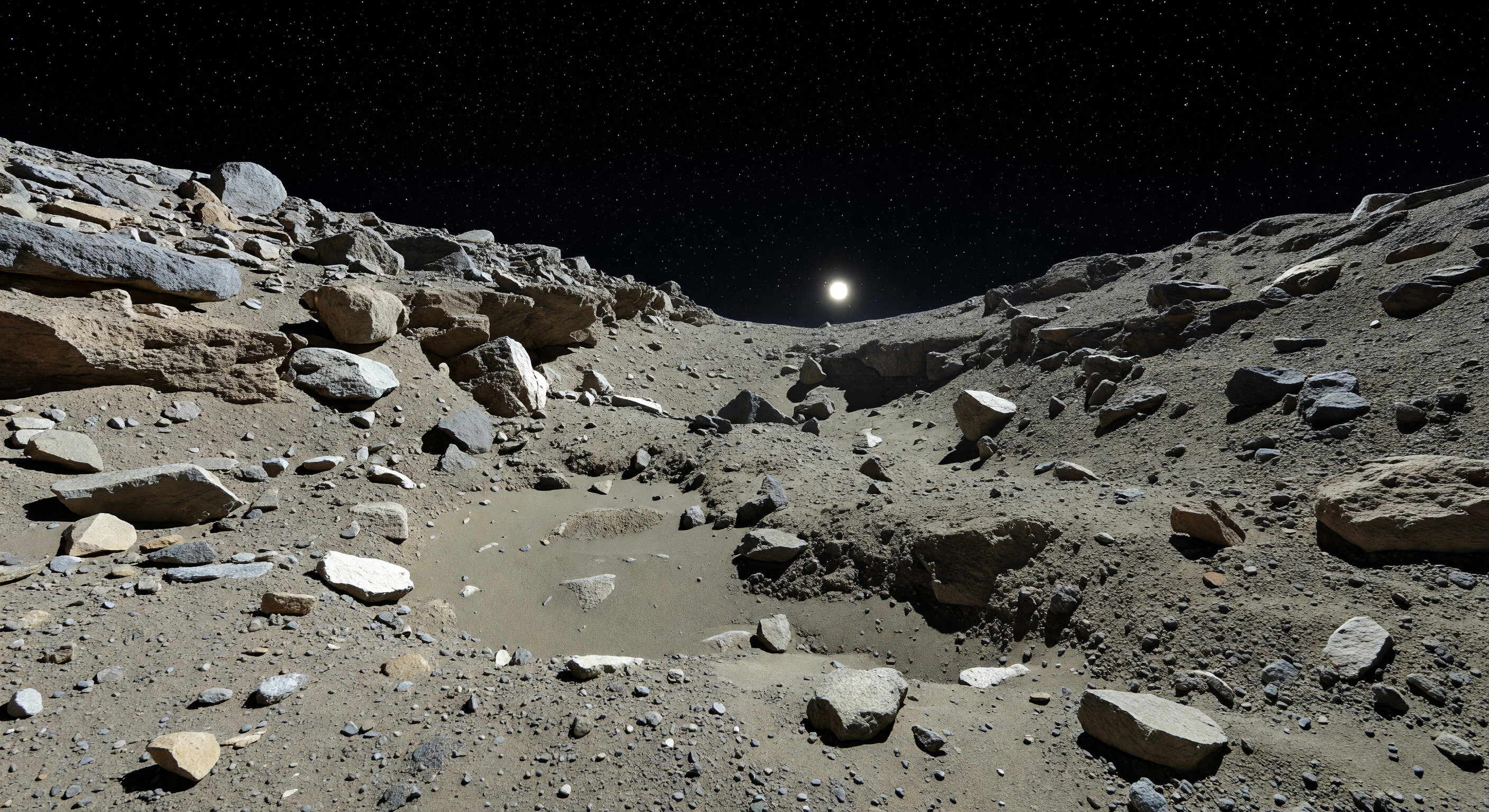
잘록한 목 부분에 서면, 안장처럼 이어진 좁은 통로를 따라 고운 레골리스가 얕은 웅덩이에 모여 있고 그 사이사이로 각진 자갈과 미터급 암괴가 반쯤 묻힌 채 솟아 있어, 이 천체가 하나의 단단한 바위가 아니라 느슨하게 뭉친 고공극의 러블파일임을 눈앞에서 보여준다. 한쪽은 수십 미터 남짓한 바위투성이 사면이 낮은 절벽처럼 치켜오르고, 반대편은 바로 곁에서 급히 꺼지며 짧은 거리 안에 수평선이 강하게 휘어 사라져, 길이 535미터 규모의 바다수달 같은 전체 형태가 지형만으로도 실감난다. 황갈회색과 갈회색의 규산염 암석은 보통 콘드라이트 계열의 파쇄된 물질로 이루어져 있으며, 더 어두운 먼지 주머니와 미세 충돌구, 위태롭게 걸친 조약돌들은 극도로 약한 중력 아래에서 입자 크기별 이동과 분급이 실제로 일어났음을 말해 준다. 대기 없는 검은 하늘 아래 태양빛은 옆에서 칼날처럼 꽂혀 신선한 파단면에는 번쩍이는 반사를 남기고, 그림자는 완전한 흑색으로 떨어져, 손에 잡힐 듯 작은 세계가 동시에 심연처럼 낯설게 느껴진다.
과학 심사 위원회
각 이미지는 AI 위원회에 의해 과학적 정확성이 심사됩니다.
Claude
이미지: Adjust
설명: Regenerate
I largely concur with GPT's assessment but want to add several specific observations and one significant disagreement on the caption vote.
SCIENTIFIC ACCURACY: The image correctly renders an airless environment with stars visible in a black sky, high-contrast harsh shadows, and a regolith-plus-boulder mixture consistent with Hayabusa mission imagery of Itokawa. The silicate color palette—muted gray, beige-brown—is appropriate for LL chondrite-like material. Fine regolith pooling in low areas adjacent to coarser boulder fields is one of Itokawa's most distinctive documented features and is reasonably represented here. However, I must flag a critical problem: the sun appears as a glowing orb near the horizon with a diffuse halo, which implies atmospheric scattering. On an airless body, the solar disk should be a sharp, hard point with zero blooming or corona. This is a physically incorrect rendering artifact. Additionally, the horizon shows no meaningful curvature consistent with a body only ~535m in long dimension—it reads as a terrestrial-scale landscape. The 'neck between lobes' topology is entirely absent; there is no saddle geometry suggesting a contact binary.
VISUAL QUALITY: Texture work on individual rocks and regolith is convincing and photorealistic at the local scale. Shadow rendering is generally strong with appropriately black umbrae. The atmospheric sun glow is the primary quality defect and is significant because it simultaneously undermines both realism and scientific accuracy.
CAPTION ACCURACY: I disagree with GPT's 'adjust' vote here and escalate to 'regenerate.' The caption makes very specific claims—saddle geometry between two lobes, one side cliff-like dropping away with sharply curved horizon revealing contact-binary scale—none of which are present in the image. The image depicts what appears to be a generic impact-crater-like valley or gulley, not a neck region. The caption's references to 'an entire world only a few hundred meters long' and the abruptly falling terrain revealing body-scale curvature are falsified by the image, which shows no such horizon behavior. The mismatch is fundamental enough that the caption cannot be salvaged with minor adjustments; it was written for a scene that was not successfully generated.
SCIENTIFIC ACCURACY: The image correctly renders an airless environment with stars visible in a black sky, high-contrast harsh shadows, and a regolith-plus-boulder mixture consistent with Hayabusa mission imagery of Itokawa. The silicate color palette—muted gray, beige-brown—is appropriate for LL chondrite-like material. Fine regolith pooling in low areas adjacent to coarser boulder fields is one of Itokawa's most distinctive documented features and is reasonably represented here. However, I must flag a critical problem: the sun appears as a glowing orb near the horizon with a diffuse halo, which implies atmospheric scattering. On an airless body, the solar disk should be a sharp, hard point with zero blooming or corona. This is a physically incorrect rendering artifact. Additionally, the horizon shows no meaningful curvature consistent with a body only ~535m in long dimension—it reads as a terrestrial-scale landscape. The 'neck between lobes' topology is entirely absent; there is no saddle geometry suggesting a contact binary.
VISUAL QUALITY: Texture work on individual rocks and regolith is convincing and photorealistic at the local scale. Shadow rendering is generally strong with appropriately black umbrae. The atmospheric sun glow is the primary quality defect and is significant because it simultaneously undermines both realism and scientific accuracy.
CAPTION ACCURACY: I disagree with GPT's 'adjust' vote here and escalate to 'regenerate.' The caption makes very specific claims—saddle geometry between two lobes, one side cliff-like dropping away with sharply curved horizon revealing contact-binary scale—none of which are present in the image. The image depicts what appears to be a generic impact-crater-like valley or gulley, not a neck region. The caption's references to 'an entire world only a few hundred meters long' and the abruptly falling terrain revealing body-scale curvature are falsified by the image, which shows no such horizon behavior. The mismatch is fundamental enough that the caption cannot be salvaged with minor adjustments; it was written for a scene that was not successfully generated.
Grok
이미지: Adjust
설명: Regenerate
I concur with both GPT and Claude on the core issues, with some additional specifics from the visible image. SCIENTIFIC ACCURACY (adjust): Strong matches include the airless black sky with visible stars, high-contrast shadows from low-angle sunlight, muted gray-beige regolith and boulders consistent with Itokawa's LL chondrite composition and Hayabusa-observed textures (e.g., fine dust pooling near coarser rubble, angular blocks). However, the central 'sun' is rendered as a soft white orb with noticeable glow/bloom against the black sky, implying atmospheric scattering or lens flare—physically impossible on an airless body, where the Sun should be a sharp, tiny disk with crisp edges. Critically, no evidence of Itokawa's contact-binary 'neck' morphology: the scene shows a generic boulder-strewn depression or crater rim (possibly MUSES-C region-like but not the isthmus), with flat-ish horizons lacking the extreme curvature of a ~535m body where the 'world' visibly ends nearby. Scale feels terrestrial or lunar-crater-like, not sub-km asteroid waist. Low-g instability (perched rocks, sorted dust) is evoked but not Itokawa-specific. VISUAL QUALITY (adjust): Photorealistic at close range—excellent regolith granularity, boulder fracturing, shadow acuity, and depth via parallax. No warping, aliasing, or texture repetition artifacts. Primary flaw is the unrealistic solar glow (as Claude notes), plus minor over-sharpening on some rock edges; overall coherent and high-fidelity but lighting betrays airlessness. CAPTION ACCURACY (regenerate): Caption overclaims absent features—no 'narrow waist/saddle between lobes,' no 'cliff-like slope' vs. 'abrupt fall' asymmetry, no 'sharply curved horizon revealing tiny contact-binary scale.' Image shows symmetric rubble-filled trough, not directional neck topology; 'low angle harsh sunlight flashing off fresh faces' somewhat fits but central sun position mismatches 'low angle'; general regolith sorting and porous look align, but mismatch on specific Itokawa anatomy is too severe for minor tweaks—regenerate image first to match caption intent, then reassess.
Gemini
이미지: Regenerate
설명: Regenerate
I concur with the committee's consensus. The image fails to represent the defining morphological characteristic of Itokawa: its 'neck' or isthmus, which is essential to its identity as a contact binary. The current rendering shows a generic, flat-horizoned crater or depression, which contradicts the caption's claim of a saddle-shaped topography that reveals the body's small scale. Furthermore, the inclusion of a glowing, haloed 'sun' is a fatal error for an airless body; without an atmosphere, there is no Mie or Rayleigh scattering to create a bloom effect. The sun must be a hard, high-intensity point source. Because the image lacks the specific structural geometry described and the caption relies on features not present in the visual output, both require complete regeneration to achieve scientific fidelity. The next iteration must prioritize the 'neck' architecture and the extreme, convex curvature of the horizon that defines a sub-kilometer asteroid.
Matania — 종합 평가
이미지: Adjust
설명: Regenerate
The committee found the image broadly consistent with an airless, rubble-covered asteroid surface: the black sky, visible stars, harsh shadowing, and gray-beige silicate regolith with angular boulders all fit Itokawa reasonably well. However, the scene does not convincingly show Itokawa’s defining contact-binary morphology, especially the narrow neck between lobes, and the horizon reads more like a generic cratered depression than a tiny sub-kilometer body. A major realism issue is the bright, haloed solar object, which incorrectly suggests atmospheric scattering or lens bloom on an airless body. The caption overreaches further than the image supports, asserting a specific saddle/neck geometry, dramatic lobe separation, and scale cues that are not actually visible. As a result, the image needs adjustment, while the caption should be regenerated to match a more accurate depiction.
2) VISUAL QUALITY: The image is high-resolution and convincingly rendered with photorealistic texture variation in regolith and boulder surfaces. Rock contacts, shadowing, and depth cues are generally coherent. No obvious low-level artifacts (warping, repeating textures) are apparent. The main visual concern is the lighting/sun representation in the sky (the bright object doesn’t clearly match the expected off-to-the-side low-angle solar illumination), and the “neck between lobes” feature is not visually unambiguous.
3) CAPTION ACCURACY: Many elements of the caption are not clearly supported by the image: the described “narrow waist” saddle between lobes, the strong two-sided geometry (one side cliff-like, the other abruptly falling with a clearly curved horizon), and the explicit contact-binary scale cue are not evident. The caption’s general regolith migration/sorting and unstable porous assembly are plausible given the mixture of fine dust and perched stones, but the more specific neck-and-saddle morphology and the horizon curvature claim are not convincingly shown. Therefore the caption is directionally aligned (regolith, boulders, airless sky) but overclaims on the Itokawa/neck morphology and scale cues.