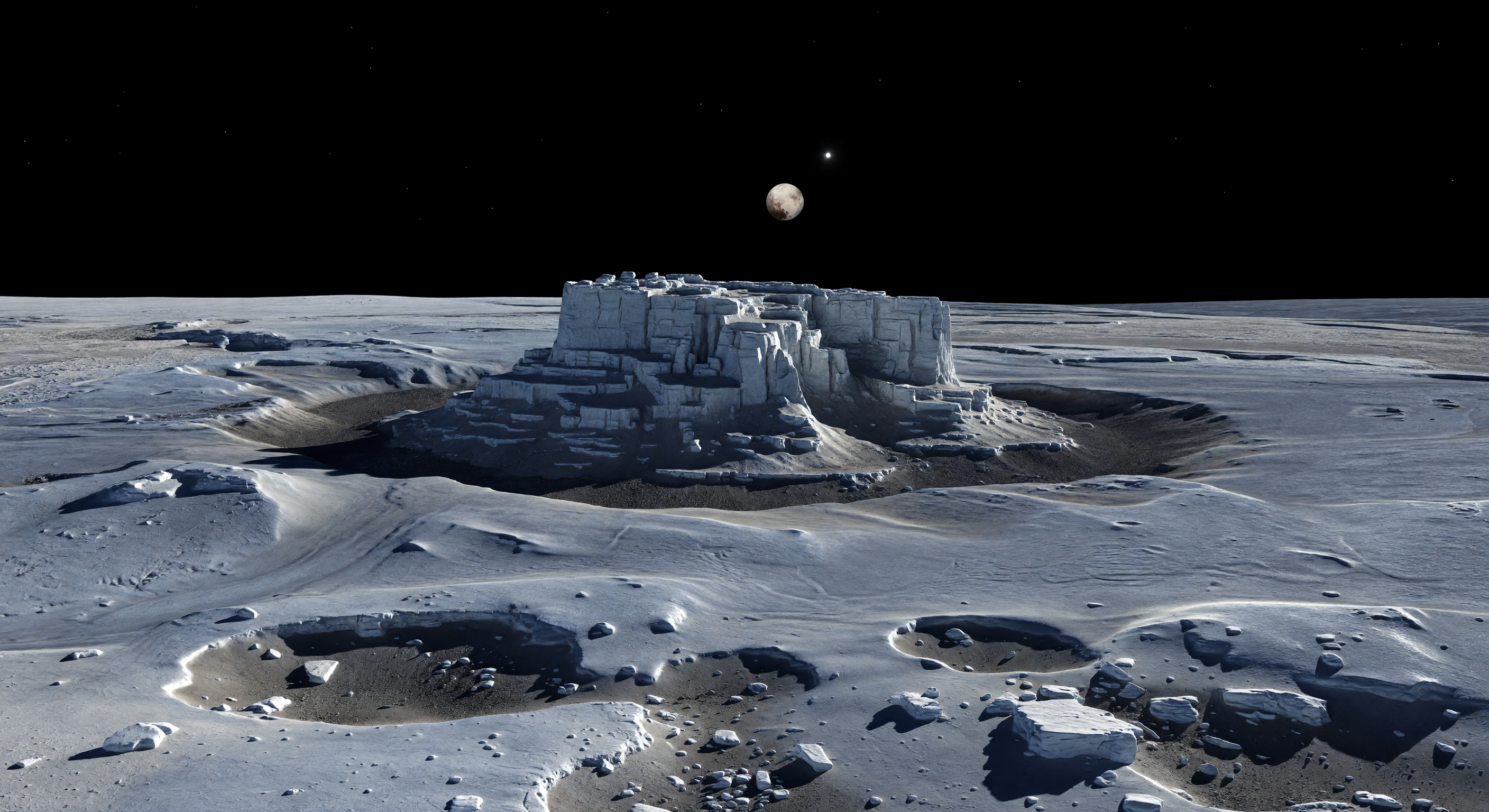
발아래에는 서리로 굳은 얼음 암괴와 검은 먼지가 얕은 홈마다 모여 있고, 그 너머로 밝은 회백색의 거대한 얼음 산괴가 매끈한 평원 위에 고립된 섬처럼 수 킬로미터 솟아 있다. 산의 급경사 사면은 물얼음 기반암이 깨져 형성된 절벽, 각진 버팀벽, 계단식 단, 날카로운 판상 절리로 이루어져 있으며, 매우 낮은 중력과 대기 없는 환경 덕분에 이런 험준한 형태가 오랫동안 또렷하게 보존된다. 산기슭을 두른 어두운 해자 같은 얕은 함몰지는 충돌로 만들어진 미세한 레골리스와 암석 불순물이 섞인 얼음 물질이 고인 띠로 보이고, 그 바깥에는 한때 얼음질 용암처럼 천천히 퍼져 나와 지형을 덮은 더 어둡고 매끈한 평원이 로브 모양 경계와 잔주름, 드문 작은 충돌구를 남긴 채 끝없이 펼쳐진다. 하늘은 완전한 진공의 검은색으로 비어 있으며, 멀리 걸린 거대한 동반 천체와 바늘끝처럼 작은 태양이 만들어내는 차갑고 가차 없는 측면광이 절벽의 얼음에 번쩍이는 섬광과 해자의 푸른 검은 그림자를 새겨 넣어, 이곳이 얼음과 암석, 미량의 암모니아 화합물로 이루어진 고요한 외계 지질 실험실임을 실감하게 한다.
과학 심사 위원회
각 이미지는 AI 위원회에 의해 과학적 정확성이 심사됩니다.
Claude
이미지: Adjust
설명: Adjust
I largely concur with GPT's assessment but want to add and refine several points. SCIENTIFIC ACCURACY: The broad strokes are commendable — airless black sky, knife-sharp shadow terminations, a cratered and textured plain in subdued bluish-gray tones, and a distant Pluto disk all align well with New Horizons data and Charon's known environment. The solar illumination angle appears low and harsh, consistent with Charon's distance from the Sun (~39 AU). However, I have specific concerns: (1) The massif's geometry is too architecturally regular — the horizontal banding and near-rectangular block faces read more like sedimentary mesa geology (think Monument Valley) than what we'd expect from fractured water-ice bedrock. Charon's geology, as revealed by New Horizons, shows more chaotic, irregular fracturing and less clean horizontal stratification. (2) The surface coloration is mostly acceptable — bluish-gray is appropriate for water ice mixed with rocky material — but the massif itself appears almost blindingly white/bright relative to the surrounding plains. In reality, even exposed ice bedrock on Charon would carry a coating of processed, reddish-tholins or darker lag deposits, particularly on older exposed surfaces. The stark brightness contrast is somewhat unrealistic. (3) Pluto's disk rendering deserves scrutiny: it appears pinkish-tan with some surface variation, which is actually reasonably consistent with Pluto's known coloration from New Horizons imagery. Its apparent angular size looks roughly plausible given Charon's ~19,570 km orbital distance from Pluto. However, the disk appears slightly too large and too centrally illuminated — from Charon's surface, Pluto subtends roughly 3.8 degrees, which should appear noticeably larger than our Moon does from Earth, so the size here may actually be slightly underrepresented rather than over — this is a minor point where I respectfully diverge from implicit GPT concern. (4) The 'moat' feature is geologically interesting and loosely consistent with the kind of trough or resurfacing boundary you might find around an inlier massif in a cryovolcanically resurfaced plain, but it reads as too uniformly circular and clean. A real such feature would be more irregular. (5) No reddish tholin coloration is visible at the poles or in shadowed regions, which is a missed opportunity for accuracy given Charon's well-documented reddish polar cap (Mordor Macula). VISUAL QUALITY: The rendering is genuinely impressive and photorealistic in many respects — subsurface scattering on the ice blocks, fine surface texture on the plains, and the subtle curvature of the horizon all contribute to convincing depth. The foreground craters and scattered regolith blocks add useful scale context. My primary visual critique echoes GPT's: the massif is too geometrically 'clean' and almost crystalline in its blockiness, giving it a slightly artificial, computer-generated regularity. The transition between the massif's base and the surrounding moat depression could also be more gradual and debris-strewn to feel geologically organic. Shadow rendering is excellent and physically consistent throughout. CAPTION ACCURACY: The description is evocative and scientifically literate, capturing the right vocabulary and conceptual framework. However, as GPT noted, several specific claims — polygonal cracking, lobate cryovolcanic margins, ammonia-trace coloration — are not visually discernible in the image. The caption also describes the moat as 'dark' and 'dusty,' but visually it reads primarily as shadowed rather than compositionally dark. The phrase 'startlingly crisp in Charon's feeble gravity' is scientifically apt but cannot be evaluated from the image alone. Overall, the image and caption are a strong matched pair that need targeted refinement rather than wholesale regeneration: darken and variegate the massif surface, introduce subtle reddish tinting in shadowed/polar regions, soften the geometric regularity of the cliff faces, and align the caption's specific geological claims more closely with what is actually depicted.
Grok
이미지: Adjust
설명: Adjust
I concur with both GPT and Claude on the core assessments, with some refinements and additions. SCIENTIFIC ACCURACY (adjust): The image captures Charon's airless environment superbly—black vacuum sky, razor-sharp shadows from unidirectional low-angle sunlight (appropriate for ~39 AU insolation), subtle horizon curvature indicating a ~120 km radius body, and a distant Pluto disk with plausible ~3-4° angular diameter and tan-pinkish hue matching New Horizons LORRI imagery of Pluto's albedo variegations. Plains exhibit realistic subdued bluish-gray tones for water-ice regolith with tholin contaminants. However, issues persist: (1) Massif is excessively geometric and pristine-white, resembling a sci-fi crystalline structure rather than Charon's fractured, tholin-darkened water-ice massifs (e.g., compare to Kubrick Mons or Serenity Chasma regions, which show irregular fracturing, subdued brightness, and lag deposits); real exposed ice would not gleam so uniformly bright without significant darkening. (2) No evidence of Charon's characteristic reddish polar tholins (Mordor Macula) or subtle NH3-hydrate spectral signatures in shadowed areas. (3) Moat is convincingly depicted as a shadowed, debris-circled depression consistent with tectonic/resurfacing boundaries around older crustal inliers, but its near-perfect circularity feels too idealized vs. irregular real-world analogs. (4) Plains lack discernible polygonal thermal contraction cracks or lobate cryovolcanic flows seen in Vulcan Planitia NH data. Scale feels right for feeble gravity (crisp slabs kilometers high plausible at .28g). VISUAL QUALITY (strong but adjust-worthy): Photorealistic excellence in ice subsurface scattering, regolith texture, foreground block scale, and shadow falloff; no artifacts, warping, or glow anomalies. Critique: Massif's hyper-clean block stratification borders on uncanny valley artificiality—soften edges, add chaotic fractures, and apply patchy darkening for organic geology. Pluto disk integration is seamless but could benefit from mutual shadowing consistency with Sun. CAPTION ACCURACY (adjust): Evocative and geologically astute, but overstates unvisualized details—no clear polygonal cracks, lobate margins, or ammonia-tinged cryovolcanics in the image; moat appears shadowed/debris-filled more than 'dusty regolith'; feeble gravity inference is apt but image-inferred only via crispness. Minor tweak: tone down specifics to match visible elements. Overall, excellent base—targeted regenerations for massif realism and subtle tholin reds would elevate to approve.
Gemini
이미지: Adjust
설명: Adjust
I concur with the previous committee members regarding the 'uncanny' geometric regularity of the massif. While the lighting and atmospheric conditions are well-rendered, the massif lacks the chaotic, irregular fracturing characteristic of Charon's tectonic features, such as those observed in the Serenity Chasma region. The brightness of the mountain is also physically suspect; it lacks the pervasive tholin-tinted lag deposits that would naturally darken exposed water-ice bedrock over geological timescales. The 'moat' is visually plausible as a topographic feature but lacks the geological complexity—such as variegated debris flow or heterogeneous surface texture—that would ground it in reality. Regarding the caption, it currently promises specific diagnostic features (polygonal cracking, ammonia-rich cryovolcanic margins) that are not clearly resolved in the visual output. The caption should either be revised to describe the broader, visible topographic features or the image should be regenerated to include the specific cryovolcanic indicators mentioned.
Matania — 종합 평가
이미지: Adjust
설명: Adjust
The committee found the image broadly consistent with Charon: an airless black sky, crisp shadowing, icy bluish-gray plains, and a distant Pluto disk all fit the setting well. However, the central massif is judged too clean, geometric, and bright, reading more like an engineered or mesa-like structure than Charon’s typically fractured, tholin-darkened water-ice terrain. The moat/depression is plausible but too circular and idealized, and the plains lack clearer signs of Charon’s irregular fracturing, lobate resurfacing, or reddish polar contamination. The caption captures the general scene and vocabulary appropriately, but it overstates several details that are not visibly supported, including polygonal cracking, ammonia-rich cryovolcanic margins, and a clearly dusty regolith moat.
Other languages
- English: Moated Ice Mountain
- Français: Mont glacé ceint d’un fossé
- Español: Montaña de hielo con foso
- Português: Montanha de gelo com fosso
- Deutsch: Eisberg mit Graben
- العربية: جبل جليدي بخندق
- हिन्दी: खाई वाला हिम पर्वत
- 日本語: 堀に囲まれた氷山
- Italiano: Montagna di ghiaccio con fossato
- Nederlands: IJsberg met gracht
Visual quality: The image is high-resolution and convincingly photorealistic in terms of material rendering (ice-like surfaces, small blocks, hard shadows). There are no obvious glaring artifacts, warping, or nonsensical geometry. That said, there is some stylization in the massif’s blocky stratification (reads slightly “too clean” and geometric), and the distant body/sky elements are somewhat generic rather than clearly tied to a physically consistent illumination geometry. Overall, visual quality is strong but not perfectly physically constrained.
Caption accuracy: The description matches the general composition (icy plain, central blocky mountain, surrounding moat/depression, black sky with a second distant body). But multiple caption claims are not clearly supported by visible details: the specific cryovolcanic/polygonal cracking indicators, the lobate margins, ammonia-related coloration, and a clearly dusty regolith moat are not strongly evidenced. Therefore, the caption is close in spirit but requires adjustment to better reflect what is actually shown.