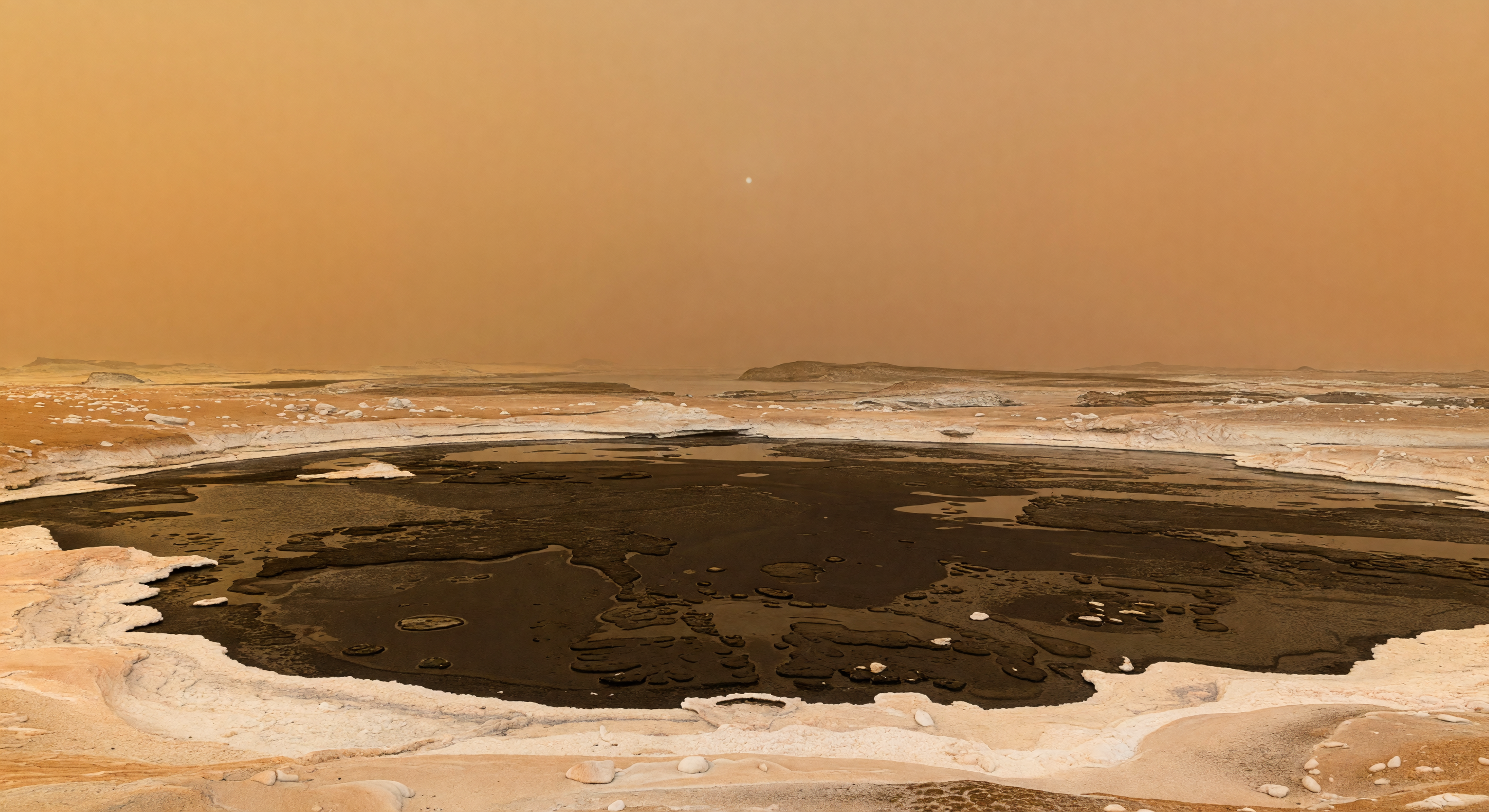
발아래에는 넓고 얕은 마른 호분이 펼쳐져 있고, 바닥은 짙은 갈색에서 거의 검은색에 이르는 유기물이 풍부한 진흙과 탄화수소 퇴적물로 덮여 있으며, 곳곳에서는 다각형으로 갈라진 마른 껍질과 낮은 능선, 얕은 물길 흔적이 희미하게 이어집니다. 그 가장자리를 두르는 밝은 크림색과 옅은 복숭아빛 띠는 한때 액체 메탄과 에탄이 고여 있다가 증발하며 남긴 증발암 퇴적층으로, 얼음처럼 보이지만 실제로는 극저온에서 석출된 탄화수소와 유기 화합물의 껍질입니다. 주변의 낮은 평원은 암석처럼 단단해진 물얼음 기반암 위에 주황갈색 대기 입자가 얇게 내려앉은 지형으로, 멀리서는 완만한 둔덕과 침식된 함몰지가 짙은 안개 속으로 녹아들며 엄청난 규모의 극지 호수 지대를 드러냅니다. 머리 위 하늘은 두꺼운 질소 대기와 광화학 연무 때문에 황갈색으로 탁하게 빛나고, 태양은 거의 보이지 않을 만큼 희미한 작은 원반에 불과해 그림자조차 흐릿합니다. 그 부드러운 꿀빛 아래서 밝은 증발암 고리는 무광택으로 은은히 빛나고, 어두운 호분 바닥은 빛을 삼켜 버려, 마치 낯선 바다가 물만 증발한 채 고요히 남아 있는 듯한 차갑고 비현실적인 정적을 느끼게 합니다.
과학 심사 위원회
각 이미지는 AI 위원회에 의해 과학적 정확성이 심사됩니다.
Claude
이미지: Adjust
설명: Adjust
I largely concur with GPT's assessment but want to add and refine several points. SCIENTIFIC ACCURACY: The broad chromatic palette is commendable — the butterscotch/amber sky, dark hydrocarbon-rich basin floor, and pale evaporite margins align well with Cassini VIMS data and theoretical models of Titan's polar lake basins (e.g., Ontario Lacus analogs). The diffuse, nearly shadowless lighting is one of the image's strongest scientific achievements, correctly conveying Titan's optically thick 1.5-bar nitrogen-haze atmosphere. The Sun rendered as a faint pinpoint blur rather than a resolved disk is appropriate given Titan's ~9.5 AU solar distance and haze opacity. However, I flag a concern GPT did not fully articulate: the water-ice 'bedrock' terrain in the middle and far distance reads as too Earth-like in texture — it resembles weathered sandstone or desert hardpan rather than the rounded, hummocky, aerially-smoothed ice terrain we'd expect from Titan's aeolian and cryogenic erosion regime. Ice at 94K behaves rheologically as rock, yes, but surface morphology should show softer, more rounded forms from methane rain erosion and organic drape, not the angular, layered cliff-face textures visible at the left margin. That left-side escarpment is a notable scientific concern — it suggests fluvial or tectonic layering more reminiscent of Earth's Colorado Plateau than Titan's relatively low-relief polar terrain. VISUAL QUALITY: The image is technically accomplished with no obvious AI tiling artifacts or compositing seams. The tonal gradients across the basin floor are convincing. My one addition to GPT's critique is that the evaporite crust coloring — bright white in places — may be slightly too high in albedo contrast; Cassini data suggests evaporite units are modestly brighter than surroundings but not starkly white, more of a muted cream-to-buff tone, which the image achieves in some areas but overshoots in the foreground right. CAPTION ACCURACY: The caption's invocation of 'polygonal crust plates' is the most significant mismatch — I see no clear polygonal tessellation on the basin floor, only smooth dark mud with irregular patchy lighter inclusions. The 'shallow channels' are marginally visible as faint linear features but are not prominent. The caption's prose is evocative and scientifically literate, but it front-loads specific sedimentological detail that the image only partially delivers. Recommend revising caption to de-emphasize polygonal cracking and channel morphology, while strengthening language around the smooth evaporite band and the diffuse illumination, which the image does depict convincingly. Overall: a strong candidate image requiring targeted geological texture refinement and caption realignment rather than full regeneration.
Grok
이미지: Adjust
설명: Adjust
I concur with both GPT and Claude's assessments on the core strengths—excellent Titanian color palette (orange-brown haze, dark organic basin, pale evaporite margins), diffuse shadowless lighting from the hazy 1.5-bar N2 atmosphere, and faint solar blur at ~9.5 AU, all aligning with Cassini RADAR/VIMS data for polar evaporite basins like those near Ontario Lacus. The central dark mudflat with subtle pitting and irregular patches evokes cryogenic wetting-drying cycles effectively. However, adding to their points: SCIENTIFIC ACCURACY issues persist in (1) no distinct polygonal crust plates or clear shallow channels on the basin floor—visible textures are smoother mud with faint linears, not the emphasized cracking; (2) the pale evaporite forms a partial ring/rim but lacks coherent shoreline terraces, appearing more as irregular bright margins; (3) distant water-ice plains show overly angular, layered escarpments (e.g., left side) inconsistent with Titan's low-relief, hummocky, aeolian-smoothed ice morphology at 94K; scale feels vast but lacks polar-flat emptiness due to prominent midground hummocks. VISUAL QUALITY is photorealistic with seamless gradients, no artifacts, but evaporite albedo is too starkly white in foreground patches (should be muted cream/beige per VIMS spectra). CAPTION ACCURACY overstates polygons, channels, and ring coherence not prominently shown; it nails atmosphere/lighting/scale vibe. Constructive: approve with tweaks to soften ice textures to rounded hummocks, add subtle polygons/channels, tone down evaporite brightness, and revise caption to 'irregular pale evaporite margins with faint polygonal mud cracks and linear traces' for better match. No need to regenerate—strong base image.
Gemini
이미지: Adjust
설명: Adjust
I concur with the previous committee members regarding the high quality of the atmosphere and lighting, which successfully capture the 'Huygens' aesthetic. However, I must emphasize a critical geological oversight: the 'water-ice bedrock' is rendered with terrestrial sedimentary stratification (like shale or sandstone) rather than the rounded, softened 'hummocky' morphology typical of Titan's cryosphere. At 94K, water ice does not fracture into sharp, angular, multi-layered escarpments; it undergoes viscous relaxation and aeolian infilling. Furthermore, the 'polygonal crust'—a hallmark of desiccation in hydrocarbon evaporites—is visually absent, appearing instead as indistinct mottled terrain. The evaporite margins are also too high-contrast; they should appear as muted, dust-coated buff tones rather than stark, bright white patches. I recommend an adjustment to the texture maps to replace sharp angularity with soft, rounded hummocks and to add a subtle tessellated (polygonal) overlay to the basin floor. The caption must be reined in to describe 'irregular evaporite margins' rather than a 'striking ring,' as the current image lacks the geometric coherence of a true shoreline terrace system.
Matania — 종합 평가
이미지: Adjust
설명: Adjust
The committee found the image broadly and convincingly Titan-like in color and lighting: the orange-brown haze, diffuse shadowless illumination, dark basin floor, and pale evaporite margins all align well with Titan polar basin imagery. The scene is technically strong and visually coherent, with no obvious artifacts. However, multiple reviewers agreed that the geology is under-specified or slightly overstated in the rendering. The basin does not clearly show polygonal cracking, distinct shallow channels, or a coherent evaporite ring/shoreline terrace system; instead it reads more as irregular bright margins around smoother dark deposits. Several members also flagged the distant terrain as too Earth-like, with angular, layered escarpments and stratified cliff textures that are inconsistent with Titan's expected rounded, hummocky, cryogenically softened ice morphology. The caption similarly overclaims specific geomorphic features not clearly visible in the image.
Other languages
- English: Empty Evaporite Basin
- Français: Bassin évaporitique désert
- Español: Cuenca evaporítica vacía
- Português: Bacia evaporítica vazia
- Deutsch: Leeres Evaporitbecken
- العربية: حوض تبخري خاوٍ
- हिन्दी: सूना वाष्पीभूत बेसिन
- 日本語: 空の蒸発岩盆地
- Italiano: Bacino evaporitico vuoto
- Nederlands: Leeg evaporietbekken
Visual quality: The image is high-resolution, coherent, and aesthetically realistic—no obvious compositing artifacts. Terrain transitions (dark liquid/mud to pale crust) are believable. Minor concerns: the evaporite layer looks somewhat unnaturally uniform in places and the “shoreline/terrace” story is only partially conveyed by the bands and edges.
Caption accuracy: The caption generally matches the broad concept (empty evaporite basin, dark hydrocarbon-rich low area, pale surrounding deposits, Titan-like atmospheric haze). But because the specific geological motifs—distinct evaporite ring, pronounced polygons/pits, and clear shallow channels—are not strongly evident, the caption likely over-specifies compared to what’s actually depicted. Adjust the wording to reflect the smoother, banded evaporite margins and less-emphasized cracking/channel textures.