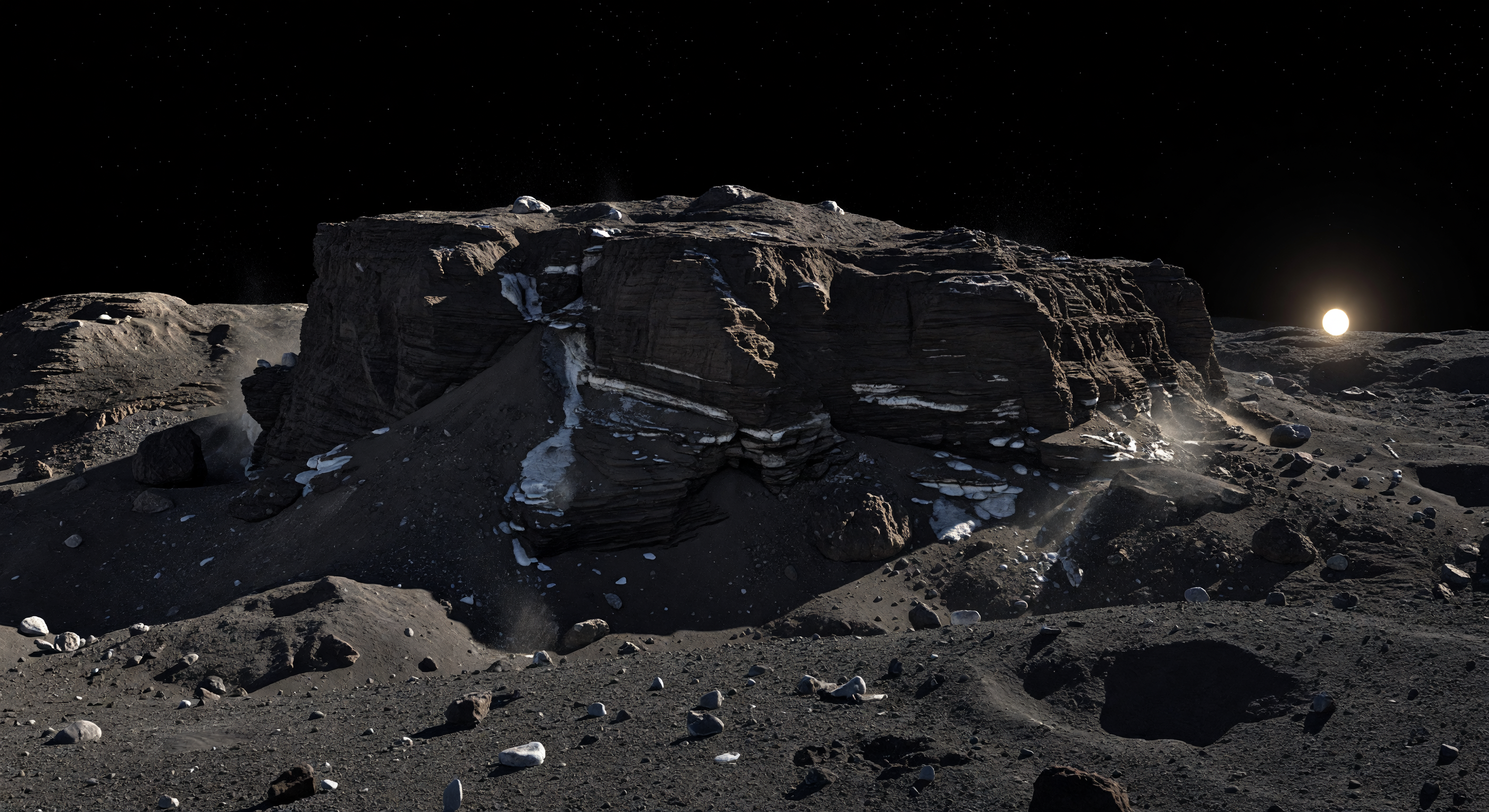
검고 숯빛을 띠는 거대한 절벽이 낮게 비껴드는 햇빛을 받아 층층의 단면을 드러내고, 무너져 내린 신선한 붕괴면에서는 어두운 유기질 먼지 껍질 아래 숨어 있던 더러운 흰빛과 옅은 푸른빛의 얼음 자국이 가늘게 번뜩입니다. 발아래에는 검은 미세 레골리스와 부서진 각력 조각, 드문드문 박힌 미터급 바위, 움푹한 얕은 구덩이가 이어지고, 거의 공기가 없는 진공과 극도로 약한 중력 때문에 그림자는 칼날처럼 선명하며 절벽 아래는 빛이 닿지 않는 완전한 암흑으로 가라앉습니다. 이 층상 절벽은 다공성의 얼음-먼지 혼합체가 반복적인 가열과 승화, 붕괴를 겪으며 쌓아 올린 내부 구조를 보여 주는 창문으로, 표면의 매우 낮은 반사율은 휘발성 물질이 빠져나간 뒤 남은 검은 유기물성 껍질을 시사합니다. 가까이 굽은 지평선과 새어나오는 듯한 희미한 가스-먼지 분출, 햇빛 가장자리에 금빛으로 테두리진 능선을 바라보고 있으면, 작은 핵 전체가 아직도 천천히 숨 쉬며 스스로의 표면을 바꾸는 살아 있는 잔해처럼 느껴집니다.
과학 심사 위원회
각 이미지는 AI 위원회에 의해 과학적 정확성이 심사됩니다.
Claude
이미지: Adjust
설명: Adjust
I largely concur with GPT's assessment but want to add several specific observations and one respectful disagreement.
SCIENTIFIC ACCURACY: The surface albedo is actually one of the stronger elements here. 9P/Tempel 1 has a geometric albedo of roughly 0.056, making it one of the darkest objects in the Solar System, and the granular plains in this image are genuinely very dark — perhaps slightly too blue-gray rather than the warm charcoal-brown documented by Deep Impact and Stardust-NExT, but acceptably close. The icy/frost exposures as narrow streaks on cliff faces are scientifically well-motivated: Deep Impact confirmed localized regions of exposed water ice, and their depiction here as thin irregular veins on fresh slump scarps is more accurate than the typical 'snow-dusted' rendering seen in amateur art. The low, hard Sun producing a black sky is correct for cometary vacuum conditions. My primary scientific concern, which I feel GPT underweighted, is gravity and morphology: in 9P/Tempel 1's gravity (~0.00017 m/s²), this cliff face is problematically steep and tall. Cliffs of this apparent scale would be structurally implausible given the extremely low cohesion and compressive strength of cometary material — the structure looks too Earth-like in its verticality and integrity. Additionally, there is NO visible sublimation activity whatsoever. This is described as a sunrise scene where 'buried volatiles are beginning to sublimate,' yet not a single wisp, jet, or dust haze is present. For a comet at perihelion approach, this is a significant omission.
VISUAL QUALITY: The rendering quality is high and largely convincing. Texture work on the cliff strata is genuinely impressive, and the granular regolith with scattered angular blocks reads as physically plausible. The frost patches are bright but not unreasonably so given fresh exposure. I disagree slightly with GPT's criticism that the scene looks 'composited' — I find the integration of terrain elements fairly coherent. The Sun's rendering as a small but intense point source on the horizon is correct for a body at ~1.5 AU. The shadow terminator is sharp and appropriate for vacuum.
CAPTION ACCURACY: The caption's claim of 'absolute black shadow' is not met — shadow regions retain noticeable detail and ambient fill, which is physically incorrect in the absence of atmosphere. The described 'terrace-like layers by collapse and erosion' are somewhat visible but read more as sedimentary banding than collapse terraces. The description of escaping gas wisps is entirely absent from the image. The caption is evocative and scientifically literate but promises more dynamic and morphologically specific content than the image delivers.
SUMMARY: The image is a strong artistic foundation that captures albedo, lighting, and general texture well. The two most actionable fixes are (1) introducing at minimum faint sublimation jets or dust hazes from sunlit fractures, and (2) softening/slumping the cliff geometry to better reflect low-cohesion cometary material under micro-gravity. I vote 'adjust' on both counts rather than 'regenerate' because the core scientific aesthetic is sound.
SCIENTIFIC ACCURACY: The surface albedo is actually one of the stronger elements here. 9P/Tempel 1 has a geometric albedo of roughly 0.056, making it one of the darkest objects in the Solar System, and the granular plains in this image are genuinely very dark — perhaps slightly too blue-gray rather than the warm charcoal-brown documented by Deep Impact and Stardust-NExT, but acceptably close. The icy/frost exposures as narrow streaks on cliff faces are scientifically well-motivated: Deep Impact confirmed localized regions of exposed water ice, and their depiction here as thin irregular veins on fresh slump scarps is more accurate than the typical 'snow-dusted' rendering seen in amateur art. The low, hard Sun producing a black sky is correct for cometary vacuum conditions. My primary scientific concern, which I feel GPT underweighted, is gravity and morphology: in 9P/Tempel 1's gravity (~0.00017 m/s²), this cliff face is problematically steep and tall. Cliffs of this apparent scale would be structurally implausible given the extremely low cohesion and compressive strength of cometary material — the structure looks too Earth-like in its verticality and integrity. Additionally, there is NO visible sublimation activity whatsoever. This is described as a sunrise scene where 'buried volatiles are beginning to sublimate,' yet not a single wisp, jet, or dust haze is present. For a comet at perihelion approach, this is a significant omission.
VISUAL QUALITY: The rendering quality is high and largely convincing. Texture work on the cliff strata is genuinely impressive, and the granular regolith with scattered angular blocks reads as physically plausible. The frost patches are bright but not unreasonably so given fresh exposure. I disagree slightly with GPT's criticism that the scene looks 'composited' — I find the integration of terrain elements fairly coherent. The Sun's rendering as a small but intense point source on the horizon is correct for a body at ~1.5 AU. The shadow terminator is sharp and appropriate for vacuum.
CAPTION ACCURACY: The caption's claim of 'absolute black shadow' is not met — shadow regions retain noticeable detail and ambient fill, which is physically incorrect in the absence of atmosphere. The described 'terrace-like layers by collapse and erosion' are somewhat visible but read more as sedimentary banding than collapse terraces. The description of escaping gas wisps is entirely absent from the image. The caption is evocative and scientifically literate but promises more dynamic and morphologically specific content than the image delivers.
SUMMARY: The image is a strong artistic foundation that captures albedo, lighting, and general texture well. The two most actionable fixes are (1) introducing at minimum faint sublimation jets or dust hazes from sunlit fractures, and (2) softening/slumping the cliff geometry to better reflect low-cohesion cometary material under micro-gravity. I vote 'adjust' on both counts rather than 'regenerate' because the core scientific aesthetic is sound.
Grok
이미지: Adjust
설명: Adjust
I agree with both GPT and Claude on the core issues: the image captures a convincingly dark, organic-rich surface (albedo ~.04-.06, matching Tempel 1's Deep Impact data), low curved horizon, black vacuum sky with sparse stars, and hard-edged solar lighting from a small, low Sun at ~1.5 AU, all scientifically spot-on. Exposed icy streaks/frost on slump scars align well with observed water ice exposures (e.g., 1-2% by area, bluish-white in spectra). However, adding to Claude's gravity critique, the ~100m cliff is implausibly vertical and cohesive for Tempel 1's ~10^3 Pa strength and 1.5x10^-4 m/s² gravity—real scarps slump to ~30-50° angles (Stardust-NExT imagery shows rounded, low-relief mounds, not sheer terraces). No visible sublimation jets/wisps from sunlit fractures, critical for a 'sunrise' active comet near perihelion (Deep Impact saw 10-20 active spots with ~1-10 m/s outflows). Shadows aren't 'absolute black'—detail visible due to insufficient contrast/depth in vacuum (no scatter).
VISUAL QUALITY: Photorealistic high-res render with excellent granular regolith, angular blocks 'floating' low-g style, and coherent strata textures—no major artifacts. Minor nit: frost patches slightly too crisp/bright (should be faint, translucent); Sun glow has subtle lens flare unrealistic for vacuum.
CAPTION ACCURACY: Mismatch on scale/morphology (terraces not sheer/100m), absent gas drift, and shadow depth; icy streaks match but lack 'dirty-white to faint bluish' subtlety.
Constructive: Adjust cliff to slumped benches (~45° max, crumbly), add 2-3 faint curved dust/gas plumes from sunlit cracks (velocity ~1 m/s upward), deepen base shadows to pure black, warm dark surface to charcoal-brown (less blue-gray). Strong base—'adjust' not 'regenerate'.
VISUAL QUALITY: Photorealistic high-res render with excellent granular regolith, angular blocks 'floating' low-g style, and coherent strata textures—no major artifacts. Minor nit: frost patches slightly too crisp/bright (should be faint, translucent); Sun glow has subtle lens flare unrealistic for vacuum.
CAPTION ACCURACY: Mismatch on scale/morphology (terraces not sheer/100m), absent gas drift, and shadow depth; icy streaks match but lack 'dirty-white to faint bluish' subtlety.
Constructive: Adjust cliff to slumped benches (~45° max, crumbly), add 2-3 faint curved dust/gas plumes from sunlit cracks (velocity ~1 m/s upward), deepen base shadows to pure black, warm dark surface to charcoal-brown (less blue-gray). Strong base—'adjust' not 'regenerate'.
Gemini
이미지: Adjust
설명: Adjust
I concur with the committee's consensus. The image possesses high visual fidelity but fails to reconcile the structural reality of a cometary nucleus with terrestrial geological tropes. Specifically, the '100-meter cliff' is geotechnically impossible for a porous, low-cohesion body like 9P/Tempel 1, which typically exhibits rounded, low-relief features rather than sheer, Earth-like vertical faces. The lighting is the most significant scientific failure; in a vacuum, the absence of atmospheric scattering dictates that shadows should be 'void-black' with no fill, yet the image shows significant light leakage into the base of the cliff. Furthermore, the total absence of sublimation-driven activity (jets or dust comae) contradicts the 'sunrise/active' premise of the caption. To bring this to a 'scientific grade' level, the cliff must be re-sculpted into a slumped, granular slope with a repose angle consistent with micro-gravity, the shadows must be crushed to absolute black, and faint, wispy outgassing must be rendered as a subtle haze emanating from the sun-exposed fracture lines.
Matania — 종합 평가
이미지: Adjust
설명: Adjust
The committee found the image scientifically promising and visually strong, with a convincing dark cometary surface, hard solar lighting, exposed icy/frosty streaks, and generally plausible regolith texture for 9P/Tempel 1. However, the morphology reads too terrestrial and too structurally intact for Tempel 1’s microgravity and weak cohesion: the cliff is overly sheer and Earth-like rather than slumped and low-relief. The scene also lacks the expected sublimation-driven activity for a sunrise comet surface, and the shadow regions are not deep enough to be physically convincing in vacuum. The caption is directionally correct in mood and broad setting, but it overstates details not clearly present, especially the terrace-like cliff geometry, the near-vertical scale, and the escaping gas wisps. Overall verdict: strong base concept, but both image and caption need refinement to better match cometary science.
Other languages
- English: Layered Cliff at Sunrise
- Français: Falaise stratifiée à l’aube
- Español: Acantilado estratificado al alba
- Português: Escarpa em camadas ao amanhecer
- Deutsch: Geschichtete Klippe im Morgenrot
- العربية: جرف طبقي عند الفجر
- हिन्दी: स्तरीय चट्टान प्रभात में
- 日本語: 夜明けの層状断崖
- Italiano: Falesia stratificata all’alba
- Nederlands: Gelaagde klif bij zonsopgang
2) VISUAL QUALITY: The image is high-resolution and largely photorealistic for an artistic planetary render. Terrain scale and texture (granular regolith, angular blocks) look plausible, and there are no obvious gross artifacts or inconsistent geometry. That said, some elements look slightly “composited” or overly crisp: the frost patches are very bright and neatly shaped, and the “gas drift” is ambiguous/weak. The overall realism would improve if sublimation features were more physically tied to sunlit fractures (thin jets/fine dust) and if shadow depth matched the described “hard light” effect more strongly.
3) CAPTION ACCURACY: The caption matches the general comet aesthetic (dark surface, exposed icy material, vacuum black sky). But it over-commits to details that are not clearly shown: (a) the explicit ~100 m nearly vertical cliff with obvious terrace-like layers is not clearly evident, and (b) active sublimation producing upward drifting grains/gas is not clearly captured. The frost-like streaks/polished slump scars are partly present, but the described process and specific morphology are stronger in the text than in the image.
Overall: Good core concept and lighting, but the geological morphology (terrace-like cliff) and activity depiction (escaping gas) are not sufficiently supported by what’s visible.