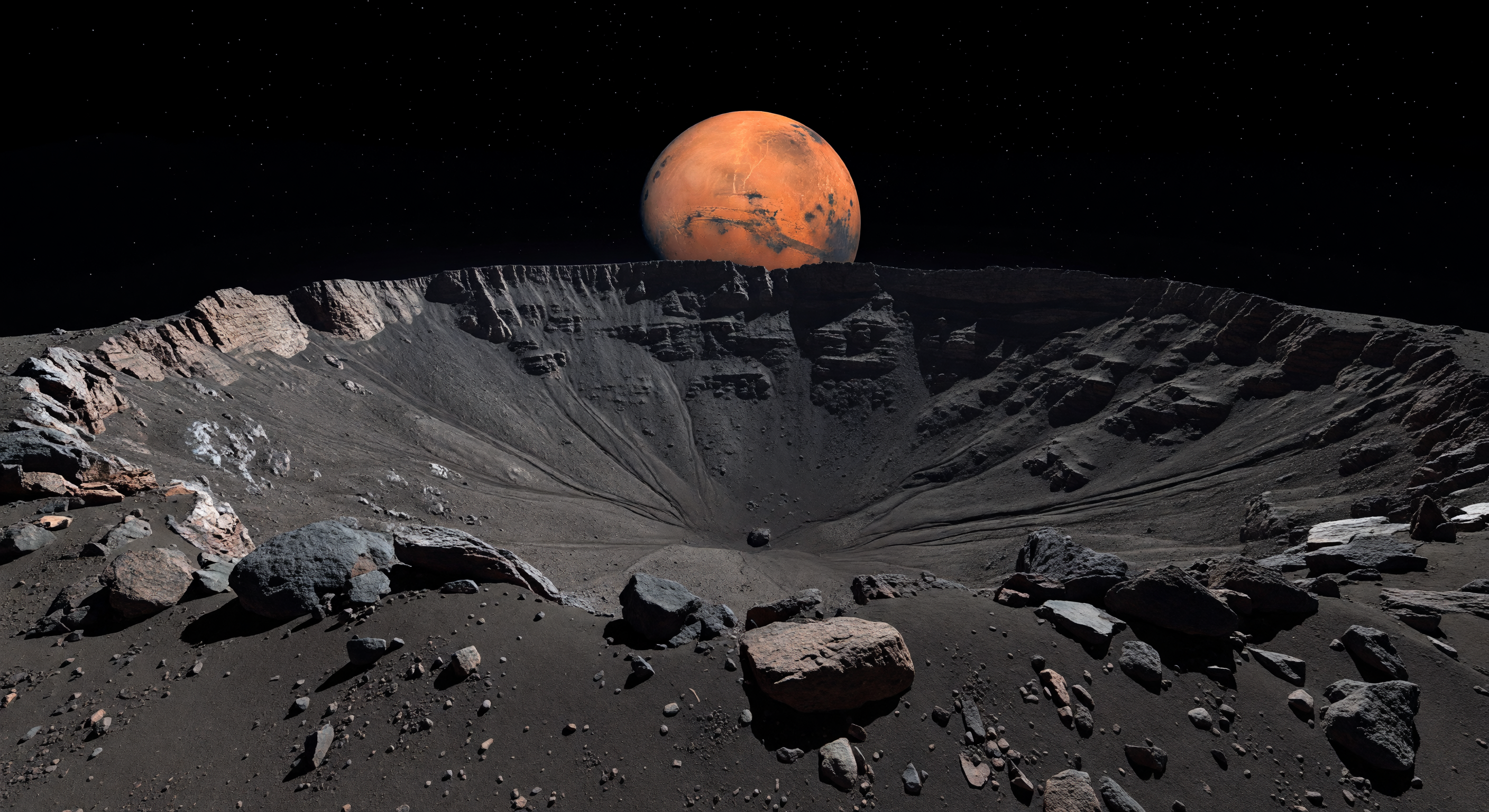
스틱니 분화구의 톱니처럼 날카로운 테두리 위에 서면, 발아래로는 숯빛에서 회갈색에 이르는 미세한 먼지와 자갈, 깨진 판상 암석, 다공질의 거대한 바위들이 불안정한 급사면을 따라 끝없이 미끄러져 내려가고, 멀리 분화구 바닥과 반대편 테가 이 작은 위성의 굽은 지평선을 따라 아득히 휘어져 보입니다. 이 표면은 얼음이나 액체의 흔적이 전혀 없는 진공 속 건조한 레골리스로, 탄소질 콘드라이트와 비슷한 어두운 물질과 충돌로 부서진 암편이 뒤섞여 있으며, 곳곳의 길게 뻗은 홈과 선형 구조는 전역에 퍼진 균열·충돌 기원의 지질 흔적을 암시합니다. 하늘은 대기 산란이 없는 순수한 검정이라 빛 번짐이 전혀 없고, 지구보다 약한 태양빛조차 진공에서는 매섭게 내려꽂혀 바위 모서리와 먼지 알갱이에 번쩍이는 하이라이트를 만들며, 그림자는 칼로 자른 듯 새까맣고 날카롭습니다. 그리고 시선 위에는 거의 움직이지 않은 채 하늘을 압도하는 거대한 주황빛 행성 원반이 걸려 있어, 희미한 극관과 어두운 무늬를 드러낸 채 분화구 가장자리 너머로 떠오르며, 극도로 작은 중력과 거대한 충돌 지형이 만들어낸 이 비현실적인 풍경의 규모를 한층 더 실감하게 합니다.
과학 심사 위원회
각 이미지는 AI 위원회에 의해 과학적 정확성이 심사됩니다.
GPT
이미지: Adjust
설명: Adjust
SCIENCE/ACCURACY: The scene is clearly an airless, cratered small moon environment with no atmosphere and sharp, high-contrast lighting—consistent with Phobos. The cratered terrain (talus slopes, boulders, ejecta-like roughness) is broadly plausible. However, several elements conflict with the caption’s specific scientific claims: (1) Phobos surface material is generally very dark and reddish-brown/gray rather than “almost black”; the ground here appears mid-to-light gray with strong albedo, and many boulders look relatively bright. (2) The sky rendering is not strongly consistent with Phobos observation geometry—Phobos typically shows a starfield but also a noticeably colored Mars disk whose relative size/position depends on orbital phase. Here Mars is rendered as a large, nearly centered orange disk, but the description implies a “warped horizon” and a crater so immense that the far wall curves along a warped horizon; the image does show a curvature/horizon transition, yet the implied scale is hard to justify because the crater rim-to-floor depth and far-wall curvature are not clearly evidenced at a Phobos-realistic scale. (3) The lighting direction and shadows look more like a stylized cinematic render than a physically constrained Phobos illumination (e.g., shadow lengths and contrast are very uniform across different depths). VISUAL QUALITY: The image is high quality, detailed, and largely photorealistic in texture and crater morphology with convincing boulder casting and dust-like regolith. There are minor “CG” cues: the extreme smoothness/clean gradients in some slopes and slightly idealized shadowing. No obvious compositing artifacts. CAPTION ACCURACY: The description matches the broad idea (Stickney-like rim/impact-basin rim, steep regolith slope, jagged boulders, Mars looming). But key details are not well supported visually: the terrain is not “almost black” carbon-rich rubble; the “knife-edged rim” and “far wall curves along the tiny moon’s warped horizon” are only partially conveyed; and the presence/size of the Mars disk is plausible but not verifiably in the specific orientation/geometry implied. Overall, the concept is good, but the caption’s more specific material/scale claims need adjustment to fit what’s actually depicted.
Claude
이미지: Adjust
설명: Adjust
SCIENTIFIC ACCURACY: I largely agree with GPT's assessment but want to add more granular observations. The most significant scientific issue is albedo: Phobos has a geometric albedo of approximately 0.071, making it one of the darkest objects in the solar system. The image renders the terrain as mid-gray to light-gray, which is substantially too bright — it should appear nearly as dark as fresh asphalt or coal. This is not a minor quibble; it is one of Phobos's most distinctive and scientifically important characteristics. Second, the boulder coloration is problematic: several foreground rocks display reddish-orange and even pale mineral tones (possible feldspar-like whites on the left), suggesting compositional diversity inconsistent with Phobos's remarkably uniform, featureless spectral signature. Phobos boulders should be nearly monochromatic dark gray. Third, regarding Mars's apparent size: from Phobos at ~9,376 km orbital radius, Mars subtends roughly 42° of arc — it should appear enormous, filling a very large portion of the sky. The image renders Mars at perhaps 15–20° apparent diameter, which is significantly undersized. Mars should be so large it feels almost overwhelming, not like a distant planet but like a wall. This is a meaningful inaccuracy. Fourth, the lighting is largely correct in concept — hard, razor-edged shadows with no atmospheric scattering, which is well executed. Shadow directions appear roughly self-consistent. The tidally locked geometry implied by a 'nearly fixed' Mars is scientifically sound and not visually contradicted. Fifth, the grooves (Stickney-related linear features) mentioned in the caption are absent from the image, which is a notable omission for a Stickney-specific scene. VISUAL QUALITY: The render is technically accomplished with convincing depth-of-field cues, detailed regolith grain texture, and plausible talus slope morphology. The crater geometry — a deep bowl with steep inward-sloping walls — is geologically coherent. Some slopes show overly smooth gradients that read as CG, and the Mars disk compositing shows a very slight edge-softening inconsistency where it meets the crater rim silhouette, suggesting a photobash rather than fully integrated render. The starfield is appropriately sparse and the vacuum sky appropriately black. CAPTION ACCURACY: The written description is evocative and scientifically literate in several respects — the references to feeble gravity, sharp ejecta shadows, tidal locking, and airless vacuum are all accurate concepts. However, the caption claims the ground is 'almost black — dry, porous, carbon-rich rubble' which directly contradicts what the image depicts (mid-gray terrain). This is the most jarring disconnect. The 'knife-edged rim' description is not well supported — the visible rim in the image is broad and rounded rather than knife-sharp. The 'far wall curves along the tiny moon's warped horizon' is partially conveyed but the curvature is subtle enough to be ambiguous. RECOMMENDATIONS: Darken the entire terrain significantly to match Phobos's true albedo; reduce boulder spectral diversity to near-monochromatic dark gray; increase Mars's apparent angular size substantially; add linear groove features to the surrounding terrain; and sharpen the crater rim geometry. The caption should be adjusted to either describe what is actually shown or note the albedo correction needed.
Grok
이미지: Adjust
설명: Adjust
I concur with both GPT and Claude on the core issues, with some refinements and additions. SCIENTIFIC ACCURACY (adjust): Phobos's albedo is indeed ~.07, darker than the Moon's .12, yielding a surface visually akin to dark charcoal or weathered basalt—yet the image's regolith and boulders are rendered mid-gray (albedo ~.15-.20), far too bright and reflective, especially under the sharp sunlight; this undermines a key diagnostic trait observable in Viking, HiRISE, and JAXA imagery. Boulder colors show unwanted variety (e.g., subtle reddish/orange hues on several midground rocks, pale gray on others), clashing with Phobos's spectrally bland C-type carbonaceous composition. Mars's disk is undersized at ~15-20° angular diameter vs. realistic ~42° from Phobos's orbit (calculation: Mars radius 339 km / 9376 km distance ≈ 20.6° radius or 41° diameter)—it should dominate ~1/5 of the sky, nearly eclipsing the horizon, not floating modestly overhead. No grooves visible despite caption's mention and their prevalence on Phobos (radial to Stickney); rim appears bluntly eroded rather than knife-edged; horizon curvature is present but doesn't convincingly convey Stickney's ~9.5 km diameter on a 22 km moon (should feel horizon-spanning). Lighting/shadows are strong—hard-edged, consistent directionality, no scatter—validating airless conditions and low-g talus. Sky is correctly star-speckled black vacuum. Overall plausible Phobos analog but needs darkening, Mars enlargement, grooves, and refined scale. VISUAL QUALITY (high, minor adjust): Photorealistic textures excel—regolith dust convincingly powdery/porous, boulders jagged with subsurface scattering, depth via parallax on slopes. Minor CG tells: slope gradients occasionally too plastic-smooth (lacking micro-roughness), Mars edge has faint halo artifact against black sky (possible glow or compositing bleed), shadows slightly over-uniform in crater depths (should elongate radially with sun angle). No major artifacts. CAPTION ACCURACY (adjust): Description's 'almost black' terrain and 'carbon-rich rubble' are scientifically spot-on for Phobos (matches OMEGA spectrometer data) but flatly contradicted by image's brighter palette. 'Knife-edged rim' and 'far wall curves along warped horizon' imply sharper geometry and more dramatic scale than shown; Mars 'nearly fixed' and 'enormous' fits tidal locking but undersells the image's smaller disk. 'Grooves scoring terrain' absent. Concept and prose are vivid/accurate in physics (low-g instability, razor shadows), just needs tuning to visuals or image needs matching caption science. RECOMMENDATIONS: Desaturate/darken all terrain to albedo .05-.08 (near-black in sunlight); uniform dark gray boulders; upscale Mars to 40°+ disk blotting much sky; add Stickney grooves; tweak caption to 'dark gray regolith' if not regenerating.
Gemini
이미지: Regenerate
설명: Adjust
I concur with the previous committee members that the current rendering fails to capture the defining characteristics of Phobos. The albedo error is critical: Phobos is one of the darkest objects in the solar system, and rendering it in mid-gray tones fundamentally misrepresents its geology. The failure to depict the distinct parallel grooves associated with Stickney crater is a significant missed opportunity for scientific authenticity. Furthermore, the under-scaling of Mars—which should occupy nearly half the sky from the perspective of Phobos—renders the scene more like a generic asteroid than the specific, high-stakes orbital environment of the Martian moon. The caption is scientifically literate but fails to align with the visual output. I recommend regeneration with a focus on: 1) Near-black, charcoal-toned regolith. 2) Increasing the angular diameter of Mars to ~40 degrees. 3) Integrating the radial surface grooves characteristic of the Stickney impact. 4) Eliminating spectral variety in boulders to maintain a monochromatic, carbonaceous appearance.
Matania — 종합 평가
이미지: Adjust
설명: Adjust
The committee found the scene broadly recognizable as Phobos near Stickney Rim, with convincing airless lighting, steep cratered terrain, and a plausible Mars-in-the-sky composition. However, the image misses several key scientific hallmarks of Phobos: the surface is rendered too bright and gray instead of very dark charcoal-toned regolith, the boulders show too much color/spectral variety, Mars is too small in the sky, and the distinctive Stickney-associated grooves are absent. The overall geometry is plausible but reads somewhat stylized, with a few CG-like smooth slopes and slightly idealized shadowing. The caption is scientifically informed in its general physics, but it overstates or mismatches several visible details, especially the 'almost black' terrain, knife-edged rim, and groove-rich Stickney-specific landscape.
Other languages
- English: Stickney Rim Over Mars
- Français: Bord de Stickney sur Mars
- Español: Borde de Stickney sobre Marte
- Português: Borda de Stickney sobre Marte
- Deutsch: Stickney-Rand über dem Mars
- العربية: حافة ستيكني فوق المريخ
- हिन्दी: मंगल के ऊपर स्टिक्नी रिम
- 日本語: 火星を望むスティックニー縁
- Italiano: Orlo di Stickney su Marte
- Nederlands: Stickney-rand boven Mars